
apii



Use AI on Arabic and Gulf documents without handing over the personal data.
apii is a local privacy layer. It finds the sensitive data in your text — names, national IDs, IBANs, phone numbers, addresses, VAT and commercial-registration numbers, organizations, emails — and replaces each value with a reversible token before anything reaches an AI model. The model only ever works on tokens; the real values stay encrypted on your machine and are restored locally when the reply comes back.
pip install "apii[all]"
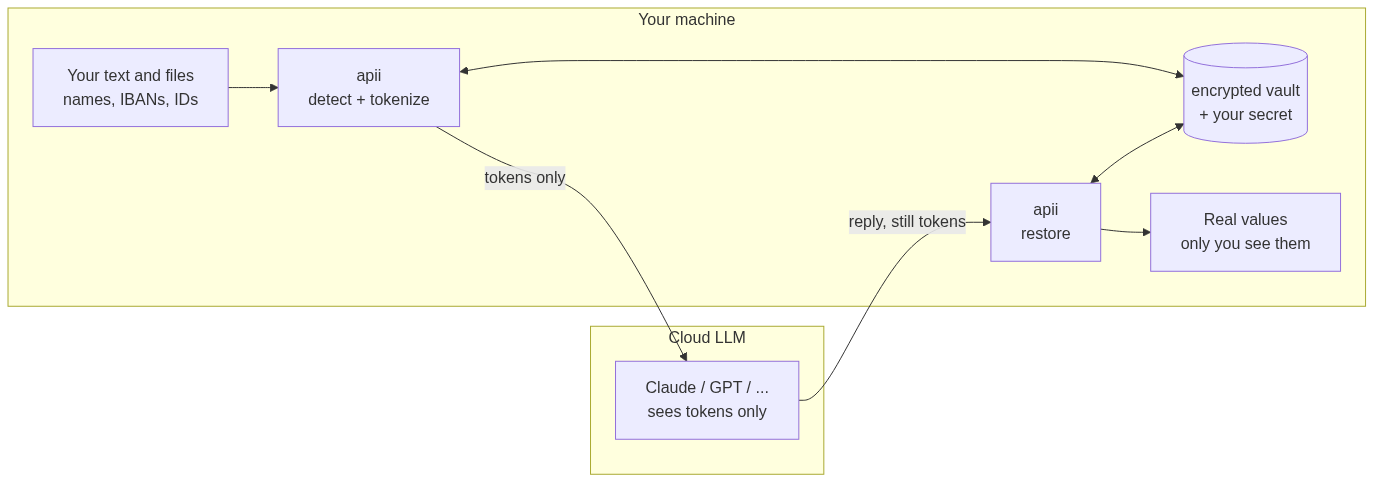
Only tokens ever cross to the model. The single network call apii makes is a one-time, optional model download — point it at your own copy and it runs fully offline, forever.
▶ Try it in your browser: the live playground — paste text and watch PII tokenize and restore, nothing to install. (Or run it locally:
python demo/server.py.)
Why apii exists
Teams across the Gulf — banks, fintechs, telcos, government, healthcare — increasingly cannot send customer data to a US-hosted model, for legal and contractual reasons. apii is how you keep using Claude, GPT, Copilot, or your AI coding tools on that work anyway: the PII never leaves your machine, and the model sees only placeholders like EMAIL_C7E2….
It's built for Arabic, not adapted to it — it reads Arabic names, Arabic-Indic digits (٠٥٠…), and right-to-left text that English-first tools silently drop, and it validates structured identifiers (IBAN by ISO-7064 MOD-97, national IDs by check digit) instead of trusting a pattern that merely looks right.
- 🌍 Arabic + English, all six GCC countries — names, IDs, IBANs, phones, VAT, CR, addresses
- 🔒 Local by default — no service to run, no account, nothing uploaded
- 🪶 Light — pure Python, no PyTorch; NER runs as an int8 ONNX graph
- 🔁 Reversible & consistent — the same value always maps to the same token, and only your secret turns it back
Install
apii[all] is the whole tool — CLI, on-device NER, the proxy, and document support. Embedding apii as a library instead? Stay lean and add only what you touch.
| install | adds |
|---|---|
pip install apii |
core detection (regex + checksums) and the apii CLI |
pip install "apii[ner]" |
on-device PERSON / ORGANIZATION detection |
pip install "apii[cli]" |
encrypted-vault persistence (--vault) |
pip install "apii[proxy]" |
the streaming apii serve gateway |
pip install "apii[documents]" |
PDF extraction (CSV / JSON / HTML / DOCX / XLSX are built in) |
pip install "apii[all]" |
everything above |
Requires Python 3.10+. The NER models (~210 MB, int8 ONNX) download once from Hugging Face and cache locally; without them every structured kind still works — only PERSON and ORGANIZATION need a model.
Quickstart
# detect + tokenize; the token↔value map is saved to an encrypted vault
echo "Email omar@aajil.sa, IBAN SA0380000000608010167519" | apii redact --vault demo.vault
# → Email EMAIL_180AC17DC476B40B, IBAN IBAN_BA6B8757242BA7BB

# hand the tokens to any model, then restore its reply
apii restore reply.txt --vault demo.vault
Tokens are deterministic, so the same person keeps the same token across a document — the model can reason about "the same customer" without ever learning who they are.
Use it with your AI tools
One engine, four ways in. Pick whichever fits how you work.
Proxy — in front of any API
Run one local gateway and point any client's base URL at it. apii tokenizes the request, forwards only tokens upstream, and restores the (streamed) reply — your client and your API key are untouched.
apii serve # → http://127.0.0.1:8720 (--host / --port to change)
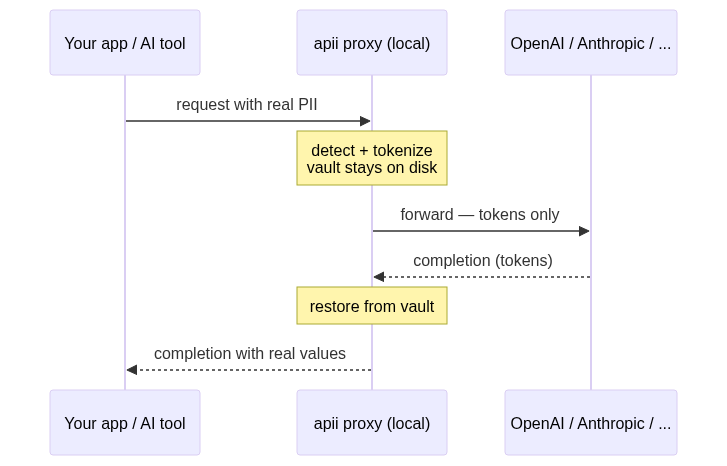
One port speaks three wire formats — OpenAI Chat, OpenAI Responses (what Codex uses), and Anthropic Messages — so it fronts OpenAI, Anthropic, Codex, and anything OpenAI-compatible (OpenRouter, LiteLLM, Together, vLLM…). Choose the upstream with APII_OPENAI_BASE / APII_ANTHROPIC_BASE.
| your client | point it at |
|---|---|
| OpenAI SDK / chat apps | base_url = http://127.0.0.1:8720/v1 |
| Codex CLI (Responses API) | a model-provider with base_url = …:8720/v1, wire_api = "responses" |
| Claude Code / Anthropic SDK | ANTHROPIC_BASE_URL = http://127.0.0.1:8720 |
| OpenRouter / LiteLLM / any OpenAI-compatible | the OpenAI base URL above, with APII_OPENAI_BASE=<provider> |
# route OpenAI-style traffic through OpenRouter, PII-safe:
APII_OPENAI_BASE=https://openrouter.ai/api/v1 apii serve
Every route is verified end-to-end — streaming and non-streaming — against a live provider and the real Codex CLI.
Claude Code — the transparent hook
apii install-claude-hook wires two hooks into Claude Code, then apii watch shows you the decoded side:
| hook | what it does |
|---|---|
| redact-on-read | tokenizes PII in a file before the model reads it — Claude only ever sees tokens |
| restore-on-write | turns tokens back into real values before bytes hit disk — your files come out correct |
It's non-blocking: you work normally, the model just never receives PII. Run apii watch in a second pane to read Claude's replies with the real values restored, locally.
Agent skill — for any coding agent
skills/apii/SKILL.md is the portable Agent Skills format. Drop it into Claude Code, Codex, or Cursor and the agent learns to redact and restore on its own:
cp -r skills/apii ~/.claude/skills/ # or .claude/skills/ for a single project
CLI, batch, library, and UI
apii detect notes.txt                                                        # audit only — detections as JSON
apii redact-dir ./statements --out-dir ./masked --ext csv --vault s.vault    # whole folders, layout preserved
apii ui                                                                      # paste-in / paste-out page at :8765
from apii.anonymizer import Anonymizer
a = Anonymizer(secret="…", tenant="acme")
r = a.anonymize("Email omar@aajil.sa, IBAN SA0380000000608010167519")
send_to_llm(r.text)                      # the model sees tokens
show_user(a.deanonymize(model_reply))    # restored locally
Which one? They stack — use as many as you like:
| what it is | reach for it when | |
|---|---|---|
| Skill | teaches an agent to redact / restore deliberately | the agent drives; works in any tool; zero setup |
| Hook | automatic redact-on-read + restore-on-write | you want it enforced and invisible — Claude Code |
| Proxy | a hard transport boundary the provider can't see past | you don't control the client, or want it provider-wide |
What it detects
| kind | how it's found |
|---|---|
EMAIL |
format |
PHONE |
GCC country codes, Saudi 05X, international shapes |
IBAN |
ISO-7064 MOD-97 checksum (all six GCC countries) |
TAX_NUMBER |
15-digit Saudi / GCC VAT |
COMMERCIAL_REGISTRATION |
10-digit CR, label-cued |
NATIONAL_ID |
UAE-784 / Saudi Iqama / GCC, check-digit validated |
PERSON |
on-device NER (no name lists) |
ORGANIZATION |
on-device NER |
ADDRESS |
PO-box / street patterns + NER locations |
Quality is measured against a 1,340-span corpus of real, publicly-sourced values in tests/eval/ (pytest tests/python -q runs it). Structured IDs are checksum-validated, so a number that merely looks like an IBAN doesn't survive.
Out of scope by design: API keys, payment-card numbers, and free-form internal codes — redacting those reliably needs context apii doesn't claim to have.
How it works
apii keeps two boundaries apart:
- Privacy boundary — what the model receives: only tokens, always.
- Display boundary — what you see: real values, because the data is yours and never leaves your machine.
The bridge between them is a local, encrypted vault (~/.apii/default.vault, ChaCha20-Poly1305) and a secret (~/.apii/secret, chmod 600). Each token is HMAC-SHA256(secret, value) — deterministic, and irreversible without your secret. Restoration happens at the last mile (your screen, your files) and never re-enters the model's context.
Reference
Commands
| command | what it does |
|---|---|
apii redact [file] |
Anonymize text (stdin or a file) → stdout; save the token↔value map to --vault. |
apii restore [file] --vault V |
Reverse it: tokens → real values, from the vault. |
apii detect [file] |
Audit mode — list detections as JSON, change nothing. |
apii scan-dir DIR --out F |
Detect across a folder; write per-file JSONL summaries + totals. |
apii redact-dir DIR --out-dir D |
Redact every matching file (format-aware) into --out-dir, merging records into one --vault. |
apii serve |
Local anonymizing LLM proxy — /v1/messages, /v1/chat/completions, /v1/responses (needs [proxy]). |
apii ui |
Local paste-in / paste-out web UI (127.0.0.1:8765). |
apii install-claude-hook |
Wire redact-on-read + restore-on-write into Claude Code (--global for all projects). |
apii watch |
Tail the current folder's Claude session, restoring tokens for your screen. --once dumps it so far. |
apii hook / apii daemon / apii hook-client |
The per-event hook, an optional hot daemon, and a thin bridge to it. |
Common flags: --secret (or $APII_SECRET), --tenant, --vault, --policy strict|balanced|audit, --no-ner. Run apii <cmd> --help for the rest.
Environment
| variable | purpose |
|---|---|
APII_SECRET |
Vault HMAC / encryption key. Falls back to the managed ~/.apii/secret (auto-created, chmod 600). |
APII_HOME |
Config + vault directory (default ~/.apii). |
APII_POLICY |
Default policy: strict (default) / balanced / audit. |
APII_NER_THRESHOLD |
NER minimum confidence (default 0.85). |
APII_NER_CASE_AUG |
Lowercase-name recovery: auto (default) / always / off. |
APII_NER_MODEL / APII_NER_EN_MODEL |
Use your own local Arabic / English ONNX model directories. |
APII_NER_HF_REPO |
Hugging Face repo to fetch models from (default aajil-labs-sa/arabic-pii-ner). |
APII_NER_NO_DOWNLOAD |
Disable the model auto-download (fully offline). |
APII_OPENAI_BASE / APII_ANTHROPIC_BASE |
Upstream targets for apii serve. |
APII_SUPPRESS_PHRASES |
Path to a phrase file of vocabulary to never tokenize. |
APII_GEO_GAZETTEER |
Path to an optional gazetteer for address detection. |
NER models & credit
The bundled models are int8-ONNX redistributions of two open models — please keep crediting the original authors:
- Arabic —
hatmimoha/arabic-nerby Hatim Mohamed, onasafaya/bert-base-arabicby Ali Safaya. - English —
dslim/bert-base-NERby David S. Lim (MIT, CoNLL-2003).
Hosted (quantized, with full provenance + SHAs) at aajil-labs-sa/arabic-pii-ner.
Make it yours
apii is a self-contained Python package under a permissive license — yours to run, fork, self-host, and extend, privately or commercially. No server to depend on, no account to create.
- Tune detection in
apii/recognizers/— a regex, a checksum, a new country shape. - Swap the NER models with
APII_NER_MODEL/APII_NER_EN_MODEL, or pointAPII_NER_HF_REPOat your own repo. - Run fully offline: bring the models locally and set
APII_NER_NO_DOWNLOAD=1.
Contributions are welcome — open an issue or a pull request. A real miss on real (de-identified) data is the most useful thing you can send: the recognizers are checksum- and context-driven, not a fixed list, so misses are exactly what sharpens them.
Contact
Questions, feedback, security reports, or partnership inquiries — labs@aajil.sa. For bugs and feature requests, a GitHub issue is fastest.
License
© Aajil Labs. Dual-licensed — your choice of MIT or Apache-2.0 (see LICENSE-MIT and LICENSE-APACHE). You may use, modify, and redistribute this software, including privately and commercially, under either license; keep the copyright and license notices in copies. The bundled NER models are redistributed under their original authors' terms — credit them as above.
1 maintainer

Download files
Download the file for your platform. If you're not sure which to choose, learn more about installing packages.
Source Distribution
Built Distribution
Filter files by name, interpreter, ABI, and platform.
If you're not sure about the file name format, learn more about wheel file names.
Copy a direct link to the current filters
File details
Details for the file apii-0.1.3.tar.gz.
File metadata
- Download URL: apii-0.1.3.tar.gz
- Upload date:
- Size: 348.3 kB
- Tags: Source
- Uploaded using Trusted Publishing? No
- Uploaded via:
twine/6.2.0 CPython/3.12.13
File hashes
| Algorithm | Hash digest | |
|---|---|---|
| SHA256 |
8c88e71dd5da7f29bb60e00b919d6c9b00f00ee57a436e6f54b3716c01c0aa6d
|
|
| MD5 |
5a204ff63baa69d014a1b7b91c40c421
|
|
| BLAKE2b-256 |
2dd5150acc666d503a95b7743f29a45feb3d1924a9631e2327feb08222ef4d2b
|
File details
Details for the file apii-0.1.3-py3-none-any.whl.
File metadata
- Download URL: apii-0.1.3-py3-none-any.whl
- Upload date:
- Size: 122.0 kB
- Tags: Python 3
- Uploaded using Trusted Publishing? No
- Uploaded via:
twine/6.2.0 CPython/3.12.13
File hashes
| Algorithm | Hash digest | |
|---|---|---|
| SHA256 |
8c81ef2f2bb9597b90170e3e6677f4122aaaea0edff7bc4035c2ff169e04a48b
|
|
| MD5 |
0c9f7a6a9e7b998ea4fa565f137411a8
|
|
| BLAKE2b-256 |
d6aa8992f3db5f2f6dd39918669d0f17fc6f198cfc02a26d18f3f67788fc5c65
|














