





✨ Features
|
🔄 Automatic Key Rotation
|
🔁 Smart Retry Logic
|
🛡️ Anti-Bot Evasion
|
|
⚡ Dual Mode Support
|
🧠 Intelligent Headers
|
🛣️ Multi-Provider Routing
|
🚀 Quick Start
📦 Installation
pip install apikeyrotator
⚡ Basic Usage
from apikeyrotator import APIKeyRotator

# Initialize with API keys
rotator = APIKeyRotator(api_keys=["key1", "key2", "key3"])

# Make requests - it's that simple!
response = rotator.get("https://api.example.com/data")
print(response.json())

# The rotator automatically:
# ✅ Rotates keys on rate limits
# ✅ Retries on failures
# ✅ Manages headers intelligently

### 🛣️ Multi-Provider Fallback Routing

```python
from apikeyrotator import FallbackRouter, ProviderRoute, APIKeyRotator

router = FallbackRouter(routes=[
    ProviderRoute(name="Primary", rotator=APIKeyRotator(api_keys=["key1"])),
    ProviderRoute(
        name="Fallback",
        rotator=APIKeyRotator(api_keys=["key2"]),
        request_transformer=lambda m, u, k: (m, "https://api.fallback.com/data", k)
    )
])

# Automatically falls back to the second API if the first is exhausted!
response = router.get("https://api.primary.com/data")
### 🌟 Using Environment Variables

Create a `.env` file:

```bash
API_KEYS=key1,key2,key3
Then use without explicit keys:
from apikeyrotator import APIKeyRotator

# Automatically loads from .env
rotator = APIKeyRotator()

response = rotator.get("https://api.example.com/data")
🔥 Advanced Configuration
from apikeyrotator import APIKeyRotator

rotator = APIKeyRotator(
    api_keys=["key1", "key2", "key3"],

    # Retry & Timeout
    max_retries=5,              # Retry up to 5 times per key
    base_delay=1.0,             # Start with 1s delay
    timeout=15.0,               # 15s request timeout

    # Anti-Bot Features
    user_agents=[               # Rotate User-Agents
        "Mozilla/5.0 (Windows NT 10.0; Win64; x64)...",
        "Mozilla/5.0 (Macintosh; Intel Mac OS X 10_15_7)..."
    ],
    random_delay_range=(1.0, 3.0),  # Random 1-3s delays
    proxy_list=[                # Rotate proxies
        "http://proxy1.com:8080",
        "http://proxy2.com:8080"
    ]
)

# Now make requests with all these features active!
response = rotator.get("https://api.example.com/data")
🌐 Asynchronous Usage
import asyncio
from apikeyrotator import AsyncAPIKeyRotator

async def main():
    async with AsyncAPIKeyRotator(api_keys=["key1", "key2"]) as rotator:
        # Make async requests
        response = await rotator.get("https://api.example.com/data")
        data = await response.json()
        print(data)

asyncio.run(main())
🎯 Why APIKeyRotator?
┌────────────────────────────────────────────────────────────────┐
│  ✓ Effortless API key management                              │
│  ✓ Automatic rate limit handling                              │
│  ✓ Smart retry logic with exponential backoff                 │
│  ✓ Anti-bot evasion (User-Agents, delays, proxies)            │
│  ✓ Both sync and async support                                │
│  ✓ Intelligent header detection and persistence               │
│  ✓ Clean, modern Python with full type hints                  │
└────────────────────────────────────────────────────────────────┘
📊 Comparison
| Feature | Manual Management | APIKeyRotator |
|---|---|---|
| Key rotation | ❌ Manual | ✅ Automatic |
| Retry logic | ❌ Custom code | ✅ Built-in |
| Rate limit handling | ❌ Manual | ✅ Automatic |
| Error classification | ❌ Status codes | ✅ Intelligent |
| Anti-bot features | ❌ Not included | ✅ Complete |
| Session management | ❌ Manual | ✅ Optimized |
| Code complexity | ❌ High | ✅ Minimal |
🎨 Use Cases
🕷️ Web Scraping
from apikeyrotator import APIKeyRotator
from bs4 import BeautifulSoup

# Configure for web scraping
rotator = APIKeyRotator(
    api_keys=["key1", "key2", "key3"],
    user_agents=[
        "Mozilla/5.0 (Windows NT 10.0; Win64; x64)...",
        "Mozilla/5.0 (Macintosh; Intel Mac OS X 10_15_7)..."
    ],
    random_delay_range=(1.0, 3.0),
    max_retries=5
)

# Scrape multiple pages
for page in range(1, 11):
    response = rotator.get(f"https://example.com/products?page={page}")
    soup = BeautifulSoup(response.content, 'html.parser')
    # Process data...
📊 Data Collection
from apikeyrotator import APIKeyRotator

rotator = APIKeyRotator(api_keys=["key1", "key2", "key3"])

# Collect data from multiple endpoints
endpoints = ["/users", "/posts", "/comments", "/analytics"]

data = {}
for endpoint in endpoints:
    response = rotator.get(f"https://api.example.com{endpoint}")
    data[endpoint] = response.json()
    print(f"✓ Collected {endpoint}")
🔄 High-Volume Requests
import asyncio
from apikeyrotator import AsyncAPIKeyRotator

async def fetch_all_items(item_ids):
    async with AsyncAPIKeyRotator(api_keys=["key1", "key2", "key3"]) as rotator:
        tasks = [
            rotator.get(f"https://api.example.com/items/{id}")
            for id in item_ids
        ]
        responses = await asyncio.gather(*tasks)
        return [await r.json() for r in responses]

# Fetch 1000 items concurrently
items = asyncio.run(fetch_all_items(range(1000)))
🛠️ Production API Client
from apikeyrotator import APIKeyRotator, AllKeysExhaustedError
from typing import Dict, List

class APIClient:
    def __init__(self, api_keys: List[str]):
        self.rotator = APIKeyRotator(
            api_keys=api_keys,
            max_retries=5,
            base_delay=2.0
        )

    def get_user(self, user_id: int) -> Dict:
        try:
            response = self.rotator.get(f"https://api.example.com/users/{user_id}")
            return response.json()
        except AllKeysExhaustedError:
            # Fallback to cache or alternative source
            return self._get_cached_user(user_id)

client = APIClient(api_keys=["key1", "key2", "key3"])
user = client.get_user(123)
🔧 Configuration Options
| Parameter | Type | Default | Description |
|---|---|---|---|
api_keys |
List[str] or str |
None |
API keys to rotate |
env_var |
str |
"API_KEYS" |
Environment variable name |
max_retries |
int |
3 |
Max retry attempts per key |
base_delay |
float |
1.0 |
Base delay for exponential backoff |
timeout |
float |
10.0 |
Request timeout in seconds |
user_agents |
List[str] |
None |
User-Agent strings to rotate |
random_delay_range |
Tuple[float, float] |
None |
Random delay range (min, max) |
proxy_list |
List[str] |
None |
Proxy URLs to rotate |
error_classifier |
ErrorClassifier |
None |
Custom error classifier |
📚 View Complete API Reference →
🛡️ Error Handling
from apikeyrotator import (
    APIKeyRotator,
    NoAPIKeysError,
    AllKeysExhaustedError
)

try:
    rotator = APIKeyRotator(api_keys=["key1", "key2"])
    response = rotator.get("https://api.example.com/data")

except NoAPIKeysError:
    print("❌ No API keys provided or found")

except AllKeysExhaustedError:
    print("❌ All keys failed after maximum retries")
    # Implement fallback strategy

except Exception as e:
    print(f"❌ Unexpected error: {e}")
Error Classification System:
- RATE_LIMIT (429): Switches to next key immediately
- TEMPORARY (5xx): Retries with exponential backoff
- PERMANENT (401, 403): Removes invalid key from pool
- NETWORK: Connection errors, retries or switches key
📖 Learn More About Error Handling →
🎯 Advanced Features
📚 Documentation
| Resource | Description |
|---|---|
| 📖 Documentation Index | Complete documentation hub |
| 🚀 Getting Started | Quick start guide |
| 📋 API Reference | Complete API documentation |
| 💡 Examples | Real-world code examples |
| 🔧 Advanced Usage | Power features & customization |
| 🚨 Error Handling | Comprehensive error management |
| ❓ FAQ | Frequently asked questions |
| 🔒 Security | Security best practices |
🧪 Testing
# Install test dependencies
pip install pytest pytest-asyncio requests-mock aioresponses

# Run all tests
pytest

# Run with coverage
pytest --cov=apikeyrotator --cov-report=html

# Run specific test file
pytest tests/test_rotator.py -v
🤝 Contributing
Contributions are what make the open-source community amazing! We welcome:
- 🐛 Bug reports
- 💡 Feature suggestions
- 📝 Documentation improvements
- 🔧 Code contributions
📖 Read Contributing Guidelines →
Quick Contribution Steps
- Fork the Project
- Create your Feature Branch (
git checkout -b feature/AmazingFeature) - Commit your Changes (
git commit -m 'Add some AmazingFeature') - Push to the Branch (
git push origin feature/AmazingFeature) - Open a Pull Request
📈 Performance
APIKeyRotator is optimized for production use:
- ⚡ Connection Pooling: Reuses TCP connections
- 🧠 Smart Caching: Caches successful header configurations
- 🔄 Async Support: Handle thousands of concurrent requests
- 📊 Memory Efficient: Minimal memory footprint
Benchmarks
# Synchronous: ~100 requests/second
# Asynchronous: ~1000 requests/second (10x faster)
🔒 Security
Security is a top priority. Please review our Security Policy for:
- 🔐 Best practices for API key management
- 🛡️ Reporting vulnerabilities
- 📜 Security features
- ✅ Security audit checklist
Found a security issue? Please report it privately via the internal issue tracker.
📜 License
Distributed under the MIT License. See LICENSE for more information.
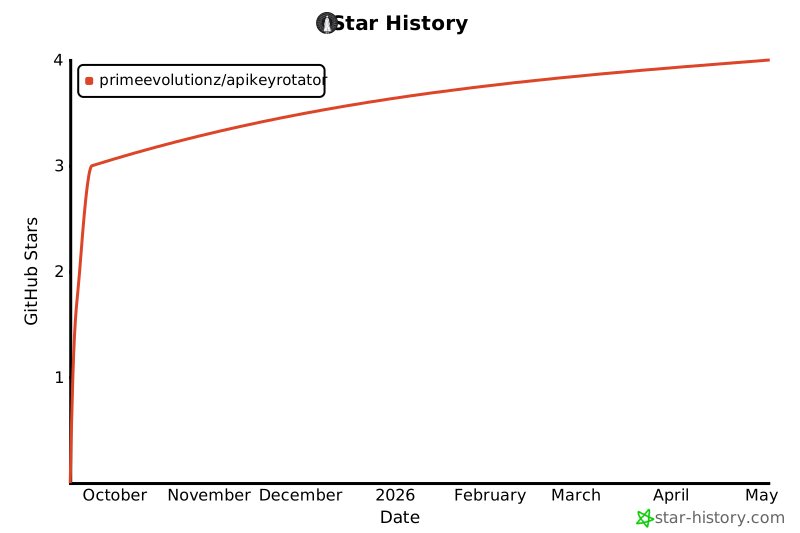
🌟 Star History
💖 Support
If you find this project helpful, please consider:
- ⭐ Starring the repository
- 🐛 Reporting bugs
- 💡 Suggesting new features
- 📢 Sharing with others
📞 Contact & Support
- GitHub Issues: Report bugs
- GitHub Discussions: Ask questions
🔗 Links
- PyPI: pypi.org/project/apikeyrotator
- GitHub: github.com/PrimeevolutionZ/apikeyrotator
- Documentation: Full Documentation
- Changelog: What's New



1 maintainer

Metadata
1 maintainer
Release files for apikeyrotator 0.6.1
For a detailed explanation of source distributions (sdists) and built distributions (wheels), please see the package formats documentation.
Source distribution (sdist)
| File | Size | Uploaded | |
|---|---|---|---|
| apikeyrotator-0.6.1.tar.gz | 55.9 kB | Details |
Built distribution (wheel)
| File | Interpreter | ABI | Platform | Reset |
|---|---|---|---|---|
| apikeyrotator-0.6.1-py3-none-any.whl | Python 3 | none | any | Details |
Total release size: 109.8 kB
Release files / apikeyrotator-0.6.1.tar.gz
| Download URL | apikeyrotator-0.6.1.tar.gz |
|---|---|
| Size | 55.9 kB |
| Tags | Source |
|
SHA-256 checksum How to use checksums |
f56ad1341cf9a7cb65596cb036663f64d69553b16bb68d8a613309fcbe0ac471
|
|
BLAKE2b-256 checksum How to use checksums |
a7dd598df2000363062732674ce94c7fa432292762ba7cd036432e4a5b1002b5
|
| Upload date | |
|
Uploaded using Trusted Publishing? What is trusted publishing? |
No |
| Uploaded via |
twine/6.2.0 CPython/3.12.0
|
Release files / apikeyrotator-0.6.1-py3-none-any.whl
| Download URL | apikeyrotator-0.6.1-py3-none-any.whl |
|---|---|
| Size | 53.9 kB |
| Tags | Python 3 |
|
SHA-256 checksum How to use checksums |
0bcc11bc219cdbd38f945b9d2b14619df504e9c892685cdd89cb593b7e39ec4d
|
|
BLAKE2b-256 checksum How to use checksums |
7b1da4987bf38fe042b6387707a6ca902d06c2dff040e5b283866918cf678117
|
| Upload date | |
|
Uploaded using Trusted Publishing? What is trusted publishing? |
No |
| Uploaded via |
twine/6.2.0 CPython/3.12.0
|














