
apiparity
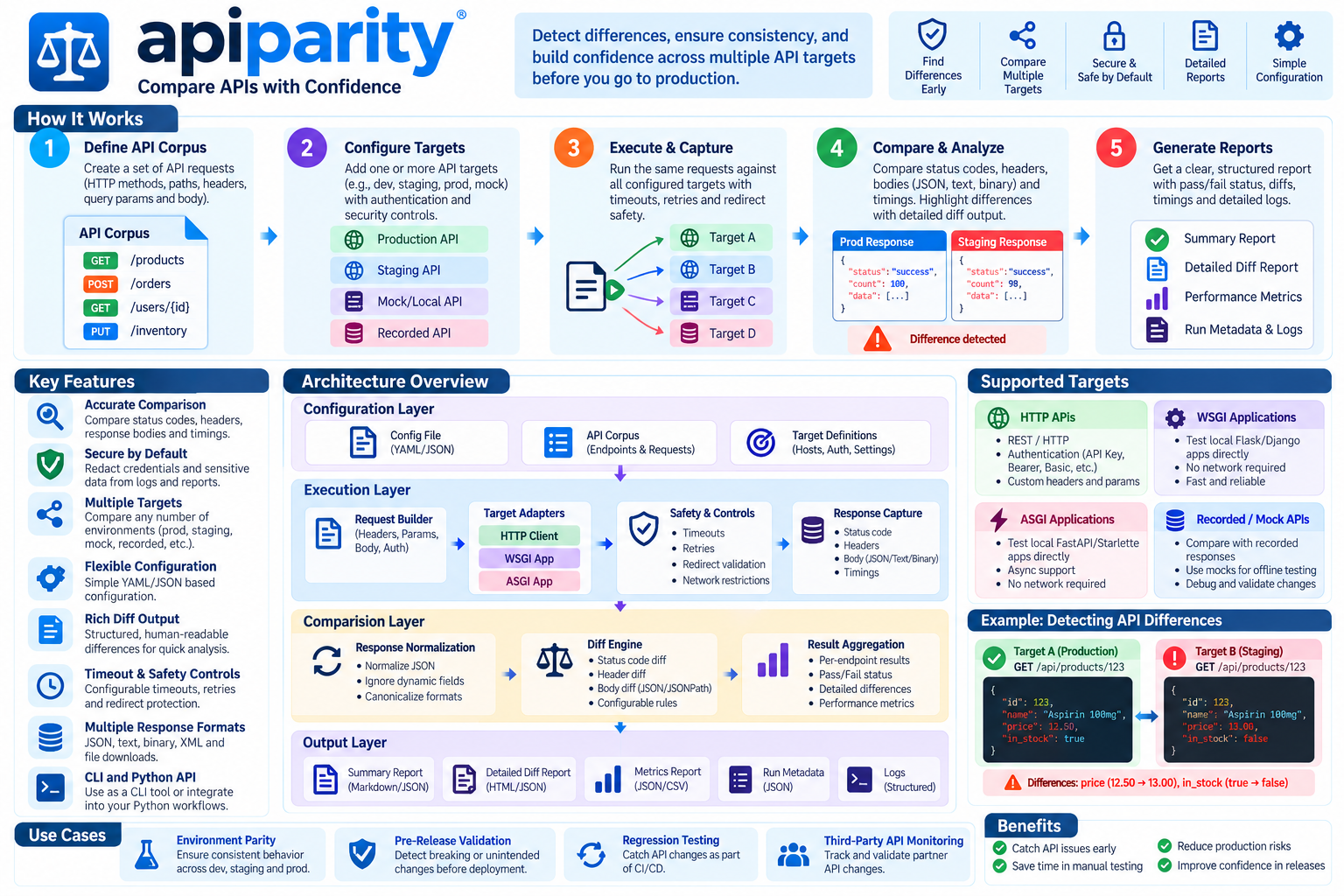
Behavioral parity checker for API migrations. Replay one request corpus against a baseline (old) and a candidate (new) implementation, and report exactly where behavior differs — with RFC 6901 JSON Pointer paths, not vague "something changed" output.
Built for teams migrating a Flask (or any WSGI) service to FastAPI (or any ASGI) service, re-versioning an API, or refactoring a handler: you describe the traffic once, run it against both implementations, and get an actionable diff report plus CI-friendly exit codes.
  baseline (old app)  ──►  same requests  ──►  candidate (new app)
                                │
                                ▼
              status · headers · JSON structure · text/binary bodies
                                │
                                ▼
        report.json · junit.xml · terminal summary   (secrets redacted)
No full-parity guarantees. apiparity proves that the requests in your corpus behave the same under the conditions of the run. Coverage of the corpus, application state, external integrations, and environment limits what any comparison can prove. Treat a green run as strong evidence, not proof of total equivalence.
The problem it solves
Migrating an API framework (Flask → FastAPI, Django → Litestar, v1 → v2 of your own code)
is where regressions hide: a status code quietly changes from 422 to 400, a field renames,
a header disappears, an error body gains a detail wrapper. Unit tests cover what you
thought to assert; production traffic covers the rest — after it breaks.
apiparity lets you capture the request shapes that matter (a corpus file you keep in version control) and replay them against both implementations, diffing every observable behavior. It works in-process (import both apps, no ports, no deploys) or over HTTP (two running services on loopback), and it fails closed: it will not replay mutating traffic or talk to non-loopback hosts without explicit opt-ins.
Install
pip install apiparity-check
Runtime dependencies: httpx, PyYAML — nothing else. Optional extras for in-process
targets:
pip install "apiparity-check[flask]"    # WSGI targets (Flask, Werkzeug, ...)
pip install "apiparity-check[fastapi]"  # ASGI targets (FastAPI, Starlette, ...)
Requires Python ≥ 3.11.
Quick start
1. Write a corpus (requests.yaml) — the requests you want compared:
version: 1
normalization:
  ignored_json_pointers:
    - /metadata/request_id     # uuid that changes every run
    - /metadata/generated_at   # timestamp
cases:
  - id: customer-detail
    method: GET
    path: /api/customers/c-1001
  - id: create-order
    method: POST
    path: /api/orders
    json: {item: "widget", quantity: 2}
2. Validate without sending anything:
apiparity validate --corpus requests.yaml \
    --old-app legacy_flask.app:app --old-kind wsgi \
    --new-app migrated_fastapi.app:app --new-kind asgi \
    --allow-mutating-requests
3. Compare:
apiparity compare --corpus requests.yaml \
    --old-app legacy_flask.app:app --old-kind wsgi \
    --new-app migrated_fastapi.app:app --new-kind asgi \
    --allow-mutating-requests --output build/apiparity
Equivalent implementations → exit 0, all cases matched. A behavioral difference →
exit 1 with the exact pointer:
  [02/08] customer-detail              MISMATCH
      [error] json_value — /customer/status: value differs
          baseline="active"  candidate="inactive"
Invalid config, a safety refusal, or a target that fails to start → exit 2 (no valid
comparison was produced). A run that failed to execute never returns 0.
This repository ships runnable examples against fixture apps in tests/fixtures —
see examples/README.md.
Target types
| Kind | Flag | How it runs | Use for |
|---|---|---|---|
http |
--old-url / --new-url |
Real HTTP via httpx (loopback enforced by default) | Two deployed/local services |
wsgi |
--old-app mod:attr --old-kind wsgi |
In-process via httpx.WSGITransport |
Flask, Werkzeug, any WSGI app |
asgi |
--new-app mod:attr --new-kind asgi |
In-process via httpx.ASGITransport + manual lifespan driver (--old-lifespan/--new-lifespan: auto|required|off) |
FastAPI, Starlette, any ASGI app |
Mixed modes are fine (WSGI baseline vs ASGI candidate — the flagship use case). Apps can
be imported directly (legacy_flask.app:app) or via a factory
(legacy_flask.app:create_app --old-factory). In-process targets execute the application's
import-time code in your process and may touch real databases and external services —
point them at test configuration.
HTTP targets never honor environment/system proxy settings: requests go exactly where you point them.
Corpus format (YAML or JSON, schema version: 1)
version: 1
defaults:                     # optional, applied to every case
  timeout_seconds: 10
  follow_redirects: false
normalization:                # optional, corpus-level rules
  ignored_json_pointers: ["/metadata/request_id"]
cases:
  - id: unique-id             # required, unique
    description: optional text
    method: GET               # GET HEAD OPTIONS POST PUT PATCH DELETE
    path: /api/things         # must start with /
    query: {limit: ["3"], tags: ["a", "b"]}   # repeated values preserved in order
    headers: {Authorization: "Bearer ${API_TOKEN}"}  # ${VAR} from environment
    json: {key: value}        # or data: "raw" or files: [...] — one body only
    timeout_seconds: 5        # optional per-case override
    enabled: true             # false → skipped with reason
- Strict validation: unknown fields, duplicate ids, conflicting bodies, malformed YAML/JSON, and file paths escaping the corpus directory are all rejected before any request is sent.
${VAR}interpolation in string values (headers, query, bodies, paths): a missing variable aborts the run; resolved secret values are never logged.- Full schema:
docs/configuration.mdandREQUIREMENTS.md§7.
Configuration file (optional, --config apiparity.yaml)
version: 1
targets:
  old: {kind: http, url: "http://127.0.0.1:5000"}
  new: {kind: asgi, app: "migrated_fastapi.app:app", lifespan: "auto"}
comparison:
  max_differences_per_case: 50
  response_size_limit_bytes: 1048576
  timing: {mode: "off", max_ms: null}      # off | warn | fail
normalization:
  ignored_headers: []                      # replaces defaults when set
  ignored_json_pointers: ["/metadata/request_id"]
redaction:
  sensitive_json_pointers: ["/credentials/token", "/data/password"]
safety:
  allow_mutating_requests: false
  allow_remote_targets: false
reporting: {json: true, junit_xml: true, terminal: true}
Precedence (highest wins): CLI flags > config file > corpus defaults > built-ins.
Full schema and every knob: docs/configuration.md.
Normalization rules in depth: docs/normalization.md.
Reports
| Output | File | Purpose |
|---|---|---|
| JSON | report.json |
Canonical, schema-versioned (schema_version: 1), machine-readable |
| JUnit XML | junit.xml |
One <testcase> per request case — works in any CI test viewer |
| Terminal | stdout | Human summary; --verbose for per-case detail, --quiet for final line |
- Differences are categorized (
status_code,json_key_removed,header_value,text_body,transport_error,timeout, ...) with RFC 6901 JSON Pointer paths. - Secrets are redacted before anything reaches a report or the terminal: sensitive
headers (
authorization,cookie,set-cookie,x-api-key,proxy-authorization+ name-pattern matches like*token*,*secret*,*password*), configured JSON pointers (/credentials/tokenby default), and URL userinfo in error messages are masked as[REDACTED]. Sensitive values that differ are still detected — you see that they differ, never what they are. - Response body previews are off by default (
--include-bodiesto enable; still redacted). - JSON bodies are compared structurally (key order ignored, array order preserved by
default); text bodies decode per charset; binary bodies compare bytewise. Responses
larger than
response_size_limit_bytes(5 MiB default) are truncated and the case can never report as a match.
CI integration
Exit codes are the contract:
| Code | Meaning |
|---|---|
0 |
Every enabled case matched (skipped cases allowed) |
1 |
≥ 1 behavioral mismatch or configured failure |
2 |
Invalid config/corpus, safety refusal, or target init failure — no valid comparison was produced |
# GitHub Actions fragment
- run: pip install apiparity-check flask fastapi uvicorn
- run: apiparity validate --corpus tests/parity/corpus.yaml --config tests/parity/config.yaml
- run: >
    apiparity compare --corpus tests/parity/corpus.yaml --config tests/parity/config.yaml
    --output build/apiparity --quiet
- uses: actions/upload-artifact@v4
  if: always()
  with:
    name: parity-reports
    path: build/apiparity/
A full workflow (lint, typecheck, tests, build on 3.11–3.13) lives in
.github/workflows/ci.yml.
Safety
apiparity is a replayer, and replay has consequences. The guards fail closed —
see docs/safety.md for the full model:
- Mutating methods (
POST/PUT/PATCH/DELETEand anything outside{GET, HEAD, OPTIONS}) require--allow-mutating-requests. There is no rollback; a run prints a safety summary naming exactly what it is about to do. - Non-loopback HTTP targets require
--allow-remote-targets. A private IP is never assumed to be a test environment. - TLS verification on, timeouts on every request, no redirects and no retries by default.
- In-process targets import your application module: import-time code runs, real databases may be touched. Use test configuration.
- Baseline and candidate must use isolated, identically seeded state for state-changing comparisons. Even GET can have side effects.
- apiparity cannot roll back side effects and does not claim to.
Report vulnerabilities per SECURITY.md — never in a public issue.
Python API
The primary API is async; compare_sync is a convenience wrapper:
from apiparity import AppConfig, TargetConfig, compare_sync

config = AppConfig(
    old_target=TargetConfig(kind="wsgi", app="legacy_flask.app:app"),
    new_target=TargetConfig(kind="asgi", app="migrated_fastapi.app:app"),
)
result = compare_sync(corpus="requests.yaml", config=config)
print(result.summary.matched, result.summary.exit_code)
for case in result.mismatches:
    for diff in case.differences:
        print(case.case_id, diff.category, diff.path, diff.baseline_value, diff.candidate_value)
Async form: await compare(corpus=..., config=..., old_target=..., new_target=...).
Target clients are opened and closed inside compare* — the caller never manages
lifecycle. Invalid input raises ConfigError / CorpusError / VariableResolutionError /
SafetyError / TargetInitError (all subclasses of ApiParityError); infrastructure
failures appear per-case as failed results with transport_error/timeout
differences, not as exceptions. See help(apiparity) and
docs/architecture.md.
Limitations
This is a behavioral parity checker, not a converter or a test framework. Deliberately out of scope for 0.1.0:
- No code conversion: it never generates Flask→FastAPI patches (LLM or otherwise).
- No HTML report: JSON, JUnit XML, and terminal only.
- No pytest plugin: use the exit codes (or the Python API) from pytest.
- No snapshot/blessing flow: the baseline is never silently updated to make failures disappear.
- No distributed replay or concurrency: cases run sequentially in corpus order — ordering semantics (create-then-read) depend on it.
- No database snapshot/restore, traffic capture, or automatic rollback: state management is your responsibility.
- No non-HTTP protocols; no body persistence to disk; multipart file uploads are restricted to files inside the corpus directory (no trusted mode).
Development
python -m venv .venv
.venv\Scripts\activate          # Windows
pip install -e ".[dev]"
Quality gates (all must pass — see CONTRIBUTING.md):
ruff check .
ruff format --check .
mypy src
pytest -q --cov=apiparity --cov-report=term-missing
python -m build
Coverage gate: ≥ 90% on comparison.py and safety.py.
Documentation
| Document | Contents |
|---|---|
docs/architecture.md |
Runner/adapter model, data flow, design decisions |
docs/configuration.md |
Config + corpus schema, precedence, env vars |
docs/normalization.md |
Every normalization rule with examples |
docs/safety.md |
Opt-ins, loopback rules, side-effect policy |
docs/troubleshooting.md |
Transport vs behavioral diffs, common errors |
REQUIREMENTS.md |
Full behavioral specification |
License
MIT — see LICENSE. © 2026 Shashi Kundan.
1 maintainer

Metadata
1 maintainer
Release files for apiparity-check 0.1.3
For a detailed explanation of source distributions (sdists) and built distributions (wheels), please see the package formats documentation.
Source distribution (sdist)
| File | Size | Uploaded | Provenance | |
|---|---|---|---|---|
| apiparity_check-0.1.3.tar.gz | 62.0 kB | Without provenance | Details |
Built distribution (wheel)
| File | Interpreter | ABI | Platform | Reset |
|---|---|---|---|---|
| apiparity_check-0.1.3-py3-none-any.whl | Python 3 | none | any | Details |
Total release size: 125.8 kB
Release files / apiparity_check-0.1.3.tar.gz
| Download URL | apiparity_check-0.1.3.tar.gz |
|---|---|
| Size | 62.0 kB |
| Tags | Source |
|
SHA-256 checksum How to use checksums |
50abd74bbba414632edc1c6992fc5d2e96f06f98b925218562e40c0b5dc03c78
|
|
BLAKE2b-256 checksum How to use checksums |
fde8c14079e8ba82dd1882d5a7ab92986a1f0f484eb6ed4819c3a2ccc1578b50
|
| Upload date | |
|
Uploaded using Trusted Publishing? What is trusted publishing? |
No |
| Uploaded via |
twine/7.0.0 CPython/3.11.3
|
Release files / apiparity_check-0.1.3-py3-none-any.whl
| Download URL | apiparity_check-0.1.3-py3-none-any.whl |
|---|---|
| Size | 63.7 kB |
| Tags | Python 3 |
|
SHA-256 checksum How to use checksums |
2b98897da28712c9159da754866050662777ad92859b87c70c8f362755dc785e
|
|
BLAKE2b-256 checksum How to use checksums |
e308f206c8ef70e1147652dc1f8836664bd7fca625fb4a2b837421edfc4af2f9
|
| Upload date | |
|
Uploaded using Trusted Publishing? What is trusted publishing? |
No |
| Uploaded via |
twine/7.0.0 CPython/3.11.3
|
Security for apiparity-check 0.1.3
Provenance
Provenance describes where a file came from. On PyPI, provenance is shared via attestations, which provide a verifiable record of the build or publishing details. View details, limitations and caveats.
No provenance found
None of the files in this release were uploaded with provenance metadata.
A note on package security
PyPI is a repository for distributing packages, not a service for auditing them. While third-party security researchers and our staff do their best to detect and remove malicious packages, PyPI cannot guarantee the quality, security or suitability of any given package.














