
Map your application's AI attack surface from source: MCP servers (with security audit), agent frameworks, LLM call sites, model gateways, AI infrastructure, provider keys, and HTTP/OpenAPI endpoints. Local, static, CI-friendly, with a visual UI.
Verified details
These details have been verified by PyPIProject links
GitHub Statistics
Maintainers

Project description
ai-surface
Find the AI attack surface your code is about to ship. Locally, offline, before the PR merges.




ai-surface is a static analyzer that maps the AI in your codebase: LLM calls, agents, MCP servers, RAG and vector stores, model gateways, self-hosted runtimes, and the HTTP APIs that expose them. Run it on your laptop or in CI. It inventories every AI component a change introduces, flags risk indicators (and assigns severity where the deep-dive audit has enough evidence), and can fail the build when a PR introduces a new risk.
It runs entirely on your machine. No network calls, no telemetry, no credentials. Your source never leaves the host.
pip install apisec-ai-surface   # install once
ai-surface scan . --ui          # then run `ai-surface` (interactive map)
It also generates an AI-BOM and maps findings to the OWASP LLM Top 10 and the EU AI Act, NIST AI RMF, and ISO 42001 (see Compliance). Runtime exploit validation is out of scope for this OSS scanner; it maps and audits the surface statically.
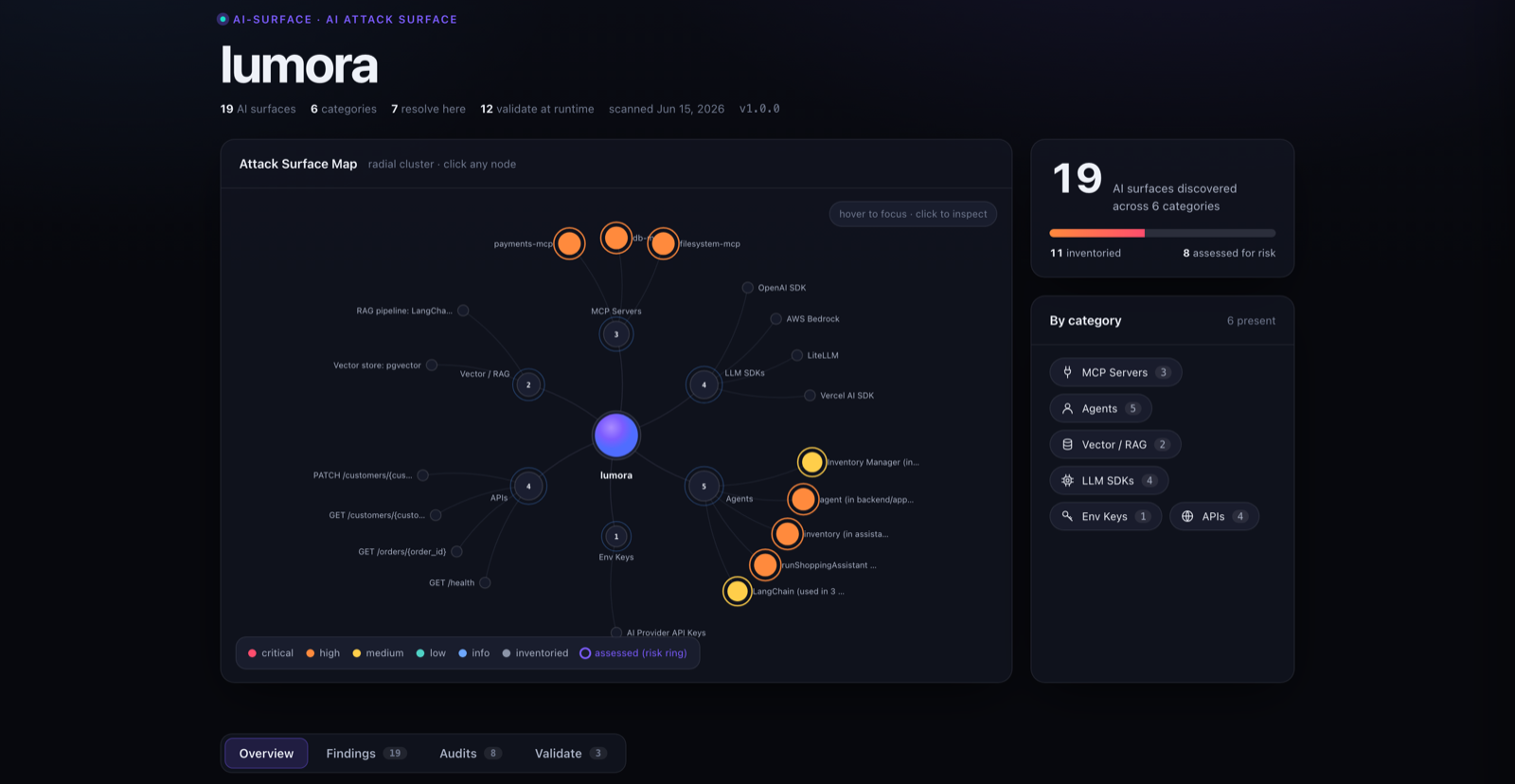
The --ui map: every detected AI surface as a node, grouped by category, served on loopback.
Who is this for?
Use ai-surface if you are:
- adding agents, MCP servers, RAG, or LLM calls to an application
- reviewing AI-related pull requests
- building an AI-BOM or an AI-governance inventory
- trying to understand where AI risk enters your codebase
Built for DevSecOps, AppSec, and platform teams.
Table of Contents
- Who is this for?
- Quick start
- What it detects
- Proven on real code
- GitHub Action and CI gating
- Output formats
- CLI reference
- Compliance and governance
- How it works
- Comparison with adjacent tools
- What it does not do
- Roadmap
- Runtime validation
- Development
- License
Quick start
# Install once, then run `ai-surface` anywhere (recommended)
pipx install apisec-ai-surface
ai-surface scan .

# Or a one-off run with no install
uvx --from apisec-ai-surface ai-surface scan .

# Or in a project venv
pip install apisec-ai-surface && ai-surface scan .

# Explore the results visually
ai-surface scan . --ui
Requires Python 3.9+. The CLI scan runs 100% locally; --ui serves on loopback only.
What a scan looks like
AI Attack Surface Report
------------------------------------------------------------------
Scanned: lumora
19 AI surfaces  |  6 categories  |  8 assessed for risk

MCP SERVERS  (discovery + deep-dive audit)
  - payments-mcp                                          [CRITICAL]
      [!] secrets-in-env     secret in MCP env block      (LLM02, EU Art. 15)
      [!] financial-action   exposes refund / payout      (LLM06, EU Art. 9)
      [!] no-human-oversight no approval gate on payout    (EU Art. 14)

AGENT FRAMEWORKS
  - LangChain Agent: support_agent (backend/app/ai/support_agent.py)
      tools: process_refund, lookup_order, send_email, search_knowledge
      [!] high-blast-radius  read AND financial/destructive tools
      [!] pii-to-llm         customer email/address in the prompt  (EU Art. 10)

VECTOR / RAG
  - RAG pipeline: LangChain  +  Vector store: pgvector
      [!] ingests external content (RAG poisoning surface) (LLM08)

API ENDPOINTS
  - GET   /customers/{customer_id}    [!] object-id in path (BOLA candidate)
  - PATCH /customers/{customer_id}    [!] object-id in path (BOLA candidate)
------------------------------------------------------------------
First run on a mature repo
The first scan surfaces everything already shipping. The pattern that scales:
ai-surface scan . --update-baseline           # 1. snapshot today's inventory
ai-surface scan . --baseline                  # 2. then show only what changed
ai-surface scan . --baseline --fail-on high   # 3. in CI, fail only on NEW high+ risk
--baseline --fail-on high is the recommended PR gate: low-noise, non-blocking on pre-existing debt, and actionable.
What it detects
Eight categories, one per detector. Configuration, keys, and specs are detected on any stack; deep code-level detection is strongest on Python and TypeScript/JavaScript (full matrix in docs/LANGUAGE_SUPPORT.md).
| Category | Coverage | What it finds |
|---|---|---|
| Agent frameworks | 10 Python + 6 JS/TS | LangChain, LangGraph, CrewAI, LlamaIndex, AutoGen, Haystack, Semantic Kernel, Pydantic AI, AWS Strands; LangChain.js, LangGraph.js, Vercel AI SDK, Mastra, OpenAI Agents, LlamaIndex.ts. Extracts each agent's tool inventory and flags financial / destructive / high-blast-radius authority. |
| MCP servers | Discovery + deep-dive audit | Configured (.mcp.json) and in-house source servers. Each gets a severity, risk flags with remediation, detected secrets (name and type only, never values), and registry/trust signals. |
| Vector stores / RAG | 13 stores + 2 frameworks | Pinecone, Weaviate, Chroma, Qdrant, Milvus, FAISS, LanceDB, pgvector, Elasticsearch/OpenSearch/Vespa/Redis (vector mode), plus LangChain / LlamaIndex pipelines. Flags managed-store egress, the RAG data flow, embeddings, and external ingestion. |
| LLM SDK call sites | 13 providers | Anthropic, OpenAI, Azure OpenAI, AWS Bedrock (direct + Strands), Google Generative AI, Vertex AI, Together, Mistral, Cohere, Replicate, Groq, LiteLLM, Vercel AI SDK. Models extracted, non-literal data flow flagged. |
| API endpoints | HTTP/REST + OpenAPI | OpenAPI/Swagger specs and framework routes (FastAPI/Starlette, Flask, Express, Spring, Django). Captures method, path, auth style, and flags a BOLA candidate on object-id path segments. |
| Model gateways | Configs + source | LiteLLM proxy, Portkey, Helicone, Cloudflare AI Gateway, OpenRouter. |
| AI infrastructure | Manifests + IaC | K8s/Helm/compose workloads (ollama, vllm, TGI, etc.), AI-runtime Dockerfiles, Terraform Bedrock/SageMaker/Vertex endpoints. |
| AI provider keys | Names only | OPENAI_API_KEY, ANTHROPIC_API_KEY, etc. across .env files. Never reads values. |
Inventory categories carry no invented severity; severity comes only from the deep-dive audit layers (MCP, agents, RAG). See docs/DETECTORS.md for every pattern matched.
Proven on real code
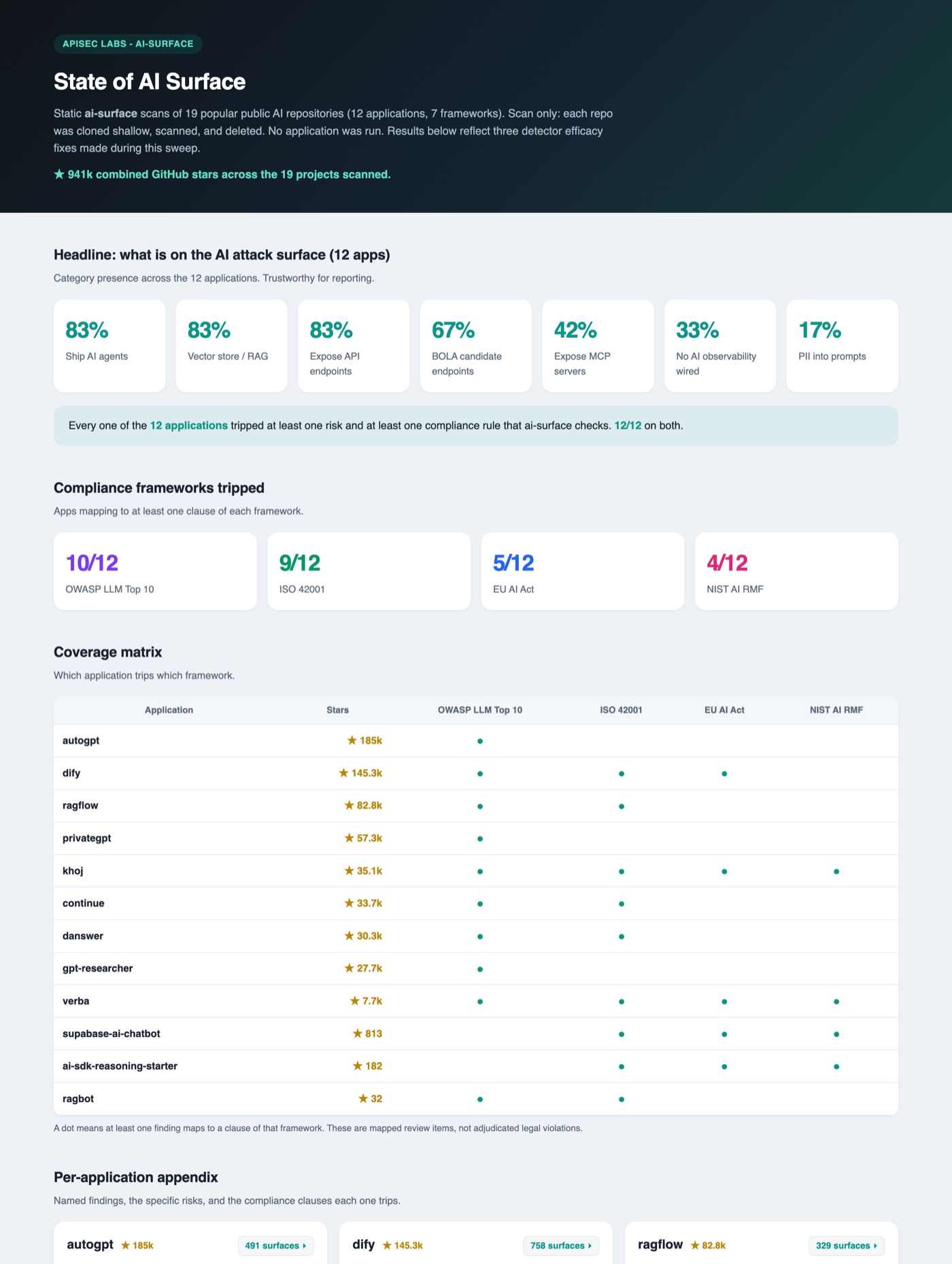
We statically scanned 19 of the most popular open-source AI projects on GitHub (AutoGPT, Dify, RAGFlow, AutoGen, CrewAI, LlamaIndex, Continue, Danswer, and more). Scan only: each repo was cloned shallow, scanned, and deleted. No app was run, no code left the host. Across the 12 applications in that set:
| Signal | Apps |
|---|---|
| Ship AI agents | 83% |
| Have a vector store / RAG layer | 83% |
| Expose API endpoints with BOLA candidates | 67% |
| Expose MCP servers | 42% |
| Run an agent/MCP surface with no observability wired | 33% |
These are category-presence numbers, which are the reliable signal; raw per-component counts are indicative only. Full methodology, per-app appendix, and the honest caveats are in the State of AI Surface report.
GitHub Action and CI gating
Drop this into .github/workflows/ai-surface.yml:
name: AI Surface Check
on: [pull_request]

permissions:
  contents: read
  pull-requests: write

jobs:
  ai-surface:
    runs-on: ubuntu-latest
    steps:
      - uses: actions/checkout@v4
        with: { fetch-depth: 0 }    # required for base-vs-head diff
      - uses: apisec-inc/AI-Surface@v1
        with:
          path: '.'
          comment-on-pr: 'true'
          fail-on: 'high'           # fail only on NEW high-or-critical findings
Every PR gets a sticky comment showing what changed in this PR, not just current state. fail-on gates on assessed severity, so inventory never trips it and the build only fails when a PR introduces a new finding at or above the threshold. On a PR it gates on newly introduced findings only; on a push it gates on current state. The CI log prints the offending finding, file, and remediation.
In any non-GitHub CI, the gate is just an exit code:
ai-surface scan . --fail-on high # exit 1 if any critical/high finding
See docs/CI_INTEGRATION.md for policy files, thresholds, and multi-repo rollups.
Output formats
ai-surface scan .                      # rich terminal output
ai-surface scan . --ui                 # interactive map in a local browser
ai-surface scan . --output json        # machine-readable JSON (schema 1.0)
ai-surface scan . --output markdown    # markdown report
ai-surface scan . --output cyclonedx   # CycloneDX AI-BOM (governance artifact)
ai-surface scan . --output sarif       # SARIF 2.1.0 for GitHub code scanning
ai-surface scan . --write-inventory    # writes .ai-inventory.md to the scan root
ai-surface scan . --quiet              # one-line summary for CI
- CycloneDX is your AI-BOM, generated in CI the way you already generate an SBOM, with the governance mappings attached.
- SARIF uploads to the GitHub Security tab and shows as inline PR annotations.
- The
--uiviewer serves over127.0.0.1from a throwaway temp directory. No scanning in the browser, no egress, no telemetry.
CLI reference
# Scan and report
ai-surface scan .                          # pretty terminal
ai-surface scan . --ui                     # interactive map
ai-surface scan . --output json|markdown|cyclonedx|sarif

# Filter to categories  (aliases: mcp, agents, llm, gateway, infra, keys, api, vector)
ai-surface scan . --categories mcp,agents  # MCP + agents only
ai-surface scan . --categories vector      # vector stores / RAG only

# CI gate: severity threshold, exit code 1 at or above it
ai-surface scan . --fail-on high           # fail on critical/high
ai-surface scan . --fail-on-risk           # aggressive: any risk indicator

# Baseline mode: snapshot, then show only what is NEW
ai-surface scan . --update-baseline        # writes .ai-surface-baseline.json
ai-surface scan . --baseline               # diff vs the snapshot
ai-surface scan . --baseline --fail-on high  # the recommended PR gate

# Compare two scans (used by the GitHub Action under the hood)
ai-surface compare base.json head.json     # markdown diff
Compliance and governance
Every audited finding maps to the OWASP LLM Top 10 and to the specific EU AI Act / NIST AI RMF / ISO 42001 clauses it evidences. The UI shows these as badges; the JSON and CycloneDX outputs carry them as structured data. The CycloneDX output is your AI-BOM.
ai-surface produces evidence; it does not certify compliance. A framework requirement is only reported when the scan actually produced that kind of evidence.
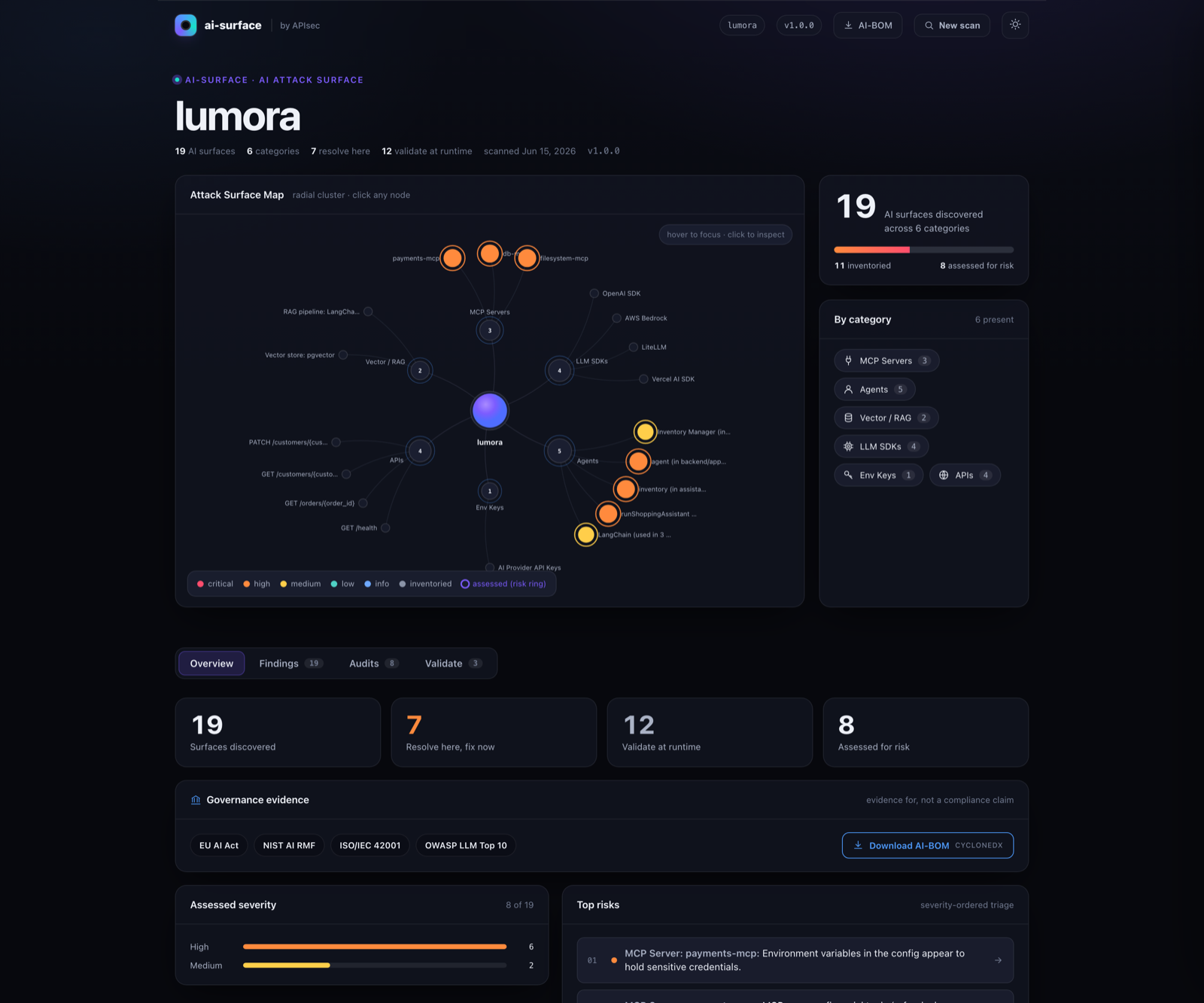
What each framework gets from a scan
| Framework | Inventory | Risk | Human oversight | Logging | Data governance |
|---|---|---|---|---|---|
| EU AI Act | Art. 11-12 | Art. 9 | Art. 14 | Art. 12 | Art. 10 |
| NIST AI RMF | MAP | MEASURE | n/a | MEASURE 3 | MEASURE |
| ISO/IEC 42001 | Annex A | Risk assessment | n/a | A.6.2.6 | A.7 |
| OWASP LLM Top 10 | per-finding LLM01-LLM10 mapping |
How risk flags map to clauses
| Risk flag | OWASP | EU AI Act | NIST | ISO 42001 |
|---|---|---|---|---|
secrets-detected / secrets-in-env |
LLM02 | Art. 15 | ||
financial-action / destructive-action / high-blast-radius |
LLM06 | Art. 9 | ||
no-human-oversight |
LLM06 / LLM09 | Art. 14 | ||
no-observability |
Art. 12 | MEASURE 3 | A.6.2.6 | |
pii-to-llm |
LLM02 | Art. 10 | A.7 | |
unverified-source / remote-mcp |
LLM03 | A.10 | ||
| vector store / RAG present | LLM08 | Art. 10 | data | A.7 |
Full detail, including the honesty boundary, is in docs/COMPLIANCE.md.
How it works
ai-surface is a static source-code analyzer. It reads files, pattern-matches against known AI-surface signatures, runs the deep-dive audit and governance-mapping passes, and produces a report. No code execution, no network calls, no credentials.
flowchart LR
    A[Developer writes AI code] -->|opens PR| B[CI runs ai-surface]
    B --> C[Walk files, root .gitignore honoured]
    C --> D[8 detectors + MCP/agent/RAG audit]
    D --> E[Map to OWASP + EU/NIST/ISO clauses]
    E --> F[Diff vs baseline + attach AI-BOM]
    F --> G{DevOps reviewer}
    G -->|approve| H[Merge]
    G -->|block| I[Request changes]

    style D fill:#d6efec,stroke:#00a99d,stroke-width:2px
    style E fill:#ede9fe,stroke:#7c3aed,stroke-width:2px
    style G fill:#fef3c7,stroke:#d97706,stroke-width:2px
The only network call in the whole project is the GitHub Action posting a PR comment via a token your workflow provides. Local CLI runs are 100% offline. Deep dive: docs/ARCHITECTURE.md.
Comparison with adjacent tools
| Tool | What it tells you | When it sees AI |
|---|---|---|
| SAST (Semgrep, CodeQL) | Code-pattern vulnerabilities | After commit; doesn't index AI surfaces |
| DAST (Burp, ZAP) | Reachable web vulnerabilities | After deploy; sees HTTP, not LLM internals |
| SCA (Snyk, Dependabot) | Vulnerable dependencies | After commit; sees packages, not usage |
| Observability (Helicone, LangSmith) | What LLM calls happened | After deploy; runtime traffic |
| AI-BOM tools (Cisco AI Defense) | Inventory of AI components | Often runtime/cloud; no PR gate |
| ai-surface | What AI attack surface is about to ship, mapped to governance | At PR time, before merge, offline |
| APIsec platform | Which AI surfaces are actually exploitable | PR time + runtime; replayable evidence |
ai-surface does not replace any of these. It focuses on the PR-time AI-attack-surface gap that most adjacent tools do not cover directly.
What it does not do
- Runtime telemetry or behavior monitoring. Use Helicone, LangSmith, Arize, Phoenix.
- Runtime exploit validation. It maps and audits statically; it does not prove exploitability against a running app (see Runtime validation).
- Prompt injection / jailbreak / bias / accuracy testing. Out of scope by design, permanently. It is a structural analyzer, not a model evaluator.
- Full cross-file dataflow for tool resolution. Regex/AST-light today; agent tools built by factory functions are not yet resolved, so the deep audit can under-fire on large platforms. Treat the map as a strong floor, not a proof of completeness. AST/dataflow is the top roadmap item.
- Secret-value reads or PII classification. Secrets are reported by name and type only, values redacted. Use a dedicated secret scanner for value-level coverage.
Roadmap
| Version | Status | What's in it |
|---|---|---|
| v1.0 | Shipped | 8-category mapping, MCP + agent + RAG audits, OWASP + EU/NIST/ISO governance mapping, AI-BOM + SARIF, interactive --ui map, frozen schema 1.0, GitHub Action with PR diff comments, --baseline and --fail-on gates. |
| Fast-follow | Planned | AST / cross-file dataflow for tool resolution, .ai-surface.yml policy file, GitLab CI component. |
| Later | Planned | kubectl plugin, live cluster discovery, continuous mode + drift alerts, multi-repo rollup, plugin SDK. |
Runtime validation
ai-surface tells you what AI attack surface exists and how risky it looks statically. To validate which surfaces are actually exploitable in a running application (agent-to-tool authorization, integration-chain exploits, BOLA across the agent layer, with replayable evidence), see APIsec.
| Source surface | Paid destination |
|---|---|
| AI / agent surfaces | agent validation |
| MCP servers | MCP runtime validation |
| Discovered APIs | API outside-in runtime testing |
The disconnect between free discovery and paid runtime validation is intentional: bridges are an upgrade path, not an integration. No finding data leaves your machine; the bridge is a deep link.
Development
git clone https://github.com/apisec-inc/AI-Surface
cd AI-Surface
python -m venv .venv && source .venv/bin/activate
pip install -e ".[dev]"
pytest                       # 341 tests
ruff check src/ tests/       # lint
mypy src/                    # types
Adding a detector: implement the Detector protocol in types.py, register it in default_detectors(), add fixtures and tests under tests/. The report shape is frozen in docs/SCHEMA_v1.md. See CONTRIBUTING.md.
Project
| Resource | Link |
|---|---|
| Detectors | docs/DETECTORS.md |
| Compliance mapping | docs/COMPLIANCE.md |
| Language support | docs/LANGUAGE_SUPPORT.md |
| Architecture | docs/ARCHITECTURE.md |
| CI integration | docs/CI_INTEGRATION.md |
| Report schema | docs/SCHEMA_v1.md |
| State of AI Surface | docs/STATE_OF_AI_SURFACE.md |
| Privacy | docs/PRIVACY.md |
| Changelog | CHANGELOG.md |
License
MIT. See LICENSE.
Built by APIsec. Part of the APIsec Labs OSS family.
Project details
Verified details
These details have been verified by PyPIProject links
GitHub Statistics
Maintainers
Release history Release notifications | RSS feed


Download files
Download the file for your platform. If you're not sure which to choose, learn more about installing packages.
Source Distribution
Built Distribution
Filter files by name, interpreter, ABI, and platform.
If you're not sure about the file name format, learn more about wheel file names.
Copy a direct link to the current filters
File details
Details for the file apisec_ai_surface-1.0.0.tar.gz.
File metadata
- Download URL: apisec_ai_surface-1.0.0.tar.gz
- Upload date:
- Size: 1.9 MB
- Tags: Source
- Uploaded using Trusted Publishing? Yes
- Uploaded via: twine/6.1.0 CPython/3.13.12
File hashes
| Algorithm | Hash digest | |
|---|---|---|
| SHA256 |
5a0772c85f424326d0a47d8c71559eac5be53fe85cfbc759fbaef54190c20111
|
|
| MD5 |
ff3a20bc5965288d1110b99499a25208
|
|
| BLAKE2b-256 |
5255c51b917474767e3b84f911c1d70e05edf42c5589bf9fc096aaa6762f84c5
|
Provenance
The following attestation bundles were made for apisec_ai_surface-1.0.0.tar.gz:
Publisher:
publish.yml on apisec-inc/AI-Surface
-
Statement:
-
Statement type:
https://in-toto.io/Statement/v1 -
Predicate type:
https://docs.pypi.org/attestations/publish/v1 -
Subject name:
apisec_ai_surface-1.0.0.tar.gz -
Subject digest:
5a0772c85f424326d0a47d8c71559eac5be53fe85cfbc759fbaef54190c20111 - Sigstore transparency entry: 1852494206
- Sigstore integration time:
-
Permalink:
apisec-inc/AI-Surface@0f77d5b72dfeba71e4737ab4a78535567fe492c9 -
Branch / Tag:
refs/tags/v1.0.0 - Owner: https://github.com/apisec-inc
-
Access:
public
-
Token Issuer:
https://token.actions.githubusercontent.com -
Runner Environment:
github-hosted -
Publication workflow:
publish.yml@0f77d5b72dfeba71e4737ab4a78535567fe492c9 -
Trigger Event:
workflow_dispatch
-
Statement type:
File details
Details for the file apisec_ai_surface-1.0.0-py3-none-any.whl.
File metadata
- Download URL: apisec_ai_surface-1.0.0-py3-none-any.whl
- Upload date:
- Size: 193.3 kB
- Tags: Python 3
- Uploaded using Trusted Publishing? Yes
- Uploaded via: twine/6.1.0 CPython/3.13.12
File hashes
| Algorithm | Hash digest | |
|---|---|---|
| SHA256 |
4bf38bd52e67f14fe56bd12118966be9ce55264856c9f60fa5cf78dcc83aa67e
|
|
| MD5 |
7548ba47d7acb1dc83564686b3596394
|
|
| BLAKE2b-256 |
bd905a1ba9ddf26d6a286b88aa27b952f1667f729c2a47e1601dee8538312672
|
Provenance
The following attestation bundles were made for apisec_ai_surface-1.0.0-py3-none-any.whl:
Publisher:
publish.yml on apisec-inc/AI-Surface
-
Statement:
-
Statement type:
https://in-toto.io/Statement/v1 -
Predicate type:
https://docs.pypi.org/attestations/publish/v1 -
Subject name:
apisec_ai_surface-1.0.0-py3-none-any.whl -
Subject digest:
4bf38bd52e67f14fe56bd12118966be9ce55264856c9f60fa5cf78dcc83aa67e - Sigstore transparency entry: 1852494422
- Sigstore integration time:
-
Permalink:
apisec-inc/AI-Surface@0f77d5b72dfeba71e4737ab4a78535567fe492c9 -
Branch / Tag:
refs/tags/v1.0.0 - Owner: https://github.com/apisec-inc
-
Access:
public
-
Token Issuer:
https://token.actions.githubusercontent.com -
Runner Environment:
github-hosted -
Publication workflow:
publish.yml@0f77d5b72dfeba71e4737ab4a78535567fe492c9 -
Trigger Event:
workflow_dispatch
-
Statement type:






