
This release has been yanked by its maintainers, and will be ignored by installers, except when explicitly specified.
Reason given by maintainers: Discontinued. Apolo CAD will be distributed from apolocad.com.
Genix Apolo CAD
An agent-native 3D parametric CAD for industrial machinery. Built to be driven by an AI agent (Claude Opus or others) over MCP — or by hand in your browser.
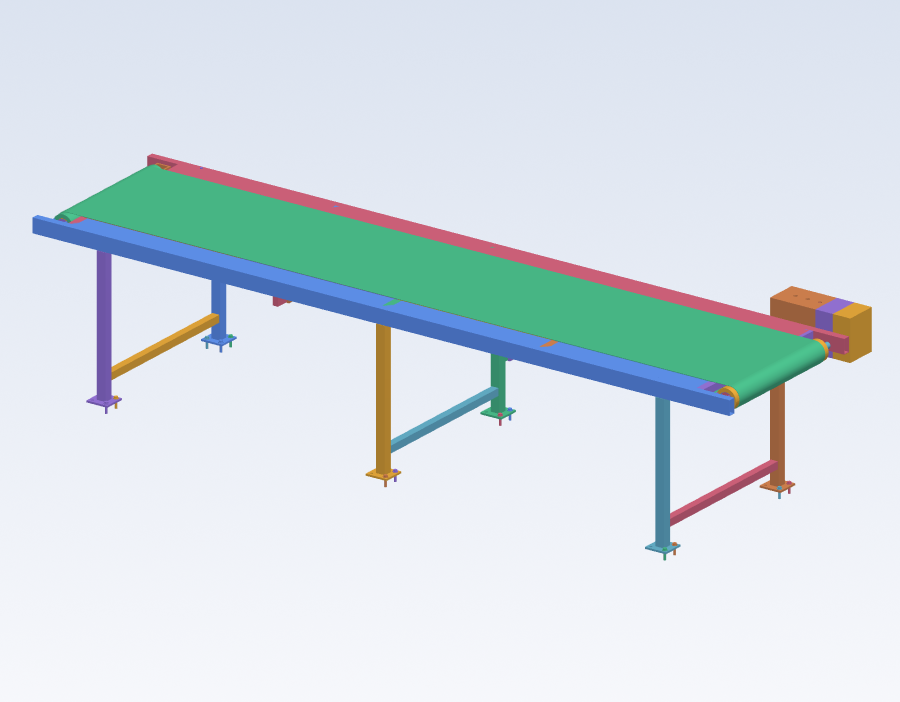
Apolo is a headless parametric CAD for designing real machines. Its edge isn't the kernel (it uses OpenCascade, like FreeCAD) but its agent-native architecture: every operation is a command against an API, the whole document is an editable command log, and the same JSON Schemas that generate the UI also generate the agent's tools.
The upshot: an AI agent can design complete machines end to end —not just autocomplete— and verify them: detect interferences, simulate gravity, look at a render (vision) and emit fabricable shop drawings.
Install
pip install apolo-cad
Optional extras: apolo-cad[physics] (gravity/drop tests, MuJoCo), apolo-cad[fea] (linear
static FEA), apolo-cad[sketch] (PlaneGCS solver where no wheel is published — needs a C++
toolchain; otherwise the sketcher falls back to the SciPy engine automatically).
Run
apolo --open # API + web UI on http://127.0.0.1:8000
Use it from an AI agent (MCP)
Apolo exposes 79 MCP tools, so any MCP-compatible client (Claude Code, Claude Desktop, …) can
design machines. Keep apolo running, then register the stdio server:
{
  "mcpServers": {
    "apolo-cad": {
      "command": "apolo-mcp",
      "env": { "APOLO_URL": "http://127.0.0.1:8000" }
    }
  }
}
Then just ask:
"Design a 4 m × 600 mm belt conveyor for 1–15 kg parcels, with a hollow-shaft gearmotor and gravity-type take-up tensioning. Check there are no interferences and show me a render."
The agent models (run_batch — atomic batches, one undo step), perceives (render_view
returns an image → vision), validates (check_interference, engineering_check,
gravity_test) and documents (drawing_set, assembly_manual → shop drawings, cut lists,
BOMs, assembly manuals). Everything lives in the command log: editable, undoable, reproducible.
What it does
- Modeling — primitives, fillet/chamfer/shell/drill, patterns, mirror, revolve, sweep/loft, sheet metal with flat-pattern DXF/SVG, constrained 2D sketching, STEP import.
- Assembly & kinematics — persistent face mates, joints, rail/N-DOF constraints, motion studies with collision scanning.
- Library & BOM — a 231-reference catalog from real standards (ISO/ASTM/DIN/EN) + machine super-commands (belt conveyor, weldment, frame, sheet metal, robot arm).
- Validation — engineering rules, OCCT interference booleans, and gravity-based assembly validation (simulates what falls).
- Pro manufacturing drawings — HLR → SVG/DXF/PDF, sections, auto hole dimensioning, drawing sets, exploded views, assembly manuals, GD&T and ISO 2553/2768/1302 shop annotation.
- FEA (linear static) — per part, and bonded multi-material assembly (whole welded frame, safety factor per piece).
- Engineering deliverables — calculation report (A4 PDF citing CEMA/ISO/DIN/EN/AISC per check), costed BOM + quotation, tolerance stack-up, installation sheet, and a green/amber/red delivery check before you ship a design.
Data location
Installed from PyPI, your projects live in ~/.apolo/ (override with APOLO_HOME, or point
APOLO_DB at a specific SQLite file). Running from a source checkout, they stay in the repo's
data/ — same as before.
Links
- Source & docs: https://github.com/mariorojasmz/apolo-cad
- Issues: https://github.com/mariorojasmz/apolo-cad/issues
MIT © 2026 Mario Rojas. Built on OpenCascade (LGPL), build123d, FastAPI, three.js and MuJoCo.
1 maintainer

Metadata
1 maintainer
Release files for apolo-cad 0.1.0
For a detailed explanation of source distributions (sdists) and built distributions (wheels), please see the package formats documentation.
Source distribution (sdist)
| File | Size | Uploaded | Provenance | Actions |
|---|---|---|---|---|
| apolo_cad-0.1.0.tar.gz | 822.9 kB | Without provenance | Details for apolo_cad-0.1.0.tar.gz |
Built distribution (wheel)
| File | Interpreter | ABI | Platform | Actions Reset |
|---|---|---|---|---|
| apolo_cad-0.1.0-py3-none-any.whl | Python 3 | none | any | Details for apolo_cad-0.1.0-py3-none-any.whl |
Total release size: 1.7 MB
Release files / apolo_cad-0.1.0.tar.gz
| Download URL | apolo_cad-0.1.0.tar.gz |
|---|---|
| Size | 822.9 kB |
| Tags | Source |
|
SHA-256 checksum How to use checksums |
a4c449acd0caad848a8fd55b1497de6fe054e10f7b111b86b78552448d7e5bc5
|
|
BLAKE2b-256 checksum How to use checksums |
f45f77c1ef7fff3f91a4d687a6f8b40752297a86998087d807221e24a1c66959
|
| Upload date | |
|
Uploaded using Trusted Publishing? What is trusted publishing? |
No |
| Uploaded via |
twine/7.0.0 CPython/3.13.5
|
Release files / apolo_cad-0.1.0-py3-none-any.whl
| Download URL | apolo_cad-0.1.0-py3-none-any.whl |
|---|---|
| Size | 881.5 kB |
| Tags | Python 3 |
|
SHA-256 checksum How to use checksums |
39c379931d557ba549162e91c04c75820d44d64f94a8c7439d2a115bf4a8eb48
|
|
BLAKE2b-256 checksum How to use checksums |
8c3e1ed64c934f6f75bda69d9e316893fccb8881d07c5b7cc29a4aaa9896a3ac
|
| Upload date | |
|
Uploaded using Trusted Publishing? What is trusted publishing? |
No |
| Uploaded via |
twine/7.0.0 CPython/3.13.5
|
Security for apolo-cad 0.1.0
Provenance
Provenance describes where a file came from. On PyPI, provenance is shared via attestations, which provide a verifiable record of the build or publishing details. View details, limitations and caveats.
No provenance found
None of the files in this release were uploaded with provenance metadata.
A note on package security
PyPI is a repository for distributing packages, not a service for auditing them. While third-party security researchers and our staff do their best to detect and remove malicious packages, PyPI cannot guarantee the quality, security or suitability of any given package.
To learn more about protecting yourself from malicious actors, visit our package security documentation.













