








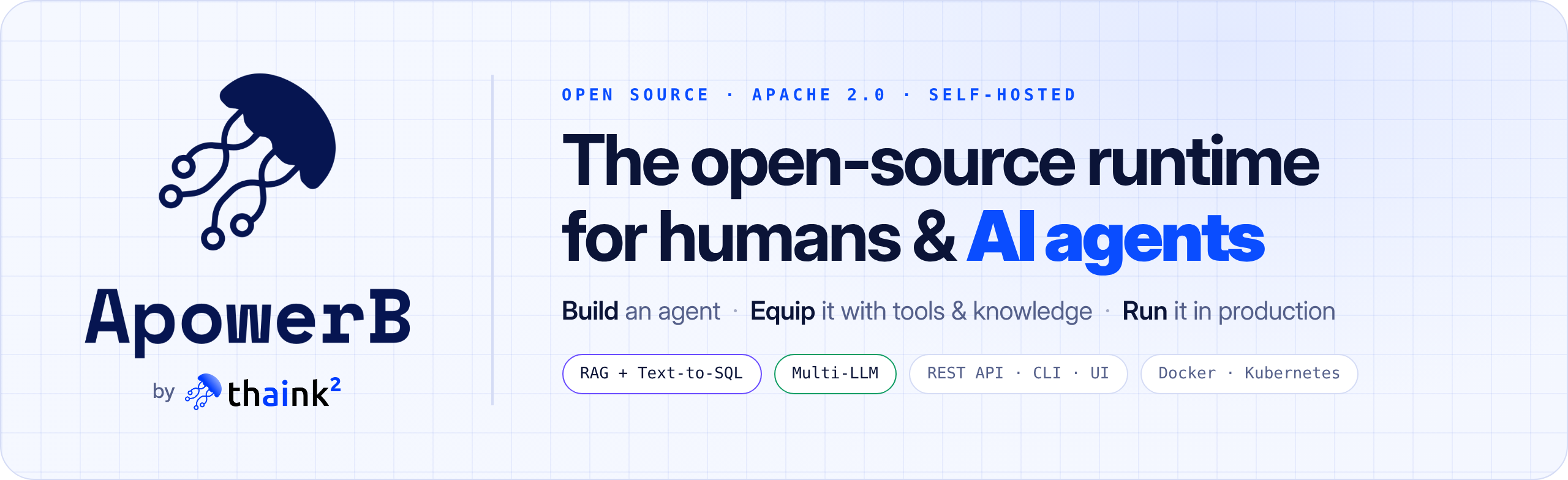
Build, run and govern AI agents that work while you don't.
The open-source agentic framework to build, orchestrate, and operate production AI agents.
Documentation • Quickstart • API Reference • Deployment • thaink2

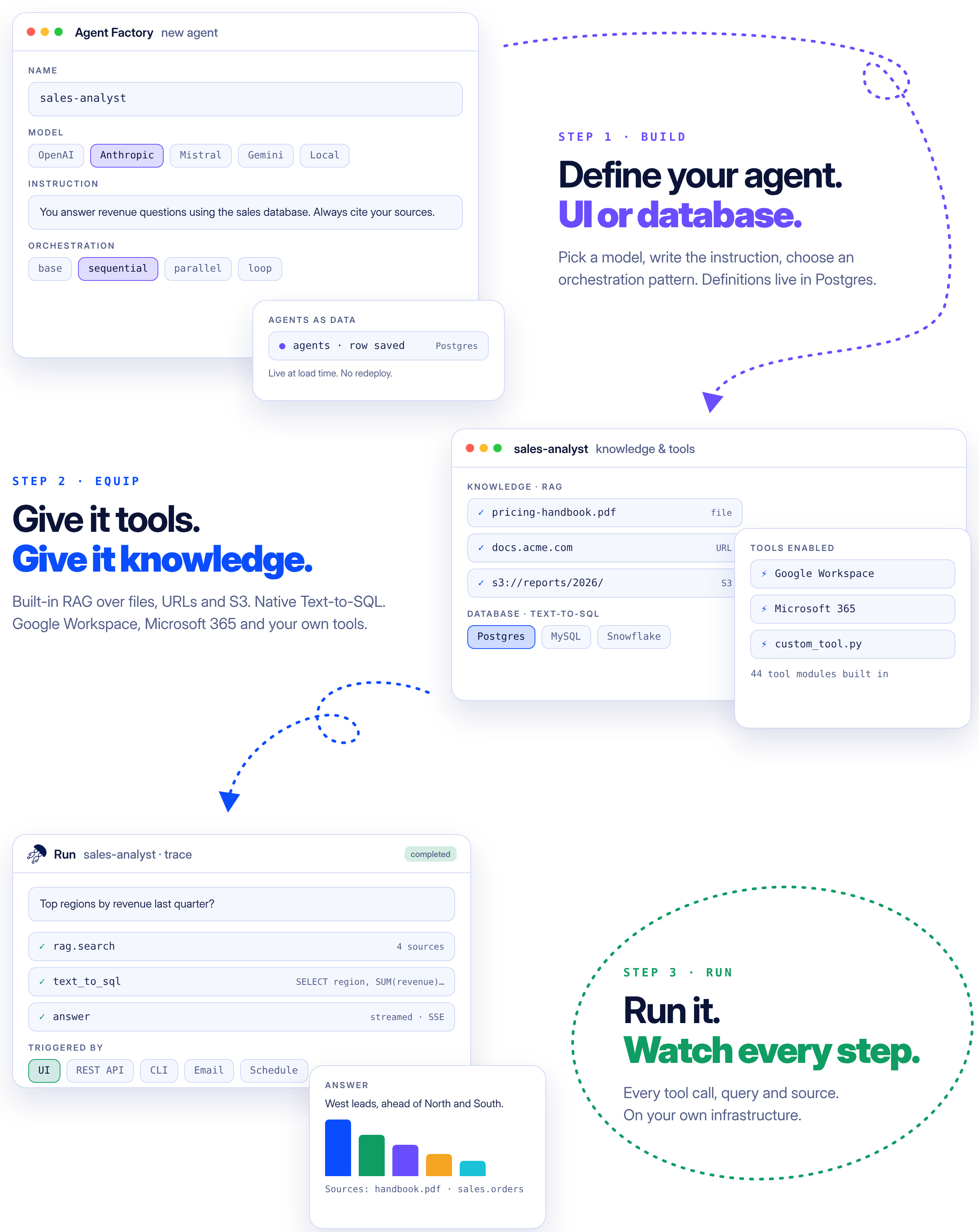
apowerb is an open-source platform to build, run and govern AI agents in production. It covers multi-agent orchestration, RAG and Text-to-SQL, MCP servers and built-in business tools, email- and schedule-triggered runs, token quotas and session audit. You can self-host it with Docker Compose or Helm. The core is Apache-2.0; a few enterprise modules (billing, identity-provider sign-in, MFA, agent evaluation, the supervision screen) are sold separately by thaink².
- Build agents from the web interface or the REST API — instructions, model, tools, knowledge bases — and compose them: sequential, parallel, loop, sub-agents.
- Connect them to your systems: any MCP server, plus built-in tools for Google Workspace, Microsoft 365, GitHub, HubSpot, Pipedrive, Odoo, SQL databases, Oracle, MongoDB, S3, web search, OCR, speech and sandboxed Python.
- Ground them in your data with built-in RAG (files, URLs, databases, S3) and Text-to-SQL.
- Run them without you: on a schedule, or triggered by a new Gmail or Outlook message.
- Operate them in production: streaming responses, auditable session traces, per-user token quotas, revocable sessions, encrypted secrets, users, groups and permissions.
Built on FastAPI, Google ADK and LiteLLM, so it works with Anthropic, OpenAI, Mistral, Gemini, Azure AI Foundry, OVHcloud and any other LiteLLM provider. Bring your own model key.
What people build with it
- Inbox triage: a new Outlook or Gmail message triggers an agent that reads it, classifies it, looks up the customer in the CRM and drafts the reply.
- Morning reports: a scheduled agent asks the database in plain language (Text-to-SQL), turns the result into a chart and mails the summary.
- Document assistants: agents answer from your contracts, procedures or SharePoint files through RAG.
- Back-office automation: create deals in HubSpot or Pipedrive, update Odoo records, file documents in OneDrive or Drive — from a conversation or unattended.
How it differs
- Unattended by design: webhooks and schedules start agents without anyone in the chat, and every run leaves an auditable session trace.
- Business systems first: Microsoft 365, Google Workspace, ERPs, CRMs and SQL databases are built-in tools, not a plugin hunt.
- Production controls in the open-source core: users, groups, permissions, per-user token quotas, revocable sessions, encrypted secrets.
- Not a canvas: agents are defined in the web interface or through the REST API, stored in PostgreSQL and run on Google ADK — scriptable, reviewable and reproducible.
See it in action
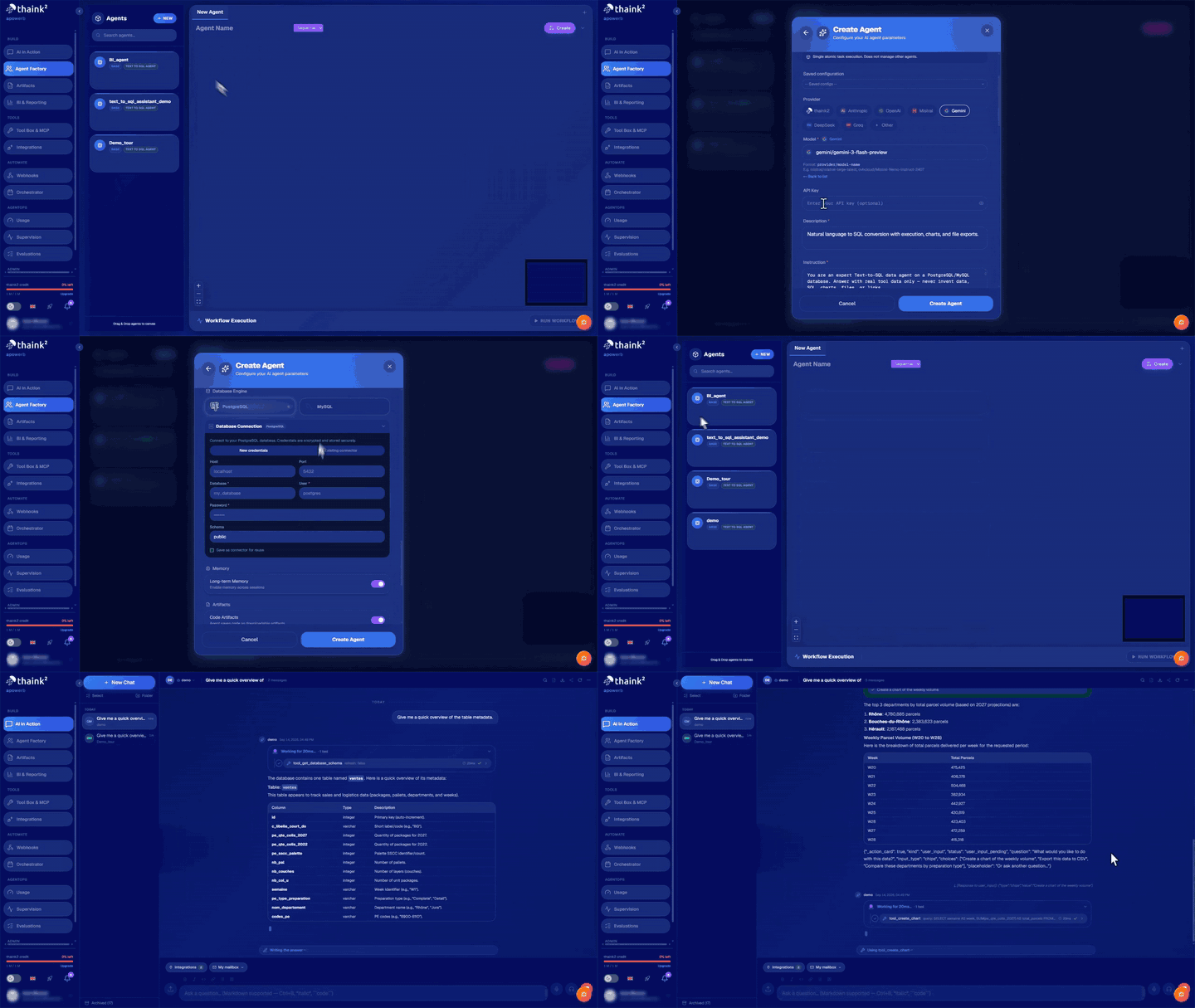 Build an agent Define it in the UI or through the REST API |
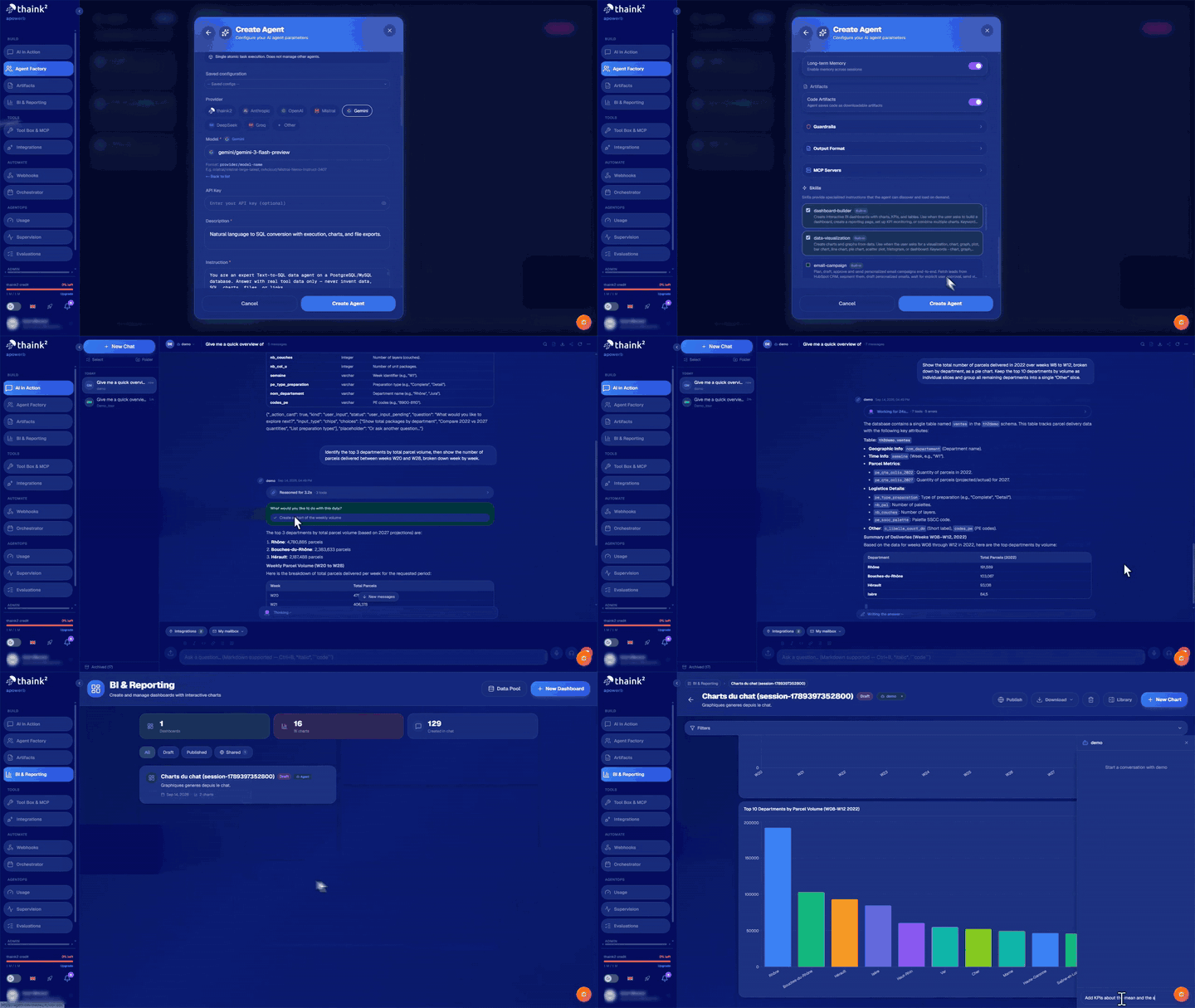 Add tools and knowledge RAG, Text-to-SQL, 44 tool modules |
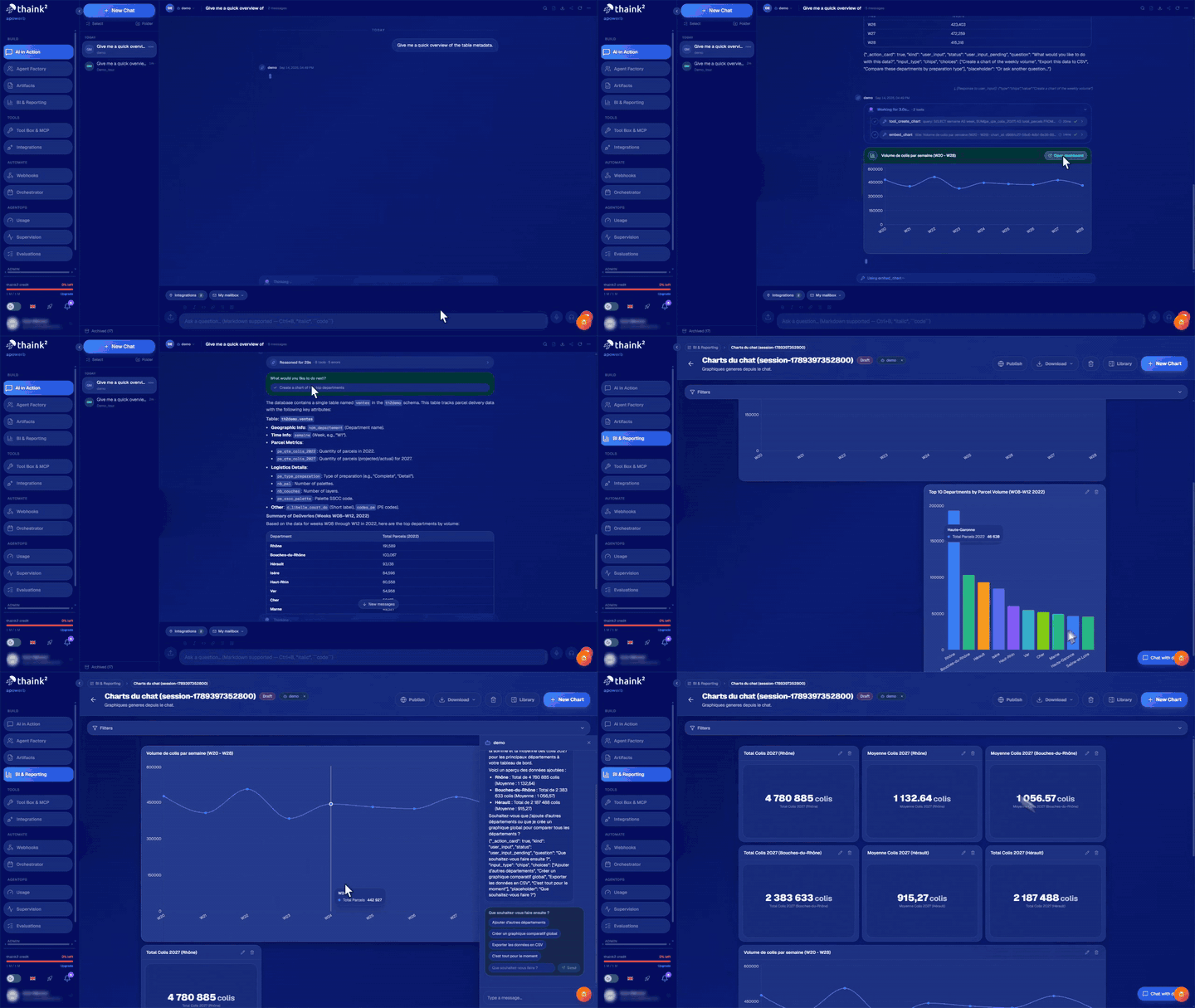 Run and watch See exactly what it did |
Quick start
Three commands, a database included, and nothing to fill in:
git clone https://github.com/apowerb/apowerb-hosting.git && cd apowerb-hosting
cp .env.example .env && ./scripts/generate-secrets.sh
docker compose -f docker-compose/docker-compose.yml --env-file .env up -d
The interface is on http://localhost:3000, the API on
port 8000. generate-secrets.sh writes the random values the stack needs, and
Postgres runs inside the stack — there is no external database to provide.
Agents need a model to answer, and that is the one thing this cannot invent for
you. Add your own key in the interface, or declare a shared one in .env
(DEFAULT_LLM_MODEL and DEFAULT_LLM_API_KEY). Until then everything else
works and the model simply does not appear in the list.
apowerb-hosting holds this
stack, plus Kubernetes manifests, a Helm chart and a Traefik overlay.
Installation from source below is the other path:
it wants your own PostgreSQL.
Table of Contents
- Quick start
- Features
- Open-source core and commercial bricks
- Prerequisites
- Installation from source
- Configuration
- Running
- CLI
- Architecture
- API Reference
- Available Tools
- Integrations
- Webhooks
- RAG (Retrieval-Augmented Generation)
- Text-to-SQL
- SSE Streaming
- Token metering and quotas
- Scheduled runs
- Agent Hub
- Supported Models
- Development
- Troubleshooting
Features
Agents
- Google ADK (Agent Development Kit) for agent definition and execution
- LiteLLM for multi-model compatibility (Anthropic, OpenAI, Mistral, Google, Azure AI Foundry, OVHcloud, and more)
- Multi-pattern orchestration: base, parallel, sequential, loop
- Sub-agents for hierarchical composition, and skills and workflows for reusable steps
- Persistent sessions with conversation context and history compaction
- Guardrails on inputs and outputs, and admission control for runs
- Artifact generation: agents can create and execute code files
- Agent Hub: publish and clone agents across organizations
Data and integrations
- MCP servers: attach your own over HTTP; the
stdiotransport is opt-in (MCP_STDIO_ENABLED=1) because it runs a command on the host - Modular tool system: Google Workspace, Microsoft 365, GitHub, CRMs, databases, RAG, and more — see Available Tools
- RAG as a Service: index files, URLs, databases, and S3 into knowledge bases
- Text-to-SQL: natural language to SQL query conversion
- BI: charts, dashboards and datasets built from agent results
- OAuth workspace integrations: Google, Microsoft, GitHub
Automation
- Webhooks: Gmail (Pub/Sub) and Outlook (Graph API) push notifications trigger agents
- Scheduled runs: cron-based agent execution, driven by an external orchestrator
- SSE streaming: real-time agent responses, RAG progress, and notifications
Operations and security
- REST API based on FastAPI, with a CLI for agent and server management
- Administration panel: users, groups, permissions, and a per-user MFA requirement once the MFA brick is loaded
- Session audit: an auditable session list and traces, scoped to what the caller may read
- Token metering with a monthly per-user quota on the shared model
- Revocable sessions: a per-account cut-off that refuses tokens minted before it
- Encryption for API keys, tokens, and sensitive data
- Bug reports: any user files a defect from the app; the server attaches the server
log lines of the failing request (correlated by
X-Request-ID), where the user was, and an optional consented screenshot. Reviewed in a triage screen before any issue is created — and the GitHub sink refuses a public repository - PostgreSQL database with auto-migrations
Open-source core and commercial bricks
This repository is the open-source core, and everything listed above is in it. thaink² sells a few additional capabilities as separate bricks that plug into the core through documented hooks:
| Brick | What it adds on top of the core |
|---|---|
| Billing | Credit packages, Stripe checkout, crediting logic |
| Consumption analysis | Usage broken down per agent, per tool and per user (the metering itself is in the core) |
| Supervision screen | The supervision UI (session list and traces are served by the core) |
| Agent evaluation | Evaluation of agents |
| Prospection | Prospection and campaigns |
| Identity-provider sign-in | Sign-in with GitHub, Google, Microsoft, LinkedIn |
| Multi-factor authentication | MFA enrolment and challenge (/api/auth/mfa/*). The core stores and enforces the per-user requirement, and refuses it (409 mfa_not_available) while no second factor can be enrolled |
| Organisation management | Creating, renaming, deleting organisations and moving people between them |
On a core-only install, the routes of an absent brick answer 404: that means
"not in this edition", not "object not found". Bricks are loaded through
TH2_EXTENSIONS (see Extensions).
Prerequisites
The quick start above needs Docker and Docker Compose, and nothing else. What follows is for running the core from its sources:
- Python 3.10+ (CI runs on 3.13)
- PostgreSQL
- UV (package manager)
Installation from source
- Install UV and create virtual environment:
pip install uv
uv venv
- Activate the virtual environment:
# Windows
.venv\Scripts\activate

# macOS/Linux
source .venv/bin/activate
- Install dependencies:
uv sync
uv pip install .
- Configure environment:
cp .env.example .env
Configuration
Required Variables
On the quick start path, none of these are yours to fill in — the Compose stack wires the database and generates the key. This section is for an installation that brings its own PostgreSQL.
Five settings, and the server refuses to boot without them
(RUNTIME_REQUIRED_FIELDS in configs/settings.py):
| Variable | Description |
|---|---|
DB_HOST |
PostgreSQL database host |
DB_NAME |
Database name |
DB_USER |
Database username |
DB_PASSWORD |
Database password |
ENCRYPT_KEY |
Encryption key for secrets and JWT signing — a url-safe base64 32-byte key, Fernet.generate_key() |
Two more are read from the same block and are not required, each having a
default: DB_PORT (5432) and DB_SCHEMA (public).
TEST_TOKEN is not required either, and has not been since 0.2.x. The only
middleware that reads it is mounted nowhere, so demanding it forced every
deployment to invent one. An .env that still carries it is harmless.
Optional Variables
Security & JWT
| Variable | Default | Description |
|---|---|---|
WORKING_MODE |
development |
development or production |
ALGORITHM |
HS256 |
JWT signing algorithm |
ACCESS_TOKEN_EXPIRE_MINUTES |
120 |
JWT token lifetime |
Public URLs
Where this installation is reached, and where it sends people. Each one ships
with a localhost default, which is right on a laptop and wrong everywhere
else — a value handed to a browser or written into a mail points at the
reader's machine, not at the server.
Set APP_PUBLIC_URL and four others follow.
| Variable | Default | Description |
|---|---|---|
APP_PUBLIC_URL |
http://localhost:3000 |
Public URL of the front app. Password-reset and e-mail-verification links are built from it, and the settings below are deduced from it |
PUBLIC_BASE_URL |
http://localhost:8000 |
Public URL of this API, for the callback URLs it hands out to webhooks |
ROOT_PATH |
http://localhost:8000 |
Base of the HTTP calls this API makes to itself. Usually an internal address, not the public one |
Declaring APP_PUBLIC_URL fills these in, their paths being fixed by the
pages that serve them — only the origin varies:
| Deduced | Becomes |
|---|---|
GITHUB_INTEGRATION_REDIRECT_URI |
<APP_PUBLIC_URL>/integrations/github/callback |
GOOGLE_INTEGRATION_REDIRECT_URI |
<APP_PUBLIC_URL>/integrations/google/callback |
FRONTEND_URLS |
<APP_PUBLIC_URL> |
CORS_ALLOWED_ORIGINS |
<APP_PUBLIC_URL> |
Anything you set yourself always wins — deducing only fills a blank, and only from a base that is a single absolute URL, scheme included. A base declared but empty, or holding a comma-separated list, deduces nothing and is reported by the startup warning below. An installation that configures none of these behaves exactly as before.
⚠️ CORS_ALLOWED_ORIGINS deduced from your front URL widens what the
browser is allowed to call from, compared with the localhost default. That
is the intent — but it is a security setting, so set it yourself if your
policy is narrower than "the front I just declared".
⚠️ GITHUB_REDIRECT_URI and GOOGLE_REDIRECT_URI are not deduced, and not
read either: the front computes its own sign-in callback from the browser's
origin and sends it with the code exchange. Setting them changes nothing.
CORS
| Variable | Default | Description |
|---|---|---|
CORS_ALLOWED_ORIGINS |
http://localhost:3000 |
The origin whitelist CORS actually uses (comma-separated) |
FRONTEND_URLS |
http://localhost:3000 |
Despite the name, not read by CORS — only used to derive the Outlook mail OAuth callback |
OAuth — User Login (identity-provider brick)
| Variable | Description |
|---|---|
GITHUB_CLIENT_ID / GITHUB_CLIENT_SECRET |
GitHub OAuth (login) |
GITHUB_REDIRECT_URI |
GitHub login callback |
GOOGLE_CLIENT_ID / GOOGLE_CLIENT_SECRET |
Google OAuth (login) |
GOOGLE_REDIRECT_URI |
Google login callback |
MICROSOFT_CLIENT_ID / MICROSOFT_CLIENT_SECRET |
Microsoft OAuth (login) |
MICROSOFT_TENANT_ID |
Microsoft tenant (common for multi-tenant) |
LINKEDIN_CLIENT_ID / LINKEDIN_CLIENT_SECRET |
LinkedIn OAuth (login) |
OAuth — Workspace Integrations
| Variable | Description |
|---|---|
GOOGLE_INTEGRATION_CLIENT_ID |
OAuth app for Google Workspace (Drive, Gmail, Calendar, Sheets, Docs) |
GOOGLE_INTEGRATION_CLIENT_SECRET |
Google integration secret |
GOOGLE_INTEGRATION_REDIRECT_URI |
Google integration callback |
MICROSOFT_INTEGRATION_CLIENT_ID |
OAuth app for Microsoft 365 (Outlook, Teams, OneDrive, SharePoint) |
MICROSOFT_INTEGRATION_CLIENT_SECRET |
Microsoft integration secret |
MICROSOFT_INTEGRATION_TENANT_ID |
Microsoft integration tenant |
MICROSOFT_INTEGRATION_REDIRECT_URI |
Microsoft integration callback |
OUTLOOK_MAIL_REDIRECT_URI |
Callback for the Outlook Mail tool connection. Deduced from APP_PUBLIC_URL |
GITHUB_INTEGRATION_CLIENT_ID |
OAuth app for GitHub workspace integration |
GITHUB_INTEGRATION_CLIENT_SECRET |
GitHub integration secret |
GITHUB_INTEGRATION_REDIRECT_URI |
GitHub integration callback |
Gmail Pub/Sub Webhooks
| Variable | Description |
|---|---|
GMAIL_PUBSUB_PROJECT_ID |
Google Cloud project ID |
GMAIL_PUBSUB_TOPIC |
Pub/Sub topic name (just the name, not the full path) |
RAG
| Variable | Default | Description |
|---|---|---|
RAG_WEBHOOK_SECRET |
th2-webhook-default-secret |
HMAC-SHA256 secret for RAG webhooks (change in production!) |
RAG_BASE_URL |
— | RAG API base URL (th2llm) |
The RAG service calls back on PUBLIC_BASE_URL (see Public URLs).
Stripe (billing brick)
settings still declares these, and user still carries stripe_customer_id, but the
billing routes and the credit logic live in the billing brick. Setting them changes
nothing in a core-only install.
| Variable | Description |
|---|---|
STRIPE_SECRET_KEY |
Stripe secret key |
STRIPE_PUBLISHABLE_KEY |
Stripe publishable key |
STRIPE_WEBHOOK_SECRET |
Stripe webhook signing secret |
S3 Storage (optional)
| Variable | Description |
|---|---|
STORAGE_MODE |
local or s3 |
S3_REGION |
AWS region |
S3_ACCESS_KEY / S3_ACCESS_KEY_SECRET |
S3 credentials |
S3_ENDPOINT |
S3 endpoint URL |
S3_BUCKET_NAME |
Bucket name |
Orchestrator (scheduled runs, optional)
Two backends drive scheduled runs. ORCHESTRATOR selects one; the code still defaults to
mage, the historical backend, so an instance that wants th2etl must say so explicitly.
| Variable | Default | Description |
|---|---|---|
ORCHESTRATOR |
mage |
mage or th2etl |
With ORCHESTRATOR=th2etl:
| Variable | Default | Description |
|---|---|---|
TH2ETL_BASE_URL |
http://localhost:8009 |
th2etl instance |
TH2ETL_API_KEY |
— | Must equal the API_KEY of that th2etl instance — its business routes require Authorization: Bearer <key> |
With ORCHESTRATOR=mage:
| Variable | Default | Description |
|---|---|---|
BASE_URL |
http://localhost:6789 |
Mage AI scheduler URL |
API_KEY |
— | Mage API key |
OAUTH_TOKEN |
— | Mage OAuth token |
PROJECT_NAME |
default_repo |
Mage project name |
Extensions
| Variable | Default | Description |
|---|---|---|
TH2_EXTENSIONS |
— | Comma-separated modules to load as bricks |
Installing a brick and loading it are two different steps: a package present in the
environment but absent from TH2_EXTENSIONS behaves exactly like one that was never
installed. Check the loaded set, not the installed set, when a capability seems missing.
Running
Via CLI
apowerb serve
Via Uvicorn
uv run uvicorn apowerb.main:app --reload
Server starts at http://127.0.0.1:8000/
/docs, /redoc and /openapi.json are removed from the served routes by default:
they hand the full route inventory to an unauthenticated caller, which is enough to
fingerprint a deployment from the outside. Opt in with PUBLISH_API_SCHEMA=true for a
browsable Swagger; WORKING_MODE=production overrides that flag as a second lock.
The published reference is at docs.apowerb.com.
CLI
# Start server
apowerb serve --host 0.0.0.0 --port 8000

# Manage agents
apowerb agents list
apowerb agents create
apowerb agents delete <agent_id>

# Manage tools
apowerb tools list

# Manage runs
apowerb runs list
Architecture
apowerb/
├── src/apowerb/
│   ├── main.py              FastAPI entry point, middleware, router mounting, startup
│   ├── models.py            SQLAlchemy ORM models
│   │
│   ├── auth/                Email/password login, JWT dependencies, session cut-off
│   ├── users/               User CRUD
│   ├── routers/             HTTP endpoints, one module per family
│   ├── core/                Business logic behind the routers
│   │   ├── adk_runner.py        ADK execution
│   │   ├── adk_agent_builder.py agent Python file generation
│   │   ├── extensions/         brick loader and registry hooks
│   │   ├── guardrails.py       input/output guardrails
│   │   ├── run_gate.py         admission control for runs
│   │   └── history_compaction.py  conversation trimming
│   ├── tools_store/         Tool registry + portfolio of tool modules
│   ├── skills_store/        Reusable agent skills
│   ├── agent_store/         Agent templates and seeds
│   ├── bi/                  Charts, dashboards, datasets
│   ├── sqlgen/              Text-to-SQL generation
│   ├── integrations/        OAuth workspace integrations
│   ├── artifacts/           Artifact storage and execution
│   ├── scheduler/           Orchestrator clients (th2etl, mage), background workers
│   ├── storage/             Local and S3 storage abstraction
│   ├── middleware/          Request middleware
│   ├── helpers/             Database, security, encryption, notification bus, migrations
│   ├── schema/              Pydantic schemas
│   ├── configs/             Settings and logging
│   └── cli/                 Typer CLI (`apowerb`)
│
├── agents_pool/             Generated agent code (runtime)
├── artifacts_store/         Artifacts written by agents (runtime, local mode)
├── uploads/                 Uploaded files (runtime, local mode)
├── tests/
└── pyproject.toml
Routers that arrive with the bricks are not in this tree — see Open-source core and commercial bricks.
Startup Sequence
On application start, apowerb:
- Creates required directories (
agents_pool/,artifacts_store/,uploads/) - Runs auto-migrations (
ensure_*functions) for all database tables - Generates agent Python modules from database
- Starts the webhook renewal background task (every 6 hours)
- Mounts the Google ADK FastAPI sub-application
API Reference
The full reference — every route, parameter and response shape — is generated from the code and published at docs.apowerb.com/api-reference. It is not duplicated here: a hand-maintained route table in this file went stale within two weeks last time, and a stale reference is worse than none.
Route families in this edition, all under /api unless noted:
| Family | What it covers |
|---|---|
auth |
Email/password login, refresh, logout, password reset, email verification |
users |
User CRUD, me |
admin |
Users, groups, permissions, MFA requirement |
bug-reports |
In-app defect reports, triage, and the reviewed GitHub issue sink |
agents |
Agent CRUD, reload, status, template resync, run |
adk |
ADK execution: run, streaming (run_sse), sessions, titles, traces |
tools, tools_config |
Tool registry and per-agent tool configuration |
skills, workflows |
Reusable skills, multi-step flows |
superagents |
Templates composing several agents |
rag |
Indexing files, URLs, databases, S3; status and progress stream |
artifacts |
Files produced by agents, listing, download, execution, library |
files |
Upload (including chunked), download, delete |
data-lake |
Pin storage read/write/list |
hub |
Publish and clone agents |
integrations |
OAuth workspace connections (Google, Microsoft, GitHub) |
emailing |
Outlook mail OAuth flow, shared mailboxes |
webhooks |
Subscription CRUD and inbound push dispatch |
notifications |
User notifications and SSE stream |
supervision |
Session list and session trace for audit (/api/adk/sessions*), scoped to what the caller may read |
scheduler |
Scheduled runs through the configured orchestrator |
charts, dashboards, bi-* |
BI: charts, dashboards, datasets, refresh, stats |
share |
Shareable conversation links |
api-keys |
Saved provider keys |
config, health |
Public configuration, liveness |
Served by bricks, and answering 404 here: billing, usage, prospection,
campaigns, MFA (/api/auth/mfa/*), identity-provider sign-in
(/api/users/{github,google,microsoft,linkedin}), evaluation, and organisation
management (/api/admin/organizations*).
Who may read another account's session is answered by the core
(register_supervision_scope, wired to the superadmin check); the supervision
screen is what the brick provides.
Upgrading: organisation management left the core
Since the release that carries this note, the five /api/admin/organizations* routes are
served by a brick rather than by the core. The mechanism stayed, deliberately:
- the
admin_organizationandadmin_org_membertables are still created here, and existing rows are left untouched; - an administrator is still bounded by the organisation they belong to, so a boundary drawn before the upgrade keeps being enforced after it;
- a user's organisation is still reported by
/api/admin/usersand/api/admin/me.
What an install without the brick loses is the ability to create, rename, delete an organisation or to move somebody between two. If you never created one, nothing changes: with no organisation to belong to, an administrator who is not a superadmin administers only their own account — which is what this build already did.
Available Tools
Google Workspace
| Tool Module | Functions |
|---|---|
google_drive |
List, search, read, download files |
google_gmail |
List, search, read, send emails |
google_calendar |
List, search, create events |
google_sheets |
Get spreadsheet info, read, write cells |
google_docs |
Create, read, append to documents |
Microsoft 365
| Tool Module | Functions |
|---|---|
outlook_mail |
List, search, read, send emails, list folders, download attachments |
onedrive_read, onedrive_write |
List, search, read, download, upload, update files, create folders, delete, shared files |
teams |
List chats, get/send messages, reply, search, create group chats, list members |
sharepoint |
Find sites, browse and search document libraries, read files (text, CSV, Excel, Word, PDF) — read-only, Sites.Read.All |
Developer & Business Apps
| Tool Module | Functions |
|---|---|
github |
List repositories, read files, search code, read pull requests, index repository docs |
hubspot, marketing |
HubSpot contacts and deals, sales leads |
pipedrive |
Create and search Pipedrive deals and people |
odoo |
Search, read, create and update Odoo records |
datadog |
Send application logs to Datadog |
Data & Database
| Tool Module | Functions |
|---|---|
database, database_mcp |
Generic database queries, SQL execution |
oracle |
Read-only SQL on Oracle Database (single SELECT / WITH, read-only transaction), list tables |
mongodb |
List collections, find, count and aggregate documents — read-only ($out / $merge refused) |
text_to_sql |
Natural language to SQL, schema introspection |
db_to_rag |
Index database query results into RAG |
data_handler |
Data filtering, aggregation, transformation |
business_intelligence, bi_datasets |
Charts, dashboards and datasets |
tabpfn |
Tabular classification and regression (Prior Labs API) |
RAG & Knowledge
| Tool Module | Functions |
|---|---|
rag |
Create, list, search, delete knowledge bases |
memory |
Save/search user memory, tool usage patterns |
ocr |
Extract text (markdown) from documents and images |
Communication
| Tool Module | Functions |
|---|---|
emailing |
Send emails (SMTP) |
audio |
Speech-to-text, text-to-speech, audio analysis and generation |
Utilities
| Tool Module | Functions |
|---|---|
basic |
Read files, data loader, image conversion, bearer tokens |
api_call |
Generic API calls, Thaink² forecast |
python_script |
Run Python in a confined subprocess |
image_generation |
Generate images (multi-provider) |
s3_tools |
Read S3 PDFs, search S3 files |
visualization |
Chart generation, CSV to chart export |
web_search_mcp |
Web search via MCP |
thaink2 |
Custom Thaink² RAG tools |
apowerb tools list prints the registry of the running install.
Integrations
OAuth Providers
apowerb supports two categories of OAuth:
- User Login — Sign up / log in via OAuth (GitHub, Google, Microsoft, LinkedIn). Provided by the identity-provider brick.
- Workspace Integrations — Connect external services as tools for agents. In the core.
Connecting a Workspace Integration
- User calls
GET /api/integrations/{provider}/{service}/connectto get the OAuth URL - User authorizes the app on the provider's consent screen
- Provider redirects to
POST /api/integrations/{provider}/callback - apowerb stores the access/refresh tokens encrypted in the
integrationstable - Agent tools can now use the integration tokens
Supported Services
| Provider | Services | Scopes |
|---|---|---|
| Drive, Gmail, Calendar, Sheets, Docs | Service-specific (e.g., gmail.readonly, drive.readonly) |
|
| Microsoft | Outlook, Teams, OneDrive, SharePoint | Service-specific (e.g., Mail.Read, Files.ReadWrite) |
| GitHub | Repositories, Gists | repo, gist, read:user |
Webhooks
apowerb can automatically trigger agents when events occur in connected services (new email, etc.). Two providers are supported: Gmail (via Google Pub/Sub) and Outlook (via Microsoft Graph subscriptions).
How It Works
Email arrives → Provider pushes notification → apowerb receives it
     → Fetches new email content → Runs associated agent → Logs result
Webhook Subscription API
| Method | Endpoint | Description |
|---|---|---|
| POST | /api/webhooks/subscriptions |
Create subscription |
| GET | /api/webhooks/subscriptions |
List subscriptions |
| PATCH | /api/webhooks/subscriptions/{id} |
Update (agent, template, change_type) |
| DELETE | /api/webhooks/subscriptions/{id} |
Delete and unsubscribe |
| POST | /api/webhooks/subscriptions/{id}/renew |
Manually renew |
| GET | /api/webhooks/logs |
View execution logs |
Create a subscription:
POST /api/webhooks/subscriptions
{
  "provider": "google_gmail",
  "resource": "INBOX",
  "agent_id": "AGENT_ID",
  "change_type": "created",
  "agent_message_template": "New email from {{ sender }}: {{ subject }}\n\n{{ body }}"
}
Automatic Renewal
- Gmail watches expire after 7 days
- Outlook subscriptions expire after 3 days
- A background task runs every 6 hours and renews subscriptions expiring within 12 hours
Gmail Webhook Setup (Pub/Sub)
Architecture
Gmail  ──push──▶  Google Pub/Sub  ──HTTP POST──▶  apowerb
                  (topic)                         /api/webhooks/gmail/notifications
                                                        │
                                                        ▼
                                                  Fetch new emails via Gmail API
                                                        │
                                                        ▼
                                                  Run associated agent
Prerequisites
- A Google Cloud project with billing enabled
- Gmail API and Cloud Pub/Sub API enabled
- A Google OAuth 2.0 application for workspace integration
- A publicly accessible URL for apowerb
Step 1 — Enable Google APIs
gcloud services enable gmail.googleapis.com pubsub.googleapis.com \
  --project=YOUR_PROJECT_ID
Step 2 — Create a Pub/Sub Topic
gcloud pubsub topics create gmail-notifications \
  --project=YOUR_PROJECT_ID
Step 3 — Grant Gmail Permission to Publish
Gmail uses the service account gmail-api-push@system.gserviceaccount.com to push notifications. Grant it the Pub/Sub Publisher role:
gcloud pubsub topics add-iam-policy-binding gmail-notifications \
  --project=YOUR_PROJECT_ID \
  --member="serviceAccount:gmail-api-push@system.gserviceaccount.com" \
  --role="roles/pubsub.publisher"
Note: In the Google Cloud Console UI, the "Publisher" role may not appear in the dropdown by default — type "publisher" in the search bar to find it, or use the CLI command above.
Step 4 — Create a Push Subscription
gcloud pubsub subscriptions create gmail-notifications-push \
  --topic=gmail-notifications \
  --push-endpoint=https://YOUR_DOMAIN/api/webhooks/gmail/notifications \
  --project=YOUR_PROJECT_ID
Step 5 — Configure OAuth 2.0
In Google Cloud Console → Credentials:
- Create an OAuth 2.0 Client ID (type: Web application)
- Add authorized redirect URI:
https://YOUR_DOMAIN/integrations/google/callback - Add scope:
https://www.googleapis.com/auth/gmail.readonly
Step 6 — Set Environment Variables
GOOGLE_INTEGRATION_CLIENT_ID=your-client-id.apps.googleusercontent.com
GOOGLE_INTEGRATION_CLIENT_SECRET=GOCSPX-xxxxxxxxxx
GOOGLE_INTEGRATION_REDIRECT_URI=https://YOUR_DOMAIN/integrations/google/callback

GMAIL_PUBSUB_PROJECT_ID=your-gcp-project-id
GMAIL_PUBSUB_TOPIC=gmail-notifications

PUBLIC_BASE_URL=https://YOUR_DOMAIN
Step 7 — Connect Gmail Account
In the apowerb-ui UI: Integrations → Connect Google (Gmail)
Step 8 — Create Webhook Subscription
Via UI (Webhook Manager) or API:
curl -X POST https://YOUR_DOMAIN/api/webhooks/subscriptions \
  -H "Authorization: Bearer TOKEN" \
  -H "Content-Type: application/json" \
  -d '{
    "provider": "google_gmail",
    "resource": "INBOX",
    "agent_id": "AGENT_ID",
    "change_type": "created"
  }'
Outlook Webhook Setup
Prerequisites
- A registered Microsoft Azure AD application
- Microsoft Graph API permissions:
Mail.Read - A publicly accessible HTTPS URL
Setup
- Configure
MICROSOFT_INTEGRATION_*environment variables - Connect Outlook integration in the UI
- Create a webhook subscription with
"provider": "microsoft_outlook"
The Outlook handler uses Microsoft Graph change notifications with clientState validation.
Webhook Troubleshooting
| Error | Cause | Fix |
|---|---|---|
403 — User not authorized |
Gmail can't publish to Pub/Sub topic | Grant gmail-api-push@system.gserviceaccount.com the Publisher role on your topic |
404 — Topic not found |
Topic missing or wrong project | Verify GMAIL_PUBSUB_PROJECT_ID and GMAIL_PUBSUB_TOPIC |
| Notifications not arriving | Push subscription misconfigured | Verify the push endpoint URL is correct and publicly accessible |
401 — Invalid credentials |
OAuth token expired | Reconnect the integration from the UI |
| Watch expired | Auto-renewal failed | Check scheduler logs, manually renew via API |
RAG (Retrieval-Augmented Generation)
RAG lets agents answer questions based on documents you provide — PDFs, web pages, database exports, or S3 files.
How It Works
Upload documents → Documents get indexed (via th2llm) → Agent searches them when answering
Indexing Sources
| Source | Endpoint | Description |
|---|---|---|
| Files | POST /api/rag/index-files |
Upload PDF, CSV, TXT, DOCX, etc. (max 50 MB/file) |
| URL | POST /api/rag/index-url |
Crawl and index a web page |
| Database (SQL) | POST /api/rag/index-db |
Index query results using a SQL query |
| Database (NL) | POST /api/rag/index-db-nl |
Index query results using natural language |
| S3 | POST /api/rag/index-s3 |
Index files from an S3 bucket |
Tracking Progress
- Poll:
GET /api/rag/status/{knowledge_id} - Stream (SSE):
GET /api/rag/stream/{agent_id}?session_id=xxx
Security
- Path traversal prevention on session/agent IDs
- SSRF protection on URL indexing (blocks localhost, private IPs)
- Session ownership validation
- HMAC-SHA256 signature verification on th2llm webhooks
Text-to-SQL
Agents can connect to relational databases and convert natural language questions into SQL queries.
- Create a database tool config with connection parameters
- Create an agent with
text_to_sqltool enabled - Ask questions — the agent introspects the schema, generates SQL, executes it, and returns results
SSE Streaming
Three SSE streaming channels are available:
| Channel | Endpoint | Events |
|---|---|---|
| Agent response | POST /api/adk/run_sse |
Token-by-token agent output |
| RAG progress | GET /api/rag/stream/{agent_id} |
connected, status, complete |
| Notifications | GET /api/notifications/stream |
Real-time user notifications |
Token metering and quotas
Token metering is in the core. register_core_usage() is wired when the app is built,
before load_overlay(), and the recorder writes one llm_usage row per completed
model turn. GET /api/config/default-llm/usage serves the caller their own gauge.
The cap covers only the shared thaink2/default model
(llm_usage.billed_to_thaink2): a personal API key is paid for by whoever supplies it, so
it is never capped. A run over the cap is refused with a 402 before the answer starts,
never cut mid-stream. DEFAULT_LLM_MONTHLY_TOKEN_QUOTA is the per-user allowance for the
current Europe/Paris calendar month, and 0 means unlimited — the kill-switch to use
without a redeploy if the guard blocks wrongly. DEFAULT_LLM_USER_TOKEN_CAP and
DEFAULT_LLM_GLOBAL_TOKEN_CAP (sliding window of DEFAULT_LLM_CAP_WINDOW_HOURS, 0 =
unlimited) are the fallback cap, per account and for the whole deployment; they apply only
when no scale is registered on register_default_llm_cap, and the core registers one, so
a standard install is capped by the monthly quota.
Credits and payments are not in this edition. The user row carries a credit balance and
transactions / credit_purchases exist in the schema, but the packages, the Stripe
checkout and the crediting logic belong to the billing brick, and /api/billing/*
answers 404 here. The per-agent, per-tool and per-user breakdown is the consumption
analysis brick.
Scheduled runs
Agent runs can be automated on a schedule. The core does not run the cron itself: it
registers the schedule with an external orchestrator, selected by ORCHESTRATOR
(th2etl, or the historical mage which is still the code default).
POST /api/adk/schedule_run
{
  "agent_id": "agent42",
  "user_id": "user@example.com",
  "session_id": "session_scheduled",
  "new_message": {
    "role": "user",
    "parts": [{ "text": "Generate the daily report" }]
  },
  "schedule_interval": "@daily",
  "start_time": "2026-03-10T08:00:00"
}
Schedule Presets
| Preset | Cron |
|---|---|
@hourly |
0 * * * * |
@daily |
0 0 * * * |
@weekly |
0 0 * * 0 |
@monthly |
0 0 1 * * |
| Custom | e.g., */15 * * * * |
Agent Hub
Agents can be published to a shared Hub and cloned by other users:
POST /api/hub/publish— Publish an agent (copies config, tools, instructions)POST /api/hub/clone— Clone a Hub agent into your workspaceGET /api/hub— Browse available agents
Database Models
| Table | Description | Key Fields |
|---|---|---|
user |
User accounts | email, password, role, credits, stripe_customer_id, OAuth IDs, mfa_enabled, mfa_required, sessions_valid_from |
integrations |
Connected OAuth services | user_id, provider, access_token, refresh_token, scopes, meta |
webhook_subscriptions |
Active webhook watches | user_id, integration_id, provider, subscription_id, resource, agent_id, status, expiration |
webhook_logs |
Webhook execution history | subscription_id, trigger_event, email_subject, agent_response, duration_ms, status |
notifications |
User notifications | user_id, title, message, type (webhook/info/warning/error), is_read |
transactions |
Credit movements | user_id, type (purchase/usage/refund/bonus), amount, balance_after, stripe IDs |
credit_purchases |
Stripe purchase sessions | user_id, stripe_session_id, credits_amount, price_paid, status |
llm_usage |
Per-call token accounting | agent_id, owner_id, invocation_id, model, token counts, created_at |
business_intelligence |
BI charts, dashboards, datasets | owner, definition, refresh state |
shared_conversations |
Shareable conversation links | share_id, session, owner |
oauth_states |
Short-lived OAuth state tokens | state, provider, expiry |
Sessions, events and ADK artifacts live in the tables Google ADK owns (sessions,
events), which supervision reads directly rather than fanning out one HTTP call per
agent.
Some columns here serve bricks rather than the core: credits, stripe_customer_id,
mfa_enabled and the transactions / credit_purchases tables are declared so a brick
can use them, and stay untouched without one. mfa_required is set by the core's admin
panel, and llm_usage is written by the core itself (see
Token metering and quotas).
Supported Models
apowerb calls models through LiteLLM, so any
provider LiteLLM supports works: Anthropic, OpenAI, Mistral, Google Gemini, Azure AI
Foundry, OVHcloud, and more. A model is named with its LiteLLM provider prefix, for
example anthropic/<model>, openai/<model>, mistral/<model>, gemini/<model>,
azure_ai/<deployment> or ovhcloud/<model>.
Azure AI Foundry
For a Foundry serverless endpoint, set the model name with the azure_ai/
provider prefix and pass the endpoint settings in agent_model_params:
{
  "agent_model": "azure_ai/llama-3-3-70b-instruct",
  "agent_model_params": {
    "model_api_base": "https://<resource>.models.ai.azure.com",
    "model_api_key": "<api-key>",
    "model_api_version": "2025-04-01-preview"
  }
}
model_api_version is optional and is also accepted as api_version.
For Microsoft Entra ID, resolve a bearer token with DefaultAzureCredential
in the deployment environment and provide that token as model_api_key; LiteLLM
passes it through the same api_key argument. Tool schemas and tool calls remain
enabled through the normal ADK LiteLlm path.
Development
# Install development dependencies
uv sync --group dev

# Run tests
pytest

# Linting
ruff check .
ruff format .
Troubleshooting
Common Errors
| Code | Meaning |
|---|---|
400 |
Bad request — check your request body |
401 |
Unauthorized — missing or invalid token |
402 |
The monthly token quota on the shared model is exhausted |
403 |
Forbidden — you don't own this resource |
404 |
Not found — or a route served by a brick this install does not load |
413 |
File too large — max 50 MB per file |
422 |
Unprocessable — e.g., query returned no data |
500 |
Internal server error |
503 |
Service temporarily unavailable |
Detailed API Guide
Guides, quickstart and the generated API reference are at docs.apowerb.com. Their source lives in apowerb/apowerb-docs.
Contributing
Contributions are welcome. CONTRIBUTING.md covers the development setup, the branch and commit conventions this repository actually uses, and what makes a pull request reviewable.
Security issues take a different path: see SECURITY.md, and do not open a public issue for one.
Support
Ask on Discord, or open an issue on this repository.
License
apowerb is distributed under the Apache License 2.0. Copyright 2025-2026 thaink².
The commercial bricks listed in Open-source core and commercial bricks are distributed separately under commercial terms and are not covered by this licence. The token metering and the cap live in this repository, so they are covered by it.
"apowerb" and the apowerb logo are trademarks of thaink². The licence covers the code, not the marks — see TRADEMARK.md.
Metadata
Release files for apowerb 0.2.58
For a detailed explanation of source distributions (sdists) and built distributions (wheels), please see the package formats documentation.
Source distribution (sdist)
| File | Size | Uploaded | |
|---|---|---|---|
| apowerb-0.2.58.tar.gz | 1.0 MB | Details |
Built distribution (wheel)
| File | Interpreter | ABI | Platform | Reset |
|---|---|---|---|---|
| apowerb-0.2.58-py3-none-any.whl | Python 3 | none | any | Details |
Total release size: 2.3 MB
Release files / apowerb-0.2.58.tar.gz
| Download URL | apowerb-0.2.58.tar.gz |
|---|---|
| Size | 1.0 MB |
| Tags | Source |
|
SHA-256 checksum How to use checksums |
2dce8ee5c5a732c62f9f2003136faf00227361239090c2de60be30d8ec1b249c
|
|
BLAKE2b-256 checksum How to use checksums |
7259ef7d12a48d84067aecd7d9ae9e26e3b3cf4cd52dc0445ac48c16eeba3ebc
|
| Upload date | |
|
Uploaded using Trusted Publishing? What is trusted publishing? |
Yes |
| Uploaded via |
twine/7.0.0 CPython/3.13.14
|
Provenance
Provenance describes where a file came from. On PyPI, provenance is shared via attestations, which provide a verifiable record of the build or publishing details. View details, limitations and caveats.


PyPI Publish Attestation
PyPI verified that this artifact, at this checksum, originated from the publisher listed below.
Signed by GitHub Actions, verified by PyPI on Oct 8, 2026.
Transparency logRelease files / apowerb-0.2.58-py3-none-any.whl
| Download URL | apowerb-0.2.58-py3-none-any.whl |
|---|---|
| Size | 1.2 MB |
| Tags | Python 3 |
|
SHA-256 checksum How to use checksums |
d87b5ddc4a133bccd52609e125ed2f216c5840bbdfb1e1b4704ce8c7afa4fb39
|
|
BLAKE2b-256 checksum How to use checksums |
f0440db309725d535ef21d7a7548ab3521b4424958f3427395ccd85b577b7ecd
|
| Upload date | |
|
Uploaded using Trusted Publishing? What is trusted publishing? |
Yes |
| Uploaded via |
twine/7.0.0 CPython/3.13.14
|
Provenance
Provenance describes where a file came from. On PyPI, provenance is shared via attestations, which provide a verifiable record of the build or publishing details. View details, limitations and caveats.
PyPI Publish Attestation
PyPI verified that this artifact, at this checksum, originated from the publisher listed below.
Signed by GitHub Actions, verified by PyPI on Oct 8, 2026.
Transparency log













