
 # arabic-itn
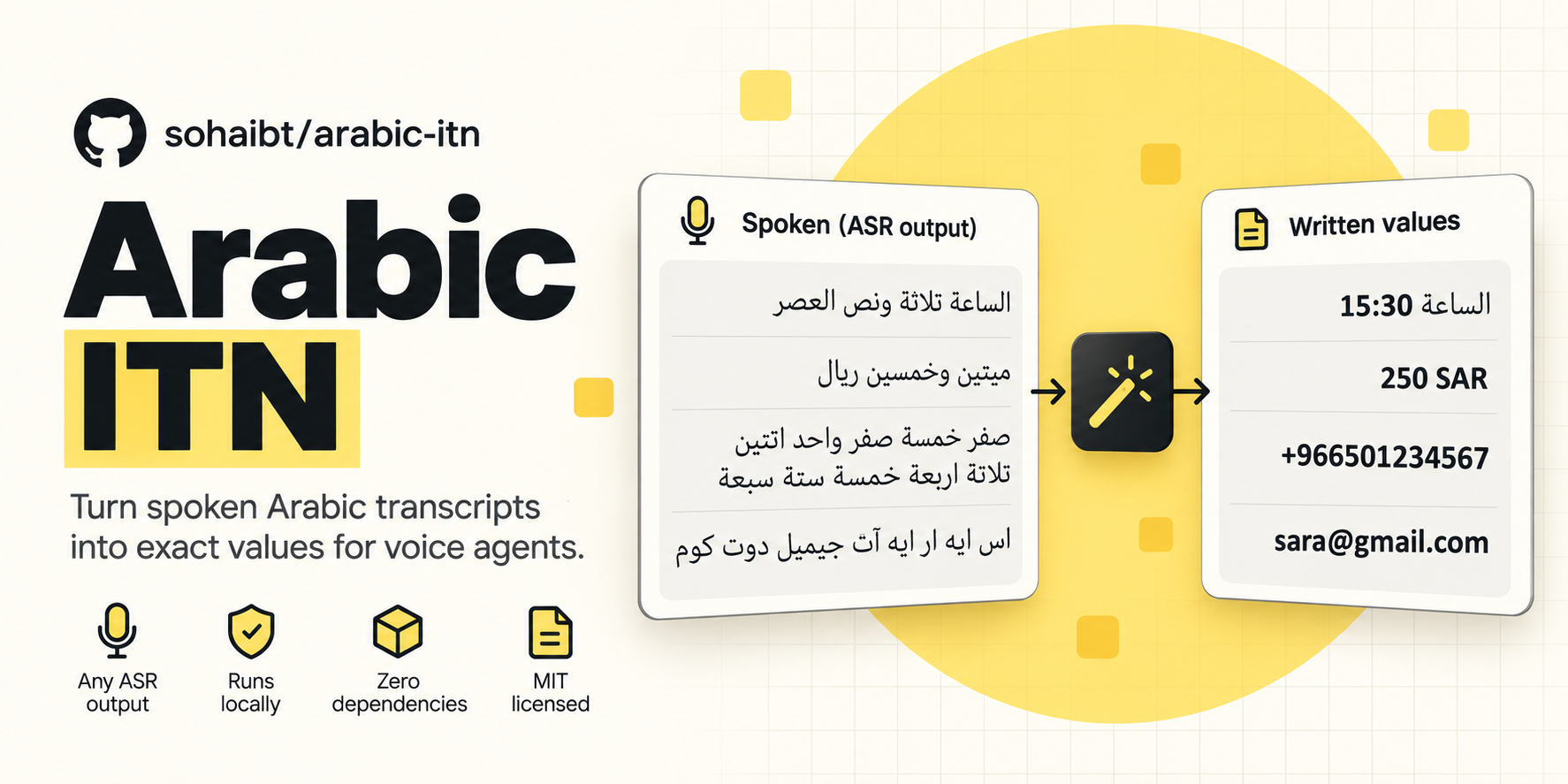
Turn spoken-form Arabic ASR transcripts into the exact values a voice agent needs: phone numbers, money, dates, times, spelled emails and order IDs.
الساعة تلاتة ونص العصر                      ->  الساعة 15:30
ميتين وخمسين ريال                           ->  250 SAR
صفر خمسة صفر واحد اتنين تلاتة اربعة ...     ->  +966501234567
اس ايه ار ايه آت جيميل دوت كوم              ->  sara@gmail.com
رقم الطلب ايه بي واحد اتنين تلاتة اربعة     ->  رقم الطلب AB-1234
يوم الخميس خمسة عشر أكتوبر ٢٠٢٦             ->  2026-10-15
A small rule-based Python library and CLI. Standard library only, runs locally, works on any ASR's text output.
Install
pip install arabic-itn
Python 3.8+, no dependencies.
Usage
from arabic_itn import normalize

normalize("حول ميتين وخمسين ريال على صفر خمسة صفر واحد اتنين تلاتة اربعة خمسة ستة سبعة")
# {"text": "حول 250 SAR على +966501234567",
#  "spans": [{"type": "money", "raw": "ميتين وخمسين ريال", "value": "250 SAR"},
#            {"type": "phone", "raw": "صفر خمسة صفر ...", "value": "+966501234567"}]}

normalize("صفر خمسة صفر واحد اتنين تلاتة اربعة خمسة ستة سبعة", country="AE")["text"]
# "+971501234567"
Span types: number, digits, phone, money, time, date, email, order_id.
raw is the exact input substring; value is what replaced it in text.
CLI: one transcript per stdin line, one JSON object per stdout line.
echo "المبلغ ميتين وخمسين ريال" | arabic-itn
echo "صفر خمسة صفر واحد اتنين تلاتة اربعة خمسة ستة سبعة" | arabic-itn --country AE
python -m arabic_itn < transcripts.txt
What it handles
- Digits: Arabic-Indic (٠-٩) and Persian (۰-۹) digits to 0-9.
- Number words: MSA and common Gulf / Egyptian / Levantine forms, masculine and feminine, teens (خمسة عشر, خمستاشر, خمسطعش), hundreds (ميتين, تلتمية, خمس مية), thousands (ألف, ألفين, تلات تلاف, عشرين ألف) and millions. Lone small words stay as words ("واحد صاحبي", "ألف مبروك", "خمسة ستة أيام").
- Phones: digit-by-digit or grouped speech, دبل/double and تريبل/triple, زائد/plus and 00
prefixes. Saudi and UAE mobiles become E.164. A local
05...number takes thecountryargument (defaultSA), because both countries use 05 prefixes. Other digit runs of 3 or more digits (OTP codes) become plain digits. - Money: ريال/درهم/جنيه/دولار to SAR/AED/EGP/USD, with هللة/فلس/قرش/سنت subunits and dual forms (ريالين).
- Times: "الساعة ..." with ونص/وربع/وتلت/إلا ربع/minutes, MSA ordinals (الثالثة والنصف), and period words (الصبح, الظهر, العصر, المسا, بالليل) to 24-hour time. Without a period word the hour stays as spoken (03:30). Without "الساعة" a period word is required.
- Dates: [weekday] day [من] month [سنة] year to ISO dates. Gregorian and Levantine month names, or "شهر عشرة". Only converted when the year is given. Invalid dates are left alone.
- Emails: Latin words, English letter names in Arabic script (اس ايه ار ايه), at/آت, dot/دوت/نقطة, underscore, dash, and common domains said in Arabic (جيميل, هوتميل, ياهو, كوم).
- Order IDs: letters then digits to
AB-1234. A trigger word just before it (رقم الطلب, الكود, رقم الحجز, order, code) lets one letter and one digit count.
How it is different
- Arabic, for voice agents. Premove ITN is English-only. NVIDIA's Arabic ITN grammar is a heavy WFST stack under the Riva license. Soniox handles Arabic values only inside its paid STT.
- MIT, zero dependencies, local. Drop it after any ASR in any Python pipeline. Nothing leaves the process.
- Built for the values agents act on: Gulf phone shapes, SAR/AED, order IDs, code-switched English letters.
- Public test set:
tests/cases.tsvhas 233 utterance/expected pairs. Add yours.
Tests
python -m unittest
Limits
Rule-based, not a learned model. It covers common forms, not every dialect. See backlog.md for
what is planned and BUILD_REPORT.md for known gaps.
License
MIT
1 maintainer

Metadata
1 maintainer
Release files for arabic-itn 0.1.0
For a detailed explanation of source distributions (sdists) and built distributions (wheels), please see the package formats documentation.
Source distribution (sdist)
| File | Size | Uploaded | Provenance | |
|---|---|---|---|---|
| arabic_itn-0.1.0.tar.gz | 19.9 kB | Without provenance | Details |
Built distribution (wheel)
| File | Interpreter | ABI | Platform | Reset |
|---|---|---|---|---|
| arabic_itn-0.1.0-py3-none-any.whl | Python 3 | none | any | Details |
Total release size: 32.8 kB
Release files / arabic_itn-0.1.0.tar.gz
| Download URL | arabic_itn-0.1.0.tar.gz |
|---|---|
| Size | 19.9 kB |
| Tags | Source |
|
SHA-256 checksum How to use checksums |
3f876a4cdbd9e997a343544cb77109cf546e1a017978382bb37adeba2e05e542
|
|
BLAKE2b-256 checksum How to use checksums |
c8f115884041cc0164b71705ed565acc52b31337850e09d5c155b5fcb9ed9811
|
| Upload date | |
|
Uploaded using Trusted Publishing? What is trusted publishing? |
No |
| Uploaded via |
uv/0.11.2 {"installer":{"name":"uv","version":"0.11.2","subcommand":["publish"]},"python":null,"implementation":{"name":null,"version":null},"distro":{"name":"macOS","version":null,"id":null,"libc":null},"system":{"name":null,"release":null},"cpu":null,"openssl_version":null,"setuptools_version":null,"rustc_version":null,"ci":null}
|
Release files / arabic_itn-0.1.0-py3-none-any.whl
| Download URL | arabic_itn-0.1.0-py3-none-any.whl |
|---|---|
| Size | 13.0 kB |
| Tags | Python 3 |
|
SHA-256 checksum How to use checksums |
1cff980a5bfa19a1dd1034ba52f2b65a624491e85c3d89b5c4f1f647ec9e1d37
|
|
BLAKE2b-256 checksum How to use checksums |
dae633e3d4e3c249ff63c2042c71578cc47782a81feb10cb8e9150176a3d864f
|
| Upload date | |
|
Uploaded using Trusted Publishing? What is trusted publishing? |
No |
| Uploaded via |
uv/0.11.2 {"installer":{"name":"uv","version":"0.11.2","subcommand":["publish"]},"python":null,"implementation":{"name":null,"version":null},"distro":{"name":"macOS","version":null,"id":null,"libc":null},"system":{"name":null,"release":null},"cpu":null,"openssl_version":null,"setuptools_version":null,"rustc_version":null,"ci":null}
|
Security for arabic-itn 0.1.0
Provenance
Provenance describes where a file came from. On PyPI, provenance is shared via attestations, which provide a verifiable record of the build or publishing details. View details, limitations and caveats.
No provenance found
None of the files in this release were uploaded with provenance metadata.
A note on package security
PyPI is a repository for distributing packages, not a service for auditing them. While third-party security researchers and our staff do their best to detect and remove malicious packages, PyPI cannot guarantee the quality, security or suitability of any given package.













