
Arbitration Graphs


TL;DR: Replace those rusty state machines with safe and scalable arbitration graphs!
Hierarchical behavior models for complex decision-making and behavior generation in robotics!
- 🌱 Bottom-up
Combine simple atomic behavior components to generate complex behaviors. - 🧩 Functional decomposition
Behavior components address How to do it? and Can we do it?, while Arbitrators decide What to do? - 🧠 Meta-framework
Integrate diverse methods in one decision-making framework. Why not combine optimization-based planning, probabilistic approaches (POMDPs), and machine learning (RL)? Use any approach where it performs best! - 🛠️ Maintainability
Add new behaviors without having to touch existing ones – did we mention strict modularity and functional decomposition? - 🛡️ Behavior Verification
Use tightly integrated verifiers to ensure that only safe and valid behavior commands are executed. - 🪂 Graceful Degradation
Your behavior is unreliable or unsafe? Arbitrators will gracefully fall back to the next-best option.
😋 Click for more reasons!
- 📈 Scalability
Stack behavior components in arbitrators to create hierarchical behavior models. - 💡 Transparency
Easily follow and understand the decision-making process, e.g., with our GUI. - 📦 Header-Only
Simple integration – just include this header-only C++17 library! - 🐍 Python Bindings
For easy prototyping, testing, and integration of machine learning algorithms, all the functionality is available via Python bindings. - 📜 Permissive License
Published under MIT license to ensure maximum flexibility for your projects.
🤨 How does it compare to Behavior Trees?
Behavior Trees (BTs) are great for a variety of applications and thrive within a vibrant community!
Kudos to Petter Ögren's crew, Michele Colledanchise and Davide Faconti 🖖
But, Arbitration Graphs bring great value, especially for safety critical applications like self-driving cars and mobile robots in general – by strictly coupling preconditions to behaviors and tightly integrating behavior verification. A bit more in detail:
| Behavior Trees | Arbitration Graphs | |
|---|---|---|
| Interfaces | Nodes return execution status (success, failure, or running). ⏵ more flexibility w.r.t. a node's actuator interfaces |
Behavior components & arbitrators return commands (e.g., a trajectory). ⏵ control theory motivated interface ${f(\boldsymbol{x}) \to \boldsymbol{u}}$ ⏵ command can be verified by each arbitrator |
| Preconditions | Implemented by condition nodes distributed throughout the tree. ⏵ easy to reuse preconditions for multiple behaviors |
Require behavior components to define their own preconditions. ⏵ tight coupling of preconditions to behaviors ⏵ robustness and safety less dependent on node arrangement |
| Safety | Each node decides on its success or failure. ⏵ can lead to safety and reliability issues, if not carefully managed |
Integrate safety into the selection mechanism, using node-independent verifiers. ⏵ reduces the burden on behavior engineers ⏵ allows an easy integration of unsafe behavior components (ML, probabilistic, …) |
At a Glance
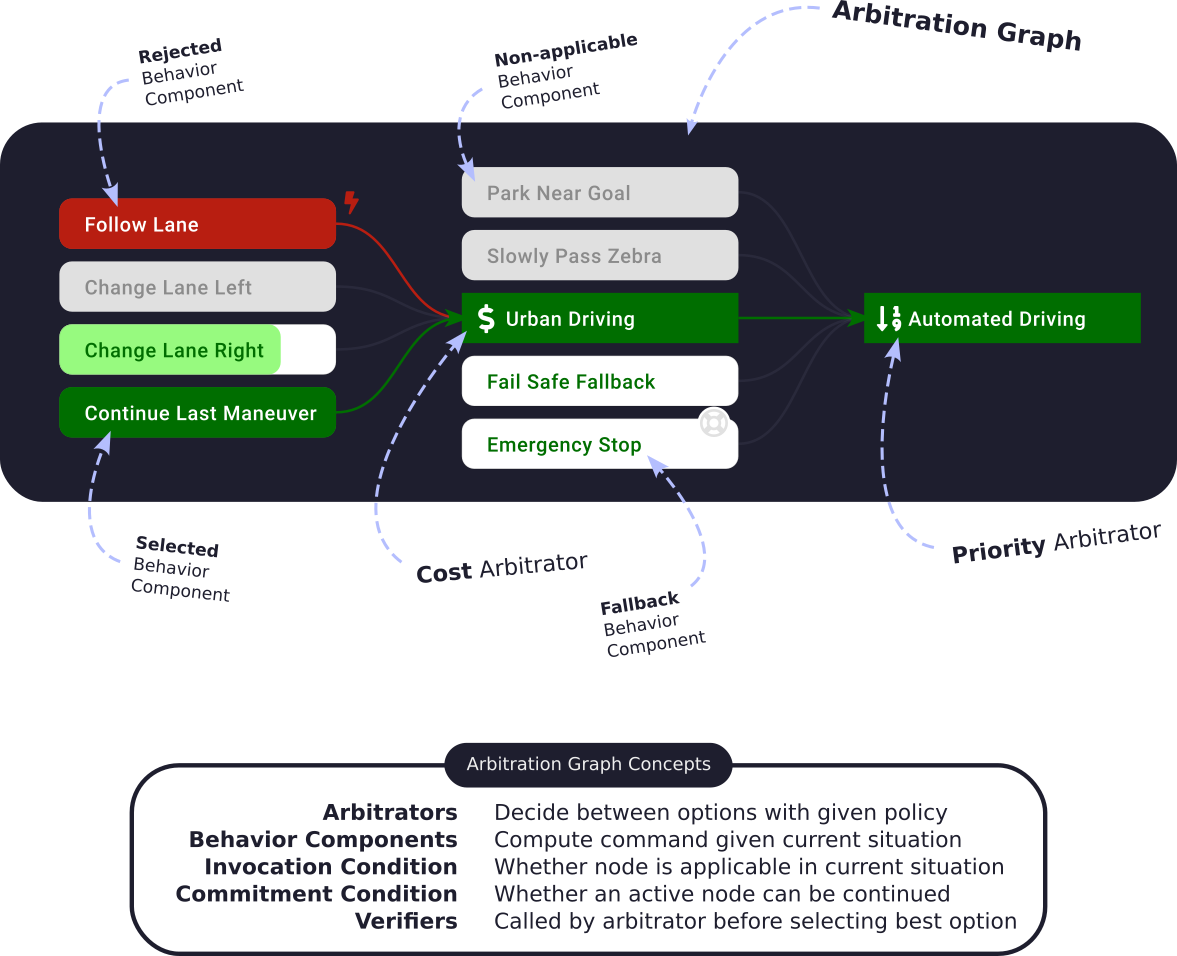
Arbitration Graphs break down complex decision-making into atomic behavior components and arbitrators.
Behavior components compute a command (e.g., a trajectory) based on the current state of the world. They define whether they can be executed in the current state using their invocation condition.
Arbitrators select the best option based on a defined decision-making policy. Options can be behavior components or nested arbitrators.
Verifiers check whether the command of a behavior component is safe and valid prior to being selected by an arbitrator.
Demo
We provide a demo of this library using Pac-Man as an example application.
The arbitration graph controls Pac-Man on its journey to collect tasty dots 🍬
Run the demo with:
git clone https://github.com/KIT-MRT/arbitration_graphs.git
cd arbitration_graphs/demo
docker compose up
Open the GUI with your favorite browser:
http://0.0.0.0:8080
Explanation
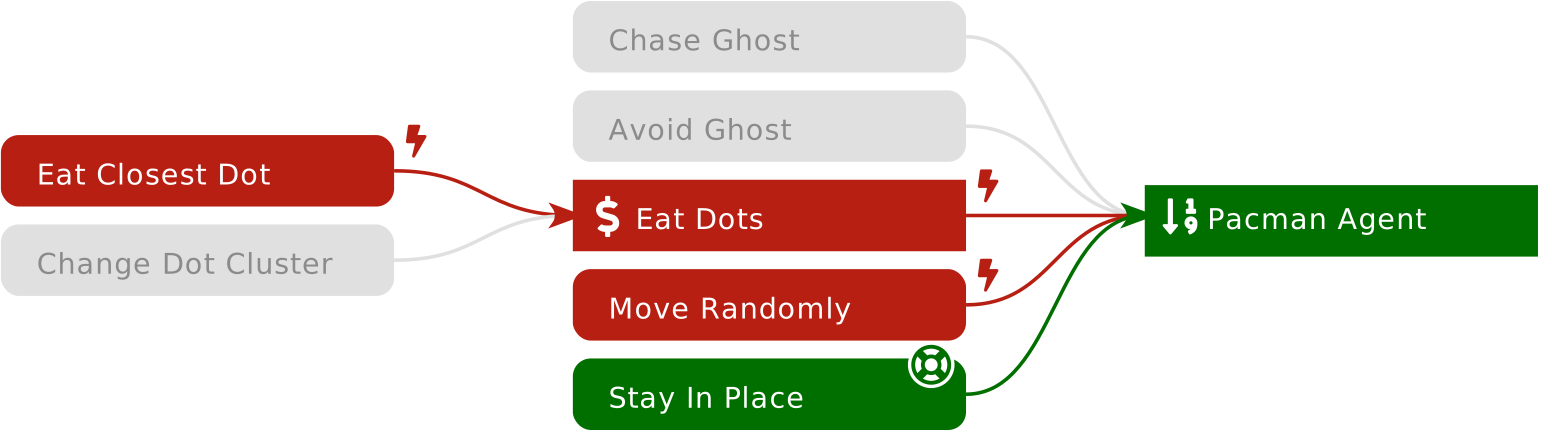
You will see the Pac-Man Agent arbitrator selecting between five behavior options (by priority).
The Eat Dots option is itself an arbitrator with two sub-behaviors (selecting by expected benefit).
In this scene,
- the Chase Ghost and Avoid Ghost behaviors are not applicable (no ghosts in close vicinity) → grey background,
- the Eat Closest Dot and Move Randomly behavior failed verification (our verification showcase) → red background,
- thus, the least-prioritized Stay in Place behavior is being executed → green background.

Installation
Note: We are currently working on a new major release of the library which will include some breaking changes. See the corresponding issue and pull request for details and the current status.
The Python interface to the arbitration graph library is generated using pybind11 and provides a convenient interface to utilize the full power of the arbitration graph library in Python.
Via PyPI (Recommended)
Even more good news: The package is available on PyPI, so installing it is as easy as running:
pip install arbitration-graphs
Note: The package requires Python 3.8 or higher and currently only supports a limited set of platforms. Let us know if you need support for an additional platform and we will see what we can do!
From Source
You can also build the package from source. Handy for development or if your target platform is currently not supported by the pre-built package.
Prerequisites
First make sure all dependencies are installed:
- The arbitration graph core library (see ../README.md)
- Python 3.8 or higher
- pybind11 >= 3.0.0
- ninja
See also the Dockerfile for how to install these packages under Debian or Ubuntu.
Via pip
# From local repository
git clone https://github.com/KIT-MRT/arbitration_graphs.git
cd arbitration_graphs/python_bindings
pip install .

# Or directly from GitHub
pip install git+https://github.com/KIT-MRT/arbitration_graphs.git#subdirectory=python_bindings
Via CMake
Clone the repository and build the package using CMake:
mkdir -p arbitration_graphs/python_bindings/build
cd arbitration_graphs/python_bindings/build
# Point to the pybind11 CMake configuration directory, if not installed globally (e.g., via pip in a virtual environment)
cmake -Dpybind11_DIR=$(pybind11-config --cmakedir) ..
cmake --build .
Development
Using Docker image
Clone the repository and run the development image
git clone https://github.com/KIT-MRT/arbitration_graphs.git
cd arbitration_graphs/python_bindings
docker compose build arbitration_graphs_pybind_devel
docker compose run --rm arbitration_graphs_pybind_devel
This mounts the source into the container's /home/blinky/arbitration_graphs folder.
There, you can edit the source code, compile and run the tests etc.
Running unit tests
This package includes unit tests analogous to the C++ tests. To run all tests, use the following command:
cd arbitration_graphs/python_bindings
python -m unittest discover
Contributors
This library and repo has been crafted with ❤️ by
Christoph Burger



Nick Le Large
Piotr Spieker
Christoph and Piotr coded the core in a pair-programming session. Piotr also contributed the GUI and GitHub Page. Nick implemented the awesome Pac-Man demo and tutorial, with drafting support by Christoph, reviews and finetuning by Piotr. The Python bindings have been contributed by Nick and reviewed by Piotr.
The repository is maintained by Piotr Spieker
Citation
If you use arbitration graphs in your research, we would be pleased if you cite our work:
Piotr Spieker, Nick Le Large, and Martin Lauer, “Better Safe Than Sorry: Enhancing Arbitration Graphs for Safe and Robust Autonomous Decision-Making,” Nov. 15, 2024, arXiv: arXiv:2411.10170. doi: 10.48550/arXiv.2411.10170.
@misc{spieker2024ArbitrationGraphs,
  title={Better Safe Than Sorry: Enhancing Arbitration Graphs for Safe and Robust Autonomous Decision-Making},
  author={Piotr Spieker and Nick Le Large and Martin Lauer},
  year={2024},
  eprint={2411.10170},
  eprinttype = {arXiv},
  archivePrefix={arXiv},
  primaryClass={cs.RO},
  doi = {10.48550/arXiv.2411.10170},
  url={https://arxiv.org/abs/2411.10170},
}
Earlier publications
Behavior Verification and Fallback Layers
A safety concept that extends Arbitration Graphs with behavior verification and fallback layers in the context of automated driving has been proposed by Piotr Spieker (née Orzechowski) in his PhD thesis. This served as the basis for the paper with Nick above.
Piotr F. Orzechowski, “Verhaltensentscheidung für automatisierte Fahrzeuge mittels Arbitrationsgraphen,” phd, Karlsruher Institut für Technologie (KIT), 2023. doi: 10.5445/IR/1000160638.
@thesis{Orzechowski2023Arbitrationsgraphen,
  type = {phdthesis},
  title = {Verhaltensentscheidung für automatisierte Fahrzeuge mittels Arbitrationsgraphen},
  author = {Orzechowski, Piotr Franciszek},
  date = {2023},
  institution = {Karlsruher Institut für Technologie (KIT)},
  doi = {10.5445/IR/1000160638},
  langid = {german},
  pagetotal = {169},
}
Replacing state machines in AV
Arbitration Graphs replaced state machines in the context of automated driving at the Institute of Measurement and Control Systems (MRT) of the Karlsruhe Institute of Technology (KIT):
Piotr F. Orzechowski, Christoph Burger, and Martin Lauer, “Decision-Making for Automated Vehicles Using a Hierarchical Behavior-Based Arbitration Scheme,” in Intelligent Vehicles Symposium, Las Vegas, NV, USA: IEEE, Oct. 2020, pp. 767–774. doi: 10.1109/IV47402.2020.9304723.
@inproceedings{orzechowski2020ArbitrationGraphs,
  title = {Decision-Making for Automated Vehicles Using a Hierarchical Behavior-Based Arbitration Scheme},
  booktitle = {Intelligent Vehicles Symposium},
  author = {Orzechowski, Piotr F. and Burger, Christoph and Lauer, Martin},
  date = {2020-10},
  pages = {767--774},
  publisher = {IEEE},
  location = {Las Vegas, NV, USA},
  issn = {2642-7214},
  doi = {10.1109/IV47402.2020.9304723},
}
Foundation work in Robot Soccer
The foundations for Arbitration Graphs have been proposed in the context of robot soccer:
Martin Lauer, Roland Hafner, Sascha Lange, and Martin Riedmiller, “Cognitive concepts in autonomous soccer playing robots,” Cognitive Systems Research, vol. 11, no. 3, pp. 287–309, 2010, doi: 10.1016/j.cogsys.2009.12.003.
@article{lauer2010CognitiveConceptsAutonomous,
  title = {Cognitive Concepts in Autonomous Soccer Playing Robots},
  author = {Lauer, Martin and Hafner, Roland and Lange, Sascha and Riedmiller, Martin},
  date = {2010},
  journaltitle = {Cognitive Systems Research},
  volume = {11},
  number = {3},
  pages = {287--309},
  doi = {10.1016/j.cogsys.2009.12.003},
}
1 maintainer

Download files
Download the file for your platform. If you're not sure which to choose, learn more about installing packages.
Source Distributions
Built Distributions
Filter files by name, interpreter, ABI, and platform.
If you're not sure about the file name format, learn more about wheel file names.
Copy a direct link to the current filters
File details
Details for the file arbitration_graphs-2.0.1-cp314-cp314t-manylinux_2_27_x86_64.manylinux_2_28_x86_64.whl.
File metadata
- Download URL: arbitration_graphs-2.0.1-cp314-cp314t-manylinux_2_27_x86_64.manylinux_2_28_x86_64.whl
- Upload date:
- Size: 589.2 kB
- Tags: CPython 3.14t, manylinux: glibc 2.27+ x86-64, manylinux: glibc 2.28+ x86-64
- Uploaded using Trusted Publishing? No
- Uploaded via: twine/6.2.0 CPython/3.12.3
File hashes
| Algorithm | Hash digest | |
|---|---|---|
| SHA256 |
93359a793c656fdfc86ac3b0b31d6c204f0d94eb48dc3f97748833dac16afdda
|
|
| MD5 |
4fbd375b93e0c114d22e56cc15de87d6
|
|
| BLAKE2b-256 |
5392b831f05bb782fd2203ca8bd0b111dae875607e5b55e0798468550b1e65e4
|
File details
Details for the file arbitration_graphs-2.0.1-cp314-cp314-manylinux_2_27_x86_64.manylinux_2_28_x86_64.whl.
File metadata
- Download URL: arbitration_graphs-2.0.1-cp314-cp314-manylinux_2_27_x86_64.manylinux_2_28_x86_64.whl
- Upload date:
- Size: 584.4 kB
- Tags: CPython 3.14, manylinux: glibc 2.27+ x86-64, manylinux: glibc 2.28+ x86-64
- Uploaded using Trusted Publishing? No
- Uploaded via: twine/6.2.0 CPython/3.12.3
File hashes
| Algorithm | Hash digest | |
|---|---|---|
| SHA256 |
3d5a645273e3d7afdbd9822683a570674397eed4868c2ad0228ee2ec63a1ca6a
|
|
| MD5 |
a8f03ffe38e6b124fb8e3fb4d56a6733
|
|
| BLAKE2b-256 |
d2ba7981f1b5edb961312640cd10c7195598f70d249241e81cb30a958b19c04a
|
File details
Details for the file arbitration_graphs-2.0.1-cp313-cp313-manylinux_2_27_x86_64.manylinux_2_28_x86_64.whl.
File metadata
- Download URL: arbitration_graphs-2.0.1-cp313-cp313-manylinux_2_27_x86_64.manylinux_2_28_x86_64.whl
- Upload date:
- Size: 584.3 kB
- Tags: CPython 3.13, manylinux: glibc 2.27+ x86-64, manylinux: glibc 2.28+ x86-64
- Uploaded using Trusted Publishing? No
- Uploaded via: twine/6.2.0 CPython/3.12.3
File hashes
| Algorithm | Hash digest | |
|---|---|---|
| SHA256 |
afc707851e2f1cbf75e72832c5ce95c6779c8d3c8221de6acaffa57b31d4d0c7
|
|
| MD5 |
5c760b20cca9d5dd383f2c99e3d3a5ef
|
|
| BLAKE2b-256 |
b52500048a9e11d6822bb538e7c34824942e86fef02528d5879cfb2b6acaf61e
|
File details
Details for the file arbitration_graphs-2.0.1-cp312-cp312-manylinux_2_27_x86_64.manylinux_2_28_x86_64.whl.
File metadata
- Download URL: arbitration_graphs-2.0.1-cp312-cp312-manylinux_2_27_x86_64.manylinux_2_28_x86_64.whl
- Upload date:
- Size: 584.5 kB
- Tags: CPython 3.12, manylinux: glibc 2.27+ x86-64, manylinux: glibc 2.28+ x86-64
- Uploaded using Trusted Publishing? No
- Uploaded via: twine/6.2.0 CPython/3.12.3
File hashes
| Algorithm | Hash digest | |
|---|---|---|
| SHA256 |
49e90246b424d45ecba43e89dcc89832b5e1815d640e31c9c035e2fe23c33ec4
|
|
| MD5 |
48ed2adc51762be9690c1fa8fa531695
|
|
| BLAKE2b-256 |
587f317f67ad228511404e9fa43655272ce307b9051ad0dfc1932ffd024eea72
|
File details
Details for the file arbitration_graphs-2.0.1-cp311-cp311-manylinux_2_27_x86_64.manylinux_2_28_x86_64.whl.
File metadata
- Download URL: arbitration_graphs-2.0.1-cp311-cp311-manylinux_2_27_x86_64.manylinux_2_28_x86_64.whl
- Upload date:
- Size: 577.4 kB
- Tags: CPython 3.11, manylinux: glibc 2.27+ x86-64, manylinux: glibc 2.28+ x86-64
- Uploaded using Trusted Publishing? No
- Uploaded via: twine/6.2.0 CPython/3.12.3
File hashes
| Algorithm | Hash digest | |
|---|---|---|
| SHA256 |
fb2efbae14c9c324b04411e6bf5995cf429353c25b447d2ca2073f9678764a97
|
|
| MD5 |
f2a1af9c07af7a49ea5698b7d2f85a70
|
|
| BLAKE2b-256 |
2e99f7299aa1bfd8b7450a1e2f8fdb5c00a3e85def76f5adc8fee6214587171f
|
File details
Details for the file arbitration_graphs-2.0.1-cp310-cp310-manylinux_2_27_x86_64.manylinux_2_28_x86_64.whl.
File metadata
- Download URL: arbitration_graphs-2.0.1-cp310-cp310-manylinux_2_27_x86_64.manylinux_2_28_x86_64.whl
- Upload date:
- Size: 575.5 kB
- Tags: CPython 3.10, manylinux: glibc 2.27+ x86-64, manylinux: glibc 2.28+ x86-64
- Uploaded using Trusted Publishing? No
- Uploaded via: twine/6.2.0 CPython/3.12.3
File hashes
| Algorithm | Hash digest | |
|---|---|---|
| SHA256 |
89ee62f14f9fe39c6181de3b77dda1ca1368afb49797e193cfac5bbefcca8225
|
|
| MD5 |
cebc533ded0b6d52a8289a45a80f7ed6
|
|
| BLAKE2b-256 |
50326bb3296e1d4078608fcb49461ddf8aa9990f319fbdec5fc438e26940ae3b
|
File details
Details for the file arbitration_graphs-2.0.1-cp39-cp39-manylinux_2_27_x86_64.manylinux_2_28_x86_64.whl.
File metadata
- Download URL: arbitration_graphs-2.0.1-cp39-cp39-manylinux_2_27_x86_64.manylinux_2_28_x86_64.whl
- Upload date:
- Size: 576.0 kB
- Tags: CPython 3.9, manylinux: glibc 2.27+ x86-64, manylinux: glibc 2.28+ x86-64
- Uploaded using Trusted Publishing? No
- Uploaded via: twine/6.2.0 CPython/3.12.3
File hashes
| Algorithm | Hash digest | |
|---|---|---|
| SHA256 |
24cdb0a8bfe612f4f52beafa917abaa27410414c6638eaa9ef65ef1f100f8f16
|
|
| MD5 |
1f4a2830600ad6bb560f224258e7ecd0
|
|
| BLAKE2b-256 |
055f224419eade9f71c64b9245ab2b381ce241d9bd20eb9f06cd8609c40dc7ff
|







