
Archkeel
The agent declares before it submits. The check is deterministic.


Archkeel checks architecture boundaries and declared changes in AI-assisted code. It compares an accepted commit with a candidate, checks their scans against the configured contract, and verifies that the candidate matches an expectation published before its first submission.
It catches two failure modes that finding-only diffs miss:
- the architecture changed without being declared;
- the scanner saw less of the program, so the result looks clean only because the graph became blinder.
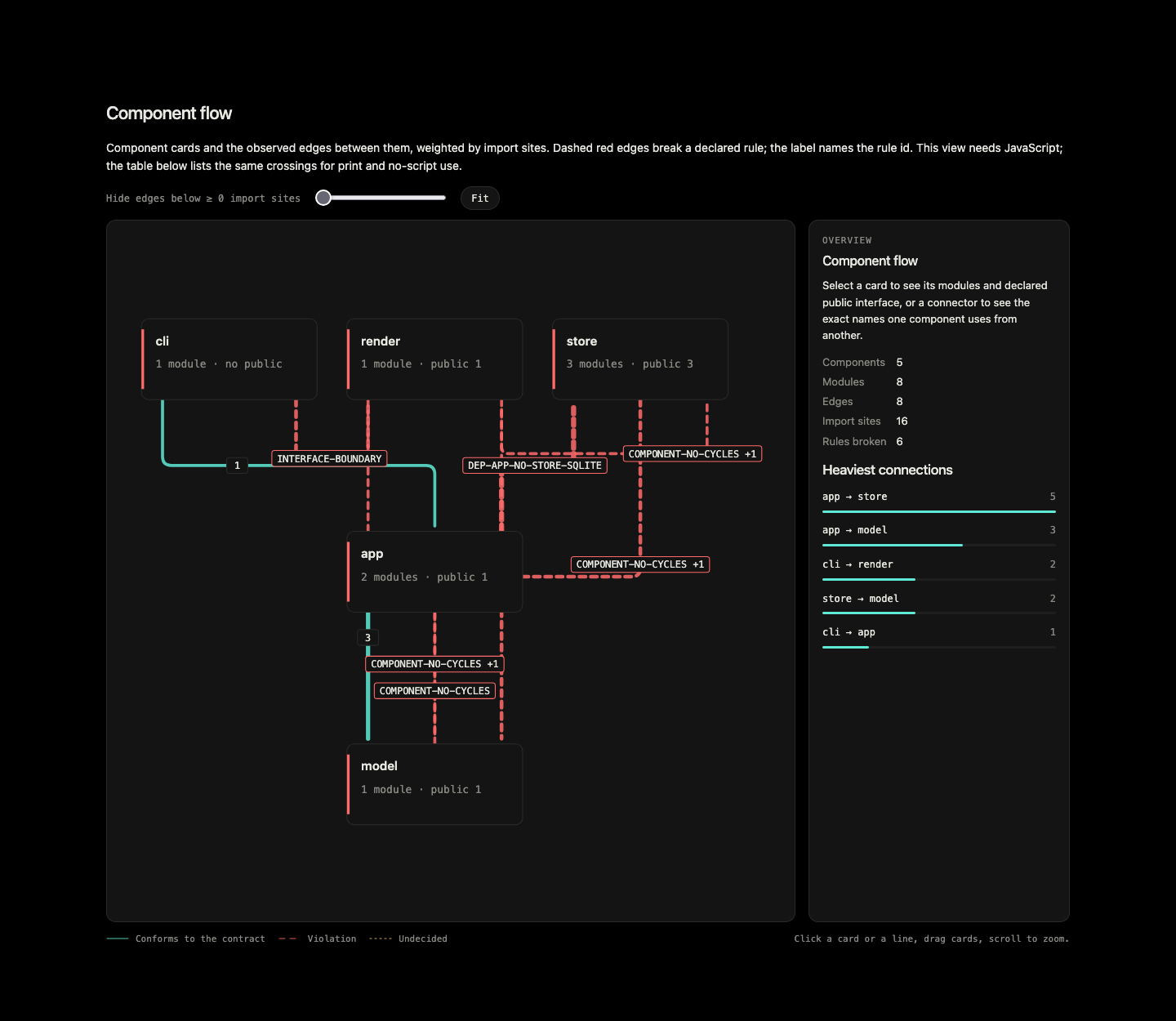
The component flow view of the HTML report (AD-10), from archkeel report on the tour
variant of fixtures/F-architecture: teal edges conform to the contract, dashed red edges
break the named rule, and dotted amber edges are still undecided.
Try the demo · Onboard your project · How it works · Reference · Roadmap
Implemented and planned work is tracked in the roadmap.
What it does, on one sample
Everything below runs on fixtures/F-architecture, a small shop with five components where
store is large enough to need an architecture of its own. make demo-onboarding replays the
whole loop in about a second, and a test pins every number on this page to what the commands
actually answer.
1. The agent drafts the target. It does not decide it.
archkeel init observes the packages and the imports, drafts one component per subpackage with
its public interface, and decides no dependency. The 20 ordered component pairs come back
as open decisions, heaviest first, each with the exact rule to choose from. validate then
refuses that draft — a contract nobody decided is not a target, and the gate stays shut until
the architect answers.
That is the split the whole tool rests on: the agent does the reading, the architect does the
deciding, and the file records which is which. Every rule carries decided_by, so a later
report counts what an agent decided and no human has reviewed.
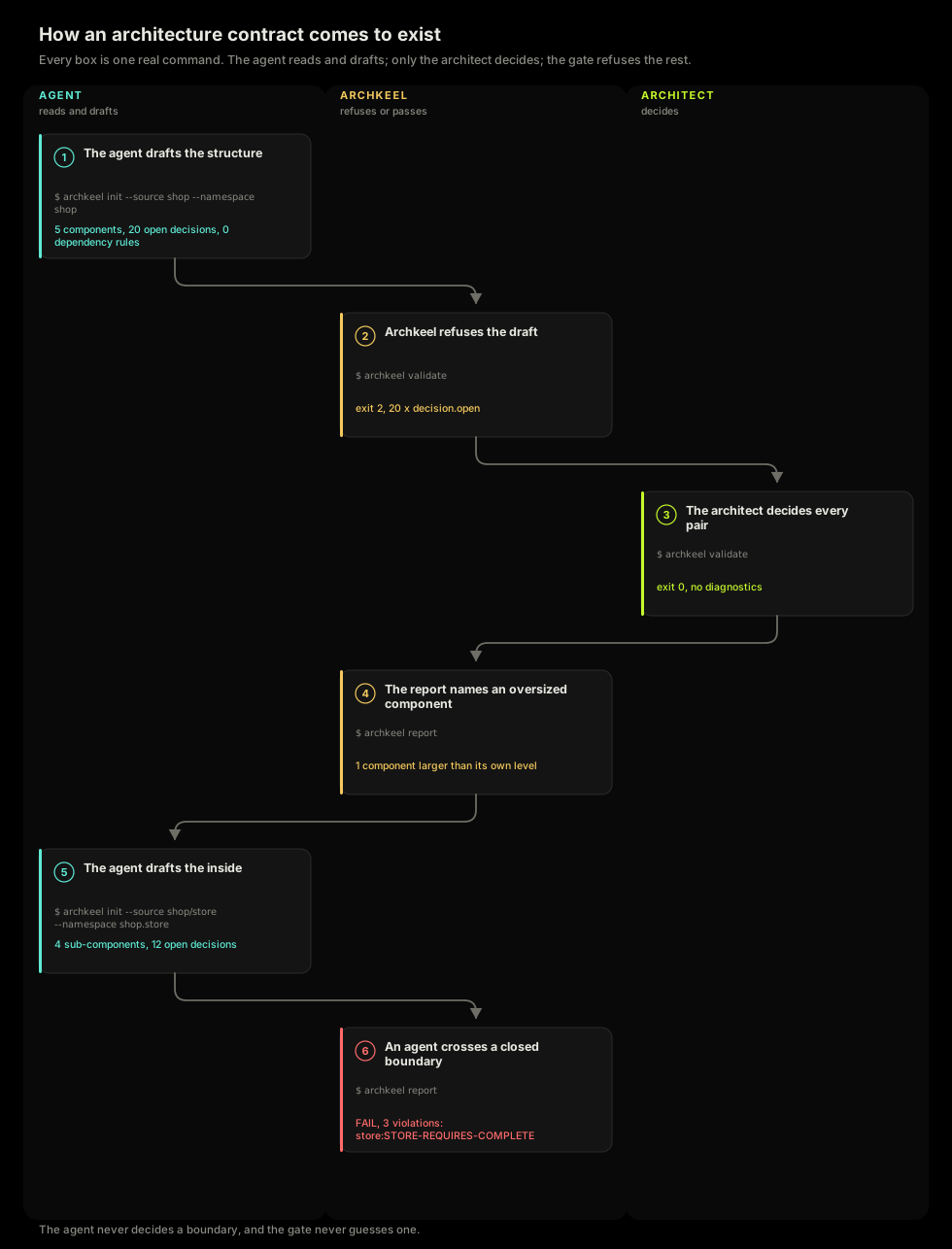
Drawn from the run itself, not by hand: a test renders the figure again from the same
values and compares it byte for byte, so a picture that disagrees with the tool is a failing
test. make demo-onboarding prints the same six steps with the reasoning under each.
2. A component that outgrows its level gets one of its own
The report names store: 7 modules where the whole level has 5 components. That is a claim,
never a verdict — a reason to ask, not permission to split. When the architect does open it,
init at the narrower scope drafts 4 sub-components and 12 more pair questions; the architect
settles them with 3 requires entries, because absence forbids. The two levels are then held
to one public surface, and the flow view opens the component into them.
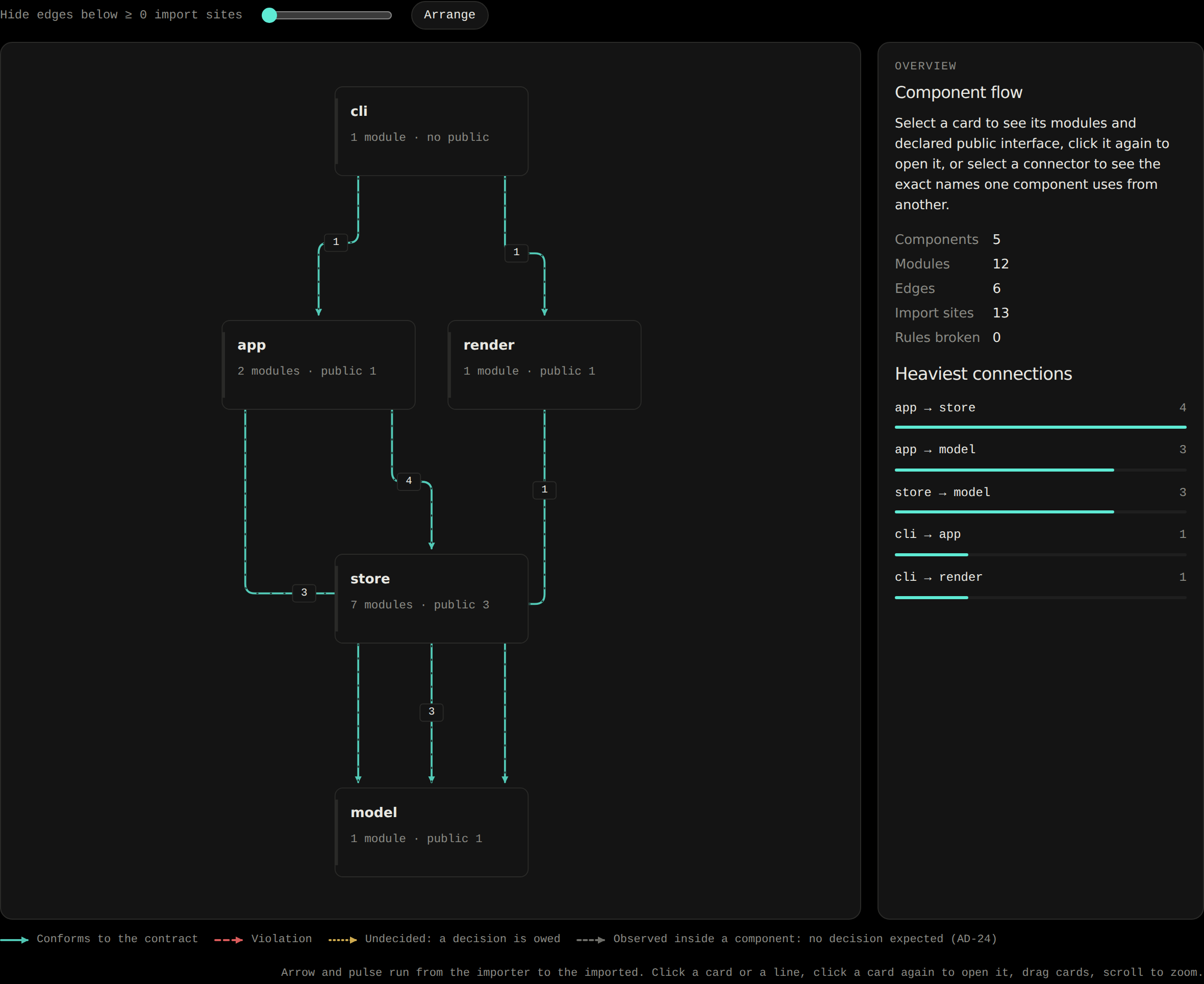
The five components. Every edge carries its import sites; teal means the contract allows it.
store shows 7 modules against a level of 5 components — that is the claim.
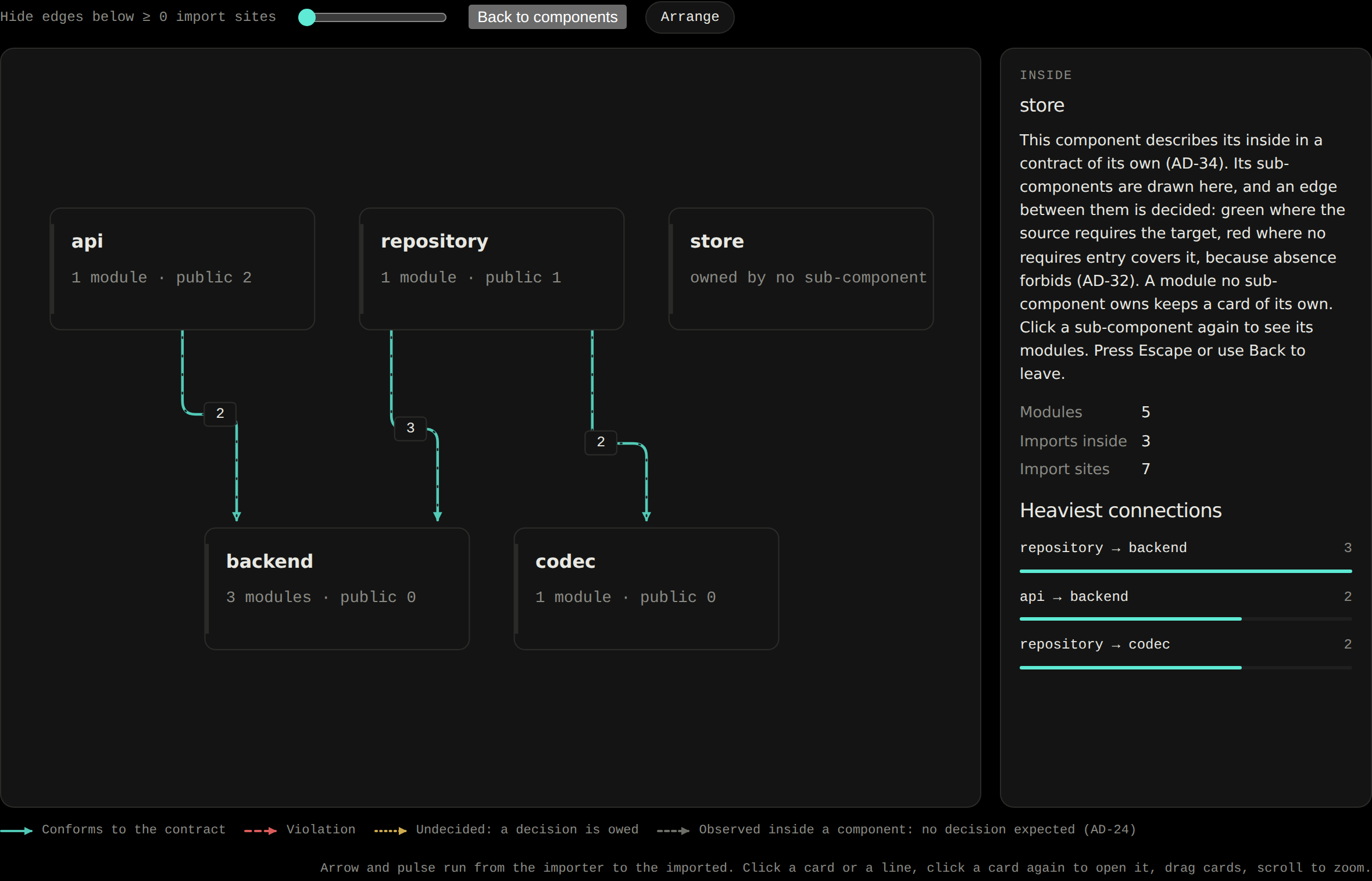
The same view after opening store: the level its own contract declares —
api, repository, codec, backend — with their
three crossings at 3, 2 and 2 import sites, and shop.store, the module no
sub-component owns, carried rather than dropped.
3. The gate names the boundary, the level and the fix
When an agent then imports across a boundary the architect closed, the finding is not a lint warning. It names the rule, the level that holds it and the importing module:
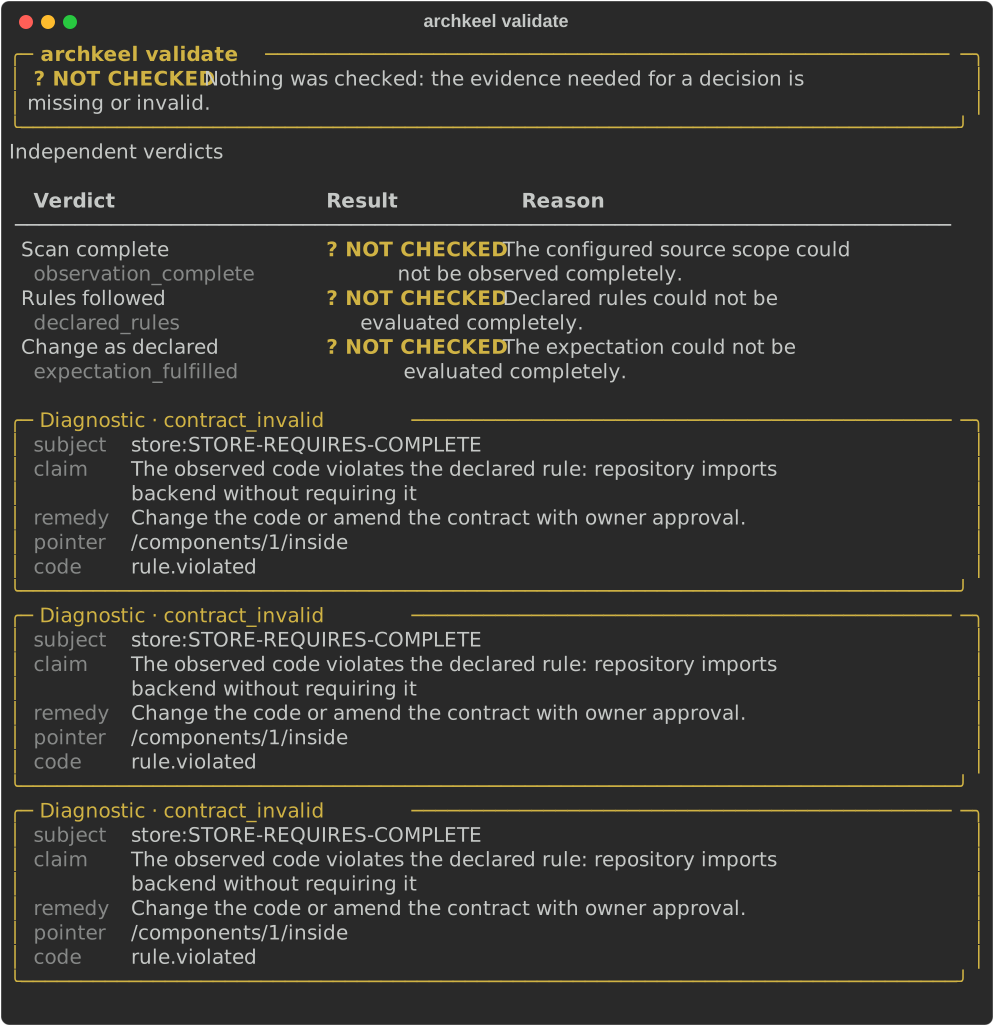
What each side gets out of it
| For the architect | The target is a file you own, not a description of the code. The distance between the two is measured, not argued. You decide once per pair and see every decision an agent made on your behalf. |
| For the agent | A boundary it can read before it writes, and a refusal it can act on: the rule id, the level that declares it, the importing module, and the contract to change. No taste, no review latency, no guessing which of ten findings matters. |
| For the review | Two failure modes a finding diff cannot see: architecture that changed without being declared, and a scan that got blinder so the result only looks clean. |
Why Archkeel
An agent can keep tests green and introduce no new architecture finding while making the code harder to analyze. If the gate compares finding identities only, that change passes.
Fixture A is the smallest example:
 def run(key: str) -> int:
-    return first() + second()
+    handlers = {"first": first, "second": second}
+    return handlers[key]()
The refactor introduces no new forbidden import, cycle, or private crossing. But static call resolution gets worse:
| Observation | Accepted | Candidate |
|---|---|---|
| Resolved calls | 2 of 2 | 0 of 1 |
| Unresolved calls | 0 | 1 |
| New finding fingerprints | 0 | 0 |
| Archkeel verdict | baseline | FAIL |
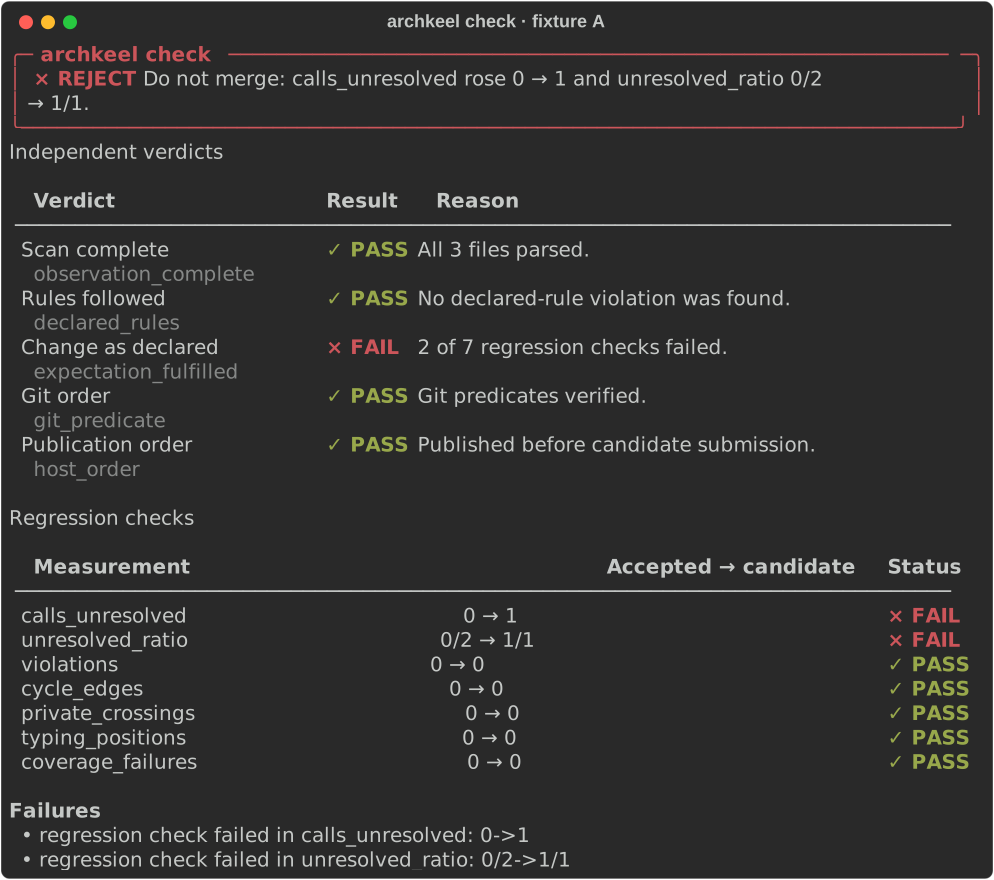
expectation_fulfilled: FAIL
regression check failed in calls_unresolved: 0->1
regression check failed in unresolved_ratio: 0/2->1/1
Archkeel compares raw measurements as well as finding counts and fingerprints. The ratio check uses integer cross-multiplication, never rounded percentages:
U_candidate × T_accepted <= U_accepted × T_candidate (when both T > 0)
What the gate adds
- Precommitment with evidence. The agent publishes the intended change before it submits the candidate. Git ancestry and host records prove the order; author timestamps do not.
- Coverage-aware regression checks. A disappearing edge is not mistaken for an improvement just because a finding disappeared with it.
- Explicit uncertainty. An incomplete scan, broken lock, empty scope, or
runtime mismatch returns exit
2with a diagnostic. Unknown never becomes green.
Archkeel complements tests, linters, and human review. It does not replace any of them. Its job is narrower: keep architecture changes declared, observable, and mechanically checkable.
Review surface
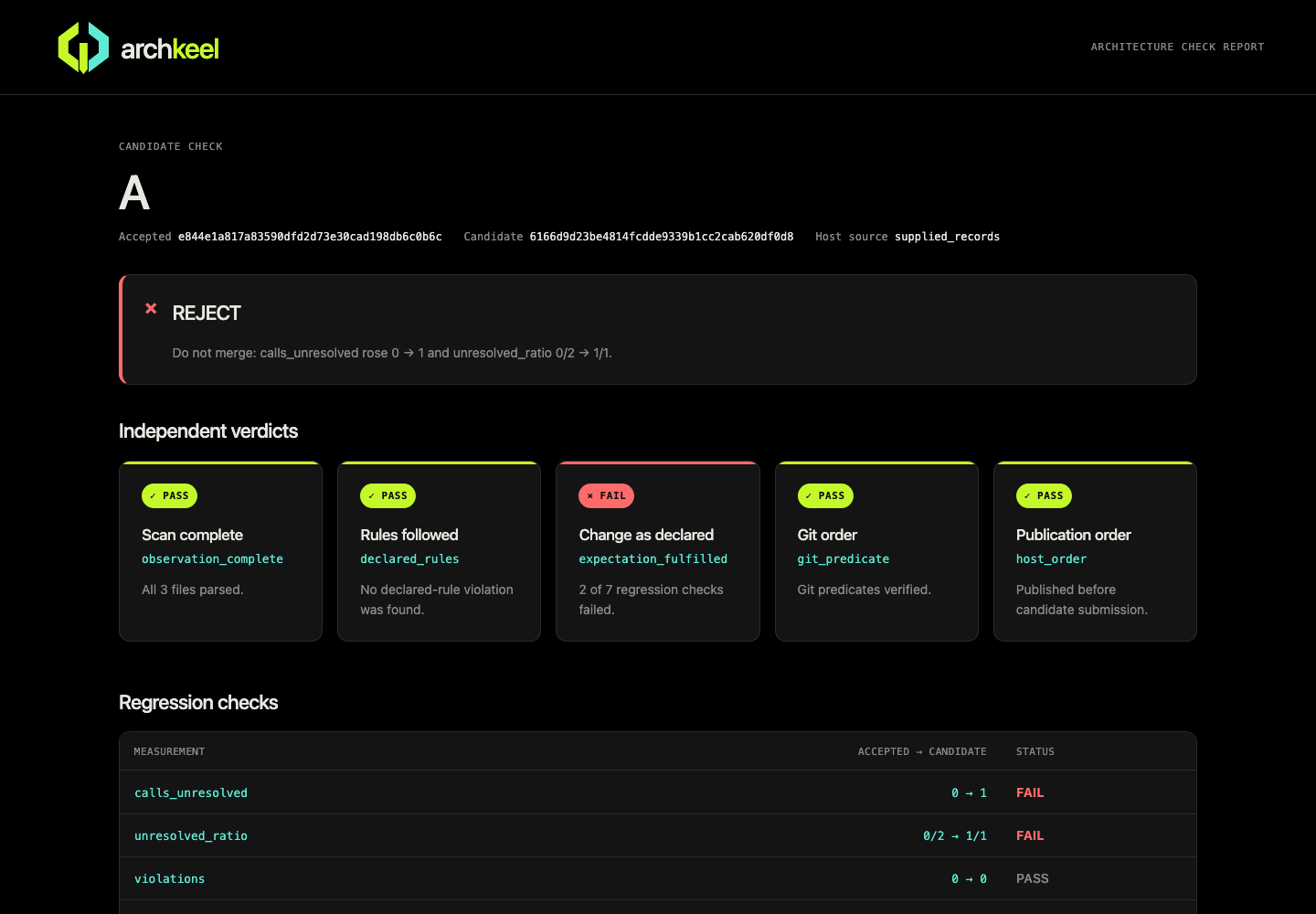
The HTML report is designed for a reviewer making a merge decision:
- Decision first.
PASS,REJECT, orNOT CHECKEDand one sentence explaining it are visible before details, in the HTML report and in the terminal. - No blended score. Scan completeness, contract compliance, expectation matching, Git order and publication order remain separate verdicts.
- Unknown stays visible. Missing or invalid evidence includes the affected subject, unknown claim, and remedy.
- Evidence stays inspectable. Exact counts, fingerprints, source locations, digests, and runtime provenance remain available beside the verdict.
- Claims are named, never gated on.
reportandvalidateprint what the four review claims found — on Archkeel itself 1 unreferenced symbol, 3 components larger than their level, 0 unread bindings, 0 repetitions — in the terminal and underclaimsin--json, while the HTML report lists the candidates. None of it reaches an exit code.
Try the demo
The demo builds three small Git repositories and runs the real checks. Fixture A is rejected because the call graph got blinder, Fixture B because its expectation was published too late, and Fixture C passes.
git clone https://github.com/rapiddweller/archkeel.git
cd archkeel
make demo
make demo-screenshots OUTPUT=<directory> also captures each HTML report as PNG and each
terminal view as SVG.
make demo-onboarding replays the loop from What it does, on one sample
on the two-level shop: what init drafts, what validate refuses, what the architect decides,
and what the gate says when an agent crosses a boundary inside the level.
make demo-onboarding
archkeel validate --root fixtures/F-architecture   # exit 0, both levels
archkeel report   --root fixtures/F-architecture   # PASS, 0 violations
Every violation the tool can find has a catalogued variant that produces it, listed in docs/architecture-demo.md.
Onboard your project
Requirements: Python 3.11+ and a Git repository with at least one commit.
uvx archkeel skill install claude    # or codex
uvx archkeel init
uvx archkeel validate
The contract is your target architecture, not a copy of the code. init observes the only
top-level package and writes archkeel.toml, architecture-contract.json and
docs/architecture/architecture.md: one component per subpackage, drafted public interfaces and
no dependency rule. Every ordered component pair is an open decision; init --json and
validate --json list them heaviest first, each with the exact allowed_dependency and
forbidden_dependency rule to choose from. The installed skill runs onboarding in one of two
modes: an interview, where the agent reads your ADRs and documents, recommends and asks only about
conflicts and gaps, or auto mode, where the agent decides. Every rule records decided_by, and
reports count the decisions the architect has not reviewed yet. The prompt is in
docs/onboarding.md; the
rule catalog is in docs/rules.md.
To install it permanently instead, run pip install archkeel. Every command explains itself
with archkeel <command> --help.
Quickstart
Observe the current repository:
archkeel report
The command writes the canonical architecture.json and a self-contained
architecture.report.html beside it. A terminal shows the decision and verdicts; pipes and
--json receive the JSON result.
Check a candidate against its published expectation:
archkeel check \
  --root /repo \
  --baseline "$B" \
  --expectation-commit "$E" \
  --head "$H" \
  --expected expectation.json \
  --expected-digest "$DIGEST" \
  --accepted-branch main \
  --branch candidate
Run the Python version required by the repository being scanned. A mismatch is
reported as runtime_mismatch with exit 2, not as broken source code.
How it works
flowchart TB
    B["Locked accepted state"] --> O["Observe accepted + candidate"]
    E["Expectation published first"] --> H["Candidate submitted"]
    H --> O
    O --> C{"Deterministic check"}
    C --> P["0 · pass"]
    C --> R["1 · reject"]
    C --> U["2 · unverifiable"]

    classDef locked fill:#141414,stroke:#C5F82A,color:#E8E8E2
    classDef declared fill:#141414,stroke:#5EEAD4,color:#E8E8E2
    classDef candidate fill:#141414,stroke:#8A8A84,color:#E8E8E2
    classDef gate fill:#C5F82A,stroke:#C5F82A,color:#0D1F05
    classDef result fill:#141414,stroke:#2A2A28,color:#E8E8E2

    class B locked
    class E declared
    class H,O candidate
    class C gate
    class P,R,U result
A check answers three independent questions. It never compresses them into a single score.
| Verdict | Question | Typical failure |
|---|---|---|
observation_complete |
Did the scan see everything it claims to see? | Incomplete scan, empty scope, rule without subjects |
declared_rules |
Does the code obey the architecture contract? | Forbidden import between components |
expectation_fulfilled |
Did the candidate match the declaration without regressions? | Coverage regression, undeclared change, late expectation |
Exit codes
| Exit | Meaning |
|---|---|
0 |
Complete report or successful check |
1 |
Rejected because at least one verdict is FAIL |
2 |
Unverifiable input, always with at least one diagnostic |
Every exit 2 diagnostic contains:
kind · subject · unknown_claim · remedy
A broken lock is therefore not interpreted as an empty accepted state.
The M → B → E → H protocol
gitGraph
    commit id: "M · accepted"
    commit id: "B · lock only"
    branch candidate
    commit id: "E · expectation only"
    commit id: "H · implementation"
| Commit | Contract |
|---|---|
| M | Accepted state. Archkeel re-observes it. |
| B | Lock-only child of M and tip of the accepted branch. It binds the config, checker, and observation digests. |
| E | Child of B that changes only the expectation file. It must be published before the first submission of H. |
| H | Descendant of E. It must not modify the lock, config, architecture contract, or expectation. |
Agent workflow
- Start from the lock commit B.
- Write the intended architecture change and commit it alone as E.
- Publish E before submitting implementation work.
- Implement the change in one or more commits ending at H.
- Run
archkeel check. Fix the code or revise the proposal in a new protocol cycle; do not rewrite protected inputs inside H.
Fixture B writes its expectation after implementation by deriving it from the observed delta. Its architecture findings are otherwise clean. Archkeel still rejects it:
host_order: FAIL
expectation_fulfilled: FAIL
expectation was not published before the first candidate submission
Precommitment proves "published before submission." It does not prove that no private edit existed before publication.
Host evidence
In GitLab CI, Archkeel reads merge-request diff versions through glab to
establish publication order.
For local testing, replay captured host records:
uv run archkeel check ... --host-records records.json
A local replay validates the record shape and behavior. It does not prove host authenticity.
Development
Run the complete project gate:
make check
This runs Ruff, strict mypy, pytest, and Archkeel's self-check.
Run the full release check, build both distributions, and install each one in isolation:
make release-check
Reproduce the protocol fixtures:
make fixtures
Archkeel checks itself
architecture-contract.json holds Archkeel to the rules it sells, and every rule was proven by a deliberate violation:
- Every pair decided. Six components, so 30 ordered pairs, decided by eight
requiresentries and onecomplete_requiresrule: a pair no entry names is forbidden, not open. All 25 rules carry a rationale and are decided by the architect. The architecture guide names the quality goal each required edge serves. - Deterministic core.
irandchecknever import adapters or presentation; the CLI is the composition root. The analyzer may import onlyarchkeel.ir.modelandarchkeel.ir.codec. - No dynamic shortcuts.
getattr,hasattr,cast,eval,exec, dynamic imports andtype: ignoreare forbidden everywhere. - Confined dependencies.
packagingonly in the analyzer runtime gate,richonly in the terminal view,rich_argparseonly in the CLI. - Complete and acyclic. Every module belongs to exactly one component, and components form no cycle.
- A second level where one was owed.
checkholds 13 modules and 23 imports between them, more than the whole top level holds, so it declares a contract of its own:entry,policyandfoundation, whose crossings itsrequiresentries cover at 21, 6 and 2 import sites. The flow view opens it as a level of its own, and the one module no sub-component owns keeps a card of its own.
make check reobserves the repository and compares it with
fixtures/D-self: the
canonical model in architecture.json, the digests in provenance.json, and the verdicts
report printed in result.json. CI also runs archkeel validate and uploads the
self-observation.
Current boundaries
Archkeel is deliberately strict about what it can prove:
- Competing implementations: review is still required when no declared rule or observed regression exposes them.
- Private crossings: only import records are checked.
import pkg; pkg._memberis not detected. - Precommitment: publication order is proven; private editing order is not.
- Analyzer runtime: Archkeel's Python must be at least the target repository's Python.
- Onboarding:
initdetects one top-level package; other layouts need--sourceand--namespace. It never decides a dependency; the architect or, in auto mode, the agent does, anddecided_bykeeps the difference visible. - Static observation: runtime behavior, data flow and performance are not observed; see docs/known-limits.md.
Roadmap
Completed work and the ordered UI, CI and release plan live in docs/roadmap.md. Items remain planned until their listed evidence exists.
License
MIT © 2026 Rapiddweller Asia Co., Ltd.
Maintained by Alexander Kell.
1 maintainer

Release files for archkeel 0.4.1
For a detailed explanation of source distributions (sdists) and built distributions (wheels), please see the package formats documentation.
Source distribution (sdist)
| File | Size | Uploaded | |
|---|---|---|---|
| archkeel-0.4.1.tar.gz | 1.5 MB | Details |
Built distribution (wheel)
| File | Interpreter | ABI | Platform | Reset |
|---|---|---|---|---|
| archkeel-0.4.1-py3-none-any.whl | Python 3 | none | any | Details |
Total release size: 1.7 MB
Release files / archkeel-0.4.1.tar.gz
| Download URL | archkeel-0.4.1.tar.gz |
|---|---|
| Size | 1.5 MB |
| Tags | Source |
|
SHA-256 checksum How to use checksums |
67d94dc93e2534cfb334e714b557f8c53d190d7fad0e4cc5fba60e31a4be9eb9
|
|
BLAKE2b-256 checksum How to use checksums |
4feb3769357e553f7a516c3f13d97ed5f65466513a241e2c3884887fd1fdb32d
|
| Upload date | |
|
Uploaded using Trusted Publishing? What is trusted publishing? |
Yes |
| Uploaded via |
uv/0.12.13 {"installer":{"name":"uv","version":"0.12.13","subcommand":["publish"]},"python":null,"implementation":{"name":null,"version":null},"distro":{"name":"Ubuntu","version":"24.04","id":"noble","libc":null},"system":{"name":null,"release":null},"cpu":null,"openssl_version":null,"setuptools_version":null,"rustc_version":null,"ci":true}
|
Provenance
Provenance describes where a file came from. On PyPI, provenance is shared via attestations, which provide a verifiable record of the build or publishing details. View details, limitations and caveats.


PyPI Publish Attestation
PyPI verified that this artifact, at this checksum, originated from the publisher listed below.
Signed by GitHub Actions, verified by PyPI on Sep 18, 2026.
Transparency logRelease files / archkeel-0.4.1-py3-none-any.whl
| Download URL | archkeel-0.4.1-py3-none-any.whl |
|---|---|
| Size | 192.4 kB |
| Tags | Python 3 |
|
SHA-256 checksum How to use checksums |
2099f6843bc5c84b2670837d8b12f1a27465e33e4c5091caf78abccee9a464ee
|
|
BLAKE2b-256 checksum How to use checksums |
4138c3005c4068e29b4bb442b3a6b267d9c4f5d9701564372d4cd58d25f56326
|
| Upload date | |
|
Uploaded using Trusted Publishing? What is trusted publishing? |
Yes |
| Uploaded via |
uv/0.12.13 {"installer":{"name":"uv","version":"0.12.13","subcommand":["publish"]},"python":null,"implementation":{"name":null,"version":null},"distro":{"name":"Ubuntu","version":"24.04","id":"noble","libc":null},"system":{"name":null,"release":null},"cpu":null,"openssl_version":null,"setuptools_version":null,"rustc_version":null,"ci":true}
|
Provenance
Provenance describes where a file came from. On PyPI, provenance is shared via attestations, which provide a verifiable record of the build or publishing details. View details, limitations and caveats.
PyPI Publish Attestation
PyPI verified that this artifact, at this checksum, originated from the publisher listed below.
Signed by GitHub Actions, verified by PyPI on Sep 18, 2026.
Transparency log













