
ArchUnitPython - Architecture Testing






Enforce architecture rules in Python projects. Check for dependency directions, detect circular dependencies, enforce coding standards and much more. Integrates with pytest and any other testing framework. Very simple setup and pipeline integration. Zero runtime dependencies.
The #1 ArchUnit-style architecture testing library for Python, measured by GitHub stars.
Inspired by the amazing ArchUnit library but we are not affiliated with ArchUnit.
Setup • Use Cases • Features • Why ArchUnitPython? • Sponsor • Contributing
⚡ 5 min Quickstart
Installation
pip install archunitpython
Add tests
Simply add tests to your existing test suites. The following is an example using pytest. First we ensure that we have no circular dependencies.
from archunitpython import project_files, metrics, assert_passes

def test_no_circular_dependencies():
    rule = project_files("src/").in_folder("src/**").should().have_no_cycles()
    assert_passes(rule)
Next we ensure that our layered architecture is respected.
def test_presentation_should_not_depend_on_database():
    rule = (
        project_files("src/")
        .in_folder("**/presentation/**")
        .should_not()
        .depend_on_files()
        .in_folder("**/database/**")
    )
    assert_passes(rule)

def test_business_should_not_depend_on_database():
    rule = (
        project_files("src/")
        .in_folder("**/business/**")
        .should_not()
        .depend_on_files()
        .in_folder("**/database/**")
    )
    assert_passes(rule)

# More layers ...
Lastly we ensure that some code metric rules are met.
def test_no_large_files():
    rule = metrics("src/").count().lines_of_code().should_be_below(1000)
    assert_passes(rule)

def test_high_cohesion():
    # LCOM metric (lack of cohesion of methods), low = high cohesion
    rule = metrics("src/").lcom().lcom96b().should_be_below(0.3)
    assert_passes(rule)
CI Integration
These tests run automatically in your testing setup, for example in your CI pipeline, so that's basically it. This setup ensures that the architectural rules you have defined are always adhered to!
# GitHub Actions
- name: Run Architecture Tests
  run: pytest tests/test_architecture.py -v
You can also export dependency graph reports as CI artifacts:
from archunitpython import project_graph

def test_generate_dependency_graph_reports():
    graph = project_graph("src/").titled("Application Architecture")

    graph.collapse_to_folder_depth(2).export_as_html(
        "reports/dependency-graph.html"
    )
    graph.export_as_mermaid("reports/dependency-graph.mmd")

    assert graph.snapshot().summary.node_count >= 0
🚐 Setup
Installation:
pip install archunitpython
That's it. Works with pytest, unittest, or any Python testing framework.
pytest (Recommended)
Use assert_passes() for clean assertion messages:
from archunitpython import project_files, assert_passes

def test_my_architecture():
    rule = project_files("src/").should().have_no_cycles()
    assert_passes(rule)
Any Other Framework
Use .check() directly and assert on the violations list:
from archunitpython import project_files

rule = project_files("src/").should().have_no_cycles()
violations = rule.check()
assert len(violations) == 0
Configuration Options
Both assert_passes() and .check() accept configuration options:
from archunitpython import CheckOptions

options = CheckOptions(
    allow_empty_tests=True,  # Don't fail when no files match
    clear_cache=True,        # Clear the graph cache
    ignore_type_checking_imports=True,  # Ignore imports inside if TYPE_CHECKING
)

violations = rule.check(options)
Excluding Files With .archignore
Add a .archignore file to your project root to permanently exclude generated or
irrelevant files from architecture checks and file-based metrics:
# Generated code
generated/

# Migration scripts
migrations/*.py

# A single root-level file
/legacy_adapter.py
Patterns support comments, blank lines, glob syntax, root-relative paths, path
patterns, and directory patterns with a trailing /.
Loading Common Rules From Config
For straightforward shared rules, you can load a JSON config file and still run the resulting rules in your normal test suite:
{
  "project_path": "src",
  "rules": [
    {
      "name": "controllers must not use services directly",
      "type": "forbidden_dependency",
      "source": "**/controllers/**",
      "target": "**/services/**"
    },
    {
      "name": "source files have no cycles",
      "type": "no_cycles"
    }
  ]
}
from archunitpython import assert_passes, rules_from_config

def test_configured_architecture_rules():
    for rule in rules_from_config("archunitpython.json"):
        assert_passes(rule)
Supported rule types are no_cycles, forbidden_dependency, and
forbidden_external_dependency. The fluent Python API remains the primary and
most flexible interface.
Explaining Rules With .because(...)
Attach a rationale to a rule so failing assertions explain why the rule exists:
rule = (
    project_files("src/")
    .in_folder("**/controllers/**")
    .should_not()
    .depend_on_files()
    .in_folder("**/database/**")
    .because("controllers should stay thin and delegate persistence")
)

assert_passes(rule)
When the rule fails, the rationale is included in the assertion message.
🐹 Use Cases
Here is an overview of common use cases.
Layered Architecture:
Enforce that higher layers don't depend on lower layers and vice versa.
Clean Architecture / Hexagonal:
Validate that domain logic doesn't depend on infrastructure.
Microservices / Modular:
Ensure services/modules don't have forbidden cross-dependencies.
🐲 Example Repository
Here is a repository with a fully functioning example that uses ArchUnitPython to ensure architectural rules:
- RAG Pipeline Test Showcase: A test showcase demonstrating ArchUnitPython's architecture testing capabilities on a RAG pipeline
🐣 Features
This is an overview of what you can do with ArchUnitPython.
Circular Dependencies
def test_services_cycle_free():
    rule = project_files("src/").in_folder("**/services/**").should().have_no_cycles()
    assert_passes(rule)
Layer Dependencies
def test_clean_architecture_layers():
    rule = (
        project_files("src/")
        .in_folder("**/presentation/**")
        .should_not()
        .depend_on_files()
        .in_folder("**/database/**")
    )
    assert_passes(rule)

def test_business_not_depend_on_presentation():
    rule = (
        project_files("src/")
        .in_folder("**/business/**")
        .should_not()
        .depend_on_files()
        .in_folder("**/presentation/**")
    )
    assert_passes(rule)
Named Layer Rules
from archunitpython import project_layers

def test_clean_architecture_layers():
    rule = (
        project_layers("src/")
        .layer("presentation").defined_by_folder("**/presentation/**")
        .layer("business").defined_by_folder("**/business/**")
        .layer("database").defined_by_folder("**/database/**")
        .where_layer("presentation")
        .may_only_depend_on_layers("business")
        .where_layer("business")
        .may_only_depend_on_layers()
        .where_layer("database")
        .may_only_depend_on_layers()
    )
    assert_passes(rule)
External Dependencies
def test_domain_does_not_import_requests():
    rule = (
        project_files("src/")
        .in_folder("**/domain/**")
        .should_not()
        .depend_on_external_modules()
        .matching("requests")
    )
    assert_passes(rule)
TYPE_CHECKING-aware Analysis
from archunitpython import CheckOptions

def test_type_only_dependencies_do_not_count_as_runtime_coupling():
    rule = (
        project_files("src/")
        .in_folder("**/api/**")
        .should_not()
        .depend_on_files()
        .in_folder("**/infrastructure/**")
    )
    assert_passes(rule, CheckOptions(ignore_type_checking_imports=True))
Dynamic Imports and Ignore Directives
ArchUnitPython detects string-based dynamic imports such as importlib.import_module("my_app.adapters.sql") and __import__("my_app.adapters.sql"). For known migration shims, you can suppress one import edge locally:
from my_app.adapters.sql import Repository # archunit: ignore
Naming Conventions
def test_naming_patterns():
    rule = (
        project_files("src/")
        .in_folder("**/services/**")
        .should()
        .have_name("*_service.py")
    )
    assert_passes(rule)
Code Metrics
def test_no_large_files():
    rule = metrics("src/").count().lines_of_code().should_be_below(1000)
    assert_passes(rule)

def test_high_class_cohesion():
    rule = metrics("src/").lcom().lcom96b().should_be_below(0.3)
    assert_passes(rule)

def test_method_count():
    rule = metrics("src/").count().method_count().should_be_below(20)
    assert_passes(rule)

def test_field_count_for_data_classes():
    rule = (
        metrics("src/")
        .for_classes_matching("*Data*")
        .count()
        .field_count()
        .should_be(3)
    )
    assert_passes(rule)
Distance Metrics
def test_proper_coupling():
    rule = metrics("src/").distance().distance_from_main_sequence().should_be_below(0.3)
    assert_passes(rule)

def test_not_in_zone_of_pain():
    rule = metrics("src/").distance().not_in_zone_of_pain()
    assert_passes(rule)
Custom Rules
You can define your own custom rules.
rule_desc = "Python files should have docstrings"

def has_docstring(file):
    return '"""' in file.content or "'''" in file.content

violations = (
    project_files("src/")
    .with_name("*.py")
    .should()
    .adhere_to(has_docstring, rule_desc)
    .check()
)

assert len(violations) == 0
Custom Metrics
You can define your own metrics as well.
def test_method_field_ratio():
    rule = (
        metrics("src/")
        .custom_metric(
            "methodFieldRatio",
            "Ratio of methods to fields",
            lambda ci: len(ci.methods) / max(len(ci.fields), 1),
        )
        .should_be_below(10)
    )
    assert_passes(rule)
Architecture Slices
import re
from archunitpython import project_slices

def test_adhere_to_diagram():
    diagram = """
@startuml
  component [controllers]
  component [services]
  [controllers] --> [services]
@enduml"""

    rule = (
        project_slices("src/")
        .defined_by_regex(re.compile(r"/([^/]+)/[^/]+\.py$"))
        .should()
        .adhere_to_diagram(diagram)
    )
    assert_passes(rule)

def test_no_forbidden_dependency():
    rule = (
        project_slices("src/")
        .defined_by("src/(**)/**")
        .should_not()
        .contain_dependency("services", "controllers")
    )
    assert_passes(rule)
Dependency Graph Reports
Generate dependency graph reports in multiple formats and narrow them to the part of the codebase you want to inspect.
Using requests library repo for example
from archunitpython import project_graph

def test_export_dependency_graph_reports():
    graph = project_graph("src/requests").titled("Application Architecture")

    graph.collapse_to_folder_depth(2).export_as_mermaid("reports/dependencies.md")

if __name__ == "__main__":
    test_export_dependency_graph_reports()
Exported mermaid diagram
flowchart LR
  n0["__init__.py"]
  n1["__version__.py"]
  n2["_internal_utils.py"]
  n3["_types.py"]
  n4["adapters.py"]
  n5["api.py"]
  n6["auth.py"]
  n7["certs.py"]
  n8["compat.py"]
  n9["cookies.py"]
  n10["exceptions.py"]
  n11["help.py"]
  n12["hooks.py"]
  n13["models.py"]
  n14["packages.py"]
  n15["sessions.py"]
  n16["status_codes.py"]
  n17["structures.py"]
  n18["utils.py"]
  n0 --> n1
  n0 --> n5
  n0 --> n10
  n0 --> n13
  n0 --> n15
  n0 --> n16
  n2 --> n8
  n3 --> n6
  n3 --> n9
  n3 --> n13
  n3 --> n17
  n4 --> n0
  n4 --> n3
  n4 --> n6
  n4 --> n8
  n4 --> n9
  n4 --> n10
  n4 --> n13
  n4 --> n17
  n4 --> n18
  n5 --> n0
  n5 --> n13
  n6 --> n2
  n6 --> n8
  n6 --> n9
  n6 --> n13
  n6 --> n18
  n9 --> n2
  n9 --> n3
  n9 --> n8
  n9 --> n13
  n10 --> n8
  n10 --> n13
  n11 --> n0
  n12 --> n0
  n12 --> n13
  n13 --> n0
  n13 --> n2
  n13 --> n4
  n13 --> n6
  n13 --> n8
  n13 --> n9
  n13 --> n10
  n13 --> n12
  n13 --> n16
  n13 --> n17
  n13 --> n18
  n14 --> n8
  n15 --> n0
  n15 --> n2
  n15 --> n3
  n15 --> n4
  n15 --> n6
  n15 --> n8
  n15 --> n9
  n15 --> n10
  n15 --> n12
  n15 --> n13
  n15 --> n16
  n15 --> n17
  n15 --> n18
  n16 --> n17
  n17 --> n8
  n18 --> n0
  n18 --> n1
  n18 --> n2
  n18 --> n3
  n18 --> n8
  n18 --> n9
  n18 --> n10
  n18 --> n13
  n18 --> n17
Supported formats:
- DOT (
export_as_dot,to_dot) - Mermaid (
export_as_mermaid,to_mermaid) - D2 (
export_as_d2,to_d2) - CSV (
export_as_csv,to_csv) - JSON (
export_as_json,to_json) - HTML (
export_as_html,to_html)
Graph exploration options:
focus_on(pattern, depth)keeps matching files and their neighbors.reachable_from(pattern)keeps matching files and their transitive dependencies.dependents_of(pattern)keeps files that transitively depend on the matching files.collapse_to_folder_depth(depth)aggregates files to folder-level graph nodes.collapse_by_pattern(pattern, replacement)maps files to custom graph nodes.include_external_dependencies()includes imports to external modules such asrequestsorsqlalchemy.include_self_dependencies()keeps self edges that are normally hidden in reports.
When you create reports through project_graph("src/"), internal file paths are displayed relative to that project root so the output stays readable.
Reports
Generate HTML reports for your metrics. Note that this feature is in beta.
from archunitpython.metrics.fluentapi.export_utils import MetricsExporter, ExportOptions

MetricsExporter.export_as_html(
    {"MethodCount": 5, "FieldCount": 3, "LinesOfCode": 150},
    ExportOptions(
        output_path="reports/metrics.html",
        title="Architecture Metrics Dashboard",
    ),
)
🔎 Pattern Matching System
We offer three targeting options for pattern matching across all modules:
with_name(pattern)- Pattern is checked against the filename (e.g.service.pyfromsrc/services/service.py)in_path(pattern)- Pattern is checked against the full relative path (e.g.src/services/service.py)in_folder(pattern)- Pattern is checked against the path without filename (e.g.src/servicesfromsrc/services/service.py)
For the metrics module there is an additional one:
for_classes_matching(pattern)- Pattern is checked against class names. The filepath or filename does not matter here
Pattern Types
We support string patterns and regular expressions. String patterns support glob.
# String patterns with glob support (case sensitive)
.with_name("*_service.py")       # All files ending with _service.py
.in_folder("**/services")        # All files in any services folder
.in_path("src/api/**/*.py")      # All Python files under src/api

# Regular expressions
import re
.with_name(re.compile(r".*Service\.py$"))
.in_folder(re.compile(r"services$"))

# For metrics module: Class name matching
.for_classes_matching("*Service*")
.for_classes_matching(re.compile(r"^User.*"))
Glob Patterns Guide
Basic Wildcards
*- Matches any characters within a single path segment (except/)**- Matches any characters across multiple path segments?- Matches exactly one character
Common Glob Examples
# Filename patterns
.with_name("*.py")              # All Python files
.with_name("*_service.py")      # Files ending with _service.py
.with_name("test_*.py")         # Files starting with test_

# Folder patterns
.in_folder("**/services")       # Any services folder at any depth
.in_folder("src/services")      # Exact src/services folder
.in_folder("**/test/**")        # Any folder containing test in path

# Path patterns
.in_path("src/**/*.py")                # Python files anywhere under src
.in_path("**/test/**/*_test.py")       # Test files in any test folder
Recommendation
We generally recommend using string patterns with glob support unless you need very special cases. Regular expressions add extra complexity that is not necessary for most cases.
Supported Metric Types
LCOM (Lack of Cohesion of Methods)
The LCOM metrics measure how well the methods and fields of a class are connected. Lower values indicate better cohesion.
# LCOM96a (Henderson et al.)
metrics("src/").lcom().lcom96a().should_be_below(0.8)

# LCOM96b (Henderson et al.) - most commonly used
metrics("src/").lcom().lcom96b().should_be_below(0.7)
All 8 LCOM variants are available: lcom96a(), lcom96b(), lcom1() through lcom5(), and lcomstar().
The LCOM96b metric is calculated as:
LCOM96b = (1/a) * sum((1/m) * (m - mu(Ai)))
Where:
mis the number of methods in the classais the number of attributes (fields) in the classmu(Ai)is the number of methods that access attribute Ai
The result is a value between 0 and 1:
- 0: perfect cohesion (all methods access all attributes)
- 1: complete lack of cohesion (each method accesses its own attribute)
Count Metrics
metrics("src/").count().method_count().should_be_below(20)
metrics("src/").count().field_count().should_be_below(15)
metrics("src/").count().lines_of_code().should_be_below(200)
metrics("src/").count().statements().should_be_below(100)
metrics("src/").count().imports().should_be_below(20)
Distance Metrics
metrics("src/").distance().abstractness().should_be_above(0.3)
metrics("src/").distance().instability().should_be_below(0.8)
metrics("src/").distance().distance_from_main_sequence().should_be_below(0.5)
Custom Metrics
metrics("src/").custom_metric(
    "complexityRatio",
    "Ratio of methods to fields",
    lambda ci: len(ci.methods) / max(len(ci.fields), 1),
).should_be_below(3.0)
📐 UML Diagram Support
ArchUnitPython can validate your architecture against PlantUML diagrams, ensuring your code matches your architectural designs.
Component Diagrams
def test_component_architecture():
    diagram = """
@startuml
component [UserInterface]
component [BusinessLogic]
component [DataAccess]

[UserInterface] --> [BusinessLogic]
[BusinessLogic] --> [DataAccess]
@enduml"""

    rule = (
        project_slices("src/")
        .defined_by("src/(**)/**")
        .should()
        .adhere_to_diagram(diagram)
    )
    assert_passes(rule)
Diagram from File
def test_from_file():
    rule = (
        project_slices("src/")
        .defined_by("src/(**)/**")
        .should()
        .adhere_to_diagram_in_file("docs/architecture.puml")
    )
    assert_passes(rule)
📊 Library Comparison
Here's how ArchUnitPython compares to other Python architecture-enforcement libraries.
ArchUnitPython is optimized for architecture rules as tests: rules live next to your normal unit tests, run in pytest/unittest/CI, and fail with test-style violation messages. Broader CLI-first tools such as Tach and Import Linter are excellent adjacent tools, but they solve the problem through separate configuration and commands rather than a test-native ArchUnit-style API.
| Feature | ArchUnitPython | Tach | Import Linter | PyTestArch |
|---|---|---|---|---|
| Primary workflow | ✅ Architecture rules as unit tests | ⚠️ CLI + tach.toml |
⚠️ CLI + contracts config | ⚠️ pytest-oriented evaluable architecture |
| ArchUnit-style fluent API | ✅ Yes | ❌ No | ❌ No | ⚠️ Partial |
| Testing framework integration | ✅ pytest, unittest, any runner | ⚠️ CI/pre-commit CLI | ⚠️ CI/pre-commit CLI | ⚠️ pytest-focused |
| Zero runtime dependencies | ✅ Standard library only | ⚠️ No app runtime impact, Rust-backed tool | ❌ Tool dependencies | ❌ Tool dependencies |
| Circular dependency detection | ✅ First-class | ✅ First-class | ⚠️ Contract/graph based | ⚠️ Import-rule based |
| File/folder dependency rules | ✅ Glob + regex | ✅ Module config | ✅ Import contracts | ✅ Module rules |
| Named layer rules | ✅ project_layers() |
✅ Supported | ✅ Supported | ✅ Supported |
| External dependency rules | ✅ depend_on_external_modules() |
⚠️ Internal module focus | ⚠️ Import contract focus | ⚠️ Internal import focus |
| TYPE_CHECKING-aware analysis | ✅ Configurable | ⚠️ Not the core API | ⚠️ Not the core API | ⚠️ Not the core API |
| Dynamic import detection | ✅ importlib + __import__ string calls |
⚠️ Not the core workflow | ⚠️ Not the core workflow | ⚠️ Import analysis focused |
| Inline ignore directives | ✅ # archunit: ignore |
✅ Supported | ⚠️ Config-based ignores | ⚠️ Rule/exclusion based |
| Naming convention checks | ✅ Files and paths | ❌ No | ❌ No | ⚠️ Module-name oriented |
| Code metrics | ✅ Counts, LCOM, distance metrics | ❌ No | ❌ No | ❌ No |
| Custom rules and metrics | ✅ Full support | ❌ No | ⚠️ Custom contracts | ⚠️ Limited custom rule composition |
| PlantUML diagram validation | ✅ Supported | ❌ No | ❌ No | ❌ No |
| Empty test protection | ✅ Fails by default | ⚠️ Config validation | ⚠️ Contract validation | ⚠️ Not the main focus |
| Graph/reporting | ✅ DOT, Mermaid, D2, CSV, JSON, HTML graph reports + metrics HTML | ✅ DOT, JSON, web graph | ✅ Browser UI | ⚠️ Optional graph visualization |
| Best fit | Architecture tests, CI fitness functions, metrics, diagrams | Modular monolith dependency governance | Config-driven import contracts | pytest import-boundary checks |
The most important differences:
- Test-native by design: ArchUnitPython rules are just Python tests, so architecture decisions are reviewed, run, and debugged in the same workflow as the rest of your test suite.
- Broader rule surface: dependency direction, cycles, layer policies, external modules, type-only imports, dynamic imports, naming, metrics, custom rules, and PlantUML validation live in one API.
- False-positive protection: empty checks fail by default, which helps catch typos in file and folder patterns before they silently make your architecture tests meaningless.
- Quality beyond imports: ArchUnitPython can enforce code metrics such as LCOM cohesion, field/method counts, abstractness, instability, and distance from the main sequence.
📢 Informative Error Messages
When tests fail, you get helpful output with file paths and violation details:
Found 2 architecture violation(s):

  1. File dependency violation
     'src/api/bad_shortcut.py' depends on 'src/retrieval/vector_store.py'

  2. File dependency violation
     'src/api/bad_shortcut.py' depends on 'src/retrieval/embedder.py'
📝 Debug Logging & Configuration
We support logging to help you understand what files are being analyzed and troubleshoot test failures. Logging is disabled by default to keep test output clean.
Enabling Debug Logging
from archunitpython import CheckOptions
from archunitpython.common.logging.types import LoggingOptions

options = CheckOptions(
    logging=LoggingOptions(
        enabled=True,
        level="debug",       # "error" | "warn" | "info" | "debug"
        log_file=True,       # Creates logs/archunit-YYYY-MM-DD_HH-MM-SS.log
    ),
)

violations = rule.check(options)
CI Pipeline Integration
# GitHub Actions
- name: Run Architecture Tests
  run: pytest tests/test_architecture.py -v

- name: Upload Test Logs
  if: always()
  uses: actions/upload-artifact@v3
  with:
    name: architecture-test-logs
    path: logs/
🏈 Architecture Fitness Functions
The features of ArchUnitPython can very well be used as architectural fitness functions. See here for more information about that topic.
🔲 Core Modules
| Module | Description | Status |
|---|---|---|
| Files | File and folder based rules | Stable |
| Metrics | Code quality metrics | Stable |
| Slices | Architecture slicing | Stable |
| Graph | Dependency graph reports | Experimental |
| Testing | Test framework integration | Stable |
| Common | Shared utilities | Stable |
| Reports | Generate HTML reports | Experimental |
ArchUnitPython uses ArchUnitPython
We use ourselves to ensure the architectural rules for this repository.
🦊 Contributing
We highly appreciate contributions. See Contributing for the full workflow.
- Use feature branches and open pull requests against
main. - Use Conventional Commits so releases can be versioned automatically.
- Do not bump versions manually for normal feature or fix work; semantic-release updates
pyproject.toml,src/archunitpython/__init__.py, andCHANGELOG.md. - CI checks linting, typing, tests, package builds, and release metadata sync.
ℹ️ FAQ
Q: What Python testing frameworks are supported?
ArchUnitPython works with pytest, unittest, and any other testing framework. We recommend pytest with assert_passes().
Q: What Python versions are supported?
Python 3.10 and above.
Q: Does ArchUnitPython have any runtime dependencies?
No. ArchUnitPython uses only the Python standard library. Development dependencies (pytest, mypy, ruff) are optional.
Q: How does it analyze Python imports?
ArchUnitPython uses Python's built-in ast module to parse source files and resolve imports. It handles absolute imports, relative imports, and package imports.
Q: How do I handle false positives in architecture rules?
Use the filtering and targeting capabilities to exclude specific files or patterns. You can filter by file paths, class names, or custom predicates to fine-tune your rules.
📅 Plans
ArchUnitPython is the Python port of ArchUnitTS. We plan to keep it in sync with the TypeScript version's features, and extend it with Python-specific capabilities.
🐣 Origin Story
ArchUnitPython started as the Python port of ArchUnitTS. With the rise of LLMs and AI integration, enforcing architectural boundaries and QA in general has become more critical than ever -- especially in Python, the dominant language in the AI/ML ecosystem.
💟 Community
Maintainers
- LukasNiessen - Creator and main maintainer
Contributors

Questions
Found a bug? Want to discuss features?
- Submit an issue on GitHub
- Join our GitHub Discussions
If ArchUnitPython helps your project, please consider:
- Starring the repository 💚
- Sponsoring development via GitHub Sponsors
- Suggesting new features 💭
- Contributing code or documentation ⌨️
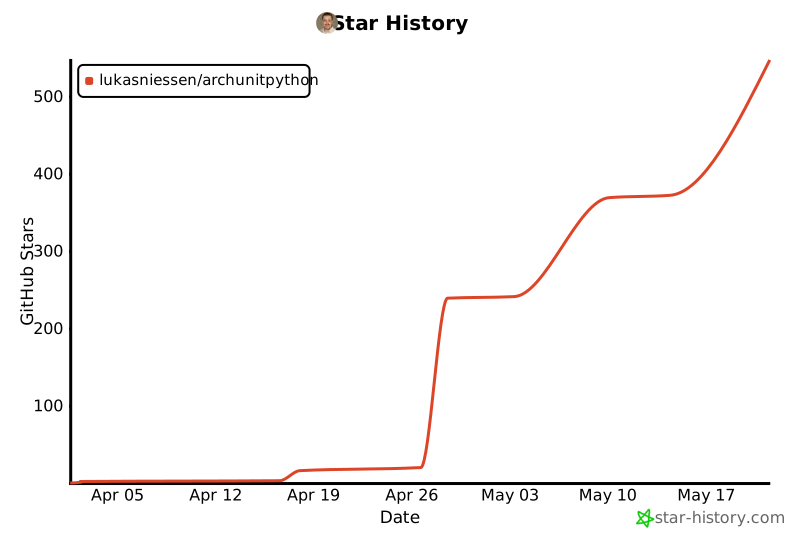
Star History
📄 License
This project is under the MIT license.
1 maintainer

Download files
Download the file for your platform. If you're not sure which to choose, learn more about installing packages.
Source Distribution
Built Distribution
Filter files by name, interpreter, ABI, and platform.
If you're not sure about the file name format, learn more about wheel file names.
Copy a direct link to the current filters
File details
Details for the file archunitpython-1.5.0.tar.gz.
File metadata
- Download URL: archunitpython-1.5.0.tar.gz
- Upload date:
- Size: 393.8 kB
- Tags: Source
- Uploaded using Trusted Publishing? No
- Uploaded via:
twine/6.2.0 CPython/3.12.13
File hashes
| Algorithm | Hash digest | |
|---|---|---|
| SHA256 |
d9ad8d66df62426f0c0f1027dc3b57729f27b48a1648db1a485f31ca425d96b5
|
|
| MD5 |
5ba1cc18262dffa33e3a32d281a4eb1d
|
|
| BLAKE2b-256 |
ff8e95f2d0c7f5f402a3b880cbff718d0ec8e3fe458e6df389d7af3800319d0b
|
File details
Details for the file archunitpython-1.5.0-py3-none-any.whl.
File metadata
- Download URL: archunitpython-1.5.0-py3-none-any.whl
- Upload date:
- Size: 78.7 kB
- Tags: Python 3
- Uploaded using Trusted Publishing? No
- Uploaded via:
twine/6.2.0 CPython/3.12.13
File hashes
| Algorithm | Hash digest | |
|---|---|---|
| SHA256 |
bb335e67018c1a846929966837b8023dc9ee28bbb8413f4e1fb8becbcd7805f1
|
|
| MD5 |
37c9dd5e978eafe7255a95b82054f7c2
|
|
| BLAKE2b-256 |
7f1d5a5bc46122de30d96cc6d477a55c49a0abd72ce4ec9fe57b8d735ecefbc7
|







