
Python library for building modular CLI applications

Project description

Argenta is a simple and elegant framework for building modular CLI applications. It provides a clean and intuitive way to create context-aware command-line tools with isolated command scopes.
Argenta is the "Simplest", "Most Modular", and "Most Elegant" way to build interactive CLI applications in Python.
📖 Read the full documentation: argenta.readthedocs.io
🌍 Other languages: RU
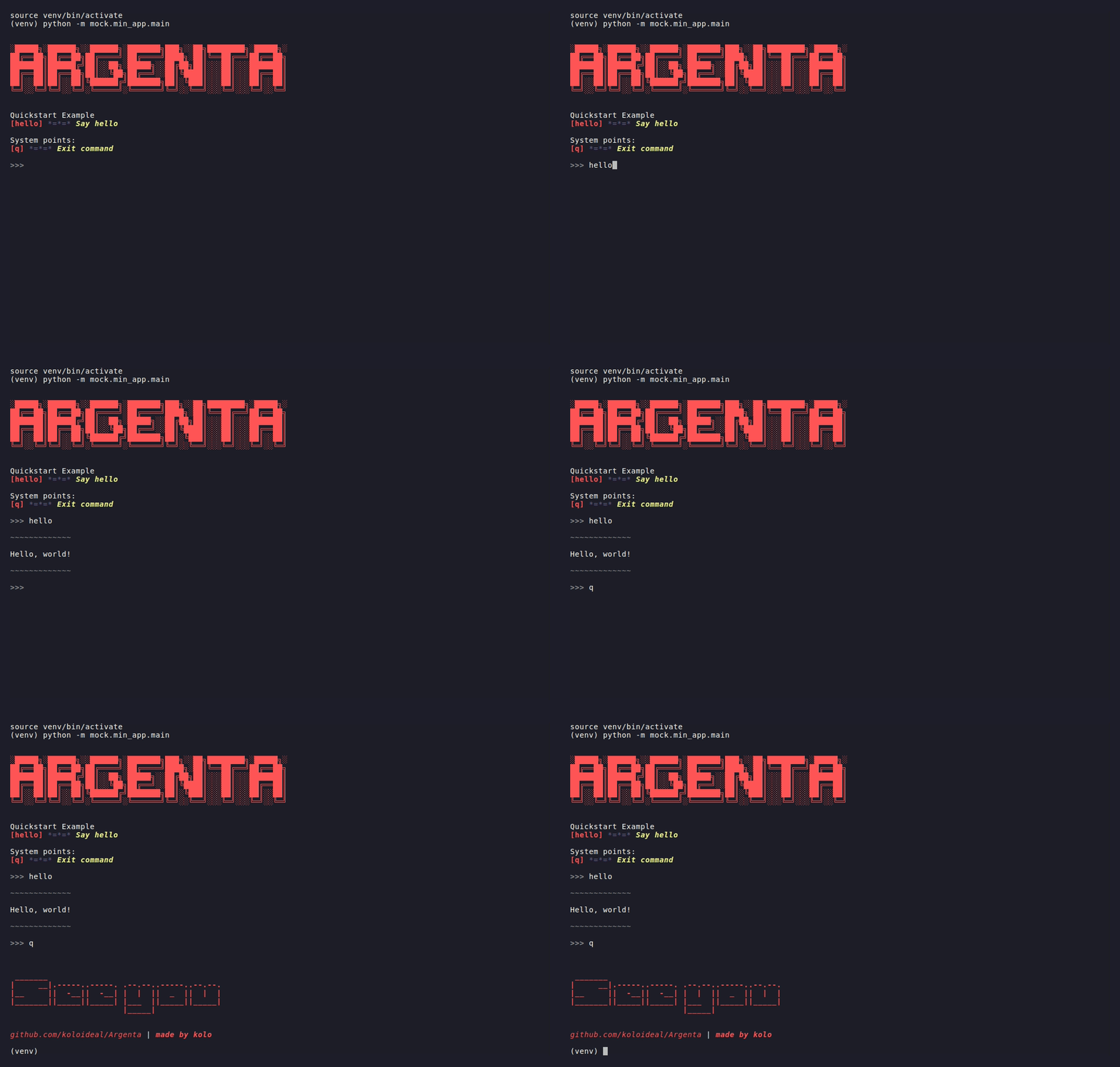
Argenta allows you to build interactive CLI applications incredibly easily. There's no need to manually parse complex command structures or manage state transitions — just use routers and commands!
✨ Installing Argenta
Argenta is available on PyPI:
$ python -m pip install argenta
or using uv:
$ uv add argenta
Argenta officially supports Python 3.12+.
🚀 Supported Features & Best Practices
Argenta is ready for the demands of building scalable, robust and maintainable CLI applications.
- Interactive Sessions: Unlike traditional CLI tools,
Argentacreates cyclic sessions, allowing users to execute commands sequentially without restarting the application. - Declarative Syntax: Commands and their handlers are declared using simple decorators, making the code intuitive and allowing you to focus on "what" you want to do, not "how".
- Native DI: Thanks to integration with dishka, you can easily inject dependencies directly into command handlers, simplifying testing, avoiding mutable globals, and much more.
- Automatic Validation and Parsing: The library handles command-line flags and arguments processing, including parsing, validation, and type conversion.
- Flexible Configuration: You can easily customize system messages, output formatting, create custom handlers for non-standard behavior, and more.
Need something more? Create an issue, we're open to suggestions.
📝 Why did we create this?
Building complex CLI applications often requires managing different contexts and command scopes. For example, when creating a utility similar to the Metasploit Framework, users need to enter specific scopes (like selecting a scanning module) and then access commands specific only to that context.
Traditional CLI frameworks don't provide an elegant way to handle this kind of modular, context-aware architecture. Argenta was built to solve this problem by providing a simple and concise way to encapsulate CLI functionality in isolated, abstracted environments.
We believe that building CLI applications should be as pleasant as building web applications with modern frameworks. Argenta brings the router pattern and clean separation of concerns to the CLI world.
🚀 Quick Start
Here's a simple example to get you started:
# routers.py
from argenta import Router, Response
from argenta.command import Flag, Command

router = Router()

@router.command(Command("hello"))
def handler(response: Response):
    """A simple hello world command"""
    print("Hello, world!")

@router.command(Command("greet", flags=Flag('name')))
def greet_handler(response: Response):
    """Greet a user by name"""
    name_flag = response.input_flags.get_flag_by_name('name')
    if name_flag:
        print(f"Hello, {name_flag.input_value}!")
    else:
        print("Hello, Stranger!")
# main.py
from argenta import App, Orchestrator
from .routers import router

app = App()
orchestrator = Orchestrator()

def main() -> None:
    # Include your routers
    app.include_router(router)

    # Start the interactive CLI
    orchestrator.start_polling(app)

if __name__ == '__main__':
    main()
That's it! You now have a fully functional interactive CLI application.
📚 Documentation
Full documentation is available at argenta.readthedocs.io
MIT 2025 kolo | made by kolo
Release history Release notifications | RSS feed


Download files
Download the file for your platform. If you're not sure which to choose, learn more about installing packages.
Source Distribution
Built Distribution
Filter files by name, interpreter, ABI, and platform.
If you're not sure about the file name format, learn more about wheel file names.
Copy a direct link to the current filters
File details
Details for the file argenta-1.2.0.tar.gz.
File metadata
- Download URL: argenta-1.2.0.tar.gz
- Upload date:
- Size: 20.2 kB
- Tags: Source
- Uploaded using Trusted Publishing? No
- Uploaded via: uv/0.9.26 {"installer":{"name":"uv","version":"0.9.26","subcommand":["publish"]},"python":null,"implementation":{"name":null,"version":null},"distro":null,"system":{"name":null,"release":null},"cpu":null,"openssl_version":null,"setuptools_version":null,"rustc_version":null,"ci":null}
File hashes
| Algorithm | Hash digest | |
|---|---|---|
| SHA256 |
9e567efcfdd993e7aceec1b8f1a45a4a7826708fcc4aa6daa6dd69a6813dbee2
|
|
| MD5 |
b7434aa74d23c68fe7b9a286f54fd949
|
|
| BLAKE2b-256 |
9d730f2ddde580e009cba8657f70607bba516059f965d27e2fea3b1679ae292f
|
File details
Details for the file argenta-1.2.0-py3-none-any.whl.
File metadata
- Download URL: argenta-1.2.0-py3-none-any.whl
- Upload date:
- Size: 33.8 kB
- Tags: Python 3
- Uploaded using Trusted Publishing? No
- Uploaded via: uv/0.9.26 {"installer":{"name":"uv","version":"0.9.26","subcommand":["publish"]},"python":null,"implementation":{"name":null,"version":null},"distro":null,"system":{"name":null,"release":null},"cpu":null,"openssl_version":null,"setuptools_version":null,"rustc_version":null,"ci":null}
File hashes
| Algorithm | Hash digest | |
|---|---|---|
| SHA256 |
29c1a9332a40e9cff8b0d0cdc9730aa4b9b071ef2005da9f76b3fb1f0ee7db1c
|
|
| MD5 |
a9ec469231c33484b6d0fb5d8ba7db98
|
|
| BLAKE2b-256 |
ae63623105280e77441779b8300388a56c86c9851624888854abf5da7524217a
|






