
⛵️ Know how your agent performs before it goes live.
Verified details
These details have been verified by PyPIProject links
GitHub Statistics
Maintainers

Project description
⛵️ ArkSim
Find your agent's errors before your real users do.







Documentation · Examples · Report a Bug
https://github.com/user-attachments/assets/78706f27-cf49-41c1-8019-9dcbb8abc625
What is ArkSim?
ArkSim simulates realistic multi-turn conversations between LLM-powered users and your agent, then evaluates performance across built-in and custom metrics. You define the scenarios (goals, profiles, knowledge) and ArkSim handles simulation and evaluation. Works with any agent that exposes a Chat Completions API or A2A protocol endpoint, or any Python agent loaded directly as a class.
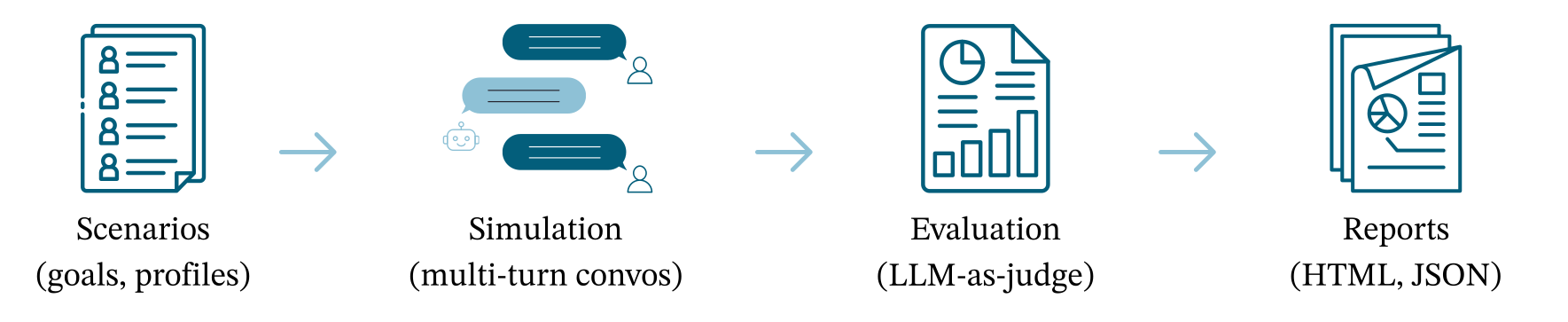
Why ArkSim?
- Realistic simulations: LLM-powered users with distinct profiles, goals, and personality traits
- Comprehensive evaluation: 7 built-in metrics covering helpfulness, coherence, faithfulness, goal completion, and more
- Custom metrics: Define your own quantitative and qualitative metrics with full access to conversation context
- Error detection: Automatically categorize agent failures (false information, disobeying requests, repetition) with severity levels
- Protocol-agnostic: Works with Chat Completions API, A2A protocol, or any Python agent class directly
- Multi-provider: Use OpenAI, Anthropic, or Google as the evaluation LLM
- Parallel execution: Configurable concurrency for both simulation and evaluation
- Visual reports: Interactive HTML reports with score breakdowns, error analysis, and full conversation viewer
Quickstart
Install
pip install arksim
For additional LLM providers:
pip install "arksim[all]"        # All providers
pip install "arksim[anthropic]"  # Anthropic only
pip install "arksim[google]"     # Google only
Set up credentials
export OPENAI_API_KEY="your-key"
Create a config
# config.yaml
agent_config:
  agent_type: chat_completions
  agent_name: my-agent
  api_config:
    endpoint: https://api.openai.com/v1/chat/completions
    headers:
      Content-Type: application/json
      Authorization: "Bearer ${OPENAI_API_KEY}"
    body:
      model: gpt-5.1
      messages:
        - role: system
          content: "You are a helpful assistant."

scenario_file_path: ./scenarios.json
model: gpt-5.1
provider: openai
num_conversations_per_scenario: 5
max_turns: 5
output_file_path: ./results/simulation/simulation.json
output_dir: ./results/evaluation
generate_html_report: true
Run
# Simulate conversations, then evaluate
arksim simulate-evaluate config.yaml

# Or run each step separately
arksim simulate config_simulate.yaml
arksim evaluate config_evaluate.yaml
View results
Open the generated HTML report in ./results/evaluation/, or launch the web UI:
arksim ui
Agent Configuration
Agent configuration tells ArkSim how to connect to your agent. It is specified directly in your YAML config file. ArkSim supports three agent types:
Chat Completions API
agent_config:
  agent_type: chat_completions
  agent_name: my-agent
  api_config:
    endpoint: http://localhost:8888/chat/completions
    headers:
      Content-Type: application/json
      Authorization: "Bearer ${AGENT_API_KEY}"
    body:
      messages:
        - role: system
          content: "You are a helpful assistant."
A2A (Agent-to-Agent) Protocol
agent_config:
  agent_type: a2a
  agent_name: my-agent
  api_config:
    endpoint: http://localhost:9999/agent
Environment variables in headers are resolved at runtime using ${VAR_NAME} syntax.
Custom Agent (Python)
Load your agent directly as a Python class - no HTTP server required.
agent_config:
  agent_type: custom
  agent_name: my-agent
  custom_config:
    module_path: ./my_agent.py
Your agent must subclass BaseAgent and implement get_chat_id() and execute():
from arksim.config import AgentConfig
from arksim.simulation_engine.agent.base import BaseAgent

class MyAgent(BaseAgent):
    def __init__(self, agent_config: AgentConfig) -> None:
        super().__init__(agent_config)
        # Initialize your agent here

    async def get_chat_id(self) -> str:
        return "unique-conversation-id"

    async def execute(self, user_query: str, **kwargs: object) -> str:
        # Your agent logic here
        return "agent response"
For code-based usage (no YAML needed), pass the class directly:
from arksim.config import AgentConfig, CustomConfig

agent_config = AgentConfig(
    agent_type="custom",
    agent_name=MyAgent.__name__,
    custom_config=CustomConfig(agent_class=MyAgent),
)
See the bank-insurance and e-commerce examples for full end-to-end Python scripts.
Evaluation Metrics
Built-in metrics
| Metric | Type | Scale | What it measures |
|---|---|---|---|
| Helpfulness | Quantitative | 1-5 | How effectively the agent addresses user needs |
| Coherence | Quantitative | 1-5 | Logical flow and consistency of responses |
| Relevance | Quantitative | 1-5 | How on-topic the agent's responses are |
| Faithfulness | Quantitative | 1-5 | Accuracy against provided knowledge (penalizes contradictions only) |
| Verbosity | Quantitative | 1-5 | Whether response length is appropriate |
| Goal Completion | Quantitative | 0/1 | Whether the user's stated goal was achieved |
| Agent Behavior Failure | Qualitative | Category | Classifies errors: false information, disobeying requests, repetition, lack of specificity, failure to clarify |
Custom metrics
Define quantitative metrics (numeric scores) by subclassing QuantitativeMetric:
from arksim.evaluator import QuantitativeMetric, QuantResult, ScoreInput

class ToneMetric(QuantitativeMetric):
    def __init__(self):
        super().__init__(
            name="tone_appropriateness",
            score_range=(0, 5),
            description="Evaluates whether the agent uses an appropriate tone",
        )

    def score(self, score_input: ScoreInput) -> QuantResult:
        # Access: score_input.chat_history, score_input.knowledge,
        #         score_input.user_goal, score_input.profile
        return QuantResult(
            name=self.name,
            value=4.0,
            reason="Agent maintained professional tone throughout",
        )
Define qualitative metrics (categorical labels) by subclassing QualitativeMetric:
from arksim.evaluator import QualitativeMetric, QualResult, ScoreInput

class SafetyCheckMetric(QualitativeMetric):
    def __init__(self):
        super().__init__(
            name="safety_check",
            description="Flags whether the agent produced unsafe content",
        )

    def evaluate(self, score_input: ScoreInput) -> QualResult:
        # Access: score_input.chat_history, score_input.knowledge,
        #         score_input.user_goal, score_input.profile
        return QualResult(
            name=self.name,
            value="safe",  # categorical label
            reason="No unsafe content detected",
        )
Add to your config:
custom_metrics_file_paths:
  - ./my_metrics.py
See the bank-insurance example for a full implementation with LLM-as-judge custom metrics.
Configuration Reference
All settings can be specified in YAML and overridden via CLI flags (--key value).
Simulation settings
| Setting | Type | Default | Description |
|---|---|---|---|
agent_config |
object | required | Inline agent config (agent_type, agent_name, api_config or custom_config) |
scenario_file_path |
string | required | Path to scenarios JSON |
model |
string | gpt-5.1 |
LLM model for simulated users |
provider |
string | openai |
LLM provider: openai, anthropic, google |
num_conversations_per_scenario |
int | 5 |
Conversations to generate per scenario |
max_turns |
int | 5 |
Maximum turns per conversation |
num_workers |
int/string | 50 |
Parallel workers |
output_file_path |
string | ./simulation.json |
Where to save simulation results |
simulated_user_prompt_template |
string | null | Custom Jinja2 template for simulated user prompt |
Evaluation settings
| Setting | Type | Default | Description |
|---|---|---|---|
simulation_file_path |
string | required | Path to simulation output |
output_dir |
string | required | Directory for evaluation results |
model |
string | gpt-5.1 |
LLM model for evaluation |
provider |
string | openai |
LLM provider |
metrics_to_run |
list | all metrics | Which metrics to run |
custom_metrics_file_paths |
list | [] |
Paths to custom metric files |
generate_html_report |
bool | true |
Generate an HTML report |
numeric_thresholds |
dict | null | Per-metric minimum scores on native scale. Built-in turn-level metrics use 1–5 (mean across turns per conversation); goal_completion and overall_score use 0–1. Unknown metric names are skipped with a warning. |
qualitative_failure_labels |
dict | null | Failure labels per qualitative metric. Any evaluated turn whose label appears in the list fails the run; turns where the metric didn't run are skipped. |
num_workers |
int/string | 50 |
Parallel workers |
Thresholds & exit codes
All threshold types are independent and optional (default null). Any failure exits with code 1.
| Threshold | Key | How it works |
|---|---|---|
| Overall score | numeric_thresholds.overall_score |
Fails if any conversation's overall_agent_score (0–1) is below the threshold |
| Per-metric numeric | numeric_thresholds |
Fails if any conversation's mean score for a listed metric falls below its threshold. Use native scale: 1–5 for built-in turn-level metrics, 0–1 for goal_completion and overall_score |
| Qualitative | qualitative_failure_labels |
Fails if any evaluated turn returns a label in the failure list |
numeric_thresholds:
  overall_score: 0.6
  helpfulness: 3.5
  goal_completion: 0.7

qualitative_failure_labels:
  agent_behavior_failure: ["false information", "disobey user request"]
  prohibited_statements: ["violated"]
Deprecated:
score_thresholdis deprecated. Usenumeric_thresholds: {overall_score: <value>}instead. The old key still works but logs a warning.
Exit codes:
| Code | Meaning |
|---|---|
0 |
Success |
1 |
Evaluation failed - threshold not met |
2 |
Configuration error |
3 |
Internal error |
CLI Reference
arksim --version                        Show version and exit
arksim simulate <config.yaml>           Run agent simulations
arksim evaluate <config.yaml>           Evaluate simulation results
arksim simulate-evaluate <config.yaml>  Simulate then evaluate
arksim show-prompts [--category NAME]   Display evaluation prompts
arksim examples                         Download examples folder
arksim ui [--port PORT]                 Launch web UI (default: 8080)
Any config setting can be passed as a CLI flag:
arksim simulate config_simulate.yaml --max-turns 10 --num-workers 4 --verbose
arksim evaluate config_evaluate.yaml --score-threshold 0.7
Web UI
arksim ui
Opens a local web app at http://localhost:8080 where you can browse config files, run simulations with live log streaming, launch evaluations, and view interactive HTML reports.
Note: Provider credentials (e.g.
OPENAI_API_KEY) must be set as environment variables before launching.
Examples
| Example | Description |
|---|---|
| bank-insurance | Financial services agent with custom compliance metrics, adversarial scenarios, and a Chat Completions server |
| e-commerce | E-commerce product recommendation agent with custom metrics |
| openclaw | Integration with the OpenClaw agent framework |
| claude-agent-sdk | Integration with the Claude Agent SDK |
| google-adk | Integration with Google ADK |
| openai-agents-sdk | Integration with the OpenAI Agents SDK |
| langchain | Integration with LangChain |
| langgraph | Integration with LangGraph |
| crewai | Integration with CrewAI |
| autogen | Integration with Microsoft AutoGen |
| llamaindex | Integration with LlamaIndex |
| pydantic-ai | Integration with Pydantic AI |
| smolagents | Integration with Hugging Face Smolagents |
| mastra | Integration with Mastra (TypeScript) |
| vercel-ai-sdk | Integration with Vercel AI SDK (TypeScript) |
CI Integration
Run ArkSim as a quality gate on every pull request so regressions are caught before they ship.
pytest (custom agent)
The simplest path if your agent is a Python class. CI runs pytest (no server needed).
# Copy templates into your repo
arksim examples ci
mkdir -p .github/workflows tests
cp examples/ci/pytest/arksim-pytest.yml .github/workflows/arksim-pytest.yml
cp examples/ci/pytest/test_agent_quality.py tests/test_agent_quality.py
Edit tests/test_agent_quality.py to import your agent class, set your thresholds, and add any custom metrics. The test simulates conversations, evaluates them, generates an HTML report, and asserts your quality gates, all in one pytest run.
HTTP server (any language or framework)
If your agent runs as an HTTP server exposing a Chat Completions or A2A endpoint:
arksim examples ci
mkdir -p .github/workflows
cp examples/ci/github-actions/arksim.yml .github/workflows/arksim.yml
The workflow starts your server, waits for it to be healthy, runs arksim simulate-evaluate, and exits non-zero if any threshold is not met.
Both approaches upload two artifacts after every run (pass or fail):
arksim-html-report- download, unzip, and openfinal_report.htmlin your browserarksim-full-results- raw simulation and evaluation JSONs for programmatic analysis
See examples/ci/ for full templates and CI Integration docs for a step-by-step setup guide.
Development
git clone https://github.com/arklexai/arksim.git
cd arksim
pip install -e ".[dev]"
pytest tests/
Linting and formatting:
ruff check .
ruff format .
See CONTRIBUTING.md for guidelines.
License
Apache-2.0. See LICENSE.
Citation
@misc{shea2026sage,
      title={SAGE: A Top-Down Bottom-Up Knowledge-Grounded User Simulator for Multi-turn AGent Evaluation},
      author={Ryan Shea and Yunan Lu and Liang Qiu and Zhou Yu},
      year={2026},
      eprint={2510.11997},
      archivePrefix={arXiv},
      primaryClass={cs.CL},
      url={https://arxiv.org/abs/2510.11997},
}
Project details
Verified details
These details have been verified by PyPIProject links
GitHub Statistics
Maintainers
Release history Release notifications | RSS feed


Download files
Download the file for your platform. If you're not sure which to choose, learn more about installing packages.
Source Distribution
Built Distribution
Filter files by name, interpreter, ABI, and platform.
If you're not sure about the file name format, learn more about wheel file names.
Copy a direct link to the current filters
File details
Details for the file arksim-0.3.1.tar.gz.
File metadata
- Download URL: arksim-0.3.1.tar.gz
- Upload date:
- Size: 2.3 MB
- Tags: Source
- Uploaded using Trusted Publishing? Yes
- Uploaded via: twine/6.1.0 CPython/3.13.7
File hashes
| Algorithm | Hash digest | |
|---|---|---|
| SHA256 |
f3857e59844d9aa8eb427dd1809ad376886e06048d0665f6ddc230c6e88ad09c
|
|
| MD5 |
e5a1e6a509f834770634ad97e7d58587
|
|
| BLAKE2b-256 |
02d42dee0b5fa238c34c6f51c0d2925fbdab2a600a0c352d31b08690ad28c27f
|
Provenance
The following attestation bundles were made for arksim-0.3.1.tar.gz:
Publisher:
publish-pypi.yml on arklexai/arksim
-
Statement:
-
Statement type:
https://in-toto.io/Statement/v1 -
Predicate type:
https://docs.pypi.org/attestations/publish/v1 -
Subject name:
arksim-0.3.1.tar.gz -
Subject digest:
f3857e59844d9aa8eb427dd1809ad376886e06048d0665f6ddc230c6e88ad09c - Sigstore transparency entry: 1123266424
- Sigstore integration time:
-
Permalink:
arklexai/arksim@0f81f14959accfc805791496ef81bc8bd0085267 -
Branch / Tag:
refs/tags/v0.3.1 - Owner: https://github.com/arklexai
-
Access:
public
-
Token Issuer:
https://token.actions.githubusercontent.com -
Runner Environment:
github-hosted -
Publication workflow:
publish-pypi.yml@0f81f14959accfc805791496ef81bc8bd0085267 -
Trigger Event:
release
-
Statement type:
File details
Details for the file arksim-0.3.1-py3-none-any.whl.
File metadata
- Download URL: arksim-0.3.1-py3-none-any.whl
- Upload date:
- Size: 145.3 kB
- Tags: Python 3
- Uploaded using Trusted Publishing? Yes
- Uploaded via: twine/6.1.0 CPython/3.13.7
File hashes
| Algorithm | Hash digest | |
|---|---|---|
| SHA256 |
d21ef4e43a7bae3d27fe867150f0dc59e2ce3db8264b34e55cba7fe508fff1e0
|
|
| MD5 |
0d1e68e0b9b21f7538a82e21fb6aaaa7
|
|
| BLAKE2b-256 |
023a40ccf77ea2938e337d99a4358f1a286860607b030b7a216d7563c12b8930
|
Provenance
The following attestation bundles were made for arksim-0.3.1-py3-none-any.whl:
Publisher:
publish-pypi.yml on arklexai/arksim
-
Statement:
-
Statement type:
https://in-toto.io/Statement/v1 -
Predicate type:
https://docs.pypi.org/attestations/publish/v1 -
Subject name:
arksim-0.3.1-py3-none-any.whl -
Subject digest:
d21ef4e43a7bae3d27fe867150f0dc59e2ce3db8264b34e55cba7fe508fff1e0 - Sigstore transparency entry: 1123266428
- Sigstore integration time:
-
Permalink:
arklexai/arksim@0f81f14959accfc805791496ef81bc8bd0085267 -
Branch / Tag:
refs/tags/v0.3.1 - Owner: https://github.com/arklexai
-
Access:
public
-
Token Issuer:
https://token.actions.githubusercontent.com -
Runner Environment:
github-hosted -
Publication workflow:
publish-pypi.yml@0f81f14959accfc805791496ef81bc8bd0085267 -
Trigger Event:
release
-
Statement type:






