
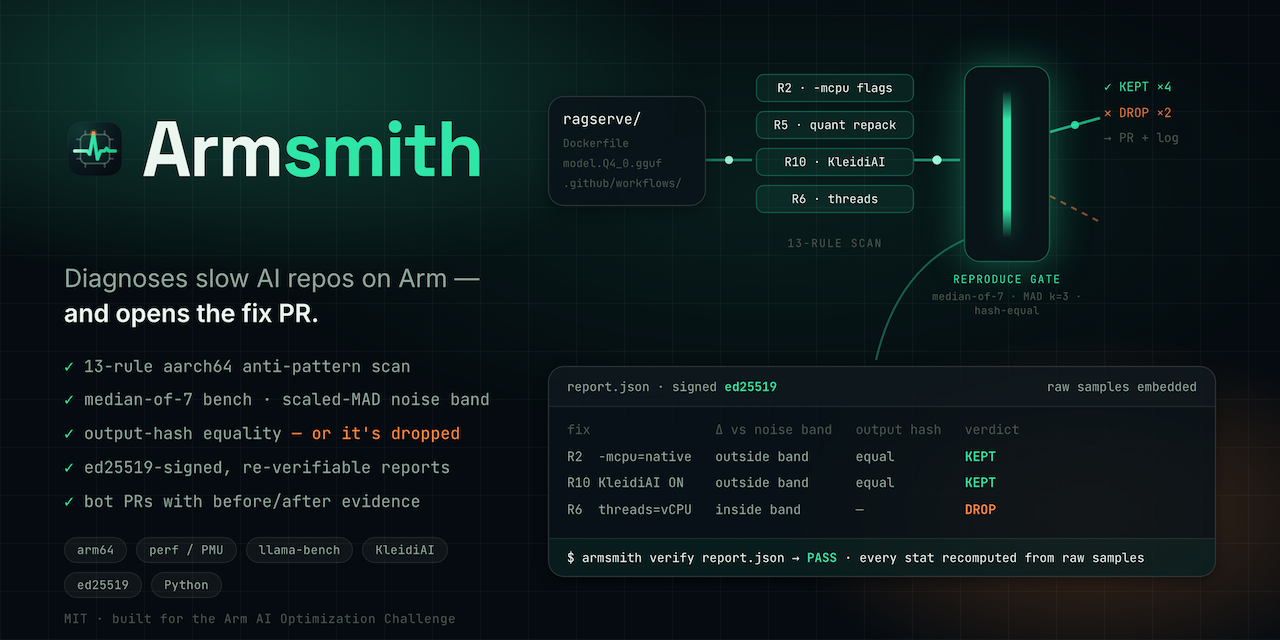






Armsmith profiles an AI repo on Arm, diagnoses why it is slow on aarch64 with a 13-rule anti-pattern pack, drafts fixes, and renders a PR in which every fix has passed a reproduce-benchmark gate — median-of-N, MAD noise bands, output-hash equality.
The LLM plans; the silicon decides. Deltas inside the noise band are reported as no change, never as wins, and fixes that fail are reported rather than quietly dropped.
Install
uvx armsmith scan .        # zero-install, one command
pipx install armsmith      # or keep it on your PATH
pip install armsmith
Use it
Scan any repo for aarch64 anti-patterns — static rules, no hardware, no network:
armsmith scan .
Record a bundle from your own machine, then diagnose your own repo. The probe rules read
observations from a bundle; record captures what your host can honestly report and copies in any
real instrument output you already have:
armsmith record . --out ./bundle --python .venv/bin/python
armsmith diagnose --replay ./bundle
The manifest it writes declares "synthetic": false, because none of it is invented. Anything the
host cannot observe is omitted, not guessed — the rules that needed it report skipped with the
probe named. env and proc_maps are never captured at all: a bundle is a published artifact, and
those carry CI tokens and host paths.
Gate your own change. Give it your before and after command and it runs the same statistics — ABAB interleaving, median-of-N, a scaled-MAD noise band, output-hash equality, a signed report. A delta inside the band is reported as no change, never as a win:
armsmith bench-cmd --rule R3 \
  --baseline-cmd "python serve_bench.py --config before.yaml" \
  --candidate-cmd "python serve_bench.py --config after.yaml"
It refuses to run off aarch64, and it carries no ISA witness — it is a stopwatch, and says so.
Take the measurement yourself, on any aarch64 box (a free GitHub ubuntu-24.04-arm runner is
enough). It refuses to run anywhere else rather than produce an Arm number off Arm hardware:
armsmith bench-live --require-witness
armsmith verify report-live.json
The number, and why you don't have to trust it
On a GitHub-hosted ubuntu-24.04-arm runner (Neoverse-N2, gcc 13.3.0), Armsmith compiles one
int8 dot-product source twice — differing only in the -march flag that rule R2 exists to
flag — disassembles both, and measures them:
-O3 -march=armv8-a |
-O3 -march=armv8.2-a+dotprod |
|
|---|---|---|
| SDOT in the hot symbol | 0 | 1 |
| median kernel time | 0.059975 s | 0.008123 s |
| Δ | — | −86.5% — a 7.4× speedup |
| noise band (k=3) | — | ±0.000144 s |
| output hash | — | identical |
| gate verdict | — | keep |
Read the first row before the timings: ARMv8.0 has no dot-product instruction, so the baseline cannot contain one. The stopwatch says 7.4×; the disassembly says why.
Every report is ed25519-signed and carries its own raw samples, so armsmith verify recomputes
every statistic and every gate verdict independently — change one digit and it prints
VERIFY FAILED.
What it looks for
13 aarch64 anti-patterns, 10 of them citing the Arm Learning Path that teaches the fix by hand:
amd64-pinned images running under QEMU · builds with no -mcpu/-march · NumPy on reference
BLAS · silent float64 coercion · GGUF quant mismatched to the ISA repack path · threads × workers
over vCPU count · ONNX Runtime session defaults · pip sdist fallback · preprocess memcpy storms ·
llama.cpp built without KleidiAI · THP/allocator untuned · CI publishing amd64-only images ·
serving overhead dominating kernel time.
armsmith rules export renders them as x86→Arm migration cards, 11 with a paste-able before→after
diff.
Honest scope
armsmith pris dry-run today. It renders exactly what would ship and makes no network call.- The measured −86.5% is one int8 microkernel on one runner. It proves the gate works on real silicon; it is never scaled into a claim about your workload. The honest number for your model is the one you measure on your own hardware.
- Live
perf/PMU capture, llama-bench, the Claude planner loop and real PR posting are markedTODO(S1)in code and exit non-zero rather than fabricate output.
Links
- Source: https://github.com/edycutjong/armsmith
- Docs & demo: https://armsmith.edycu.dev
- Releases (signed sdist + wheel): https://github.com/edycutjong/armsmith/releases
- Report JSON Schema: https://armsmith.edycu.dev/schema/report.schema.json
MIT licensed.
1 maintainer

Metadata
1 maintainer
Release files for armsmith 1.3.3
For a detailed explanation of source distributions (sdists) and built distributions (wheels), please see the package formats documentation.
Source distribution (sdist)
| File | Size | Uploaded | |
|---|---|---|---|
| armsmith-1.3.3.tar.gz | 170.4 kB | Details |
Built distribution (wheel)
| File | Interpreter | ABI | Platform | Reset |
|---|---|---|---|---|
| armsmith-1.3.3-py3-none-any.whl | Python 3 | none | any | Details |
Total release size: 287.0 kB
Release files / armsmith-1.3.3.tar.gz
| Download URL | armsmith-1.3.3.tar.gz |
|---|---|
| Size | 170.4 kB |
| Tags | Source |
|
SHA-256 checksum How to use checksums |
e39fe3ac6888a9fe049d8b3abd31d19dcf9bd238fe8b5b1400a4e8939c86b944
|
|
BLAKE2b-256 checksum How to use checksums |
82071e19df37f47b085f8eb60e32195168948bed15681368b908ac44c48eba20
|
| Upload date | |
|
Uploaded using Trusted Publishing? What is trusted publishing? |
Yes |
| Uploaded via |
twine/7.0.0 CPython/3.13.14
|
Provenance
Provenance describes where a file came from. On PyPI, provenance is shared via attestations, which provide a verifiable record of the build or publishing details. View details, limitations and caveats.


PyPI Publish Attestation
PyPI verified that this artifact, at this checksum, originated from the publisher listed below.
Signed by GitHub Actions, verified by PyPI on Aug 13, 2026.
Transparency logRelease files / armsmith-1.3.3-py3-none-any.whl
| Download URL | armsmith-1.3.3-py3-none-any.whl |
|---|---|
| Size | 116.6 kB |
| Tags | Python 3 |
|
SHA-256 checksum How to use checksums |
2d720459bf656846aebe5986afbc9b45501ad19a04d69215a1e1ba247385d690
|
|
BLAKE2b-256 checksum How to use checksums |
a35894fc5a5c0f2f8743b347fc72cadec1bb0e82de333d461f694f8459f9c618
|
| Upload date | |
|
Uploaded using Trusted Publishing? What is trusted publishing? |
Yes |
| Uploaded via |
twine/7.0.0 CPython/3.13.14
|
Provenance
Provenance describes where a file came from. On PyPI, provenance is shared via attestations, which provide a verifiable record of the build or publishing details. View details, limitations and caveats.
PyPI Publish Attestation
PyPI verified that this artifact, at this checksum, originated from the publisher listed below.
Signed by GitHub Actions, verified by PyPI on Aug 13, 2026.
Transparency log













