
Auto-Rotating Perceptrons (ARP)
This repository contains the Keras implementation of the Auto-Rotating Perceptrons (Saromo, Villota, and Villanueva) for dense layers of artificial neural networks. These neural units were presented in this paper with an oral exposition at the LXAI workshop at NeurIPS 2019.
The ARP library was developed by Daniel Saromo and Matias Valdenegro-Toro. This repository contains implementations that are not present in the LXAI @ NeurIPS 2019 paper.
What is an Auto-Rotating Perceptron?
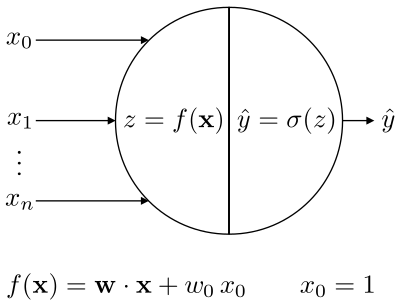
The ARP are a generalization of the perceptron unit that aims to avoid the vanishing gradient problem by making the activation function's input near zero, without altering the inference structure learned by the perceptron.
| Classic perceptron | Auto-Rotating Perceptron |
|---|---|
 |
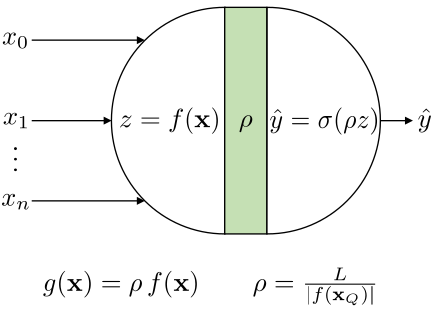 |
Hence, a classic perceptron becomes the particular case of an ARP with rho=1.
Basic principle: The dynamic region
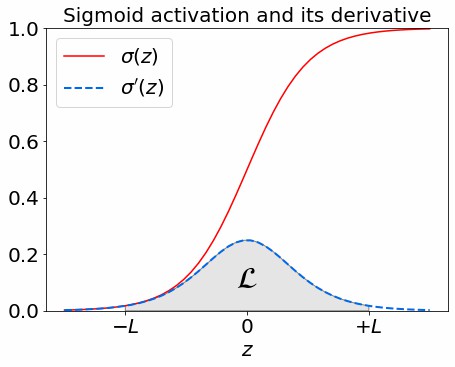
We define the dynamic region as the symmetric numerical range (w.r.t. 0) from where we would like the pre-activation values to come from in order to avoid node saturation. Recall that, in order to avoid the vanishing gradient problem (VGP), we do not want the derivative of the activation function to take tiny values. For the ARP, the dynamic region goes from -L to +L.
For example, in the unipolar sigmoid activation function (logistic curve) shown below, we would like it to receive values from -4 to 4. For inputs whose absolute values are higher than 4, the derivative of the activation is too low. Hence, the L value could be 4. The resulting dynamic region projected on the derivative curve is depicted as a gray shade.
What is L?
L is the hyperparameter that defines the limits of the desired symmetric dynamic region.
How do I choose L?
You need to analyze the activation function and its derivative. For the dynamic region, there is a trade-off. For a bigger L, you accept more non-linearity for the activation function, but at the same time, you get more saturation.
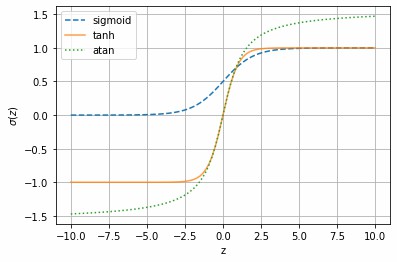
Below you have the suggested values for L, according to the activation function of the neuron:
| Activation function | L |
|---|---|
| tanh | 2 |
| sigmoid | 4 |
| arctan | 7 |
In the figure below, you can see that for inputs whose absolute values are higher than the values from the table, the derivative of the activation functions is very small.
What about xQ?
In the original ARP paper, you needed to set this value manually. Currently, by default, xQ is automatically calculated using L. However, the ARP library supports a custom selection of the xQ value.
A deeper explanation can be found in the journal version of the ARP paper (in preparation).
ARP Vs. Classic perceptrons
As shown in the example notebook (examples/example_CIFAR10_Keras.ipynb) that compares ARP and classic perceptrons, the ARP can lead to a faster convergence and lower loss values.
Furthermore, there is an application of the ARP to calibrate a wearable sensor where the test loss was reduced by a factor of 15 when changing from classic perceptrons to ARP. You can check the paper here.
In machine learning, the advantages of using one technique or another are problem-dependant. We encourage you to apply ARP in your research and discover its potential.
Keras implementation
Instalation
The ARP library is available on the Python Package Index.
To install the library, first install pip and then use the following command:
pip install arpkeras
You may need to update the pip manager. You can use:
python -m pip install –upgrade pip
Import
from ARPkeras import AutoRotDense
Creating an ARP model
The AutoRotDense class implementation inherits from the Keras Dense class. Hence, you can use it as a typical Keras Dense layer, but adding the following arguments:
xmin_lim: The lower limit of the values that will enter the neuron. For example, if we scale our input data to the range0to1, and we choosetanhas the activation function (which goes from-1to+1), then the lowest input value will bexmin_lim=-1.xmax_lim: The upper limit of the values that will enter the neuron. Analogous toxmin_lim.L: The limit of the desired symmetrical dynamic region. This value is the only hyperparameter needed for the Auto-Rotating layers. The two variables described above depend on the activation function you choose and your data preprocessing.
This is an example of use for the unipolar 'sigmoid' activation (whose output goes from 0 to +1) with data scaled to the range 0 to 1:
from tensorflow.keras.models import Sequential
from tensorflow.keras.layers import Dense
from ARPkeras import AutoRotDense

xmin_lim = 0   # min( 0,0)
xmax_lim = 1   # max(+1,1)
L = 4

model = Sequential()
model.add(Dense(20), input_shape=(123,))
model.add(AutoRotDense(10, xmin_lim=xmin_lim, xmax_lim=xmax_lim, L=L, activation='sigmoid'))
#By default the `AutoRot` flag of the Auto-Rotating layers is True.

model.summary()
This is another example, when using the 'tanh' activation (whose output goes from -1 to +1) with data scaled to the range 0 to 1:
from tensorflow.keras.models import Sequential
from tensorflow.keras.layers import Dense
from ARPkeras import AutoRotDense

xmin_lim = -1   # min(-1,0)
xmax_lim = +1   # max(+1,1)
L = 7

model = Sequential()
model.add(AutoRotDense(20, input_shape=(123,), xmin_lim=xmin_lim, xmax_lim=xmax_lim, L=L, activation='tanh'))
model.add(AutoRotDense(10, xmin_lim, xmax_lim, L, activation='tanh'))
#By default the `AutoRot` flag of the Auto-Rotating layers is True.

model.summary()
Beyond Dense layers
Is that all for the ARP? No! The journal version of the ARP paper is being finished, with the support of Dr. Edwin Villanueva and Dr. Matias Valdenegro-Toro. There, the Auto-Rotating concept was extrapolated to other layer types, creating the Auto-Rotating Neural Networks.
These are the Keras layers implemented with the Auto-Rotating operation (Tip: Just add AutoRot before the layer name):
| Keras Original Layer | Auto-Rotating Implementation |
|---|---|
Dense |
AutoRotDense |
SimpleRNN |
AutoRotSimpleRNN |
LSTM |
AutoRotLSTM |
GRU |
AutoRotGRU |
Conv1D |
AutoRotConv1D |
Conv2D |
AutoRotConv2D |
Conv3D |
AutoRotConv3D |
Conv2DTranspose |
AutoRotConv2DTranspose |
Conv3DTranspose |
AutoRotConv3DTranspose |
SeparableConv |
AutoRotSeparableConv |
SeparableConv1D |
AutoRotSeparableConv1D |
SeparableConv2D |
AutoRotSeparableConv2D |
DepthwiseConv2D |
AutoRotDepthwiseConv2D |
Coming soon 😎: Auto-Rotating Neural Networks (Saromo, Villanueva, and Valdenegro-Toro).
Citation
This code is free to use for research purposes, and if used or modified in any way, please consider citing:
@article{saromo2019arp,
  title={{A}uto-{R}otating {P}erceptrons},
  author={Saromo, Daniel and Villota, Elizabeth and Villanueva, Edwin},
  journal={LatinX in AI Workshop at NeurIPS 2019 (arXiv:1910.02483)},
  year={2019}
}
Other inquiries: daniel.saromo@pucp.pe
1 maintainer

Metadata
1 maintainer
Release files for arpkeras 1.0.0
For a detailed explanation of source distributions (sdists) and built distributions (wheels), please see the package formats documentation.
Source distribution (sdist)
| File | Size | Uploaded | |
|---|---|---|---|
| arpkeras-1.0.0.tar.gz | 7.1 kB | Details |
Built distribution (wheel)
| File | Interpreter | ABI | Platform | Reset |
|---|---|---|---|---|
| arpkeras-1.0.0-py3-none-any.whl | Python 3 | none | any | Details |
Total release size: 19.6 kB
Release files / arpkeras-1.0.0.tar.gz
| Download URL | arpkeras-1.0.0.tar.gz |
|---|---|
| Size | 7.1 kB |
| Tags | Source |
|
SHA-256 checksum How to use checksums |
11056434357015768e71f04e7b14f1156a66d35ba8559b8732dc7ec793f25002
|
|
BLAKE2b-256 checksum How to use checksums |
1e675b83e6d79d37e2939edba11e92e2e0660f0d540dcc4717dc27814daa2b6d
|
| Upload date | |
|
Uploaded using Trusted Publishing? What is trusted publishing? |
No |
| Uploaded via |
twine/3.1.1 pkginfo/1.7.0 requests/2.23.0 setuptools/46.1.3 requests-toolbelt/0.9.1 tqdm/4.45.0 CPython/3.6.9
|
Release files / arpkeras-1.0.0-py3-none-any.whl
| Download URL | arpkeras-1.0.0-py3-none-any.whl |
|---|---|
| Size | 12.5 kB |
| Tags | Python 3 |
|
SHA-256 checksum How to use checksums |
2c20ebc263e73f3dde22e727304a14df666c59e9d0e540d7ad5238df13153f2c
|
|
BLAKE2b-256 checksum How to use checksums |
70faccf375c44a12b9a59ab0283bce95ee3a3152a5f4436e9c3a85ef19a492e2
|
| Upload date | |
|
Uploaded using Trusted Publishing? What is trusted publishing? |
No |
| Uploaded via |
twine/3.1.1 pkginfo/1.7.0 requests/2.23.0 setuptools/46.1.3 requests-toolbelt/0.9.1 tqdm/4.45.0 CPython/3.6.9
|













