
arrayprobe
arrayprobe processes the raw data recorded by airborne optical array probes (OAPs), the
instruments that image cloud and precipitation particles as they pass through a laser beam. It reads
the probe's raw binary files (SPEC, DMT, PMS and SEA record formats: 2D-S, HVPS, CIP, PIP, 2DC, 2DP
and Fast2DC), reconstructs each particle's image, measures and accepts or rejects every particle,
and computes one-second particle size distributions, combined into one product per flight.
It is for anyone who works with OAP data: processing a field campaign's flights, re-processing an
old campaign with documented settings, or checking how a processed product was made. Every run
writes a .call record of exactly how each stage was called, so a result can be traced and
repeated.
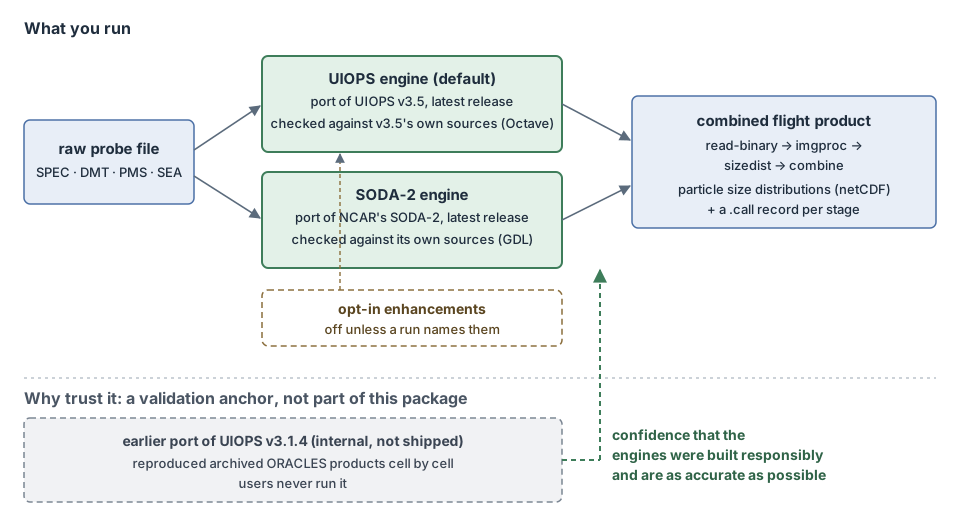
Two processing engines ship, each a Python translation of an established processing code and checked against that original running unmodified:
- UIOOPS v3.5 (its repository is spelled UIOPS; the default), translated from the MATLAB processing code of the McFarquhar group, checked stage by stage and end to end against GNU Octave running v3.5's own sources.
- SODA-2, translated from NCAR's IDL code, checked against GDL running SODA-2's unmodified sources.
Start here, with no real data: examples/1_getting_started/01_start_here.ipynb
processes a synthetic file and plots what came out, explaining each step.
Where to read next
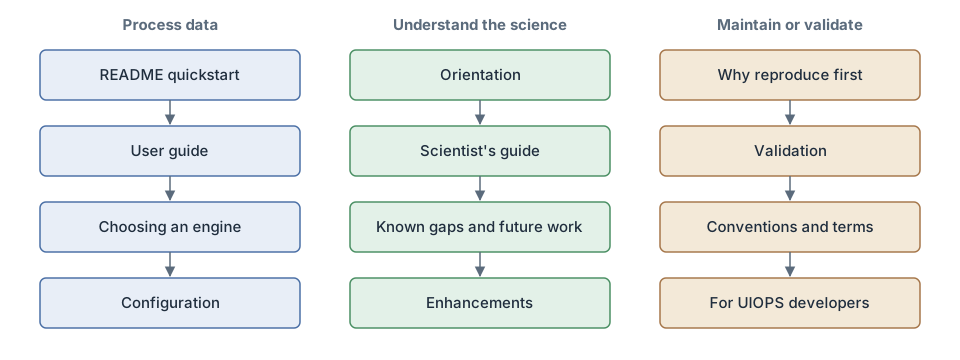
Looking up a command or a function? The CLI reference lists every arrayprobe command and flag, and the API reference links the public Python API, page by page. Each probe has its own page, listed in The probes; the whole documentation is indexed in the docs index.
Install
Needs Python 3.12 or newer. From PyPI:
pip install arrayprobe
Optional additions:
pip install "arrayprobe[extra]"adds scipy, matplotlib and psutil (the inter-arrival fitting, plots, and the run's machine-load record).pip install arrayprobe-uiops-enhancements arrayprobe-soda2-enhancementsadds the opt-in corrections for each engine.- The example notebooks run from a clone of the repository (
git clone https://github.com/sgupta92/arrayprobe.git), not from apip install, and also need xarray and Jupyter:pip install "arrayprobe[extra,zarr]" jupyter. Start here walks through the first one.
The install also provides uiops, a small module that picks an arrayprobe engine; it is not the
UIOOPS MATLAB code. To run the test suite or work on the code, install from a clone as described in
CONTRIBUTING.md.
Quickstart
Run these from any empty folder; the same two lines work on Windows, Linux and macOS:
arrayprobe make-demo-flight --dense --with-config demo/base160101000000.2DS
arrayprobe run demo/run.toml demo/base160101000000.2DS --yes
The first command writes a synthetic raw 2D-S file and a settings file, demo/run.toml, beside it.
The second runs the full pipeline on it in seconds and ends by printing ALL DONE. No campaign data
is needed. The file name carries a flight date because the combine step groups a flight's files by
it.
The run also prints a LOAD RECORD line, which says whether other processes were busy during the
run. It matters only for quoting a run time, never for the results, and reads UNRECORDED without
psutil.
What a run does
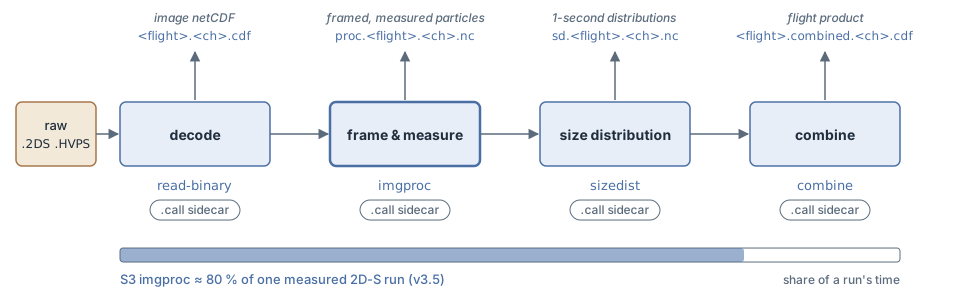
Look at the particles
A run's output folder can be browsed particle by particle, or rendered as image galleries:
arrayprobe triage --decoded-dir demo
arrayprobe gallery --decoded-dir demo --flight base160101000000.H --out demo/galleries
Your own data
arrayprobe run <config.toml> <flight> processes your own flights: the choices live in the
configuration file (Configuration), and arrayprobe --help lists
every command. If you cloned the source,
examples/start_here/README.md walks through the same run
with its settings file.
Running it faster
Opt-in parallelism on the default UIOOPS engine and on SODA-2, default serial, part of this
package, not the enhancements, because it moves no written byte. Measured, with its scope, in
Processing speed: UIOOPS v3.5's --chunks 8 runs stage 3 (imgproc)
on a CIP file 2.5–2.6× faster, all 40 variables byte-equal to the serial run; SODA-2's
--jobs 12 runs its buffer loop on a CIP (SEA) file 3.70× faster, all 35 arrays byte-equal.
The two figures come from different programs and stages and are not to be ranked against each other.
Test (from a clone)
From a clone of the repository (see CONTRIBUTING for the development setup):
# Linux, macOS
python3.12 -m venv .venv && .venv/bin/python -m pip install -e ".[pinned]" -e enhancements_uiops -e enhancements_soda2
.venv/bin/python -m unittest discover -s tests -p "test_*.py"
.venv/bin/python -m ruff check src tests scripts enhancements_uiops enhancements_soda2
# Windows, one command per line
py -3.12 -m venv .venv
.venv\Scripts\python.exe -m pip install -e ".[pinned]" -e enhancements_uiops -e enhancements_soda2
.venv\Scripts\python.exe -m unittest discover -s tests -p "test_*.py"
.venv\Scripts\python.exe -m ruff check src tests scripts enhancements_uiops enhancements_soda2
A full run of the shipped suite: unittest collects 4,728 tests on this release, and 656 of those skip (they need an optional dependency, GNU Octave or GDL output, or data files not shipped with the release).
With ARRAYPROBE_SLOW=1 and ARRAYPROBE_HYGIENE=1 set, which add the slow and documentation
checks, the first command took 1,403 s (about 23 minutes) on a 10-core laptop (Intel Core
i7-1365U, 64 GB, Windows 11) with no other load, measured 2026-10-17 with the machine's load
recorded every 30 s. The same command run from enhancements_uiops/ and from
enhancements_soda2/ took 66 s and 5 s. CI (.github/workflows/tests.yml) sets both
variables and runs all three suites.
Engines, corrections and validation
The package holds two engines: arrayprobe_uiops, the default, translated from UIOOPS v3.5, and
arrayprobe_soda2, translated from NCAR's SODA-2 (IDL). Translating them surfaced findings about the
original code. On engine 3.5 a batch run corrects data-destroying upstream defects by default,
recorded in each run's .call stamp (--protective off opts out; stray-pixel removal has its own
--stray-pixel off), and probes with no archived product get further corrections; the full list
is in Choosing an engine.
Every other correction is opt-in, in the separate packages arrayprobe-uiops-enhancements and
arrayprobe-soda2-enhancements; the engines never depend on them.
Neither engine has an archived product of its own to be compared with, because none was ever written by UIOOPS v3.5 or by this SODA-2 revision, so each is checked against its original running unmodified. Before the v3.5 translation, an earlier translation of UIOOPS v3.1.4 was built to test the approach against archived products. It is not part of this package. It reproduced archived 2D-S products from one field campaign on 15 flights, 10 exactly; on the other five, 49 of 55,008 non-zero cells differ (0.09 %). Validation reports that result and how each engine is checked; findings the UIOOPS developers had already fixed in v3.5 are marked there. Future UIOOPS and SODA-2 releases will be compared against these translations and incorporated where relevant.
Contributing
Questions, bug reports and proposed changes are welcome: email sid.gupta@anl.gov or open a GitHub issue on this repository's Issues page; see CONTRIBUTING.md.
Credits
Author: Siddhant Gupta (Argonne National Laboratory). Advisors and collaborators: Joe O'Brien and Bobby Jackson (ANL), Greg McFarquhar and Yongjie Huang (University of Oklahoma), Aaron Bansemer (NCAR MMM). Data providers: Peter Brechner and Saurabh Patil (University of Oklahoma).
This package exists because of UIOOPS and SODA-2 and the work of their developers: the McFarquhar group's UIOOPS developers, and Aaron Bansemer (NCAR), who wrote and maintains SODA-2. They wrote and still maintain the originals; credit for the processing methods is theirs.
Generative AI
Much of the porting, testing and documentation was written with the help of Anthropic's Claude, under the author's direction; the author reviewed and is responsible for the result.
Licence and citation
BSD-3-Clause, with the UIOOPS maintainers' permission; derived from UIOOPS (GPLv3 upstream). LICENSE and NOTICE.md carry the full text and attribution. An independent port; it is not a UIOOPS or SODA-2 release.
Cite this package as: Gupta, S. (2026). arrayprobe (Version 0.1.0) [Computer software]. Zenodo.
10.5281/zenodo.23574623
Please cite UIOOPS alongside it: McFarquhar et al. (2018),
10.5281/zenodo.1285969 (the methodology), and UIOOPS v3.5,
10.5281/zenodo.18945998 (the release the default engine
ports), and say which engine
produced your numbers.
arrayprobe_soda2 translates NCAR's SODA-2 (3-clause BSD); a result derived from it cites
SODA-2, as its author asks:
Aaron Bansemer. (2026). abansemer/soda2: v2.26.0 (Version v2.26.0) [Computer software]. Zenodo. https://doi.org/10.5281/zenodo.18331418
1 maintainer

Metadata
1 maintainer
Release files for arrayprobe 0.1.0
For a detailed explanation of source distributions (sdists) and built distributions (wheels), please see the package formats documentation.
Source distribution (sdist)
| File | Size | Uploaded | Provenance | Actions |
|---|---|---|---|---|
| arrayprobe-0.1.0.tar.gz | 4.7 MB | With provenance | Details for arrayprobe-0.1.0.tar.gz |
Built distribution (wheel)
| File | Interpreter | ABI | Platform | Actions Reset |
|---|---|---|---|---|
| arrayprobe-0.1.0-py3-none-any.whl | Python 3 | none | any | Details for arrayprobe-0.1.0-py3-none-any.whl |
Total release size: 6.0 MB
Release files / arrayprobe-0.1.0.tar.gz
| Download URL | arrayprobe-0.1.0.tar.gz |
|---|---|
| Size | 4.7 MB |
| Tags | Source |
|
SHA-256 checksum How to use checksums |
6635a00d9c998c65263b9ae8989dc84f686932b4b8e4ebf298bf7b6b3a8805a1
|
|
BLAKE2b-256 checksum How to use checksums |
f0a434e70e0a73a7d7fd1efb244b0f1d7a70cdc6b1e46526ce72f63ae149b208
|
| Upload date | |
|
Uploaded using Trusted Publishing? What is trusted publishing? |
Yes |
| Uploaded via |
twine/7.0.0 CPython/3.13.16
|
Provenance
Provenance describes where a file came from. On PyPI, provenance is shared via attestations, which provide a verifiable record of the build or publishing details. View details, limitations and caveats.


PyPI Publish Attestation
PyPI verified that this artifact, at this checksum, originated from the publisher listed below.
Signed by GitHub Actions, verified by PyPI on Nov 2, 2026.
Transparency logRelease files / arrayprobe-0.1.0-py3-none-any.whl
| Download URL | arrayprobe-0.1.0-py3-none-any.whl |
|---|---|
| Size | 1.3 MB |
| Tags | Python 3 |
|
SHA-256 checksum How to use checksums |
0f55384b21e1716cc2f6e0a2f53b6d8cf49933f6019a57986159ae1fe86e0d52
|
|
BLAKE2b-256 checksum How to use checksums |
32099d6eddcdd11aed11609f7b2848265fb1741e9c27e5e750db62d5145e4735
|
| Upload date | |
|
Uploaded using Trusted Publishing? What is trusted publishing? |
Yes |
| Uploaded via |
twine/7.0.0 CPython/3.13.16
|
Provenance
Provenance describes where a file came from. On PyPI, provenance is shared via attestations, which provide a verifiable record of the build or publishing details. View details, limitations and caveats.
PyPI Publish Attestation
PyPI verified that this artifact, at this checksum, originated from the publisher listed below.
Signed by GitHub Actions, verified by PyPI on Nov 2, 2026.
Transparency logSecurity for arrayprobe 0.1.0
Provenance
Provenance describes where a file came from. On PyPI, provenance is shared via attestations, which provide a verifiable record of the build or publishing details. View details, limitations and caveats.
Full provenance
All 2 files in this release have been uploaded with provenance metadata.
Attestation for arrayprobe-0.1.0.tar.gz
PyPI Publish Attestation
PyPI verified that this artifact, at this checksum, originated from the publisher listed below.
Signed by GitHub Actions, verified by PyPI on Nov 2, 2026.
Transparency logA note on package security
PyPI is a repository for distributing packages, not a service for auditing them. While third-party security researchers and our staff do their best to detect and remove malicious packages, PyPI cannot guarantee the quality, security or suitability of any given package.
To learn more about protecting yourself from malicious actors, visit our package security documentation.













