

arris





A B-Rep geometric kernel in pure Rust, for code-CAD scripts, AI agents and CAE pipelines.
An arris is the sharp edge where two surfaces meet — the thing a B-Rep kernel exists to compute.
Arris is a library, not an application. It builds solids, cuts and fuses them, blends their edges, measures, tessellates and exports them, from Rust or from Python. Four things set it apart:
- Every operation says what it did. It returns the new body and a provenance record — the faces, edges and vertices it generated, modified and deleted — so a script can pick "the edge the extrude made" instead of an index that shifts when the model changes.
- It refuses rather than guesses. Geometry it cannot do is a typed error naming the entities involved, never a panic and never an invalid shape; every result passes the invariant checker. Every vertex, edge and face carries its own tolerance instead of one global epsilon.
- It is deterministic. Same input, same output, same entity ids, on
every platform: a body built for
wasm32is byte-identical to the native one. - It is pure Rust. No
unsafe, no C++ underneath, one crate to depend on, and a Python wheel built from the same code.
Pre-1.0: the API breaks between minor versions. CHANGELOG.md lists every change, and every break with its fix.
Install
Python — a prebuilt wheel for Linux, macOS and Windows, no Rust toolchain needed:
pip install arris
Rust — one crate, arris, re-exports the whole kernel; the API is on
docs.rs:
cargo add arris
Example: a bracket in Python
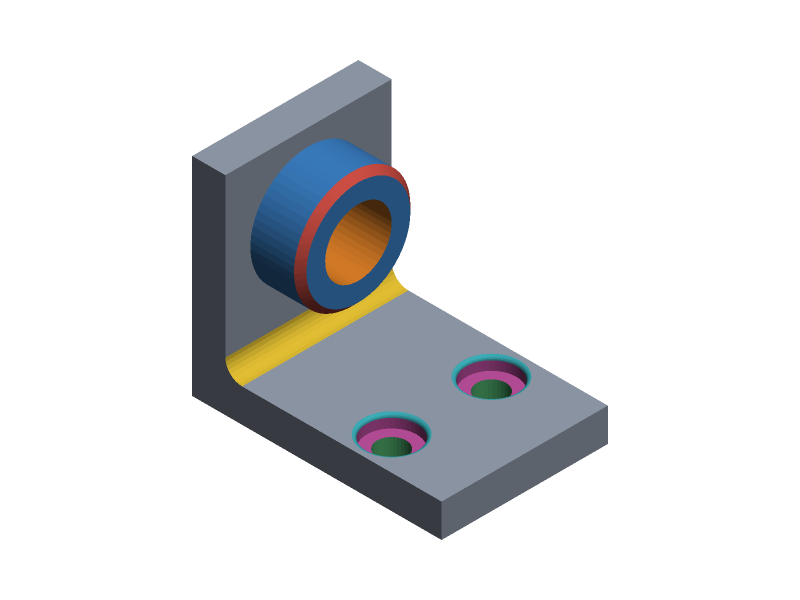
Rotate it in 3D in your browser, and see which faces each operation made
# A motor-mount bracket: extruded L profile, fused boss, bore and bolt pattern cut
# in one call, fillets on the bend and hole rims, and a chamfer on the boss.
# Full script with per-operation face colouring: crates/arris-py/examples/bracket.py

import arris
from arris.build import Solid, Workplane

# 1. Extrude the L plate, then fuse a boss on the upright leg
plate = Workplane.XZ().polygon([(0, 0), (60, 0), (60, 8), (8, 8), (8, 50), (0, 50)]).extrude(-40)
boss = Solid.cylinder((8, 20, 32), (1, 0, 0), 14, 12)
boss = boss.tag("boss", boss.faces())  # a tag follows its faces through every later operation
part = plate.fuse(boss)

# 2. Cut bore, bolt holes and counterbores in one multi-tool call
bore = Solid.cylinder((-1, 20, 32), (1, 0, 0), 8, 23)
holes = [Solid.cylinder((40, y, -1), (0, 0, 1), 3.5, 10) for y in (8, 32)]
wells = [Solid.cylinder((40, y, 5), (0, 0, 1), 6, 4) for y in (8, 32)]
part = part.cut(bore, *holes, *wells)

# 3. Fillets and chamfer: edges selected by provenance, never by index
bend = part.edges().from_role(arris.Role("extrude", "Rise", 0, 3)).one()
part = part.fillet([bend], 4)
skin = part.faces().kind("plane").normal((0, 0, 1)) - part.faces().created_by(wells[0]) - part.faces().created_by(wells[1])
walls = (part.faces().created_by(wells[0]) | part.faces().created_by(wells[1])).kind("cylinder")
rims = walls.edges() & skin.edges()
part = part.fillet(rims, 0.8)
crown = part.faces().tagged("boss")
lip = (crown.kind("plane").edges() & crown.kind("cylinder").edges()).one()
part = part.chamfer([lip], 1.5)
The binding beneath
arris.build is pure Python over the binding, arris.Model, which stays
available for anything the layer does not wrap:
# A motor-mount bracket: extruded L profile, fused boss, bore and bolt pattern cut
# in one call, fillets on the bend and hole rims, and a chamfer on the boss.
# Every face is coloured by the operation that made it, followed through provenance.
# The same part on the raw binding; the layer above it is the first snippet.

import arris

model = arris.Model()

# 1. Extrude the L plate
profile = arris.Profile(
    arris.Loop.polygon([(0, 0), (60, 0), (60, 8), (8, 8), (8, 50), (0, 50)]),
    origin=(0, 0, 0), normal=(0, -1, 0), x_axis=(1, 0, 0),
)
plate, plate_rec = model.extrude(profile, (0, 1, 0), 40)

# 2. Fuse a boss on the upright leg
boss, boss_rec = model.primitive_cylinder((8, 20, 32), (1, 0, 0), 14, 12)
body, fuse_rec = model.fuse(plate, boss)

# 3. Cut bore, bolt holes, and counterbores in one multi-tool call
wells = [model.primitive_cylinder((40, y, 5), (0, 0, 1), 6, 4) for y in (8, 32)]
tools = [
    model.primitive_cylinder((-1, 20, 32), (1, 0, 0), 8, 23)[0],
    *(model.primitive_cylinder((40, y, -1), (0, 0, 1), 3.5, 10)[0] for y in (8, 32)),
    *(w for w, _ in wells),
]
body, cut_rec = model.cut_many(body, tools)
history = plate_rec.then(fuse_rec).then(cut_rec)

# 4. Fillets and chamfer: edges selected by provenance
[bend] = [e for e in history.generated_from(arris.Role("extrude", "Rise", 0, 3)) if isinstance(e, arris.Edge)]
body, _ = model.fillet(body, [bend], 4)

rims = [
    e for _, w_rec in wells
    for f in w_rec.generated_from(arris.Role("cylinder", "Wall"))
    for e in cut_rec.generated_from(f)
    if isinstance(e, arris.Edge)
]
body, _ = model.fillet(body, rims, 0.8)

[lip] = [e for e in boss_rec.generated_from(arris.Role("cylinder", "TopRim")) if isinstance(e, arris.Edge)]
body, _ = model.chamfer(body, [lip], 1.5)
What it does
| Area | What you get |
|---|---|
| Modelling | Primitives, rigid transforms and mirroring; extrude (in any direction) and revolve of profiles of lines, arcs and elliptic arcs, including the horn and spindle tori an arc clear of the axis or ending on it makes; offset faces, shell to a wall, split by a plane; a profile as a one-face sheet body |
| Sweep and loft | Sweep a profile along lines, arcs, helix arcs and B-spline curves, with rotation-minimising or fixed-binormal frames; loft through two or more profiles, ruled or smooth |
| Booleans | Cut, fuse and common, one tool or many in one call, in any pose, over planes, cylinders, elliptic cylinders, cones, spheres, tori and NURBS faces — free-form against analytic and free-form against free-form; results with cavities, split pieces, disjoint shells and touching lumps (solids that meet along a curve or at a point, each lump keeping its own contact edges and vertices); operands tangent to each other |
| Fillet and chamfer | Constant radius along chains of edges, with miters, corners, steps, hole rims, seam crossings (square or slanted) and tangent cusps; a ball as large as the wall it rolls on (horn and spindle tori), and a fillet too wide for its face, rounded over the face's edge or a hole's rim; on free-form faces and between two of them, the blend a NURBS surface within your tolerance of the exact one |
| Queries | Ray hits, exact point classification in a batch (inside, outside, on), minimum distance, interference with the shared volume, clash screening of an assembly, the planar section of a body; volume, area, centroid and inertia of a body or of one face; a tight world-axis-aligned box of any entity; face frames and plane projection. None of them changes the body |
| Meshing | Tessellation to a chord tolerance, per face or whole, faces meshed at different times welded together; NumPy arrays from Python |
| STEP | Every solid or surface model in a file read as a checked body (horn and spindle tori included) or a typed refusal naming why; small gaps closed and reversed faces turned back, each repair named on the body; assemblies; AP214 export in the unit you choose |
| Other formats | STL and OBJ export; a deterministic native format in JSON and bytes, which every later release reads |
Not yet
Each of these is a typed refusal today, never a wrong answer:
- variable-radius fillets and chamfers;
- fillets at the corners and tangent chains the blend's closed forms do not cover (two straight edges meeting tangent, a vertex where four edges meet, flush pieces on a curved surface), and a ball too large for its face on an elliptic edge or a walked blend;
- offset and shell of elliptic-cylinder and NURBS faces;
- a NURBS face lying flush against another face over an area;
- sewing the faces of a STEP file that share no edge;
- non-manifold bodies (a shared edge or vertex within one lump; touching lumps are allowed).
Arris is narrower than Open CASCADE and is not aiming for feature parity. docs/COMPARISON.md sets out what each does today and where they differ, and its capability matrix, held cell for cell by a test, gives what each operation does and refuses for each face kind.
How it is tested
- An oracle for every fixture. Each fixture in the test corpus carries values computed by Open CASCADE — volume, area, centroid, counts, point classifications — that Arris must match within the fixture's tolerance. Open CASCADE runs as the oracle through Python and is never a build or runtime dependency (PROVENANCE.md).
- A checker after every operation. Every result passes the invariant checker, which runs after every operation in debug builds.
- Properties over random operands. Volume additivity, cut-then-fuse, commutativity, STEP round trips and more, over random operands in random poses from a fixed seed; nightly on a seed drawn from the date, up to five times CI's case count within a time budget.
- Real parts. A corpus of real STEP parts is read, checked, cut and blended, and a differential runs random recipes through Arris and Open CASCADE side by side.
Workspace
crates/arris is the facade a consumer depends on. It re-exports the
layered crates beneath it, and a crate never depends on one above it
(tools/check-layers.sh holds that in CI and in the pre-commit hook):
| Crate | Holds |
|---|---|
arris-math |
Points, frames, intervals, tolerances, the deterministic transcendentals |
arris-geom |
Curves and surfaces, NURBS, intersections, sections and fits |
arris-topo |
The B-Rep in an arena: bodies, shells, faces, edges, vertices, provenance |
arris-check |
The invariant checker |
arris-ops |
Primitives, booleans, blends, sweeps, lofts, queries |
arris-mesh |
Tessellation |
arris-io |
STEP, STL, OBJ and the native format |
arris-py |
The Python binding, published to PyPI |
arris-debug holds the developer tools — the rasteriser, the fixtures, the
property-test strategies — and is not published. The layout and its reasons
are in docs/ARCHITECTURE.md.
Prior work
Arris stands on four open projects, and it reads them, not copies them. Arris contains no code, comments or identifiers from any of them, and no line-by-line translation. Each one was read for its algorithms and for the mistakes it made, and the approach was reimplemented for Arris's own representation. PROVENANCE.md sets out the rule.
- Open CASCADE (LGPL 2.1, with an exception). The mature C++ kernel, and the test oracle. Arris runs it through Python to produce expected values; no crate links it, at build or run time. See docs/COMPARISON.md.
- truck. The original pure-Rust NURBS B-Rep. Arris learns from its NURBS evaluation, its tessellation and its marching intersections, and from why they fail at seams.
- monstertruck. An active fork of truck, with fillets, healing and more STEP. Arris learns from its fillet and healing work.
- Fornjot. A validation-first B-Rep kernel, which never reached booleans. Arris learns from its layered validation and its per-object checks.
Licence
MIT or Apache-2.0, at your option. See LICENSE-MIT and LICENSE-APACHE.
1 maintainer

Metadata
1 maintainer
Release files for arris 0.12.0
For a detailed explanation of source distributions (sdists) and built distributions (wheels), please see the package formats documentation.
Source distribution (sdist)
| File | Size | Uploaded | Provenance | Actions |
|---|---|---|---|---|
| arris-0.12.0.tar.gz | 3.0 MB | With provenance | Details for arris-0.12.0.tar.gz |
Built distributions (wheels)
| File | Actions Reset | |||
|---|---|---|---|---|
| arris-0.12.0-cp310-abi3-win_amd64.whl | CPython 3.10 | abi3 | Windows x86-64 | Details for arris-0.12.0-cp310-abi3-win_amd64.whl |
| arris-0.12.0-cp310-abi3-manylinux2014_x86_64.manylinux_2_17_x86_64.whl | CPython 3.10 | abi3 | Linux glibc 2.17+ x86-64 | Details for arris-0.12.0-cp310-abi3-manylinux2014_x86_64.manylinux_2_17_x86_64.whl |
| arris-0.12.0-cp310-abi3-manylinux2014_aarch64.manylinux_2_17_aarch64.whl | CPython 3.10 | abi3 | Linux glibc 2.17+ ARM64 | Details for arris-0.12.0-cp310-abi3-manylinux2014_aarch64.manylinux_2_17_aarch64.whl |
| arris-0.12.0-cp310-abi3-macosx_11_0_x86_64.whl | CPython 3.10 | abi3 | macOS 11.0+ x86-64 | Details for arris-0.12.0-cp310-abi3-macosx_11_0_x86_64.whl |
| arris-0.12.0-cp310-abi3-macosx_11_0_arm64.whl | CPython 3.10 | abi3 | macOS 11.0+ ARM64 | Details for arris-0.12.0-cp310-abi3-macosx_11_0_arm64.whl |
Total release size: 23.7 MB
Release files / arris-0.12.0.tar.gz
| Download URL | arris-0.12.0.tar.gz |
|---|---|
| Size | 3.0 MB |
| Tags | Source |
|
SHA-256 checksum How to use checksums |
0d9bed4a003e73f1a8957e50c95f09f97caf914515ba04c33bdd277edf165053
|
|
BLAKE2b-256 checksum How to use checksums |
15edeb5833721d6b6d4284fa33c0833dbb5df7581dbb13b438c09b75c03146d0
|
| Upload date | |
|
Uploaded using Trusted Publishing? What is trusted publishing? |
Yes |
| Uploaded via |
twine/7.0.0 CPython/3.13.16
|
Provenance
Provenance describes where a file came from. On PyPI, provenance is shared via attestations, which provide a verifiable record of the build or publishing details. View details, limitations and caveats.


PyPI Publish Attestation
PyPI verified that this artifact, at this checksum, originated from the publisher listed below.
Signed by GitHub Actions, verified by PyPI on Nov 23, 2026.
Transparency logRelease files / arris-0.12.0-cp310-abi3-win_amd64.whl
| Download URL | arris-0.12.0-cp310-abi3-win_amd64.whl |
|---|---|
| Size | 4.0 MB |
| Tags | CPython 3.10 Windows x86-64 abi3 |
|
SHA-256 checksum How to use checksums |
5a72514aabd2e5c771cb91b764163c9b8acbe9f153e129aa103b81e1b0b8dd7d
|
|
BLAKE2b-256 checksum How to use checksums |
eb652edc0b8bf8996ce9da207e1ceee7e0e5a4ffae068da3e3027140ac3bfb65
|
| Upload date | |
|
Uploaded using Trusted Publishing? What is trusted publishing? |
Yes |
| Uploaded via |
twine/7.0.0 CPython/3.13.16
|
Provenance
Provenance describes where a file came from. On PyPI, provenance is shared via attestations, which provide a verifiable record of the build or publishing details. View details, limitations and caveats.
PyPI Publish Attestation
PyPI verified that this artifact, at this checksum, originated from the publisher listed below.
Signed by GitHub Actions, verified by PyPI on Nov 23, 2026.
Transparency logRelease files / arris-0.12.0-cp310-abi3-manylinux2014_x86_64.manylinux_2_17_x86_64.whl
| Download URL | arris-0.12.0-cp310-abi3-manylinux2014_x86_64.manylinux_2_17_x86_64.whl |
|---|---|
| Size | 4.4 MB |
| Tags | CPython 3.10 Linux glibc 2.17+ x86-64 abi3 |
|
SHA-256 checksum How to use checksums |
d09ad876b99215b128c0effb10f920aff58dde6c374a88ae61b12b45ad660a70
|
|
BLAKE2b-256 checksum How to use checksums |
a4cfcb379d726eabe7f371a55da564fcff18fcf3126fae93152521f97f7aab40
|
| Upload date | |
|
Uploaded using Trusted Publishing? What is trusted publishing? |
Yes |
| Uploaded via |
twine/7.0.0 CPython/3.13.16
|
Provenance
Provenance describes where a file came from. On PyPI, provenance is shared via attestations, which provide a verifiable record of the build or publishing details. View details, limitations and caveats.
PyPI Publish Attestation
PyPI verified that this artifact, at this checksum, originated from the publisher listed below.
Signed by GitHub Actions, verified by PyPI on Nov 23, 2026.
Transparency logRelease files / arris-0.12.0-cp310-abi3-manylinux2014_aarch64.manylinux_2_17_aarch64.whl
| Download URL | arris-0.12.0-cp310-abi3-manylinux2014_aarch64.manylinux_2_17_aarch64.whl |
|---|---|
| Size | 4.2 MB |
| Tags | CPython 3.10 Linux glibc 2.17+ ARM64 abi3 |
|
SHA-256 checksum How to use checksums |
85f0766928c5aeabea4d75f59c42a0f0a3608aa0b7549d96270b0ae8da664b21
|
|
BLAKE2b-256 checksum How to use checksums |
30ae4cad9d8f89106d938da5d87b95ba0cdb97174e520be8e5d001cfd8bd798c
|
| Upload date | |
|
Uploaded using Trusted Publishing? What is trusted publishing? |
Yes |
| Uploaded via |
twine/7.0.0 CPython/3.13.16
|
Provenance
Provenance describes where a file came from. On PyPI, provenance is shared via attestations, which provide a verifiable record of the build or publishing details. View details, limitations and caveats.
PyPI Publish Attestation
PyPI verified that this artifact, at this checksum, originated from the publisher listed below.
Signed by GitHub Actions, verified by PyPI on Nov 23, 2026.
Transparency logRelease files / arris-0.12.0-cp310-abi3-macosx_11_0_x86_64.whl
| Download URL | arris-0.12.0-cp310-abi3-macosx_11_0_x86_64.whl |
|---|---|
| Size | 4.2 MB |
| Tags | CPython 3.10 abi3 macOS 11.0+ x86-64 |
|
SHA-256 checksum How to use checksums |
f4aa3a4e8e4ce53127db7558f723ede47da730293591c267d16c20d8b64c75e8
|
|
BLAKE2b-256 checksum How to use checksums |
7809c7f06c6bf6ad68295558d676c2bcb5d5e15b8a41deb7595ba57214004fe2
|
| Upload date | |
|
Uploaded using Trusted Publishing? What is trusted publishing? |
Yes |
| Uploaded via |
twine/7.0.0 CPython/3.13.16
|
Provenance
Provenance describes where a file came from. On PyPI, provenance is shared via attestations, which provide a verifiable record of the build or publishing details. View details, limitations and caveats.
PyPI Publish Attestation
PyPI verified that this artifact, at this checksum, originated from the publisher listed below.
Signed by GitHub Actions, verified by PyPI on Nov 23, 2026.
Transparency logRelease files / arris-0.12.0-cp310-abi3-macosx_11_0_arm64.whl
| Download URL | arris-0.12.0-cp310-abi3-macosx_11_0_arm64.whl |
|---|---|
| Size | 3.9 MB |
| Tags | CPython 3.10 abi3 macOS 11.0+ ARM64 |
|
SHA-256 checksum How to use checksums |
987e13bff5b48f55c716191eda1248b90b1c2bfd2091dd7dc042cf4923123f18
|
|
BLAKE2b-256 checksum How to use checksums |
e90937894481886786f7bb1569d536295fbf063f9ea06dd6648a8fd621f9252e
|
| Upload date | |
|
Uploaded using Trusted Publishing? What is trusted publishing? |
Yes |
| Uploaded via |
twine/7.0.0 CPython/3.13.16
|
Provenance
Provenance describes where a file came from. On PyPI, provenance is shared via attestations, which provide a verifiable record of the build or publishing details. View details, limitations and caveats.
PyPI Publish Attestation
PyPI verified that this artifact, at this checksum, originated from the publisher listed below.
Signed by GitHub Actions, verified by PyPI on Nov 23, 2026.
Transparency logSecurity for arris 0.12.0
Provenance
Provenance describes where a file came from. On PyPI, provenance is shared via attestations, which provide a verifiable record of the build or publishing details. View details, limitations and caveats.
Full provenance
All 6 files in this release have been uploaded with provenance metadata.
Attestation for arris-0.12.0.tar.gz
PyPI Publish Attestation
PyPI verified that this artifact, at this checksum, originated from the publisher listed below.
Signed by GitHub Actions, verified by PyPI on Nov 23, 2026.
Transparency logA note on package security
PyPI is a repository for distributing packages, not a service for auditing them. While third-party security researchers and our staff do their best to detect and remove malicious packages, PyPI cannot guarantee the quality, security or suitability of any given package.
To learn more about protecting yourself from malicious actors, visit our package security documentation.














