
Arteries
Calculate lowest-cost distances between the world's cities (population > 100,000) over a real infrastructure network, with land kilometers, sea kilometers, and port calls priced to your desired specifications.
Modeling distance is important. Economists tend to rely on great-circle (as-the-crow-flies) distances because of their numerical simplicity. The caveat is that a majority of goods do not travel in clean arcs to their destinations. They move by road to a port, by sea along shipping lanes and through chokepoints, and by road again. Arteries computes that route for every pair of cities with at least 100,000 people.
You choose what a road kilometer, a sea kilometer, and a port call cost. The package efficiently returns the cheapest route's generalized cost, together with the land and sea kilometers it uses and its number of sea legs.
Results are exact: they equal Dijkstra's algorithm on the full global multimodal graph for any choice of costs. They are also very fast. Routing all 2,075 × 2,075 city pairs takes about 20 seconds on a laptop, a major improvement over previous options.
import arteries

net = arteries.load()                       # downloads the network data once (~21 MB)

res = net.route_costs(
    land_cost=5.0,                          # cost per road km (relative to sea)
    sea_cost=1.0,                           # cost per sea km
    port_cost=1000.0,                       # cost per port call (loading or unloading)
    closed_regions=["red_sea"],             # e.g. the 2023-24 Red Sea disruption
)
df = res.to_frame()      # origin, destination, cost, land_km, sea_km, total_km, sea_legs
- Exact. The answer equals Dijkstra on the full multimodal graph for any weights. Proof and tests: docs/METHODS.md.
- Fast. Routing all 2,075 × 2,075 city pairs takes about 20 seconds, because the expensive land shortest paths are precomputed once and every new weighting only reweights a small terminal graph.
- Decomposed. Every result reports land km, sea km, and the number of sea legs of the cheapest route.
- Scenarios. You can close whole sea regions (
closed_regions=["red_sea"],"persian_gulf","black_sea","baltic_sea", or any lat/lon box), turn river and lake ports into land-only terminals (max_port_lane_km), close chokepoints (suez,panama,babalmandab,malacca,ormuz,gibraltar,bosporus,dardanelles,sunda,bering,chili,south_africa,northwest), or rescale individual sea lanes withsea_edge_multiplier.
Documentation: https://blaizegiangiulio.com/arteries/
Install
pip install arteries            # numpy, scipy, pandas
pip install "arteries[fast]"    # + numba (strongly recommended)
Data is cached in ~/.cache/arteries; set the ARTERIES_DATA environment variable to use another folder.
What is in the network
| Layer | Source | Size after processing |
|---|---|---|
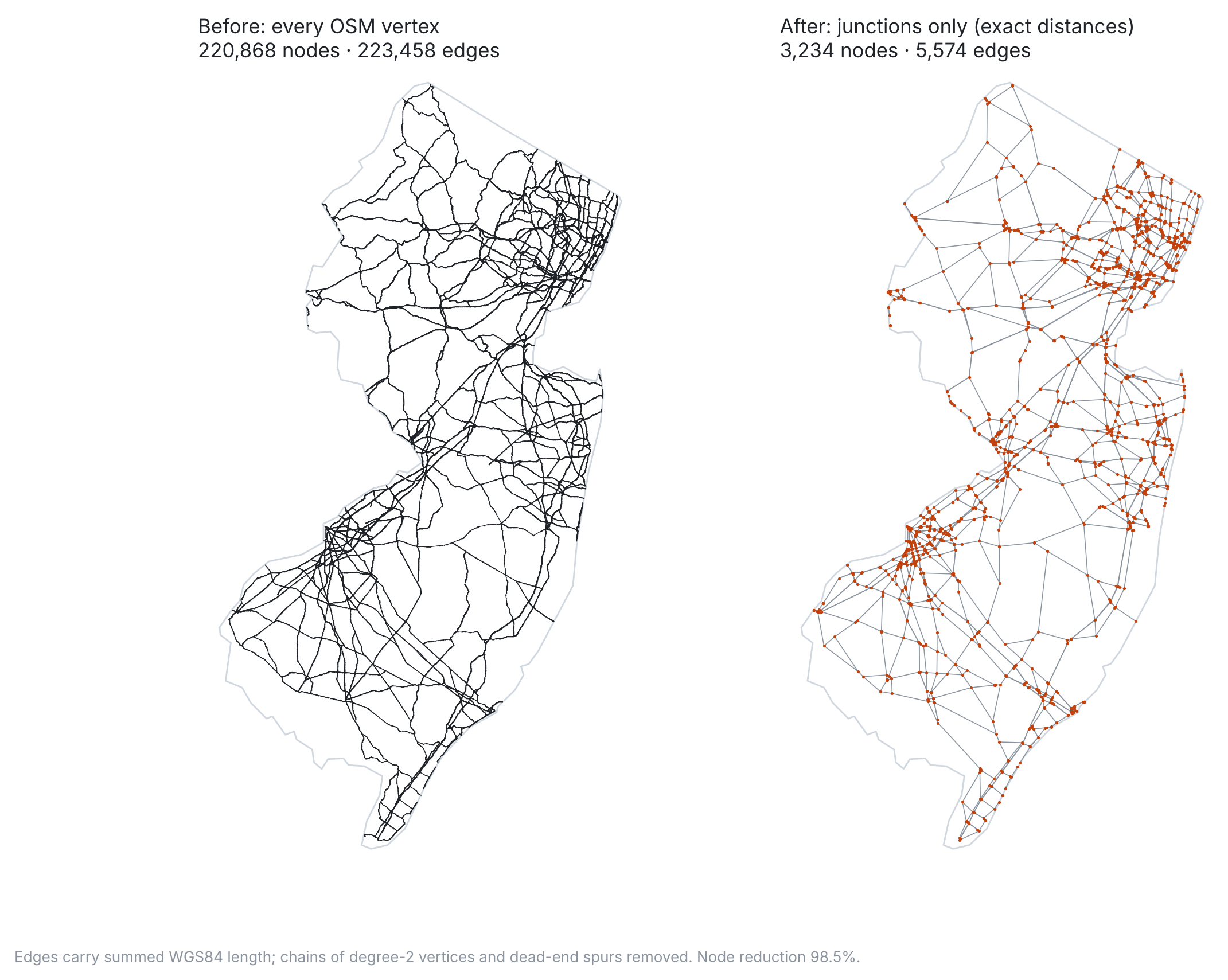
| Roads | OpenStreetMap main road classes, 236 countries | Simplified to junctions only (−99 % nodes) |
| Sea lanes | MARNET via searoute-py | 9,690 nodes, 15,947 lanes |
| Ports | IMF PortWatch | 1,804 ports (181 offshore oil terminals excluded) |
| Cities | UN WUP + Brinkhoff | 2,075 cities with ≥ 100,000 people (latest year ≤ 2026) |
Rebuilding the data
The build pipeline (python -m arteries.build ...) and the Slurm scripts (slurm/)
reproduce the release from the raw extracts. See docs/METHODS.md
for every step, the exactness arguments, validation results and resource use.
Licenses and attribution
- Code: MIT.
- Road data: © OpenStreetMap contributors, ODbL 1.0. The distributed distance data is a derivative database and is shared under ODbL.
- Maritime network: searoute-py (Apache-2.0), from Eurostat SeaRoute / ORNL shipping lanes.
- Ports: IMF PortWatch.
- Cities: UN World Urbanization Prospects and citypopulation.de (Brinkhoff).
Citation
Giangiulio, B. (2026). Arteries: exact multimodal transport distances between world cities. Python package version 0.1.0.
1 maintainer

Metadata
1 maintainer
Release files for arteries 0.1.0
For a detailed explanation of source distributions (sdists) and built distributions (wheels), please see the package formats documentation.
Source distribution (sdist)
| File | Size | Uploaded | Provenance | Actions |
|---|---|---|---|---|
| arteries-0.1.0.tar.gz | 328.4 kB | With provenance | Details for arteries-0.1.0.tar.gz |
Built distribution (wheel)
| File | Interpreter | ABI | Platform | Actions Reset |
|---|---|---|---|---|
| arteries-0.1.0-py3-none-any.whl | Python 3 | none | any | Details for arteries-0.1.0-py3-none-any.whl |
Total release size: 656.8 kB
Release files / arteries-0.1.0.tar.gz
| Download URL | arteries-0.1.0.tar.gz |
|---|---|
| Size | 328.4 kB |
| Tags | Source |
|
SHA-256 checksum How to use checksums |
b6bfb375ddbf65639d1cb9c3ed843163fb73fac1c04d589149fd6d7963ddefa7
|
|
BLAKE2b-256 checksum How to use checksums |
2e80ab6ba58d5663c5c8ae6da5265311ce6a1f083cd80852edf844e671b72ce9
|
| Upload date | |
|
Uploaded using Trusted Publishing? What is trusted publishing? |
Yes |
| Uploaded via |
twine/7.0.0 CPython/3.13.14
|
Provenance
Provenance describes where a file came from. On PyPI, provenance is shared via attestations, which provide a verifiable record of the build or publishing details. View details, limitations and caveats.


PyPI Publish Attestation
PyPI verified that this artifact, at this checksum, originated from the publisher listed below.
Signed by GitHub Actions, verified by PyPI on Oct 16, 2026.
Transparency logRelease files / arteries-0.1.0-py3-none-any.whl
| Download URL | arteries-0.1.0-py3-none-any.whl |
|---|---|
| Size | 328.4 kB |
| Tags | Python 3 |
|
SHA-256 checksum How to use checksums |
2412dcf89a6198789b4862b6202adce533330d02c700e3459634d102fdd8fb20
|
|
BLAKE2b-256 checksum How to use checksums |
4f5e7fb664e34d8374513dbe26f13212eb706907185c45f0678a3df9abf25ff5
|
| Upload date | |
|
Uploaded using Trusted Publishing? What is trusted publishing? |
Yes |
| Uploaded via |
twine/7.0.0 CPython/3.13.14
|
Provenance
Provenance describes where a file came from. On PyPI, provenance is shared via attestations, which provide a verifiable record of the build or publishing details. View details, limitations and caveats.
PyPI Publish Attestation
PyPI verified that this artifact, at this checksum, originated from the publisher listed below.
Signed by GitHub Actions, verified by PyPI on Oct 16, 2026.
Transparency logSecurity for arteries 0.1.0
Provenance
Provenance describes where a file came from. On PyPI, provenance is shared via attestations, which provide a verifiable record of the build or publishing details. View details, limitations and caveats.
Full provenance
Both files in this release have been uploaded with provenance metadata.
Attestation for arteries-0.1.0.tar.gz
PyPI Publish Attestation
PyPI verified that this artifact, at this checksum, originated from the publisher listed below.
Signed by GitHub Actions, verified by PyPI on Oct 16, 2026.
Transparency logA note on package security
PyPI is a repository for distributing packages, not a service for auditing them. While third-party security researchers and our staff do their best to detect and remove malicious packages, PyPI cannot guarantee the quality, security or suitability of any given package.
To learn more about protecting yourself from malicious actors, visit our package security documentation.













