

A benchmark to evaluate articulatory speech synthesis systems. This benchmark uses the VocalTractLab [1] as its articulatory speech synthesis simulator.
Installation
pip install articubench
Overview
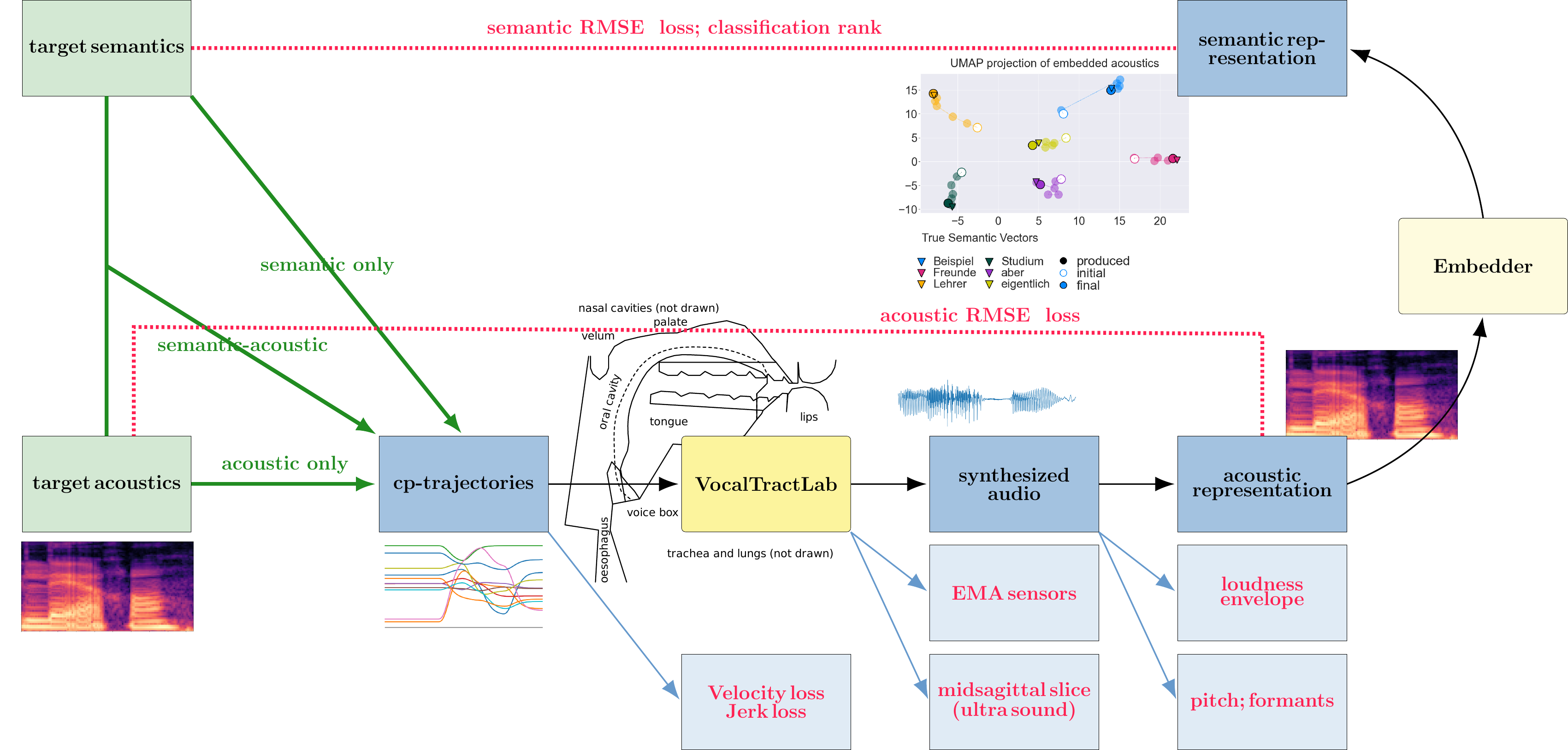
The benchmarks defines three tasks: acoustic only (copy-synthesis), semantic-acoustic and semantic only.
EMA Point animation
The EMA point animation shows the movement of the EMA sensors on the tongue tip (red), tongue body (green) and tongue back (red) of PAULEs articulation of the word “Oberreferendarin”. Shown as reference points in lighter colours are lab taken EMA data from the KEC corpus.
https://raw.githubusercontent.com/quantling/articubench/main/docs/figure/output.mp4
Control Model comparison
Comparing the PAULE, inverse, segment-based and baseline control models along different model properties. The memory demand includes the python binaries (200 MB). The segment model needs an embedder and the MFA in its pipeline, for which the data is given in parenthesis.
Property |
PAULE |
Inverse |
Seg-Model* |
Baseline-Model |
|---|---|---|---|---|
Trainable parameters [million] |
15.6 |
2.6 |
0 (6.6 + MFA) |
0 |
Execution time [seconds] |
200 |
0.2 |
0.5 (0.3 + MFA) |
< 0.0001 |
Memory demand [MB] |
5600 |
5000 |
2 (5100 + MFA) |
200 |
Energy used for Training [kWh] |
393 |
1.9 |
0.0 (7.6 + MFA) |
0.0 |
Benchmark Results
Results will be published when they are available.
Tiny / copy-synthesis |
PAULE-fast |
PAULE-full |
Inverse |
Seg-Model* |
Baseline-Model |
|---|---|---|---|---|---|
Total Score |
324.57 |
380.34 |
213.84 |
114.58 |
|
Articulatory Scores |
50 |
||||
Semantic Scores |
64.58 |
||||
Acoustic Scores |
0 |
||||
Tongue Height |
51.71 |
61.67 |
43.05 |
0 |
|
EMA sensors |
30.89 |
30.30 |
26.94 |
0 |
|
Max Velocity |
(0.0) |
(0.43) |
(19.80) |
||
Max Jerk |
(0.0) |
(0.43) |
(19.80) |
||
loudness envelope |
49.82 |
48.32 |
-5.35 |
0 |
|
spectrogram RMSE |
48.77 |
48.95 |
0.07 |
0 |
|
semantic RMSE |
67.79 |
90.67 |
54.25 |
0 |
|
Classification |
75.60 |
100 |
75.08 |
64.58 |
Tiny / semantic-acoustic |
PAULE-fast |
PAULE-full |
Inverse |
Seg-Model* |
Baseline-Model |
|---|---|---|---|---|---|
Total Score |
143.91 |
319.51 |
212.08 |
114.58 |
|
Articulatory Scores |
50 |
||||
Semantic Scores |
64.58 |
||||
Acoustic Scores |
0 |
||||
Tongue Height |
42.51 |
23.59 |
38.72 |
0 |
|
EMA sensors |
28.00 |
28.20 |
28.29 |
0 |
|
Max Velocity |
(0.0) |
(0.0) |
(19.80) |
||
Max Jerk |
(0.0) |
(0.0) |
(19.80) |
||
loudness envelope |
7.09 |
43.65 |
-6.20 |
0 |
|
spectrogram RMSE |
9.82 |
43.13 |
0.64 |
0 |
|
semantic RMSE |
11.56 |
80.94 |
55.74 |
0 |
|
Classification |
44.93 |
100 |
75.08 |
64.58 |
Tiny / semantic-only |
PAULE-fast |
PAULE-full |
Inverse |
Seg-Model* |
Baseline-Model |
|---|---|---|---|---|---|
Total Score |
195.3 |
250.90 |
259.65 |
114.58 |
|
Articulatory Scores |
50 |
||||
Semantic Scores |
64.58 |
||||
Acoustic Scores |
0 |
||||
Tongue Height |
41.23 |
47.31 |
20.75 |
0 |
|
EMA sensors |
28.84 |
28.74 |
28.62 |
0 |
|
Max Velocity |
(0.0) |
(0.0) |
(22.60) |
||
Max Jerk |
(0.0) |
(0.0) |
(22.60) |
||
loudness envelope |
2.76 |
-10.41 |
-5.54 |
0 |
|
spectrogram RMSE |
8.53 |
-2.31 |
-2.25 |
0 |
|
semantic RMSE |
39.27 |
87.78 |
100 |
0 |
|
Classification |
74.72 |
99.98 |
95.47 |
64.58 |
Small / copy-synthesis |
PAULE-fast |
PAULE-full |
Inverse |
Seg-Model* |
Baseline-Model |
|---|---|---|---|---|---|
Total Score |
91.81 |
63.21 |
|||
Articulatory Scores |
50 |
||||
Semantic Scores |
13.21 |
||||
Acoustic Scores |
0 |
||||
Tongue Height |
-1.64 |
0 |
|||
EMA sensors |
16.04 |
0 |
|||
Max Velocity |
(0.0) |
||||
Max Jerk |
(0.0) |
||||
loudness envelope |
35.72 |
0 |
|||
spectrogram RMSE |
29.12 |
0 |
|||
semantic RMSE |
-0.36 |
0 |
|||
Classification |
12.94 |
13.21 |
Small / semantic-acoustic |
PAULE-fast |
PAULE-full |
Inverse |
Seg-Model* |
Baseline-Model |
|---|---|---|---|---|---|
Total Score |
-44.96 |
63.21 |
|||
Articulatory Scores |
50 |
||||
Semantic Scores |
13.21 |
||||
Acoustic Scores |
0 |
||||
Tongue Height |
5.77 |
0 |
|||
EMA sensors |
17.49 |
0 |
|||
Max Velocity |
(0.0) |
||||
Max Jerk |
(0.0) |
||||
loudness envelope |
-44.94 |
0 |
|||
spectrogram RMSE |
-32.30 |
0 |
|||
semantic RMSE |
-3.47 |
0 |
|||
Classification |
12.49 |
13.21 |
Small / semantic-only |
PAULE-fast |
PAULE-full |
Inverse |
Seg-Model* |
Baseline-Model |
|---|---|---|---|---|---|
Total Score |
-91.83 |
63.21 |
|||
Articulatory Scores |
50 |
||||
Semantic Scores |
13.21 |
||||
Acoustic Scores |
0 |
||||
Tongue Height |
5.60 |
0 |
|||
EMA sensors |
17.50 |
0 |
|||
Max Velocity |
(0.0) |
||||
Max Jerk |
(0.0) |
||||
loudness envelope |
-71.68 |
0 |
|||
spectrogram RMSE |
-55.50 |
0 |
|||
semantic RMSE |
-1.52 |
0 |
|||
Classification |
13.78 |
13.21 |
Nomal |
PAULE |
Inverse |
Seg-Model* |
Baseline-Model |
|---|---|---|---|---|
Total Score |
||||
Articulatory Scores |
||||
Semantic Scores |
||||
Acoustic Scores |
||||
Tongue Height |
||||
EMA sensors |
||||
Max Velocity |
||||
Max Jerk |
||||
Classification |
||||
semantic RMSE |
||||
loudness envelope |
||||
spectrogram RMSE |
Literature
First ideas about the articubench benchmark were presented at the ESSV2022:
@INPROCEEDINGS{ESSV2022_1140,
TITLE = {Articubench - An articulatory speech synthesis benchmark},
AUTHOR = {Konstantin Sering and Paul Schmidt-Barbo},
YEAR = {2022},
PAGES = {43--50},
KEYWORDS = {Articulatory Synthesis},
BOOKTITLE = {Studientexte zur Sprachkommunikation: Elektronische Sprachsignalverarbeitung 2022},
EDITOR = {Oliver Niebuhr and Malin Svensson Lundmark and Heather Weston},
PUBLISHER = {TUDpress, Dresden},
ISBN = {978-3-95908-548-9}
}
Corpora
Data used here comes from the following speech corpora:
KEC (EMA data, acoustics)
baba-babi-babu speech rate (ultra sound; acoustics)
Mozilla Common Voice
GECO (only phonetic transscription; duration and phone)
Prerequisits
For running the benchmark:
python >=3.8
praat
VTL API 2.5.1quantling (included in this repository)
Additionally, for creating the benchmark:
mfa (Montreal forced aligner)
License
VTL is GPLv3.0+ license
Acknowledgements
This research was supported by an ERC advanced Grant (no. 742545), a DFG project (no. 527671319) and the University of Tübingen.
Links
1 maintainer

Metadata
1 maintainer
Release files for articubench 0.3.5
For a detailed explanation of source distributions (sdists) and built distributions (wheels), please see the package formats documentation.
Source distribution (sdist)
| File | Size | Uploaded | Provenance | |
|---|---|---|---|---|
| articubench-0.3.5.tar.gz | 4.6 MB | Without provenance | Details |
Built distribution (wheel)
| File | Interpreter | ABI | Platform | Reset |
|---|---|---|---|---|
| articubench-0.3.5-py3-none-any.whl | Python 3 | none | any | Details |
Total release size: 9.2 MB
Release files / articubench-0.3.5.tar.gz
| Download URL | articubench-0.3.5.tar.gz |
|---|---|
| Size | 4.6 MB |
| Tags | Source |
|
SHA-256 checksum How to use checksums |
098d276354394882e706e002efe60267b3d849b2006944622890c4e9d192e938
|
|
BLAKE2b-256 checksum How to use checksums |
5bcb09aca7127843cb7d9dc41f5987f707736ac8a269c1b5d4a09e3ce9a322a9
|
| Upload date | |
|
Uploaded using Trusted Publishing? What is trusted publishing? |
No |
| Uploaded via |
poetry/2.1.1 CPython/3.12.9 Linux/5.10.0-34-amd64
|
Release files / articubench-0.3.5-py3-none-any.whl
| Download URL | articubench-0.3.5-py3-none-any.whl |
|---|---|
| Size | 4.6 MB |
| Tags | Python 3 |
|
SHA-256 checksum How to use checksums |
ae519298c44ea617ba4781df70c0d3ae7bd63ee42c8a08c2ff023d279d1d106e
|
|
BLAKE2b-256 checksum How to use checksums |
9069df11b11528eb4854187d7d98738abe14ae767ce9eddd87131fa0ffc510f7
|
| Upload date | |
|
Uploaded using Trusted Publishing? What is trusted publishing? |
No |
| Uploaded via |
poetry/2.1.1 CPython/3.12.9 Linux/5.10.0-34-amd64
|
Security for articubench 0.3.5
Provenance
Provenance describes where a file came from. On PyPI, provenance is shared via attestations, which provide a verifiable record of the build or publishing details. View details, limitations and caveats.
No provenance found
None of the files in this release were uploaded with provenance metadata.
A note on package security
PyPI is a repository for distributing packages, not a service for auditing them. While third-party security researchers and our staff do their best to detect and remove malicious packages, PyPI cannot guarantee the quality, security or suitability of any given package.














