

asammdf is a fast parser and editor for ASAM (Association for Standardization of Automation and Measuring Systems) MDF (Measurement Data Format) files.
asammdf supports MDF versions 2 (.dat), 3 (.mdf) and 4 (.mf4).
asammdf works on Python >= 3.10







Status
| Continuous Integration | Coveralls | Codacy | ReadTheDocs |
|---|---|---|---|
 |
 |
 |
 |
| PyPI | conda-forge |
|---|---|
 |
 |
Project goals
The main goals for this library are:
- to be faster than the other Python-based mdf libraries
- to have clean and easy-to-understand code base
- to have minimal 3rd party dependencies
Features
- create new mdf files from scratch
- append new channels
- read unsorted MDF v3 and v4 files
- read CAN and LIN bus logging files
- extract CAN and LIN signals from anonymous bus logging measurements
- filter a subset of channels from original mdf file
- cut measurement to specified time interval
- convert to different mdf version
- export to pandas, HDF5, Matlab (v7.3), CSV and parquet
- merge multiple files sharing the same internal structure
- read and save mdf version 4.10 files containing zipped data blocks
- space optimizations for saved files (no duplicated blocks)
- split large data blocks (configurable size) for mdf version 4
- full support (read, append, save) for the following map types (multidimensional array channels):
- mdf version 3 channels with CDBLOCK
- mdf version 4 structure channel composition
- mdf version 4 channel arrays with CNTemplate storage and one of the array types:
- 0 - array
- 1 - scaling axis
- 2 - look-up
- add and extract attachments for mdf version 4
- handle large files (for example merging two files, each with 14000 channels and 5GB size, on a RaspberryPi)
- extract channel data, master channel and extra channel information as Signal objects for unified operations with v3 and v4 files
- time domain operation using the Signal class
- pandas DataFrames are good if all the channels have the same time base
- a measurement will usually have channels from different sources at different rates
- the Signal class facilitates operations with such channels
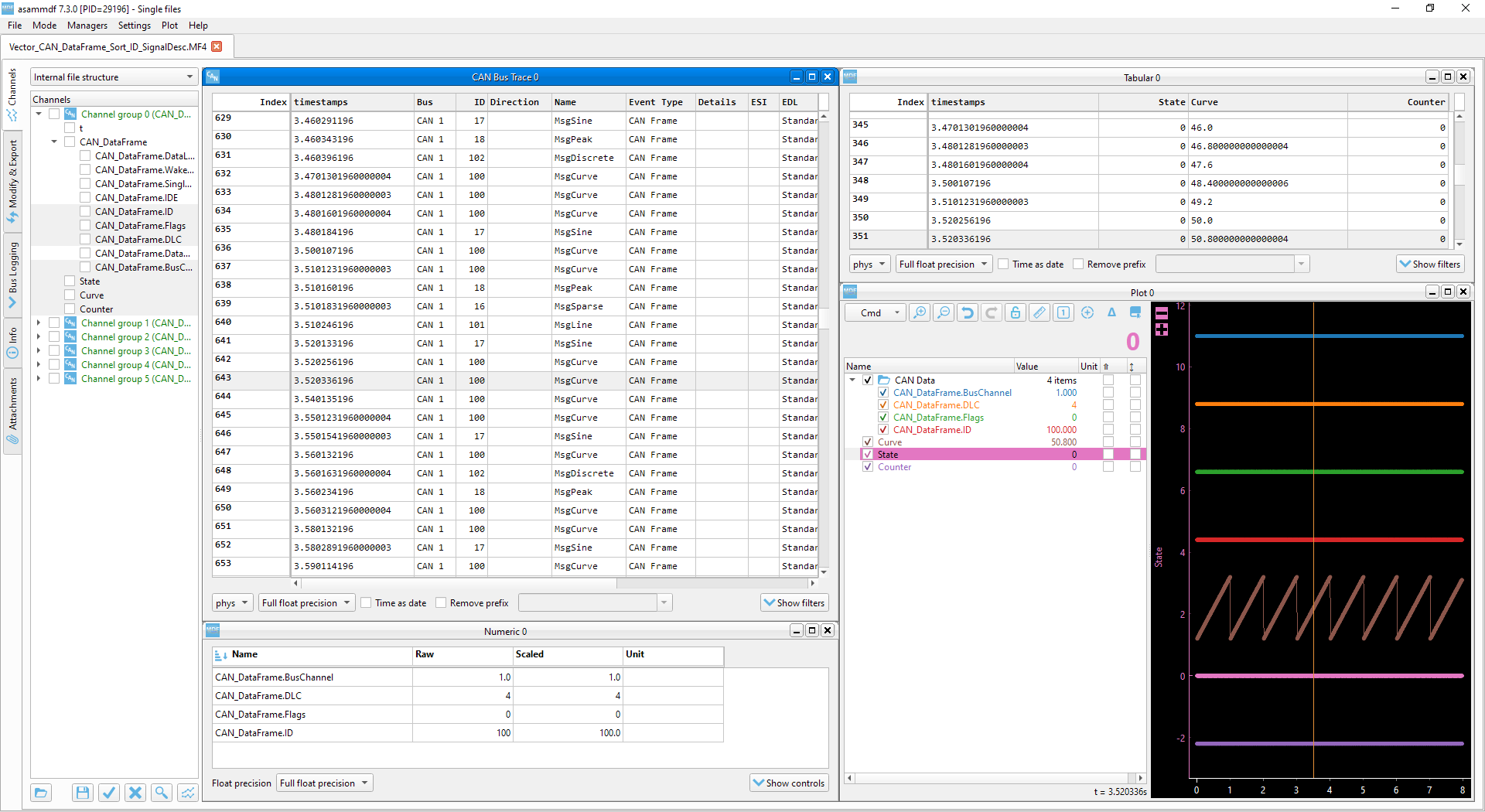
- graphical interface to visualize channels and perform operations with the files
Major features not implemented (yet)
- for version 3
- functionality related to sample reduction block: the sample reduction blocks are simply ignored
- for version 4
- experimental support for MDF v4.20 column oriented storage
- functionality related to sample reduction block: the sample reduction blocks are simply ignored
- handling of channel hierarchy: channel hierarchy is ignored
- full handling of bus logging measurements: currently only CAN and LIN bus logging are implemented with the ability to get signals defined in the attached CAN/LIN database (.arxml or .dbc). Signals can also be extracted from an anonymous bus logging measurement by providing a CAN or LIN database (.dbc or .arxml)
- handling of unfinished measurements (mdf 4): finalization is attempted when the file is loaded, however not all the finalization steps are supported
- full support for remaining mdf 4 channel arrays types
- xml schema for MDBLOCK: most metadata stored in the comment blocks will not be available
- full handling of event blocks: events are transferred to the new files (in case of calling methods that return new MDF objects) but no new events can be created
- channels with default X axis: the default X axis is ignored and the channel group's master channel is used
- attachment encryption/decryption using user provided encryption/decryption functions; this is not part of the MDF v4 spec and is only supported by this library
Usage
from asammdf import MDF

mdf = MDF('sample.mdf')
speed = mdf.get('WheelSpeed')
speed.plot()

important_signals = ['WheelSpeed', 'VehicleSpeed', 'VehicleAcceleration']
# get short measurement with a subset of channels from 10s to 12s
short = mdf.filter(important_signals).cut(start=10, stop=12)

# convert to version 4.10 and save to disk
short.convert('4.10').save('important signals.mf4')

# plot some channels from a huge file
efficient = MDF('huge.mf4')
for signal in efficient.select(['Sensor1', 'Voltage3']):
    signal.plot()
Check the examples folder for extended usage demo, or the documentation http://asammdf.readthedocs.io/en/master/examples.html
https://canlogger.csselectronics.com/canedge-getting-started/ce3/log-file-tools/asammdf-gui/
Documentation
http://asammdf.readthedocs.io/en/master
And a nicely written tutorial on the CSS Electronics site.
Contributing & Support
Please have a look at the contributing guidelines.
If you enjoy this library please consider making a donation to the numpy project or to danielhrisca using liberapay.

Contributors
Thanks to all who contributed with commits to asammdf:

Installation
asammdf is available on
- GitHub: https://github.com/danielhrisca/asammdf/
- PyPI: https://pypi.org/project/asammdf/
- conda-forge: https://anaconda.org/conda-forge/asammdf
pip install asammdf
# for the GUI
pip install asammdf[gui]
# or for anaconda
conda install -c conda-forge asammdf
In case a wheel is not present for your OS/Python versions and you lack the proper compiler setup to compile the C-extension code, then you can simply copy-paste the package code to your site-packages. In this way the Python fallback code will be used instead of the compiled C-extension code.
Dependencies
asammdf uses the following libraries
- numpy : the heart that makes all tick
- numexpr : for algebraic and rational channel conversions
- wheel : for installation in virtual environments
- pandas : for DataFrame export
- canmatrix : to handle CAN/LIN bus logging measurements
- natsort
- lxml : for canmatrix arxml support
- lz4 : to speed up the disk IO performance
- python-dateutil : measurement start time handling
Optional dependencies needed for exports
- h5py : for HDF5 export
- hdf5storage : for Matlab v7.3 .mat export
- pyarrow : for parquet export
- scipy: for Matlab v4 and v5 .mat export
Other optional dependencies
- PySide6 : for GUI tool
- pyqtgraph : for GUI tool and Signal plotting
- matplotlib : as fallback for Signal plotting
- chardet : to detect non-standard Unicode encodings
- pyqtlet2 : for the GPS window
- isal : for faster zlib compression/decompression
- fsspec : access files stored in the cloud
Benchmarks
1 maintainer

Metadata
1 maintainer
Release files for asammdf 8.8.28
For a detailed explanation of source distributions (sdists) and built distributions (wheels), please see the package formats documentation.
Source distribution (sdist)
| File | Size | Uploaded | Provenance | |
|---|---|---|---|---|
| asammdf-8.8.28.tar.gz | 11.7 MB | Without provenance | Details |
Built distributions (wheels)
| File | Reset | |||
|---|---|---|---|---|
| asammdf-8.8.28-cp310-abi3-win_amd64.whl | CPython 3.10 | abi3 | Windows x86-64 | Details |
| asammdf-8.8.28-cp310-abi3-manylinux2014_x86_64.manylinux_2_17_x86_64.manylinux_2_28_x86_64.whl | CPython 3.10 | abi3 | Linux glibc 2.17+ x86-64, Linux glibc 2.28+ x86-64 | Details |
| asammdf-8.8.28-cp310-abi3-manylinux2014_aarch64.manylinux_2_17_aarch64.manylinux_2_28_aarch64.whl | CPython 3.10 | abi3 | Linux glibc 2.17+ ARM64, Linux glibc 2.28+ ARM64 | Details |
| asammdf-8.8.28-cp310-abi3-macosx_11_0_arm64.whl | CPython 3.10 | abi3 | macOS 11.0+ ARM64 | Details |
Total release size: 17.1 MB
Release files / asammdf-8.8.28.tar.gz
| Download URL | asammdf-8.8.28.tar.gz |
|---|---|
| Size | 11.7 MB |
| Tags | Source |
|
SHA-256 checksum How to use checksums |
1b003b9be1622e4a15b9072c379da7e2cd2243adb5989087d1ff58a77b34ffb4
|
|
BLAKE2b-256 checksum How to use checksums |
4e14868c64220bfc984abdb998ecf49529c57ef8cb7316627a6ea958151aae79
|
| Upload date | |
|
Uploaded using Trusted Publishing? What is trusted publishing? |
No |
| Uploaded via |
twine/6.1.0 CPython/3.12.4
|
Release files / asammdf-8.8.28-cp310-abi3-win_amd64.whl
| Download URL | asammdf-8.8.28-cp310-abi3-win_amd64.whl |
|---|---|
| Size | 1.4 MB |
| Tags | CPython 3.10 Windows x86-64 abi3 |
|
SHA-256 checksum How to use checksums |
60a694741df57e7b8f666ba1d61cfb157102e0d998d41dc7664e57d94b09b0c2
|
|
BLAKE2b-256 checksum How to use checksums |
47d75cce69baa35f92f303c5980a065a39c5944a3e6ad6efa125d4c88f5fc869
|
| Upload date | |
|
Uploaded using Trusted Publishing? What is trusted publishing? |
No |
| Uploaded via |
twine/6.1.0 CPython/3.12.4
|
Release files / asammdf-8.8.28-cp310-abi3-manylinux2014_x86_64.manylinux_2_17_x86_64.manylinux_2_28_x86_64.whl
| Download URL | asammdf-8.8.28-cp310-abi3-manylinux2014_x86_64.manylinux_2_17_x86_64.manylinux_2_28_x86_64.whl |
|---|---|
| Size | 1.4 MB |
| Tags | CPython 3.10 Linux glibc 2.17+ x86-64 Linux glibc 2.28+ x86-64 abi3 |
|
SHA-256 checksum How to use checksums |
27ae91a909e6ccfb7eb5445ba54e0dfdb420fd017256d09365aea39f6ea6c3f4
|
|
BLAKE2b-256 checksum How to use checksums |
65e4e6bd52d9997873771e59c5cb50e44a368bfb2ce67723f3a3b654cffdfb1b
|
| Upload date | |
|
Uploaded using Trusted Publishing? What is trusted publishing? |
No |
| Uploaded via |
twine/6.1.0 CPython/3.12.4
|
Release files / asammdf-8.8.28-cp310-abi3-manylinux2014_aarch64.manylinux_2_17_aarch64.manylinux_2_28_aarch64.whl
| Download URL | asammdf-8.8.28-cp310-abi3-manylinux2014_aarch64.manylinux_2_17_aarch64.manylinux_2_28_aarch64.whl |
|---|---|
| Size | 1.4 MB |
| Tags | CPython 3.10 Linux glibc 2.17+ ARM64 Linux glibc 2.28+ ARM64 abi3 |
|
SHA-256 checksum How to use checksums |
77e7589c6994d61085af7ef5462014972d73d05c35eec9facf1acc19f3e0d3be
|
|
BLAKE2b-256 checksum How to use checksums |
27ee46c77fba3abd3b4d76ca6d34ed1915e276a2766df15ca3f943d94fcc263a
|
| Upload date | |
|
Uploaded using Trusted Publishing? What is trusted publishing? |
No |
| Uploaded via |
twine/6.1.0 CPython/3.12.4
|
Release files / asammdf-8.8.28-cp310-abi3-macosx_11_0_arm64.whl
| Download URL | asammdf-8.8.28-cp310-abi3-macosx_11_0_arm64.whl |
|---|---|
| Size | 1.3 MB |
| Tags | CPython 3.10 abi3 macOS 11.0+ ARM64 |
|
SHA-256 checksum How to use checksums |
ac4e6b7ce6c4a594c7799e9a9e888b046efbba32f88201fca9bdca3ac2c4311b
|
|
BLAKE2b-256 checksum How to use checksums |
64c71da8798d4a338a88d31fa8ddc635c7d1e9a0514c138a3abf522f7134c2b1
|
| Upload date | |
|
Uploaded using Trusted Publishing? What is trusted publishing? |
No |
| Uploaded via |
twine/6.1.0 CPython/3.12.4
|
Security for asammdf 8.8.28
Provenance
Provenance describes where a file came from. On PyPI, provenance is shared via attestations, which provide a verifiable record of the build or publishing details. View details, limitations and caveats.
No provenance found
None of the files in this release were uploaded with provenance metadata.
A note on package security
PyPI is a repository for distributing packages, not a service for auditing them. While third-party security researchers and our staff do their best to detect and remove malicious packages, PyPI cannot guarantee the quality, security or suitability of any given package.














