
Async Simple Agent Protocol - A streamlined protocol for agent-to-agent communication
Verified details
These details have been verified by PyPIProject links
GitHub Statistics
Maintainers

Project description
ASAP: Async Simple Agent Protocol
✨ From agents, for agents. Delivering reliability, as soon as possible.
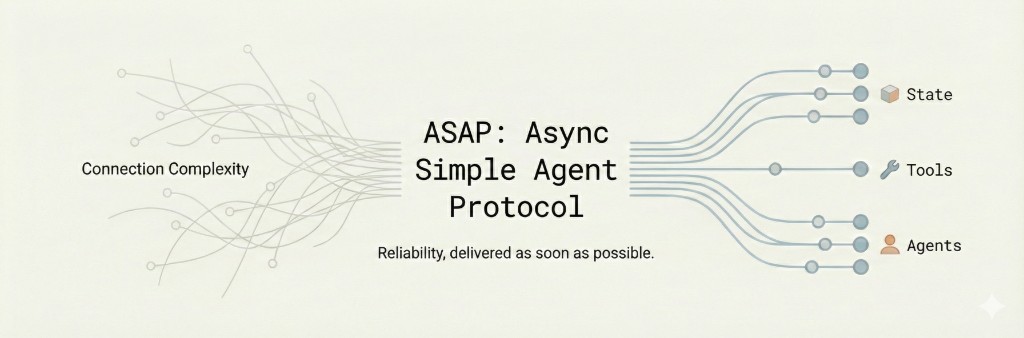
A production-ready protocol for agent-to-agent communication and task coordination.
Quick Info: v1.1.0 | Apache 2.0 | Python 3.13+ | Documentation | PyPI | Changelog
Why ASAP?
Building multi-agent systems today suffers from three core technical challenges that existing protocols like A2A don't fully address:
- $N^2$ Connection Complexity: Most protocols assume static point-to-point HTTP connections that don't scale.
- State Drift: Lack of native persistence makes it impossible to reliably resume long-running agentic workflows.
- Fragmentation: No unified way to handle task delegation, artifact exchange and tool execution (MCP) in a single envelope.
ASAP provides a production-ready communication layer that simplifies these complexities. It introduces a standardized, stateful orchestration framework that ensures your agents can coordinate reliably across distributed environments. See the spec for details.
Key Features
- Stateful orchestration — Task state machine with snapshotting for resumable workflows.
- Schema-first — Pydantic v2 + JSON Schema for cross-agent interoperability.
- Async-native —
asyncio+httpx; sync and async handlers supported. - MCP integration — Tool execution and coordination in a single envelope.
- Observable —
trace_idandcorrelation_idfor debugging. - Security — Bearer auth, OAuth2/JWT (v1.1), replay prevention, HTTPS, rate limiting. v1.1 Security Model (trust limits, Custom Claims).
Installation
We recommend using uv for dependency management:
uv add asap-protocol
Or with pip:
pip install asap-protocol
📦 Available on PyPI. For reproducible environments, prefer uv when possible.
Requirements
- Python: 3.13+
- Dependencies: Automatically installed via
uvorpip - For development: see Contributing.
- For AI agents: see AGENTS.md for project instructions.
Quick Start
1. Create an Agent (Server)
from asap.models.entities import Capability, Endpoint, Manifest, Skill
from asap.transport.handlers import HandlerRegistry, create_echo_handler
from asap.transport.server import create_app

manifest = Manifest(
    id="urn:asap:agent:echo-agent",
    name="Echo Agent",
    version="1.0.0",
    description="Echoes task input as output",
    capabilities=Capability(
        asap_version="0.1",
        skills=[Skill(id="echo", description="Echo back the input")],
        state_persistence=False,
    ),
    # Development: HTTP localhost is allowed
    # Production: Always use HTTPS (e.g., "https://api.example.com/asap")
    endpoints=Endpoint(asap="http://127.0.0.1:8001/asap"),
)

registry = HandlerRegistry()
registry.register("task.request", create_echo_handler())

app = create_app(manifest, registry)
2. Send a Task (Client)
import asyncio
from asap.models.envelope import Envelope
from asap.models.payloads import TaskRequest
from asap.transport.client import ASAPClient

async def main():
    request = TaskRequest(
        conversation_id="conv_01HX5K3MQVN8",
        skill_id="echo",
        input={"message": "hello from client"},
    )
    envelope = Envelope(
        asap_version="0.1",
        sender="urn:asap:agent:client",
        recipient="urn:asap:agent:echo-agent",
        payload_type="task.request",
        payload=request.model_dump(),
    )
    # Development: HTTP localhost is allowed (with warning)
    # Production: Always use HTTPS (e.g., "https://api.example.com")
    async with ASAPClient("http://127.0.0.1:8001") as client:
        response = await client.send(envelope)
        print(response.payload)

if __name__ == "__main__":
    asyncio.run(main())
Try it
Run the multi-agent demo (echo agent + coordinator, one round-trip):
uv run python -m asap.examples.run_demo
Run any of 14+ examples (auth, MCP, state migration, etc.):
uv run python -m asap.examples.<module_name> [options]
See the full list of 15+ examples for detailed patterns.
| Category | Examples |
|---|---|
| Core | run_demo, echo_agent, coordinator, secure_handler |
| Orchestration | orchestration (multi-agent, task coordination, state tracking) |
| State | long_running (checkpoints, resume after crash), state_migration (move state between agents) |
| Resilience | error_recovery (retry, circuit breaker, fallback) |
| Integration | mcp_client_demo (stdio), mcp_integration (ASAP envelopes) |
| Auth & limits | auth_patterns (Bearer, OAuth2), rate_limiting, secure_agent (OAuth2 + Custom Claims) |
| Concepts | websocket_concept, streaming_response, multi_step_workflow |
Testing
uv run pytest -n auto --tb=short
With coverage:
uv run pytest --cov=src --cov-report=term-missing
Testing Guide (structure, fixtures, property/load/chaos tests). Contributing (dev setup, CI).
Benchmarks
Benchmark Results: load (1,500+ RPS), stress, memory.
API Overview
Core models: Envelope, TaskRequest/TaskResponse/TaskUpdate/TaskCancel, MessageSend, ArtifactNotify, StateQuery/StateRestore, McpToolCall/McpToolResult/McpResourceFetch/McpResourceData, MessageAck (WebSocket ack). See API Reference.
Transport: create_app, HandlerRegistry, ASAPClient, WebhookDelivery/WebhookRetryManager, WebSocket client/server. Discovery: well-known manifest, GET /.well-known/asap/health, Lite Registry. See Transport and Docs index.
When to use ASAP?
ASAP is ideal for:
- Multi-agent orchestration: Coordinate tasks across multiple AI agents
- Stateful workflows: Long-running tasks that need persistence and resumability
- MCP integration: Agents that need to execute tools via Model Context Protocol
- Production systems: High-performance, type-safe agent communication
If you're building simple point-to-point agent communication, a basic HTTP API might suffice. ASAP shines when you need orchestration, state management and multi-agent coordination.
Documentation
Learn
- Docs | API Reference
- Tutorials — First agent to production checklist
- Migration from A2A/MCP
Deep Dive
- State Management | Best Practices: Failover & Migration | Error Handling
- Transport | Security | v1.1 Security Model (OAuth2 trust, Custom Claims, ADR-17)
- Observability | Testing
Decisions & Operations
- ADRs — 17 Architecture Decision Records
- Tech Stack — Rationale for Python, Pydantic, Next.js choices
- Deployment | Troubleshooting
Release
CLI
asap --version          # Show version
asap list-schemas       # List all available schemas
asap export-schemas     # Export JSON schemas to file
See CLI docs or run asap --help.
v1.1 adds OAuth2, WebSocket, Discovery (well-known + Lite Registry), State Storage (SQLite), and Webhooks. See docs index and v1.1 Security Model for details.
What's Next? 🔭
ASAP is evolving toward an Agent Marketplace — an open ecosystem where AI agents discover, trust and collaborate autonomously:
- v1.1: Identity Layer (OAuth2, WebSocket, Discovery)
- v1.2: Trust Layer (Signed Manifests, Registry API)
- v1.3: Economics Layer (Metering, SLAs, Delegation)
- v2.0: Agent Marketplace with Web App
See our vision document for the full roadmap.
Contributing
Community feedback and contributions are essential for ASAP Protocol's evolution.
We're working on improvements and your input helps shape the future of the protocol. Every contribution, from bug reports to feature suggestions, documentation improvements and code contributions, makes a real difference.
Check out our contributing guidelines to get started. It's easier than you think! 🚀
License
This project is licensed under the Apache 2.0 License - see the license file for details.
Built with Cursor using Composer 1.5, Claude Sonnet/Opus 4.5/4.6, Gemini 3.0 Pro and Kimi K2.5.
Project details
Verified details
These details have been verified by PyPIProject links
GitHub Statistics
Maintainers
Release history Release notifications | RSS feed


Download files
Download the file for your platform. If you're not sure which to choose, learn more about installing packages.
Source Distribution
Built Distribution
Filter files by name, interpreter, ABI, and platform.
If you're not sure about the file name format, learn more about wheel file names.
Copy a direct link to the current filters
File details
Details for the file asap_protocol-1.1.0.tar.gz.
File metadata
- Download URL: asap_protocol-1.1.0.tar.gz
- Upload date:
- Size: 1.0 MB
- Tags: Source
- Uploaded using Trusted Publishing? Yes
- Uploaded via: twine/6.1.0 CPython/3.13.7
File hashes
| Algorithm | Hash digest | |
|---|---|---|
| SHA256 |
923e1c87abaaeac0565f85d62291f4d9ed6eb2a142d2c478542b7a896f50814c
|
|
| MD5 |
cb777b33c6e683bedbe5a5b9cbda040b
|
|
| BLAKE2b-256 |
efc2e6d6a798e53d3bd1f398b94d87704ed51e211af9647d604889b5a5998d5f
|
Provenance
The following attestation bundles were made for asap_protocol-1.1.0.tar.gz:
Publisher:
release.yml on adriannoes/asap-protocol
-
Statement:
-
Statement type:
https://in-toto.io/Statement/v1 -
Predicate type:
https://docs.pypi.org/attestations/publish/v1 -
Subject name:
asap_protocol-1.1.0.tar.gz -
Subject digest:
923e1c87abaaeac0565f85d62291f4d9ed6eb2a142d2c478542b7a896f50814c - Sigstore transparency entry: 938969702
- Sigstore integration time:
-
Permalink:
adriannoes/asap-protocol@8e9891dc7945b6b011a0a2908ab99f1fdd6d6986 -
Branch / Tag:
refs/tags/v1.1.0 - Owner: https://github.com/adriannoes
-
Access:
public
-
Token Issuer:
https://token.actions.githubusercontent.com -
Runner Environment:
github-hosted -
Publication workflow:
release.yml@8e9891dc7945b6b011a0a2908ab99f1fdd6d6986 -
Trigger Event:
push
-
Statement type:
File details
Details for the file asap_protocol-1.1.0-py3-none-any.whl.
File metadata
- Download URL: asap_protocol-1.1.0-py3-none-any.whl
- Upload date:
- Size: 219.4 kB
- Tags: Python 3
- Uploaded using Trusted Publishing? Yes
- Uploaded via: twine/6.1.0 CPython/3.13.7
File hashes
| Algorithm | Hash digest | |
|---|---|---|
| SHA256 |
3fac5976e8c48d411016f4dd39f9824a1876c6868fe0e76e49011e772903489e
|
|
| MD5 |
0685134184ffa660ae10a0e111f10817
|
|
| BLAKE2b-256 |
b1a463dbfa69c86e2e4835c8445a773b358c7d0c69aabe064a57a16b00b2cd17
|
Provenance
The following attestation bundles were made for asap_protocol-1.1.0-py3-none-any.whl:
Publisher:
release.yml on adriannoes/asap-protocol
-
Statement:
-
Statement type:
https://in-toto.io/Statement/v1 -
Predicate type:
https://docs.pypi.org/attestations/publish/v1 -
Subject name:
asap_protocol-1.1.0-py3-none-any.whl -
Subject digest:
3fac5976e8c48d411016f4dd39f9824a1876c6868fe0e76e49011e772903489e - Sigstore transparency entry: 938969713
- Sigstore integration time:
-
Permalink:
adriannoes/asap-protocol@8e9891dc7945b6b011a0a2908ab99f1fdd6d6986 -
Branch / Tag:
refs/tags/v1.1.0 - Owner: https://github.com/adriannoes
-
Access:
public
-
Token Issuer:
https://token.actions.githubusercontent.com -
Runner Environment:
github-hosted -
Publication workflow:
release.yml@8e9891dc7945b6b011a0a2908ab99f1fdd6d6986 -
Trigger Event:
push
-
Statement type:






