
ASI-Proxy Phase Growth Simulator
A Python research simulator for Monte Carlo scenario analysis, uncertainty quantification, sensitivity analysis, and interactive risk modeling under verification, provenance, memory, coordination, debt, hazard, and finite-resource constraints.
This project does not predict ASI, estimate when superintelligence will appear, or certify that any system is ASI. It models a protocol-relative operational proxy in synthetic scenarios.





Start here
The simulator treats agent output as candidate work, not as capability capital. Candidate work must pass limited verification, independent-trust, provenance, temporal-validity, causal-support, and reuse gates. Unresolved work becomes visible residual debt. Capital also consumes resources and can decay through evidence expiry, memory staleness, monoculture, and incidents.
This makes the tool useful for questions such as:
- What happens with no OSS intervention?
- Does verification keep pace with candidate generation?
- Which readiness dimension is binding?
- Do intervention benefits survive their implementation and operating costs?
- Which module has the largest marginal contribution inside the model after overlap correction?
- Does a candidate regime survive expiry, monoculture, memory, coordination, or resource shocks?
Every answer is conditional on the scenario and model structure. It is not a world forecast.
Common use cases include scientific computing, research software validation, resource-constrained growth simulation, open-source intervention analysis, reproducible experiments, and interactive Streamlit dashboards.
Install from PyPI
Python 3.12 or 3.13 and uv are recommended:
uv tool install asi-proxy-phase-growth-simulator
apxsim doctor
apxsim gui
To run a one-off command without a persistent installation:
uvx --from asi-proxy-phase-growth-simulator apxsim doctor
Install from source
Python 3.12 or 3.13 is required. uv is the sole supported environment manager.
git clone https://github.com/kadubon/asi-proxy-phase-growth-simulator.git
cd asi-proxy-phase-growth-simulator
uv sync --frozen --all-extras --group dev
During local development, omit --frozen only when intentionally updating uv.lock:
uv sync --all-extras --group dev
No requirements.txt, database, cloud SDK, LLM API, secret, or external service is required.
Launch the Streamlit interface
uv run streamlit run streamlit_app.py
or:
uv run apxsim gui
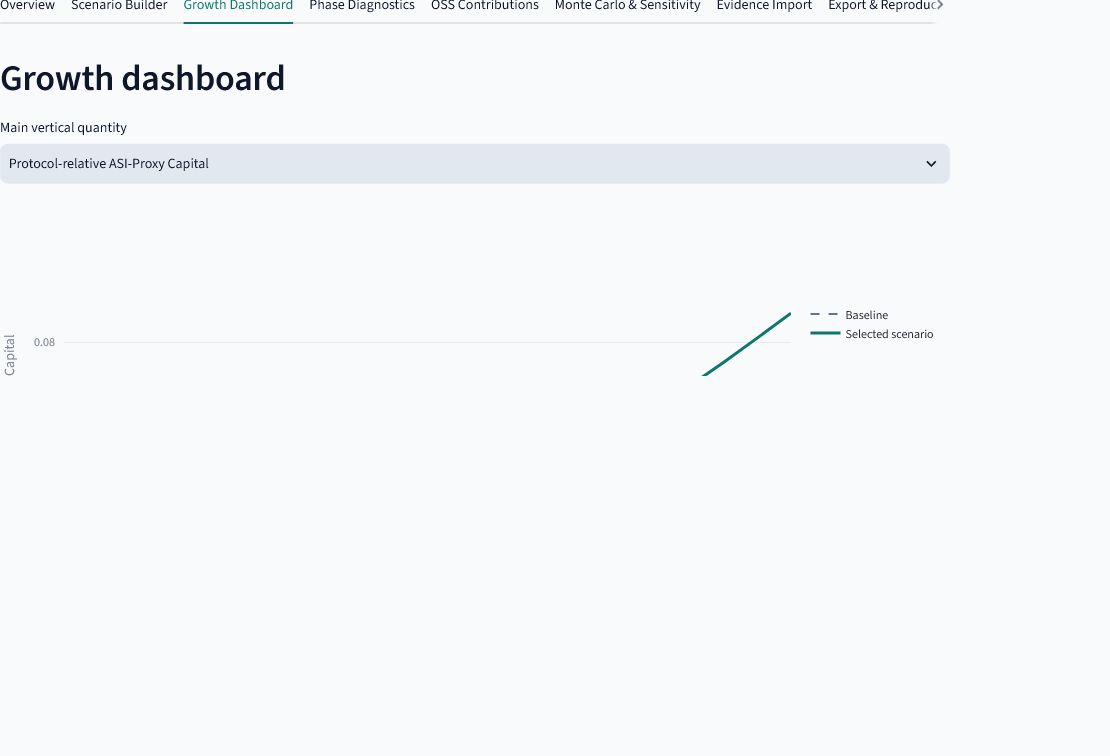
The interface has nine tabs:
- Overview
- Scenario Builder
- Growth Dashboard
- Phase Diagnostics
- OSS Contributions
- Monte Carlo & Sensitivity
- Evidence Import
- Export & Reproducibility
- About & Limitations
All major controls show plain-language labels, technical names, ranges, units, directions, and assumption warnings. The app performs local computation, has no telemetry, and limits JSON uploads to 1 MB in memory.
Command-line examples
uv run apxsim run --preset baseline --out outputs/baseline
uv run apxsim run --scenario scenario.json --out outputs/custom
uv run apxsim compare --baseline baseline.json --candidate candidate.json
uv run apxsim monte-carlo --scenario scenario.json --runs 300 --seed 42
uv run apxsim ablate --scenario scenario.json
uv run apxsim sensitivity --scenario scenario.json
uv run apxsim validate --preset baseline
uv run apxsim catalog list
uv run apxsim catalog validate
uv run apxsim evidence validate evidence.json
uv run apxsim report outputs/custom/result.json --out report.md
uv run apxsim doctor
Each command accepts --json and --deterministic/--stochastic. Commands return non-zero exit
codes for invalid inputs or failed validation.
Model in plain language
The main state contains:
- gross certified reusable capability capital;
- problem-frame quality;
- availability bandwidth;
- coordination integrity;
- verification capacity;
- effective verifier independence;
- provenance integrity;
- certified-memory retention;
- temporal integrity;
- causal support;
- residual debt;
- hazard pressure; and
- a finite resource stock.
Candidate generation is resource-saturated and depends on capital, framing, availability, coordination, and certified memory:
Q = q0 × B/(B + κB) × (1 + λK log(1 + K)) × F^aF × W^aW × C^aC × M^aM
Verification coverage is verification throughput divided by candidate flow, capped at one. Verified yield also depends on independence, provenance, temporal validity, causal support, and hazard pressure. Only verified, reusable yield enters capital. Unknown and rejected work enters residual debt rather than disappearing.
Euler and RK4 are available as reproducible fixed-step integrators. RK4 is the default. The CLI
validation command compares dt with dt/2 as a convergence check.
See Model reference for equations, units, update order, and boundary handling.
Main vertical quantity
A(t) = K(t) × Φ(t)
A: Protocol-relative ASI-Proxy Capital.K: gross certified reusable capability capital.Φ: phase readiness after a bottleneck-sensitive 13-dimensional profile and residual penalty.
The 13 dimensions are inspired by the Collective Phase Control Fabric concepts but are an
operational mapping inside this simulator—not CPCF scientific certification. The default
generalized mean uses p = -4, so a weak dimension constrains the total more strongly than it
would under an arithmetic mean. The arithmetic mean is shown only for comparison.
The capability reproduction number is:
R_cap = certified inflow / (natural decay + verifier-monoculture loss + epsilon)
R_cap > 1 means inflow exceeds losses inside the current model. It is not sufficient for the
candidate regime and is never interpreted as ASI attainment.
Candidate regime gate
The label candidate ASI-proxy growth regime appears only after all of the following hold for a
configured duration:
- phase readiness reaches its threshold;
R_cap > 1;- residual debt relative to capital remains below its threshold;
- verification coverage reaches its threshold;
- resources remain above their floor;
- no critical unknown is unresolved; and
- the conditions persist for
hold_steps.
The label is an operational scenario result, not a scientific proof of a phase transition.
OSS intervention catalog
The catalog contains semantic mappings for:
| ID | Module | Primary modeled role |
|---|---|---|
pic |
Percolation Inversion Compiler | verification, residual repair, safe reuse |
ccr |
Collective Capability Runtime | coordination, recovery, independence |
cpcf |
Collective Phase Control Fabric | diagnostics, gates, unknown preservation |
alt_foundry |
ALT Foundry Kernel | reusable certified abstraction capital |
cgt_bandwidth |
CGT Bandwidth Dynamics | constraint bandwidth and continuation |
cgt_availability |
CGT Availability | deficiency and comparison readiness |
problem_frame_gate |
Problem Frame Gate | problem framing and waste/risk routing |
verification_ecology |
Verification Ecology Kit | verifier diversity and counter-checks |
fost_ledger |
FOST Agent Ledger | provenance and unresolved obligations |
future_claim_certifier |
Future Claim Certifier | expiry and temporal authority |
observable_workflow_memory |
Observable Agent Workflow Memory | evidence-bound procedural reuse |
memoryflow_auditor |
MemoryFlow Agent Memory Auditor | memory contamination auditing |
certified_memory_governance |
Certified Memory Governance Layer | revocation and retention governance |
atrb_calibration |
Agent Trust and Residual Benchmark | system-level calibration only |
Effects are conservative theory_mapped_assumption synthetic priors. Modules in the same overlap
group use the maximum effect, not a sum. Different groups use a bounded union. Synergy is zero
unless explicitly specified. All modules have implementation and operating costs.
ATRB conditions are cumulative. Intermediate condition differences are never converted into individual module effects.
See OSS mapping and reference audit.
Scenario presets
- Baseline
- Trust and Verification Foundation
- Collective Runtime Stack
- Reusable Capital Stack
- Full Conservative Stack
- Fast Candidates / Weak Verification
- Verifier Monoculture Shock
- Evidence Expiry Shock
- Memory Poisoning Shock
- Resource-Constrained Full Stack
Every preset is synthetic and normalized. None is a forecast.
Unknowns and uncertainty
Typed inputs distinguish KnownScalar, ProbabilityDistribution, BoundedInterval, and
UnknownValue. Unknowns are not silently converted to zero, a midpoint, or a safe-looking value.
The default policy is no imputation. A bounded unknown may be sampled only when the user explicitly
chooses the sample policy; outputs are then labelled imputed.
Seeded Monte Carlo uses NumPy Generator and reports median, p10–p90, p2.5–p97.5, final
distributions, threshold-time distribution, no-transition fraction, resource exhaustion, failed
runs, and an operational false-promotion incident indicator. These bands represent uncertainty
inside the model, not total real-world uncertainty.
Sensitivity tools include one-at-a-time tornado data, Spearman rank correlation, leave-one-module- out ablation, and seeded approximate Shapley attribution for at most 12 modules.
Evidence import and calibration
The project follows:
semantic integration first
artifact adapter second
hard runtime dependency last
PIC, ATRB, and generic-status adapters normalize JSON without importing source OSS packages. Missing and incompatible fields remain unknown. Calibration rejects expired, out-of-scope, or non-causally-identified observations for module-specific effect updates. Non-resource-matched comparisons receive lower weight. The documented optional update is transparent inverse-variance shrinkage; prior and posterior are both retained.
Exports
Each run can export:
- scenario JSON;
- result JSON;
- flat result CSV;
- metrics JSON;
- Markdown report;
- provenance manifest; and
- SHA-256 digest manifest.
Exports record software version, seed, selected modules, assumptions, event order, and unresolved unknowns. A safety scan rejects common absolute local paths and secret-assignment patterns.
Testing and quality checks
uv run ruff format --check .
uv run ruff check .
uv run mypy src
uv run pytest --cov=asi_proxy_sim --cov-fail-under=90
uv run bandit -r src
uv run pip-audit
uv run python -m compileall -q src
uv run apxsim catalog validate
uv run apxsim validate --preset baseline
uv build
uv run twine check dist/*
The suite covers bounds, reproducibility, no-module effects, zero adoption, unknown preservation, resource matching, overlap, synergy defaults, phase monotonicity, debt penalty, inflow limits, convergence, shocks, Monte Carlo, adapters, CLI, and Streamlit import/render smoke tests. Coverage configuration and justified exclusions are documented in Validation.
Streamlit Community Cloud configuration
This repository is prepared for, but not deployed to, Streamlit Community Cloud. Use:
- Repository:
asi-proxy-phase-growth-simulator - Branch:
main - Main file:
streamlit_app.py - Python:
3.12
The canonical environment is pyproject.toml plus uv.lock. Do not add a competing
requirements.txt unless deployment testing proves it necessary and its generation source is
documented. Public hosting should occur only after the human checks below.
Human checks before public release
- Confirm repository links, maintainer attribution, and private vulnerability-reporting access.
- Have a domain reviewer examine every synthetic coefficient, operational threshold, non-claim, and source mapping; record disagreements rather than presenting consensus that does not exist.
- Confirm that the dashboard screenshot was generated from a reviewed, non-sensitive scenario and does not expose local paths or private data.
- Re-run the full quality commands on the exact release commit and inspect the built wheel and source archive; verify that no credentials, private inputs, absolute paths, or generated outputs are present.
- Before any public hosting, review the host's current terms, logging/privacy behavior, Python and resource limits, dependency installation path, and abuse controls. Do not upload secrets or confidential evidence.
Scientific limits
- This is not an ASI forecast, probability model, or certification system.
- It does not perform real-world causal inference.
- Most effect priors are assumptions, not measurements.
- Repository quality, stars, commits, and lines of code are not effect sizes.
- Cross-module interactions are incompletely identified.
- Phase thresholds are operational choices.
- Prediction bands are model-internal uncertainty bands.
- Structural uncertainty is only partly represented.
- Not every social, physical, or economic constraint is included.
- Implemented software does not guarantee successful adoption or benefit.
Read Limitations before interpreting results.
Security and privacy
There are no external API calls, telemetry, analytics, secrets, arbitrary code execution, pickle uploads, or unsafe YAML loaders. Uploaded scenario/evidence JSON is size-limited, decoded in memory, and schema-validated. See SECURITY.md for the threat model.
Documentation
- Japanese guide / 日本語ガイド
- Model reference
- Theory mapping
- OSS mapping
- Assumptions
- Validation
- Uncertainty
- GUI guide
- CLI guide
- Developer guide
- Limitations
- Security notes
License and citation
Licensed under Apache-2.0. See LICENSE and NOTICE.
Citation metadata is provided in CITATION.cff and codemeta.json. Until a public archive DOI exists, cite the versioned repository and commit used. Do not invent a DOI or imply external scientific validation.
1 maintainer

Download files
Download the file for your platform. If you're not sure which to choose, learn more about installing packages.
Source Distribution
Built Distribution
Filter files by name, interpreter, ABI, and platform.
If you're not sure about the file name format, learn more about wheel file names.
Copy a direct link to the current filters
File details
Details for the file asi_proxy_phase_growth_simulator-0.1.0.tar.gz.
File metadata
- Download URL: asi_proxy_phase_growth_simulator-0.1.0.tar.gz
- Upload date:
- Size: 186.8 kB
- Tags: Source
- Uploaded using Trusted Publishing? Yes
- Uploaded via:
twine/6.1.0 CPython/3.13.14
File hashes
| Algorithm | Hash digest | |
|---|---|---|
| SHA256 |
d8409b1e0e2248777c53ce071f277c82f2eae659ac997c87e4a77bd8b21e26ee
|
|
| MD5 |
dade95eaf58530934165b4c12f0be7c8
|
|
| BLAKE2b-256 |
8d84a2198761801d1b1ada755784c16e2277bf8169ae4a10804c07da0c477be6
|
Provenance
The following attestation bundles were made for asi_proxy_phase_growth_simulator-0.1.0.tar.gz:
Publisher:
workflow.yml on kadubon/asi-proxy-phase-growth-simulator
-
Statement:
-
Statement type:
https://in-toto.io/Statement/v1 -
Predicate type:
https://docs.pypi.org/attestations/publish/v1 -
Subject name:
asi_proxy_phase_growth_simulator-0.1.0.tar.gz -
Subject digest:
d8409b1e0e2248777c53ce071f277c82f2eae659ac997c87e4a77bd8b21e26ee - Sigstore transparency entry: 2210271450
- Sigstore integration time:
-
Permalink:
kadubon/asi-proxy-phase-growth-simulator@d99f6a7158bc3b200e1c233a4154eddf96a3d77d -
Branch / Tag:
refs/tags/v0.1.0 - Owner: https://github.com/kadubon
-
Access:
public
-
Token Issuer:
https://token.actions.githubusercontent.com -
Runner Environment:
github-hosted -
Publication workflow:
workflow.yml@d99f6a7158bc3b200e1c233a4154eddf96a3d77d -
Trigger Event:
release
-
Statement type:
File details
Details for the file asi_proxy_phase_growth_simulator-0.1.0-py3-none-any.whl.
File metadata
- Download URL: asi_proxy_phase_growth_simulator-0.1.0-py3-none-any.whl
- Upload date:
- Size: 82.3 kB
- Tags: Python 3
- Uploaded using Trusted Publishing? Yes
- Uploaded via:
twine/6.1.0 CPython/3.13.14
File hashes
| Algorithm | Hash digest | |
|---|---|---|
| SHA256 |
3d90e7022ca98cb849491093eff3db05353ced0c9ff7e8aa28558d899990e5fc
|
|
| MD5 |
b3522b609468fc5f7017867225d721bf
|
|
| BLAKE2b-256 |
0ccf6036cc2678421a7aaaeb3e16942e03d4045bd7d391d09d44c75cf0c85341
|
Provenance
The following attestation bundles were made for asi_proxy_phase_growth_simulator-0.1.0-py3-none-any.whl:
Publisher:
workflow.yml on kadubon/asi-proxy-phase-growth-simulator
-
Statement:
-
Statement type:
https://in-toto.io/Statement/v1 -
Predicate type:
https://docs.pypi.org/attestations/publish/v1 -
Subject name:
asi_proxy_phase_growth_simulator-0.1.0-py3-none-any.whl -
Subject digest:
3d90e7022ca98cb849491093eff3db05353ced0c9ff7e8aa28558d899990e5fc - Sigstore transparency entry: 2210271465
- Sigstore integration time:
-
Permalink:
kadubon/asi-proxy-phase-growth-simulator@d99f6a7158bc3b200e1c233a4154eddf96a3d77d -
Branch / Tag:
refs/tags/v0.1.0 - Owner: https://github.com/kadubon
-
Access:
public
-
Token Issuer:
https://token.actions.githubusercontent.com -
Runner Environment:
github-hosted -
Publication workflow:
workflow.yml@d99f6a7158bc3b200e1c233a4154eddf96a3d77d -
Trigger Event:
release
-
Statement type:







