

Fully typed fluent assertion library for Python
A modern, batteries-included fork of assertpy








Quick start
pip install assertpy2 # drop-in replacement for assertpy, just change the import
from assertpy2 import assert_that

def test_user():
    user = {"name": "Alice", "age": 30, "roles": ["viewer", "editor"]}

    assert_that(user).contains_key("name", "age")
    assert_that(user).contains_entry({"name": "Alice"})
    assert_that(user["age"]).is_between(18, 120)
    assert_that(user["roles"]).contains("viewer").does_not_contain("admin")
The full documentation covers every assertion, matcher, and integration.
|
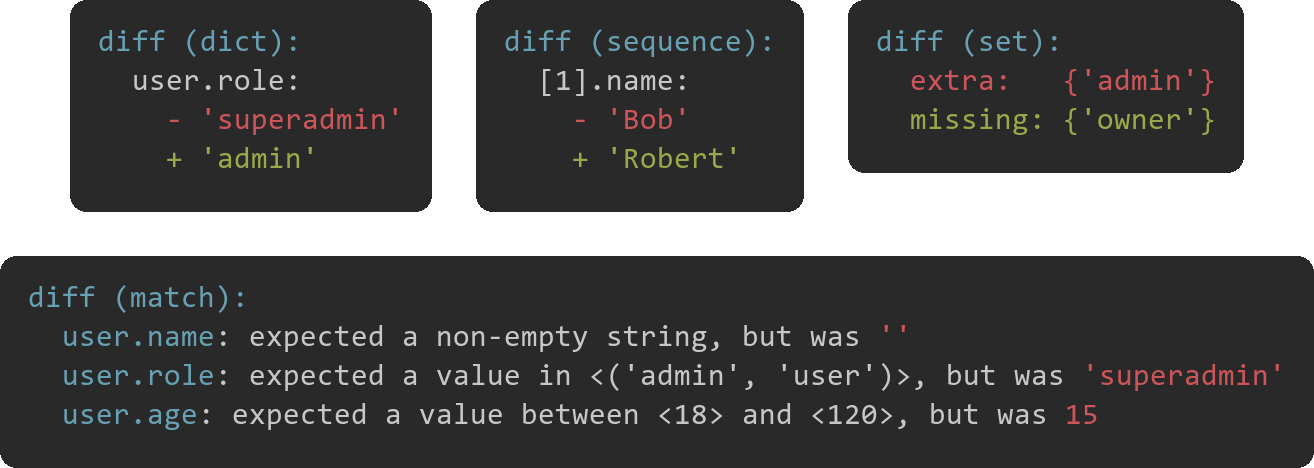
Failures that point at the difference A recursive diff names the exact path that differs, in color, instead of dumping both structures. |
Type-aware autocompleteassert_that() returns a protocol per value type, so your IDE offers the methods that fit.
|
|
Typed narrowing An assertion hands the value back statically narrowed, with no cast and no bare assert.
|
Composable matchers 45 matchers that combine with &, |, ~ and nest inside the expected structure itself.
|
|
Built for test suites Soft assertions, polling for eventual consistency, snapshots, and expected-exception chains. |
Integrations Allure, Behave, JSON Path and Schema, pandas, polars, numpy, and OpenAPI response contracts. |
Why fluent assertions?
assert states a condition well, and pytest reports it well.
What it cannot say is where two structures differ. It prints both and leaves the reading to you:
assert response == expected
E   AssertionError: assert {'id': 1, ...} == {'id': 1, ...}
E     Omitting 1 identical items, use -vv to show
E     Differing items:
E     {'user': {'name': 'Alice', 'role': 'superadmin'}} != {'user': {'name': 'Alice', 'role': 'admin'}}
E     {'status': 'active'} != {'status': 'disabled'}
assertpy2 names the exact path, in color:
assert_that(response).is_equal_to(expected)
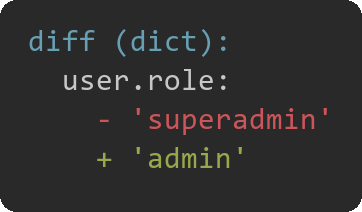
It recurses through nested containers, and matcher predicates get the same treatment.
For dynamic fields like IDs, assert a subset with
matches_structure().
The chain is the other half: one statement carries the whole intent, and your IDE offers only the methods that fit the value.
assert_that(items).is_instance_of(list).is_length(3).contains("admin")
Matchers are ordinary values that answer ==, the way unittest.mock.ANY does.
Nothing is patched, so a matcher can sit inside the expected structure itself, at any depth:
response = {"id": 7, "user": {"name": "Alice", "age": 30}, "tags": ["a", "b"]}

assert_that(response).is_equal_to(
    {
        "id": match.greater_than(0),
        "user": {"name": "Alice", "age": match.between(18, 120)},
        "tags": ["a", "b"],
    }
)

# or keep the bare `assert`, and pytest's own rewriting reports it
assert response == {
    "id": match.greater_than(0),
    "user": match.ignore(),
    "tags": ["a", "b"],
}
The fluent form keeps the path-level diff, the bare form keeps pytest's.
There are 45 matchers, combining with &, | and ~.
Type-aware autocomplete
assert_that() uses @overload to return type-specific Protocols.
Your IDE shows only methods relevant to the value you're testing, not all 100+:
assert_that("hello").→ string methods:starts_with,matches,is_alpha, ...assert_that(42).→ numeric methods:is_positive,is_between,is_close_to, ...assert_that(Path("/tmp")).→ path methods:exists,is_file,is_readable, ...assert_that(my_dict).→ dict methods:contains_key,contains_entry,has_json_path, ...assert_that(b"\x89PNG").→ bytes methods:starts_with_bytes,is_valid_utf8,decoded_as, ...
15 type-specific Protocols instead of one Any.
Works in PyCharm, VS Code, and any LSP-compatible editor.
Typed narrowing
An assertion hands the value back, statically narrowed.
is_not_none() strips None, is_instance_of() narrows to the class, and .value returns it:
order = assert_that(repo.find(42)).is_not_none().is_instance_of(PaidOrder).value
order.refund()  # statically PaidOrder - verified by ty, mypy, and pyright
For API tests,
assert_conforms()
validates a payload against a Pydantic model and narrows to it. exact=True catches contract drift:
data = assert_conforms(response.json(), OrderModel).value # data: OrderModel
A failure you can read from code
An exception is the right default, and a dead end for anything that wants to read the result.
check() runs the next assertion for its verdict instead:
response = {"user": {"name": "Alice", "role": "superadmin"}, "status": "active"}
expected = {"user": {"name": "Alice", "role": "admin"}, "status": "active"}

outcome = assert_that(response).check().is_equal_to(expected)

if not outcome and outcome.diff:
    print(outcome.diff.entries[0].path)  # user.role
It is truthy when the assertion held. When it did not, it carries .message, .actual, .expected
and a walkable .diff, and so does AssertionFailure.
So a reporter reads structure instead of parsing a string. That is how the Allure integration works, and it is open to anything else you build.
Features
Fluent API
- Structural matching:
matches_structure()for declarative dict/API-response validation. - Recursive field assertions:
all_fields_satisfy()/has_no_none_fields()apply a predicate to every leaf of an object graph. - Vacuous-assertion guard:
--assertpy2-vacuouswarns when a universal assertion passes over an empty collection, having checked nothing. - Dangling-assertion detector:
--assertpy2-danglingwarns when a chain builds an assertion and never runs it.assert assert_that(x).is_positivepasses on any value, and neither ruff nor coverage sees it. - Universal negation:
.not_inverts any assertion, no dedicatedis_not_*methods. - Collection pipeline:
filtered_on(),mapped(),flat_mapped(),first(),last(),element(),single(). - Positional & pairwise checks:
satisfies_exactly(),zip_satisfies(),contains_only_once(),has_same_size_as(), plus*_in_any_ordervariants.
Type safety
- Refinement predicates:
satisfies()takes aTypeIspredicate, so a domain check narrows the chain too. - Contract testing:
assert_conforms()validates a raw payload against a Pydantic model and narrows to it.exact=Truecatches contract drift,each=Truevalidates list endpoints.
Built-in types
- Strings, numbers, lists, tuples, sets, dicts, dates, booleans, objects, bytes, files, exceptions.
- Bytes assertions:
is_valid_utf8(),starts_with_bytes(),is_hex_equal_to(),decoded_as()forbytes/bytearray. - Dynamic assertions:
has_<name>()for any attribute, property, or zero-argument method. - Dict comparison:
is_equal_to(ignore=..., include=...)for selective key/field matching by name, regex, or type. - Recursive comparison:
is_equal_to()withtolerance,comparators, orignore_nullfor nested structures. - Extracting: flatten collections on attributes with
filterandsortsupport.
Testing
- Soft assertions: thread-safe and async-safe via
contextvars, each failure reported with itsfile:line. Group withsa.group()orassert_all(). - Polling assertions:
eventually()(async) /eventually_sync()(blocking) retry for eventual consistency, with a convergence trace on timeout. - Expected exceptions:
raises().when_called_with(), walk the cause chain (caused_by(),has_root_cause()), search anExceptionGroup(contains_error(),errors(),error_of()), or pivot to the object (raised()). - HTTP responses: assert on the response itself and every failure names the request it came from, with
decoded_as_json()to step into the body. No client library is a dependency. - Structured errors:
AssertionFailurecarries.actual,.expectedand.diff, and the diff renders into the message, so it shows off pytest too. - Assertions as values:
check()runs the next assertion for its verdict instead of raising, handing back anAssertionOutcome. - Rich pytest diffs: recursive diffs across containers, dataclasses, attrs and Pydantic models, with intra-line carets for strings.
- Snapshot testing: an external JSON file, an inline value recorded into the test source, or a value-tolerant contract, all updated with
--assertpy2-snapshot-update. - OpenAPI response contracts:
conforms_to_openapi()checks a JSON body against an operation's response schema, reporting every violation with its JSON path.
Extensibility
- Custom matchers:
register_matcher()composes existing ones,BaseMatchercarries its own predicate. Both compose with&,|,~. - Custom assertions:
add_extension()adds a method to the builder. - Regex group extraction:
extracting_group()andmatches_with_groups()for regex captures.
Integrations
- Allure (
pip install assertpy2[allure]): the pytest plugin auto-attaches structured diff and actual/expected data to Allure reports, in three configurable modes. - Behave (
pip install assertpy2[behave]): ready-made parameter types (PositiveInt,NonEmptyString, ...) for step definitions like{age:PositiveInt}. - JSON (
pip install assertpy2[json]): JSONPath navigation (at_json_path(),has_json_path()) and JSON Schema validation (matches_json_schema()). - Data frames (
pip install assertpy2[pandas]/[polars]/[numpy]): fluent equality for pandas/polars frames and numpy arrays, carrying each library's own diff.
1 maintainer

Download files
Download the file for your platform. If you're not sure which to choose, learn more about installing packages.
Source Distribution
Built Distribution
Filter files by name, interpreter, ABI, and platform.
If you're not sure about the file name format, learn more about wheel file names.
Copy a direct link to the current filters
File details
Details for the file assertpy2-2.23.0.tar.gz.
File metadata
- Download URL: assertpy2-2.23.0.tar.gz
- Upload date:
- Size: 809.5 kB
- Tags: Source
- Uploaded using Trusted Publishing? Yes
- Uploaded via:
twine/7.0.0 CPython/3.13.14
File hashes
| Algorithm | Hash digest | |
|---|---|---|
| SHA256 |
a2e1abae9f8956feccc583dde47069ebf1c6ec5f508cadaf3ee12f559ba7f0e7
|
|
| MD5 |
dd18567456e30a751b645740e93a5b6c
|
|
| BLAKE2b-256 |
2144998073e70e4e7d220e23547ae878913464793ed17cfe86d0e5a0dfaaaed6
|
Provenance
The following attestation bundles were made for assertpy2-2.23.0.tar.gz:
Publisher:
publish.yml on Solganis/assertpy2
-
Statement:
-
Statement type:
https://in-toto.io/Statement/v1 -
Predicate type:
https://docs.pypi.org/attestations/publish/v1 -
Subject name:
assertpy2-2.23.0.tar.gz -
Subject digest:
a2e1abae9f8956feccc583dde47069ebf1c6ec5f508cadaf3ee12f559ba7f0e7 - Sigstore transparency entry: 2547364537
- Sigstore integration time:
-
Permalink:
Solganis/assertpy2@05e5468b4e26e486f484137eeac2244328e907fa -
Branch / Tag:
refs/tags/v2.23.0 - Owner: https://github.com/Solganis
-
Access:
public
-
Token Issuer:
https://token.actions.githubusercontent.com -
Runner Environment:
github-hosted -
Publication workflow:
publish.yml@05e5468b4e26e486f484137eeac2244328e907fa -
Trigger Event:
release
-
Statement type:
File details
Details for the file assertpy2-2.23.0-py3-none-any.whl.
File metadata
- Download URL: assertpy2-2.23.0-py3-none-any.whl
- Upload date:
- Size: 267.3 kB
- Tags: Python 3
- Uploaded using Trusted Publishing? Yes
- Uploaded via:
twine/7.0.0 CPython/3.13.14
File hashes
| Algorithm | Hash digest | |
|---|---|---|
| SHA256 |
2919335b9fbc24032382eba883c7ccffa0f2f7330fb4585fabd5a50d690d50e4
|
|
| MD5 |
150fa21d82025bede2f86b1cc5b62c82
|
|
| BLAKE2b-256 |
75afdb1eb435624d356781f656618d8662ccf97e6d7eec12f11536508e43c1ec
|
Provenance
The following attestation bundles were made for assertpy2-2.23.0-py3-none-any.whl:
Publisher:
publish.yml on Solganis/assertpy2
-
Statement:
-
Statement type:
https://in-toto.io/Statement/v1 -
Predicate type:
https://docs.pypi.org/attestations/publish/v1 -
Subject name:
assertpy2-2.23.0-py3-none-any.whl -
Subject digest:
2919335b9fbc24032382eba883c7ccffa0f2f7330fb4585fabd5a50d690d50e4 - Sigstore transparency entry: 2547364566
- Sigstore integration time:
-
Permalink:
Solganis/assertpy2@05e5468b4e26e486f484137eeac2244328e907fa -
Branch / Tag:
refs/tags/v2.23.0 - Owner: https://github.com/Solganis
-
Access:
public
-
Token Issuer:
https://token.actions.githubusercontent.com -
Runner Environment:
github-hosted -
Publication workflow:
publish.yml@05e5468b4e26e486f484137eeac2244328e907fa -
Trigger Event:
release
-
Statement type:







