
asterisk-ai-voice-agent


Put an AI agent on the phone. Asterisk bridges a live call to this sidecar over AudioSocket, and the sidecar runs a streaming speech-to-text → LLM → text-to-speech loop, so the caller has an actual back-and-forth conversation, interruptions and all. It's self-hosted: your PBX, your API keys, your prompts, no per-minute SaaS in the middle.
  ┌────────┐   RTP    ┌──────────┐  AudioSocket (TCP)  ┌───────────────────────┐
  │ Caller │◀───────▶│ Asterisk │◀───────────────────▶│  ai-voice-agent       │
  └────────┘          └──────────┘   slin 8 kHz        │  STT → LLM → TTS loop │
                                                        │  + tool calling       │
                                                        └───────────┬───────────┘
                                                  Whisper/Scribe · Claude · Piper/ElevenLabs
What you get
- Speech in via OpenAI Whisper or ElevenLabs Scribe, with WebRTC VAD deciding when you've stopped talking.
- The brain is Anthropic Claude, streamed token-by-token so the agent starts replying before the whole answer is ready. Swapping in another LLM means implementing one small module interface, documented in PORTING.md.
- Speech out via Piper, which runs locally and costs nothing, or ElevenLabs if you want their voices. Either way it's resampled to the 8 kHz slin that Asterisk expects.
- Barge-in. Start talking and the agent shuts up, like a real conversation.
- Tool calling. Let the model transfer the call, schedule a callback, look something up in your CRM. Calls go out to a webhook you control, so the actual logic stays in your stack.
- Personas are just YAML: a greeting, a system prompt, which voice, which model, which tools.
- The pacing is handled. This is the part everyone gets wrong the first time (more below).
- Runs in Docker.
docker compose up, point Asterisk at it, done.
How it works
- Your dialplan answers a call and runs
AudioSocket(<uuid>,<host>:9092), passing a persona name via a channel variable. - The sidecar accepts the AudioSocket connection, reads the UUID frame, and loads that persona from
personas.yaml. - It speaks the greeting (TTS → AUDIO frames), then loops: caller audio → STT → on a final transcript, stream the LLM reply → buffer to sentence boundaries → TTS → paced AUDIO frames back.
- If the LLM emits a
tool_use, the sidecar POSTs it to your configured tools webhook, feeds the result back, and continues. - On hangup it tears the call down and (optionally) POSTs a transcript to your webhook.
The AudioSocket framing/pacing lives in a standalone, tested package: asterisk-audiosocket (Node/TypeScript), and in asterisk_ai_voice_agent/audiosocket.py here (Python). Same wire protocol, pick your language.
chan_websocket (optional, Asterisk 20.18+ / 22.8+)
AudioSocket is the default and needs no extra config. If you're on a new enough Asterisk you can use chan_websocket instead by uncommenting websocket_port in config.yaml. Both transports can run at once.
The difference that matters is who owns the playout clock. Under AudioSocket we own it, so queue depth sets the barge-in floor and we meter every frame. Under chan_websocket Asterisk owns it and FLUSH_MEDIA takes queued audio back, so the sidecar buffers 2 s ahead and still cuts off instantly when the caller interrupts. Measured on 22.10.1: 18 s queued, flushed after 2 s, and not one flushed byte reached the caller.
Two things to get right, both of which fail quietly otherwise:
; chan_websocket.conf — the driver defaults to a plain-text format we don't parse
[global]
control_message_format = json
; The dial string must carry the call id. chan_websocket has no UUID frame, and
; the connection_id in websocket_client.conf is the same on every call.
; Commas become '&' in the query string, because Dial() reads '&' as more channels.
same = n,Dial(WebSocket/conn1/c(slin),v(uuid=${CALLUUID}))
The id arrives with the HTTP handshake, i.e. before any media, so an unregistered call is refused before a pipeline is ever built. Channel variables also reach the sidecar in MEDIA_START, but note that Set(__FOO=x) arrives under the literal key __FOO, prefix included; Set(_FOO=x) arrives as FOO.
A word on pacing.
app_audiosocketshoves each AUDIO frame at the channel the moment it arrives. So if you synthesize a sentence and write it all at once, you overrun the far end's jitter buffer and the caller hears only the tail of every phrase, which is baffling until you figure out why. The sidecar meters outbound audio to the 20 ms frame clock and re-clamps the deadline every frame, so a slow TTS response can't make it burst to catch up. We learned this one the hard way in production; if you roll your own, steal this bit.
Quick start (Docker)
git clone https://github.com/ictinnovations/asterisk-ai-voice-agent
cd asterisk-ai-voice-agent
cp config.example.yaml config.yaml          # add your API keys
cp personas.example.yaml personas.yaml      # define your agent(s)
docker compose up -d
Quick start (pip)
Piper's phonemizer needs espeak-ng on the host, so install that first.
sudo apt-get install -y espeak-ng
pip install asterisk-ai-voice-agent

cp config.example.yaml config.yaml
cp personas.example.yaml personas.yaml
AI_AGENT_CONFIG=config.yaml AI_AGENT_PERSONAS=personas.yaml asterisk-ai-voice-agent
Running as a systemd service
For a pip install on a host that isn't running Docker, packaging/systemd/asterisk-ai-voice-agent.service runs the sidecar as an unprivileged system user:
sudo useradd --system --no-create-home --shell /usr/sbin/nologin aivoiceagent

# Config holds API keys, so keep it root-owned and group-readable only.
sudo install -d -m 0750 -o root -g aivoiceagent /etc/asterisk-ai-voice-agent
sudo install -m 0640 -o root -g aivoiceagent \
     config.example.yaml /etc/asterisk-ai-voice-agent/config.yaml
sudo install -m 0640 -o root -g aivoiceagent \
     personas.example.yaml /etc/asterisk-ai-voice-agent/personas.yaml

sudo install -m 0644 packaging/systemd/asterisk-ai-voice-agent.service \
     /etc/systemd/system/
sudo systemctl daemon-reload
sudo systemctl enable --now asterisk-ai-voice-agent
Logs go to the journal: journalctl -u asterisk-ai-voice-agent -f. Startup takes a few seconds before the ports bind, because importing numpy and the provider SDKs dominates it.
If you installed into a virtualenv rather than system-wide, point ExecStart= at that interpreter's asterisk-ai-voice-agent. Piper voices download into /var/lib/asterisk-ai-voice-agent/voices, which systemd creates via StateDirectory=; that is the only path the service can write to. The unit sets ProtectSystem=strict, so /etc/asterisk-ai-voice-agent stays read-only to the running process.
Add to your Asterisk extensions.conf:
#include "ai-voice-agent.conf"
Copy asterisk/ai-voice-agent.conf into /etc/asterisk/ and dialplan reload, then test. This rings your SIP phone and, when you answer, drops you into the demo persona:
# Replace PJSIP/1001 with your own endpoint (e.g. SIP/1001, PJSIP/myphone).
asterisk -rx 'originate PJSIP/1001 extension demo@ai-agent-test'
Answer the phone and talk to the agent. To route real traffic, point any inbound DID, queue, or extension at the bridge:
exten => _X.,1,Set(PERSONA=support)
 same => n,Goto(ai-agent-bridge,s,1)
Persona config
# personas.yaml
demo:
  greeting: "Hi! Thanks for calling. How can I help you today?"
  system_prompt: |
    You are a friendly, concise phone assistant for Acme Corp.
    Keep answers short and natural for speech. Never invent facts.
  llm_provider: anthropic
  llm_model: claude-sonnet-4-6
  llm_temperature: 0.4
  stt_provider: openai         # Whisper
  stt_language: en
  tts_provider: piper          # or elevenlabs
  tts_voice_id: en_US-amy-medium
  interrupt_enabled: true      # barge-in
  max_call_seconds: 900
  tools_enabled: [transfer, schedule_callback]   # posted to your webhook
Requirements
- Asterisk 18+ built with
app_audiosocket/res_audiosocket. - Python 3.10+ (or just Docker).
- API keys for your chosen providers. Piper TTS is fully local (no key, no cloud).
Configuration
config.yaml holds infrastructure + keys; personas.yaml holds agents. See the *.example.yaml files for the full annotated schema. Key sections:
| Section | Purpose |
|---|---|
listen |
Host/port the AudioSocket server binds (default 127.0.0.1:9092). |
providers |
API keys for anthropic / openai / elevenlabs; Piper voice dir. |
tools.webhook_url |
Where tool_use calls and transcripts are POSTed. Omit to disable tools. |
limits.max_concurrent_calls |
Concurrency cap (each call ~150 MB during synthesis). |
Latency and network tuning
The sidecar sets TCP_NODELAY on every accepted AudioSocket connection, so there's nothing to configure. Outbound audio is one 320-byte frame every 20 ms, and Nagle's algorithm holds writes that small back waiting for more data to coalesce with, which is the opposite of what a paced audio stream wants.
If Asterisk and the sidecar run on the same box over loopback, that's the whole story. Across a network, one kernel knob is worth knowing about:
# Corking can still batch small writes together even with TCP_NODELAY set.
sysctl -w net.ipv4.tcp_autocorking=0
We haven't benchmarked that one, so measure before you keep it. Ignore the older net.ipv4.tcp_low_latency advice you'll find in forum posts; the knob was removed in Linux 4.14 and does nothing today.
Tool calling (webhook contract)
When the LLM calls a tool, the sidecar POSTs:
{ "session": "<uuid>", "tool": "transfer", "args": { "target": "queue:sales" } }
Your endpoint returns a JSON result, which is fed back to the LLM as the tool result. Implement transfer/CRM/scheduling however your stack does it. (In ICTContact these map to Asterisk AMI redirects, spool updates, and CRM connectors.)
Troubleshooting
| Symptom | Likely cause / fix |
|---|---|
AudioSocket fails / call drops immediately |
Asterisk lacks the module. asterisk -rx 'module show like audiosocket'. You need app_audiosocket.so + res_audiosocket.so (Asterisk 18+). |
| Call connects but the agent is silent | Persona not found (check the sidecar log for no persona … dropping call), or TTS not ready, with no Piper voice in ./voices (./download_voices.sh en_US-amy-medium), or a bad/empty LLM API key. |
| Agent speaks but audio is choppy / only the tail of each phrase | Outbound pacing broken. Do not write TTS frames unpaced. Use the metered writer (AudioSocketTransport.play in transport.py). This is the #1 AudioSocket mistake. |
Call drops instantly, log says rejecting unregistered UUID |
The dialplan pre-register curl didn't reach the sidecar, so the UUID isn't on the allowlist. Confirm register_port (default 9091) is reachable from Asterisk and not firewalled; check for the register line in the sidecar log. Since 0.1.2 an unregistered UUID is dropped rather than served the demo persona. |
| Remote Asterisk can't reach the sidecar | Set listen.host: 0.0.0.0 in config.yaml, publish ports instead of network_mode: host, and firewall 9091/9092. Never expose them publicly. |
| Barge-in doesn't interrupt | interrupt_enabled: true on the persona, and your stt.is_speech() VAD must return True on caller speech. |
| Transcripts start mid-word | The VAD's onset lag was dropping the head of the first word. Fixed by the 300 ms lookback buffer (LOOKBACK_MS in stt.py); raise it if your callers are still being clipped. |
| Tools do nothing | tools.webhook_url unset, or the persona's tools_enabled is empty, or the named tool isn't in TOOL_SPECS (tools.py). |
Logs: set AI_AGENT_LOG=DEBUG (env or compose) for per-frame detail.
What it looks like with a UI
This project is a headless sidecar. You configure it with YAML and there's nothing to log into, by design.
The screenshots below come from ICTContact, the commercial platform this agent was pulled out of. They show the same persona model that personas.yaml describes here, so they're a useful map of what the fields mean in practice, and of what a front end over this sidecar can look like if you build one.
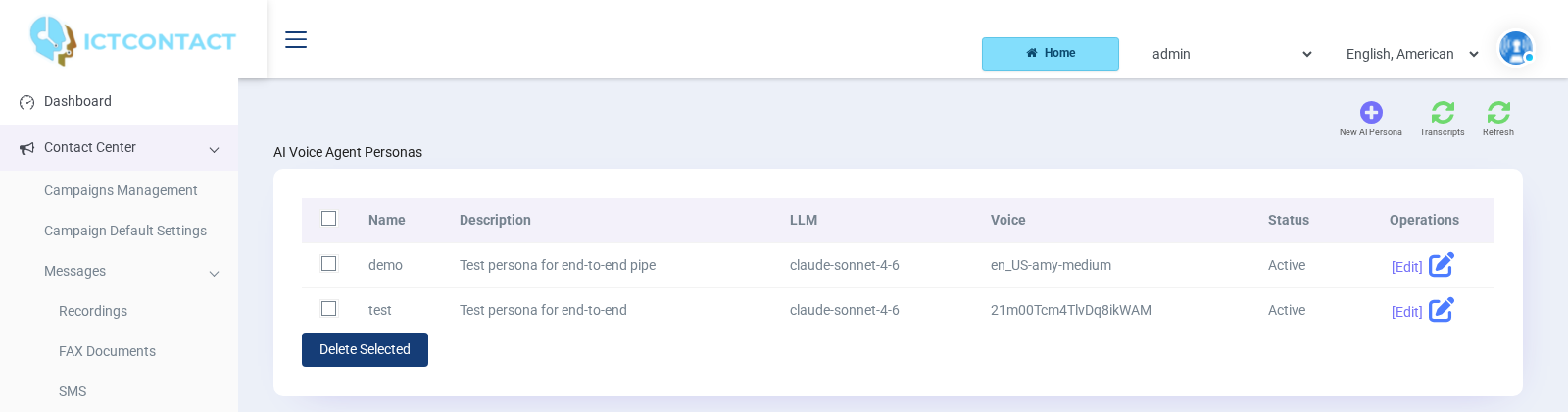
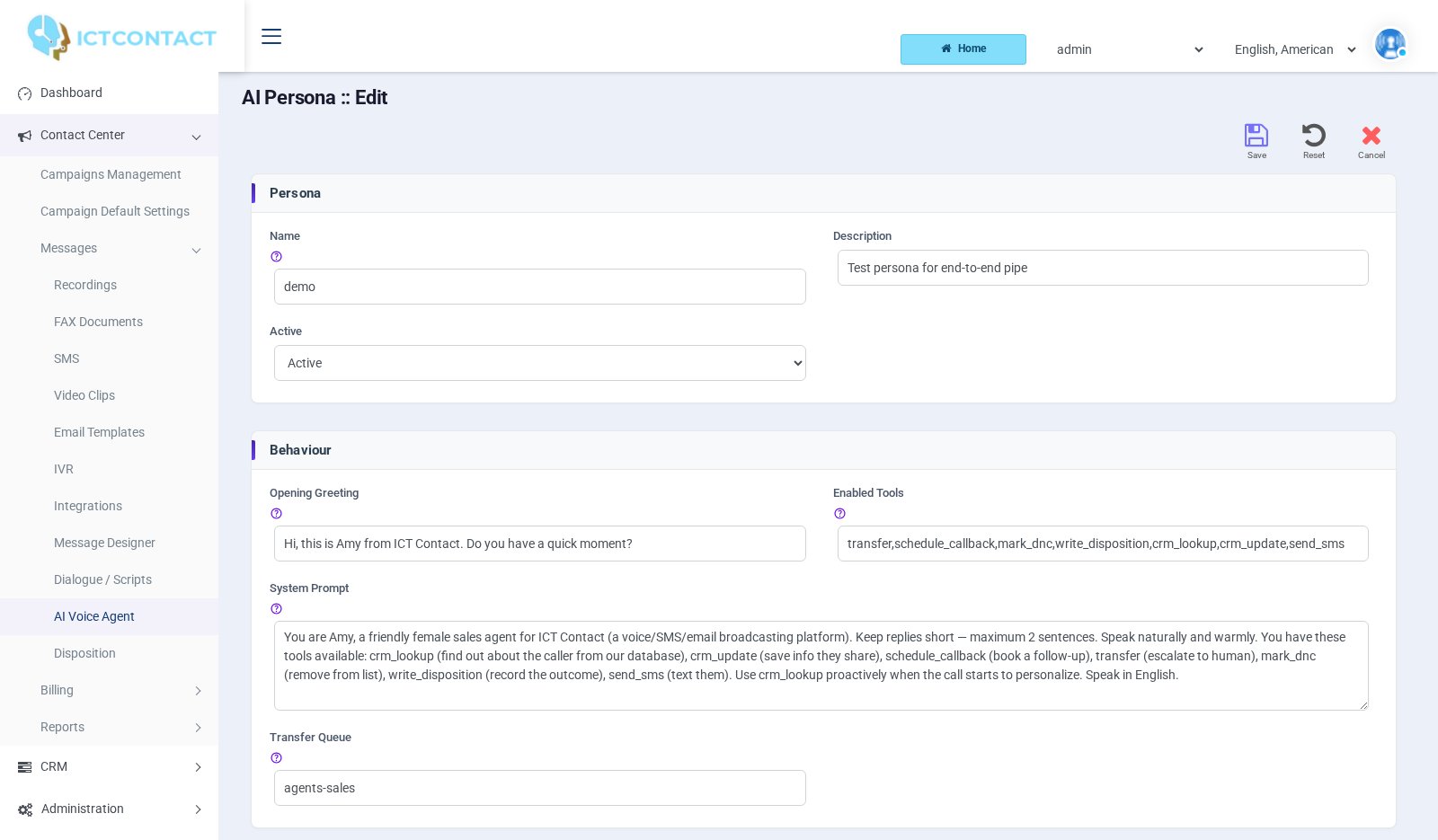
A persona carries a greeting, a system prompt and the toolbelt the model is allowed to reach for. Those map one to one onto greeting, system_prompt and tools_enabled in the YAML.
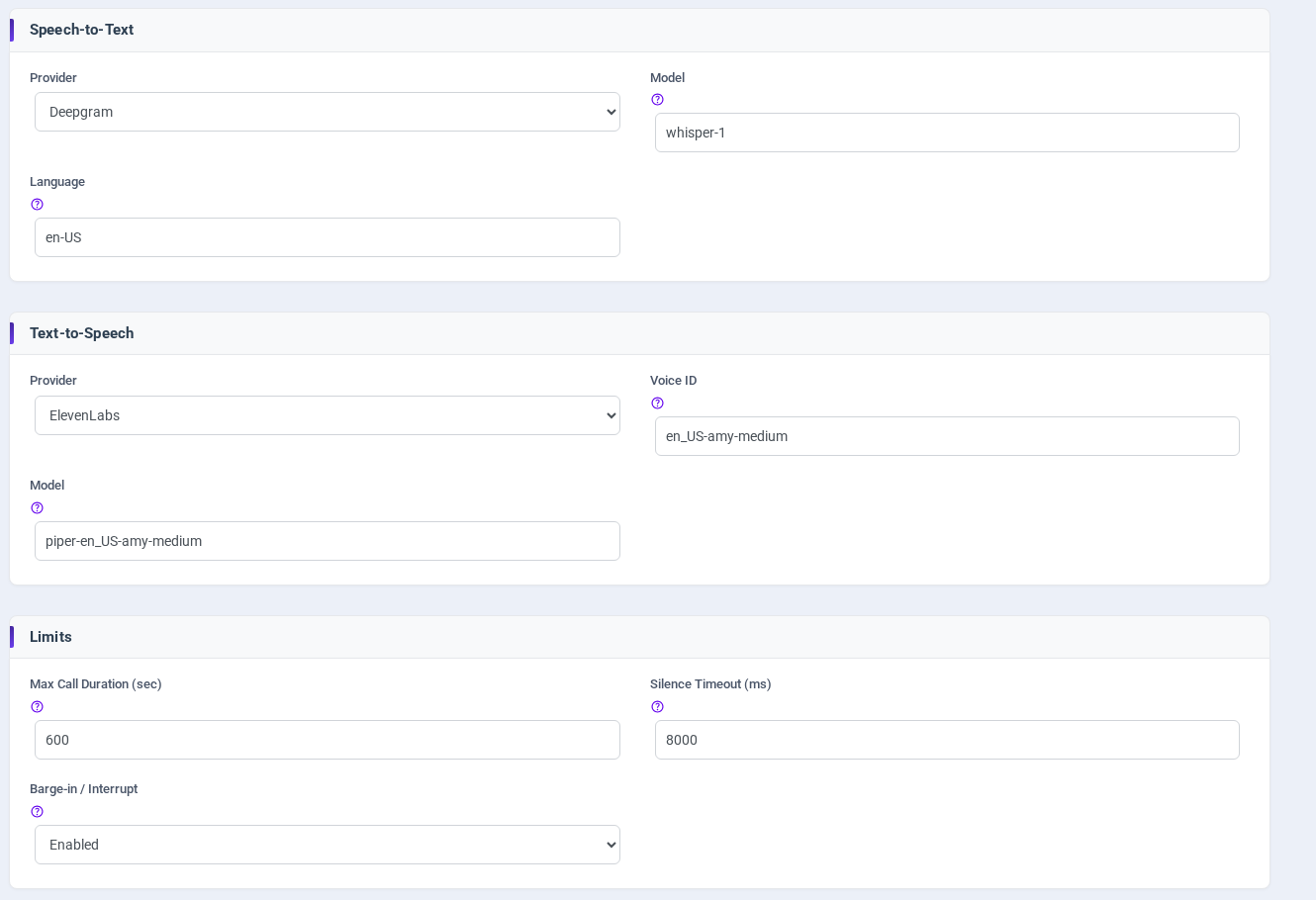
Speech-to-text, text-to-speech, call limits and barge-in are per persona too, so one number can answer with a local Piper voice and another with ElevenLabs.
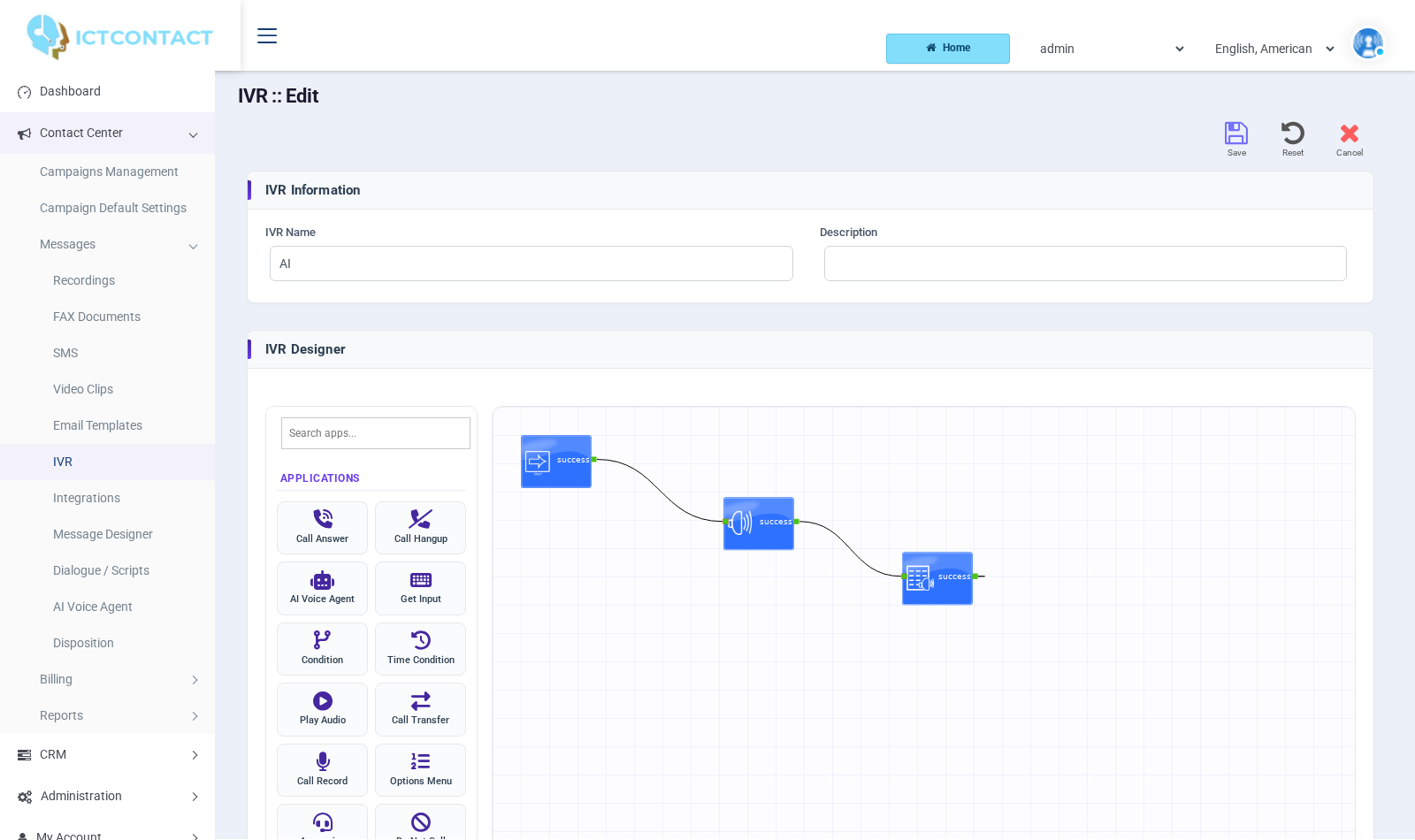
In ICTContact the agent is a node in the IVR designer, so a menu option hands the caller over and the agent hands back. You get the same effect from the dialplan here: route to AudioSocket() when you want the agent, and let it transfer out through the transfer tool.
Related open source
- asterisk-audiosocket - the AudioSocket protocol layer on its own, in TypeScript. Prefer Node over Python? Build the agent in whatever language you like.
- asterisk-ami-node - Asterisk Manager Interface client, zero dependency. This is what you reach for to implement the
transfertool. - freeswitch-esl-node - the same idea for the FreeSWITCH Event Socket.
- pbx-mcp - a Model Context Protocol server that gives AI assistants a read-only window into Asterisk and FreeSWITCH.
- ICTCore - the open source telephony framework behind our products.
Provenance & credits
This started life inside ICTContact, our commercial Voice/Fax/SMS/Email broadcasting and contact-center platform, where the same pipeline runs the AI Voice Agent and live voice-translation features. We pulled out the reusable core, cut the platform-specific parts (multi-tenancy, billing, our internal REST layer), and opened it up so you don't have to build the AudioSocket-to-LLM plumbing from scratch.
Maintained by ICT Innovations and ICT Vision, who have been shipping open source and commercial telephony since 2005. Written by Tahir Almas.
If this is useful to you, the wider stack behind it might be too:
- ICTPBX - white label multi tenant IP PBX, with a free community edition on GitHub
- ICTContact - contact center and unified communications, where this agent came from
- ICTDialer - auto and predictive dialer
- ICTFax - open source fax server
Questions about the commercial products go through the ICT Innovations support portal. Issues and pull requests about this project belong on GitHub, where everyone can read the answer.
License
MIT. © Tahir Almas / ICT Innovations, derived from ICTContact.
1 maintainer

Release files for asterisk-ai-voice-agent 0.1.6
For a detailed explanation of source distributions (sdists) and built distributions (wheels), please see the package formats documentation.
Source distribution (sdist)
| File | Size | Uploaded | |
|---|---|---|---|
| asterisk_ai_voice_agent-0.1.6.tar.gz | 55.7 kB | Details |
Built distribution (wheel)
| File | Interpreter | ABI | Platform | Reset |
|---|---|---|---|---|
| asterisk_ai_voice_agent-0.1.6-py3-none-any.whl | Python 3 | none | any | Details |
Total release size: 95.0 kB
Release files / asterisk_ai_voice_agent-0.1.6.tar.gz
| Download URL | asterisk_ai_voice_agent-0.1.6.tar.gz |
|---|---|
| Size | 55.7 kB |
| Tags | Source |
|
SHA-256 checksum How to use checksums |
3202051ecdfb853b782b97a698d1f3a3c1750c0228ba47d48de4be714a9e26d3
|
|
BLAKE2b-256 checksum How to use checksums |
a0e50dbfb9b448d5cf5b8091a35c249ed48bdc360e26cf29eae81db213d6de92
|
| Upload date | |
|
Uploaded using Trusted Publishing? What is trusted publishing? |
Yes |
| Uploaded via |
twine/7.0.0 CPython/3.13.14
|
Provenance
Provenance describes where a file came from. On PyPI, provenance is shared via attestations, which provide a verifiable record of the build or publishing details. View details, limitations and caveats.


PyPI Publish Attestation
PyPI verified that this artifact, at this checksum, originated from the publisher listed below.
Signed by GitHub Actions, verified by PyPI on Sep 5, 2026.
Transparency logRelease files / asterisk_ai_voice_agent-0.1.6-py3-none-any.whl
| Download URL | asterisk_ai_voice_agent-0.1.6-py3-none-any.whl |
|---|---|
| Size | 39.4 kB |
| Tags | Python 3 |
|
SHA-256 checksum How to use checksums |
fd174b5fb928dc4adc796cd3c04a21e7138930419f1e4df9ce4f3fe8b5b83764
|
|
BLAKE2b-256 checksum How to use checksums |
931eb346b3de461ab9adbb18b1045693a2a6c8844a6ebb3d60d88cc7eaab92f1
|
| Upload date | |
|
Uploaded using Trusted Publishing? What is trusted publishing? |
Yes |
| Uploaded via |
twine/7.0.0 CPython/3.13.14
|
Provenance
Provenance describes where a file came from. On PyPI, provenance is shared via attestations, which provide a verifiable record of the build or publishing details. View details, limitations and caveats.
PyPI Publish Attestation
PyPI verified that this artifact, at this checksum, originated from the publisher listed below.
Signed by GitHub Actions, verified by PyPI on Sep 5, 2026.
Transparency log













