
astra-nutrition

Turkish / English meal text → foods, grams and nutrition, offline by default.
$ astra-nutrition "öğlen 1 kase mercimek çorbası, biraz pilav ve 1 dilim baklava"
Mercimek Çorbası   1 kase    ok          Turkish red lentil soup   250 g   209.8 kcal
Pilav              biraz     estimated*  Cooked white rice         150 g     195 kcal
Baklava            1 dilim   amount?     Baklava                       -          -

Total: 404.8 kcal | protein 14.4 g | carbs 71.6 g | fat 6.7 g
* 1 item(s) use a default portion (estimate).
Not counted: 0 unmatched, 1 with an unreadable amount.
Status: alpha (
0.2.1, see CHANGELOG). The API may still change. Nutrition values are estimates from a public reference table; this is not medical or dietary advice.
What it does
- Parses a free-text meal into
{name, amount}items with a fine-tuned 1.5B model (Turhan123/astra-meal-parser-gguf, Q4_K_M GGUF, ~1 GB) running on CPU with llama.cpp. No API key, no network after the first download. - Normalizes amounts with deterministic rules:
100g,2 adet,1 kase,yarım,iki buçuk dilim,200 ml,two slices,half a cup, … - Matches foods against a bundled, traceable table built from USDA FoodData Central: exact match, then fuzzy match (pg_trgm-style trigrams), optionally an LLM judge.
- Never guesses silently. Every item gets a status, and the totals say whether they are complete and whether they include estimates.
Quickstart
pip install astra-nutrition          # from PyPI
pip install astra-nutrition==0.2.1   # this exact release, which never changes
The same release is also on GitHub as the tag v0.2.1. Python 3.12+. llama-cpp-python is compiled during install, so a C++ compiler
and CMake are needed (Xcode command line tools on macOS, build-essential on
Linux). The GGUF model is downloaded to the Hugging Face cache on first use.
from astra_nutrition import Analyzer

analyzer = Analyzer()  # create once and reuse: loading the model takes ~2 s
result = analyzer.analyze("2 yumurta, biraz pilav ve 1 dilim baklava")

for item in result.items:
    print(item.name, item.status, item.grams, item.nutrition)
print(result.totals.kcal, result.totals.complete, result.totals.includes_estimates)
Already have parsed items (from your own parser)? Skip the model entirely:
result = analyzer.analyze_items([("Yumurta", "2 adet"), ("Pilav", "1 tabak")])
Command line
astra-nutrition "2 yumurta ve 1 muz"              # readable table
astra-nutrition "2 yumurta ve 1 muz" --json       # the full AnalysisResult
astra-nutrition "..." --foods my_foods.csv        # add your own foods
astra-nutrition "..." --model ./model.gguf        # use a local GGUF file
Exit codes: 0 analyzed, 1 the parser could not read the meal, 2 bad input
(for example a food file with problems).
Browser demo
A small Gradio page (demo/) with example meals. It installs the released
v0.2.0 wheel (hash-checked) and runs offline, without the LLM judge:
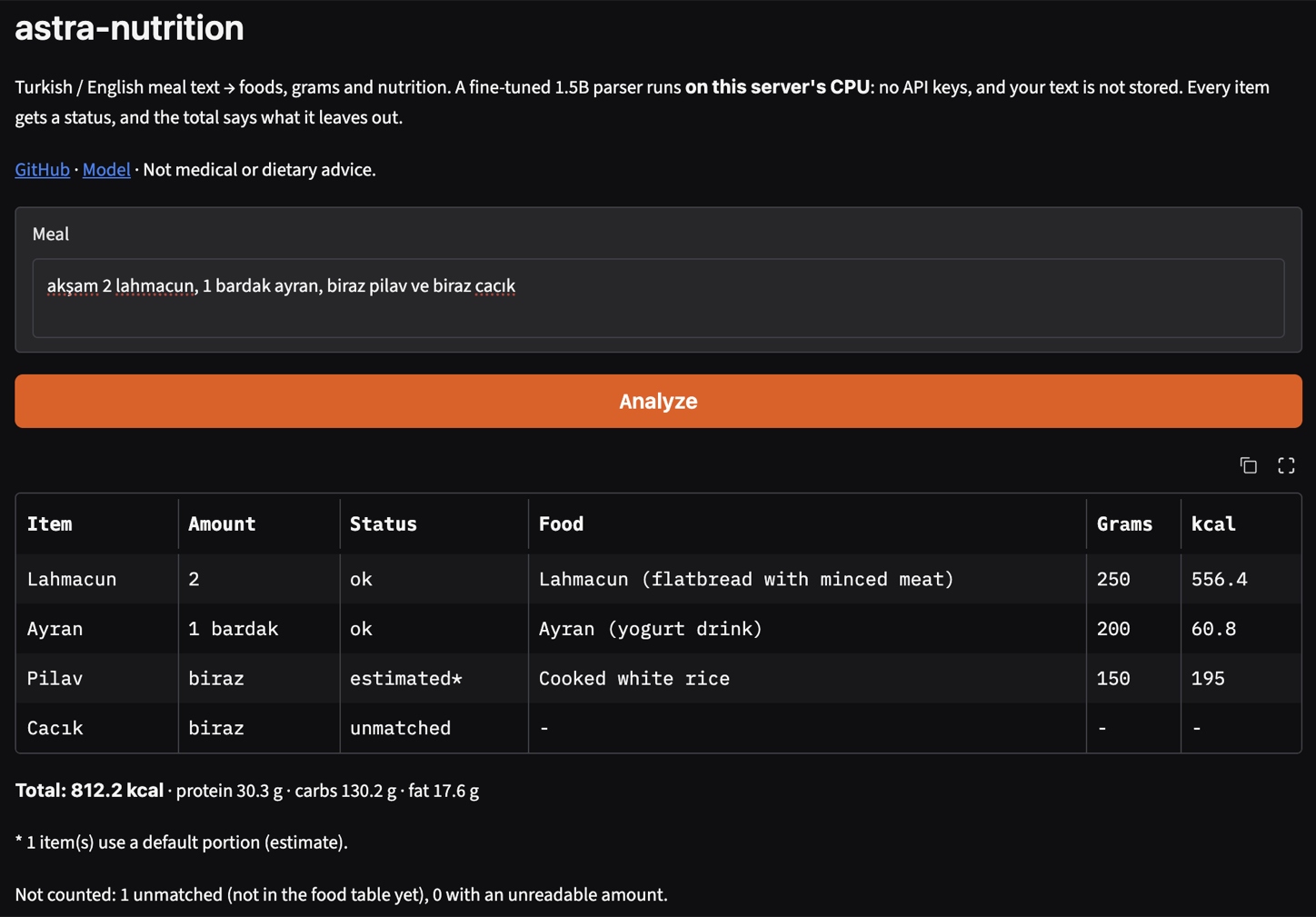
docker build -t astra-nutrition-demo demo/
docker run --rm -p 127.0.0.1:7860:7860 \
  -v astra-demo-hf:/home/user/.cache/huggingface astra-nutrition-demo
# http://127.0.0.1:7860
The volume keeps the downloaded model, so only the first start waits for it.
demo/ is also a ready Hugging Face Docker Space, but there is no hosted link:
Docker and Gradio Spaces on free CPU need a paid PRO subscription.
Web API
A thin FastAPI layer over the library (app/). Run it from the project root
after pip install -r requirements.txt and python -m scripts.download_model:
uvicorn app.main:app
| Endpoint | What it does |
|---|---|
POST /analyze {"meal_text": "..."} |
The library's AnalysisResult as JSON (max 1000 characters) |
GET /foods/search?q=...&k=5 |
Candidates from every matching stage with scores, for inspection |
GET /stats/unmatched?limit=20 |
The most frequent unmatched names and their closest food |
GET /health |
Database check only (it never runs the model), plus a count of failed log writes |
curl -s localhost:8000/analyze -H 'content-type: application/json' \
  -d '{"meal_text": "2 yumurta ve 1 muz"}'
All endpoints are plain def: the work inside is blocking (llama.cpp on the
CPU, sync PostgreSQL), so FastAPI runs it in a thread pool and the event loop
stays free. Measured: while one /analyze took 4.2 s, a /health request sent
0.1 s later answered in 103 ms. The model is loaded once at startup; matching
uses the in-memory index by default (FOOD_INDEX_BACKEND=postgres switches to
the ingested table, with identical results). Configuration lives in .env
(see .env.example). The judge is optional here too: install
requirements-judge.txt and set LLM_JUDGE_PROVIDER.
Request log and coverage gaps
Every analysis is stored in PostgreSQL as one analyses row plus one
analysis_items row per item, in a single transaction. Unmatched items keep
their closest candidate, so the foods to add next come from counting, not
guessing:
GET /stats/unmatched
[{"name": "mercimek çorbası", "times": 3, "closest_food": "lentils"},
 {"name": "ayran", "times": 2, "closest_food": "sunflower_seeds"}, ...]
Logging is best effort: the user always gets the result. The row is written
after the response is sent, with a 2 s connection timeout; a failed write is a
warning in the service log and increments log_failures in /health.
Measured with the database stopped: /analyze still answered 200 in ~0.9 s,
/health returned 503, and after the restart it reported log_failures: 1.
Set LOG_MEAL_TEXT=false to store results without the user's text.
Docker
docker-compose.yml runs PostgreSQL (with pgvector) and the API. Create
.env from .env.example first, then:
docker compose up -d              # http://127.0.0.1:8000
docker compose logs -f api        # first start: model download, then "startup complete"
- The model is not in the image. On first start the container downloads
the GGUF (~1 GB) into the
modelsvolume; later starts find it there and need no network. Measured: the first start took 213 s (mostly the download); a restart with the model already in the volume answered in 29 s. - Slim by default. The image has the parser, matcher and request log
(523 MB). The optional LLM judge needs PyTorch and sentence-transformers,
which make the image ~4× larger (2.0 GB, CPU-only PyTorch); build it in with
WITH_JUDGE=true docker compose build api. - Ready means ready. The service parses one meal at startup, so the first
real request does not pay the model's warm-up. The container's healthcheck
calls
/healthand allows a 10-minute start period for the first download. - Multi-stage build (compilers stay in the build stage), runs as a non-root
user, ports bound to
127.0.0.1only. Measured memory of the running API container: 1.1 GiB (docker stats).
Item statuses and honest totals
| Status | Meaning | Counted in totals |
|---|---|---|
ok |
Food found; grams measured or converted from a household unit | yes |
estimated |
Food found; the amount was missing or vague (biraz, some), or the parser wrote a number the user never wrote (2 adet for a plain köfte), so the food's default portion is used |
yes, and totals.includes_estimates is true |
amount_unknown |
Food found, but the amount could not be read (bir tutam), or it is a count of a dish whose only piece size is a US one (2 baklava) |
no (a guess could be 100× off) |
unmatched |
The food is not in the table | no |
totals.complete is false when any item is not counted. An unmatched item is
always reported; it is never replaced by the "nearest" food, because a wrong
food is silent wrong data while an unmatched item is visible. The closest
candidate is kept in best_candidate_food_id for debugging only.
Before matching, every item name is checked against the meal text: each word
of the name must appear in it (Turkish letters and case folded, whole words).
A name that fails, such as a food the model invented, goes to rejected_items
with the reason, is not counted, and makes totals.complete false
(totals.rejected counts them). MealParser(..., check_grounding=False)
turns the check off.
Every matched item also has food_source ("USDA SR Legacy, fdc_id …",
"USDA FNDDS …" or the source you gave for your own foods), match_method
(exact, fuzzy, llm) and amount_detail (how the grams were obtained).
Add your own foods
One CSV row per food; values per 100 g; source says where the numbers come from.
id,name_en,name_tr,aliases,kcal_100g,protein_100g,carbs_100g,fat_100g,default_grams,source,grams_per_bowl
my_lentil_soup,Lentil soup,Mercimek çorbası,mercimek çorbası|lentil soup,…,…,…,…,250,my recipe card,250
- Required:
id(a-z, 0-9, _),name_en,name_tr, the four per-100 g values,default_grams,source. - Optional:
aliases(|-separated),density_g_per_ml,note, andgrams_per_<unit>forpiece,slice,bowl,plate,glass,cup,tbsp,tsp,handful. - Merging is strict: an unknown column, an id or a name that already belongs
to another food is an error with a clear message. To replace a bundled food
on purpose, say so:
--replace bananaorreplace_ids=["banana"].
from astra_nutrition import Analyzer, FoodTable

table = FoodTable.bundled().with_user_foods("my_foods.csv")
analyzer = Analyzer(table=table)
Optional LLM judge
Exact and fuzzy matching are precise but miss synonyms and some typos. The
optional judge retrieves the 5 closest foods with embeddings
(intfloat/multilingual-e5-small) and asks an LLM whether one of them is the
same food, or none.
pip install "astra-nutrition[judge]"
Analyzer.with_judge("groq", api_key="...", model="...", rpm=30)
Analyzer.with_judge("gemini", api_key="...", model="...", rpm=10)
Analyzer.with_judge(
    "openai-compatible", base_url="http://localhost:11434/v1", model="llama3"
)
Analyzer.with_judge(my_provider)  # any object with complete_json(system, user) -> str
- Off by default, even if an API key is in your environment.
- Only item names are sent, never the meal text. A local OpenAI-compatible server (Ollama, LM Studio, vLLM) keeps everything on your machine.
- The judge may only answer with one of the offered candidate ids or
none; anything else, or any provider error, leaves the itemunmatched. - CLI:
--judge groq|gemini|openai-compatible, configured withGROQ_*,GEMINI_*orJUDGE_BASE_URL/JUDGE_MODEL/JUDGE_API_KEY/JUDGE_RPM.
Evaluation
The matching strategies were compared on 193 labeled item names produced by
the real parser from 101 meals: 49 everyday meals ("natural") and 52 meals
written to stress the matcher ("variants": synonyms, regional words, typos and
20 hard negatives such as kuru üzüm vs üzüm or sütlaç vs süt).
- Grouped dev/test split (118 / 75 names): all names of the same food stay on one side, so fixes learned on dev cannot leak into test.
- Thresholds were chosen on dev only, mechanically, by
net = correct − 3 × wrong(a wrong food costs three correct ones). Labels were frozen before any score was computed. - The test set was evaluated once, after every design was fixed.
Test results (75 names, 47 of them have a correct food in the table):
| Design | Settings (chosen on dev) | Correct / 47 | Wrong matches | Net (λ = 3) |
|---|---|---|---|---|
| A: exact | – | 18 | 0 | 18 |
| B: embeddings only (e5-small) | similarity ≥ 0.96 | 20 | 1 | 17 |
| C: exact → fuzzy (default) | trigram similarity ≥ 0.60 | 22 | 2 | 16 |
C + judge, Groq openai/gpt-oss-20b |
same | 36 | 2 | 30 |
C + judge, Gemini gemini-3.5-flash-lite |
same | 37 | 3 | 28 |
How to read this honestly:
- The judge roughly doubles recall (47% → 77–79%); this was the largest and most consistent effect on both dev and test.
- With 75 test names one item is ~1.3 points: differences of 1–3 items (Groq vs Gemini, A vs C) are within noise.
- Test is harder than dev (exact-match recall 65% on dev, 38% on test).
- Embedding similarity alone could not separate hard negatives from correct
matches:
Kuru Üzüm → Üzümscored higher (0.942) thanYohurt → Yoğurt(0.922). Embeddings measure "related", not "same food", so they are used to retrieve candidates for the judge, not to decide. - The two test errors of Design C come from fuzzy matching on substrings
(
Etli Kuru Fasulye → kuru fasulye,canned tuna in oil → canned tuna). They were found on test, so they were not tuned away in v0.1. v0.2 refuses such matches (motivated byfalafel wrapin the v0.2 dev meals), which also fixes these two names, and a test name (70% dark chocolate) shaped a detail of that rule. So the v0.1 test numbers above are no longer a clean held-out result; v0.2 gets a fresh test set. - 75% of the in-table "natural" names are exact alias copies (the same person wrote aliases and meals), against 30% in the "variants" set.
Reproduce (needs the PostgreSQL setup below): python -m eval.run_eval sweep
and python -m eval.run_eval report; judge answers are cached in
eval/results/ so results reproduce without API keys.
v0.2 meals: dev and test (end to end)
For the new dishes, someone other than the alias author wrote 95 meals in their
own words, without looking at the table (data/eval/meals_v02.txt). Each meal
is labeled with the foods a correct system finds (data/eval/labels_v02.csv),
and scoring runs the whole pipeline: parser, name and amount checks, matching.
These meals were used to find and fix problems, so they are a dev set, not a
held-out result; the test set below is.
| v0.2 dev meals (106 foods) | Found | False matches |
|---|---|---|
| Before the fixes | 68 (64%) | 4 |
| Meal-time words, wrong dishes, aliases | 88 (83%) | 3 |
| + refuse fuzzy matches that add a dish word | 87 (82%) | 1 |
| + split foods listed without a conjunction | 100 (94%) | 3 |
What they found and what was fixed: meal-time words glued to names
(Akşam Biber Dolması), wrong dishes (süzme mercimek matched raw lentils,
biber dolma raw peppers), missing names (fıstıklı baklava, soğuk ayran,
zeytin), quantities the parser invented, and US piece sizes leaking through
bare counts. A fuzzy match that adds a dish word to an alias is refused
(falafel wrap is not falafel, etli kuru fasulye not plain beans), and a
name that lists table foods without a conjunction is split (kofte pilav,
yulaf süt muz). What remains: a bread lost to the strict name check
(ekmekle), lists with a food missing from the table (ciger kavurma pilav),
and the labels themselves: kofte ekmek is labeled as its parts but
falafel pita as no table food, so splitting the latter counts as two false
matches; the labels were not changed after seeing the results. One old test
name changed with the new aliases: Zeytin now matches black olives
(correct). Rerun with python -m eval.v02 --label <name>; model
answers are cached, so reruns are fast and machine-independent.
Test. The same person then wrote 73 new meals without looking at the
table or any result; 15 that repeated dev or older eval meals were removed.
The other 58 (data/eval/meals_v02_test.txt) were labeled from the text
alone and committed before the system ever ran on them, then evaluated
once; nothing was changed afterwards.
| v0.2 test meals (49 foods, evaluated once) | Found | False matches |
|---|---|---|
| v0.1.0 (same cached model answers) | 7 (14%) | 1 |
| v0.2 | 28 (57%) | 3 |
On unseen phrasing v0.2 finds four times as many foods as v0.1.0, but far
fewer than on dev (94%): the fixes fit the dev phrasing. Most misses are
descriptive words the parser glued to a name (Lahmacun Acili, Bol Kopuklu Ayran, Ev Yapımı Yaprak Sarması, Biber Dolması Yanina Cacik), which the
rule against added dish words turns into unmatched. Two foods were lost
because the parser put them in the amount and the name was only meal-time
words (Ara Öğün / 1 bardak koy ayrani). The design held where it matters:
of 31 matches, 28 are right, and nearly every miss is a visible unmatched,
not a wrong food. Rerun: python -m eval.v02 --set test --label final.
Data and licenses
| Part | Source | License |
|---|---|---|
| Food table (141 foods, 494 names) | USDA FoodData Central: SR Legacy (2018-04) for single foods and recipe ingredients, FNDDS (2024-10-31) for 7 mixed dishes; curated | public domain (CC0) |
| Parser model | Turhan123/astra-meal-parser-gguf (Qwen2.5-1.5B, Q4_K_M) | Apache-2.0 |
| Embeddings (judge only) | intfloat/multilingual-e5-small |
MIT |
| Code | this repository | Apache-2.0 |
Every gram value in food_portions.csv is either a USDA household measure
(the source text is stored) or an explicit, labeled assumption (for example a
Turkish tea glass of 100 ml). Some Turkish dishes are mapped to their base
ingredient and documented as approximations: pilav → plain cooked rice,
kuru fasulye → boiled white beans (added oil is not counted). Generic words
have documented defaults: peynir → white cheese (feta), cheese → cheddar.
FNDDS dishes (baklava, yaprak sarma, biber dolması, falafel, tabule) keep
only weight and volume measures: FNDDS pieces are US sizes (one piece of
baklava is 80 g), so 1 dilim baklava reads as amount_unknown instead of a
wrong number, while 100 g baklava is counted.
Turkish recipes. Dishes without a USDA equivalent are computed from a
home-style Turkish recipe (data/recipes.csv, data/recipe_ingredients.csv)
with SR Legacy ingredients. The macros of the ingredients are divided by the
cooked weight, because water evaporates while the macros stay in the pot;
dividing by the raw total would understate every dish that loses water. Each
recipe states its cooked weight and where that number comes from (so far an
assumption), and the build refuses a cooked weight above the raw total.
Mercimek çorbası comes out at 84 kcal per 100 g; FNDDS's US lentil soup, a
different recipe, is 60.
Grilling breaks the "macros stay in the pot" rule: fat drips away. USDA measured it for 80/20 ground beef: 100 g raw becomes about 67 g broiled, and about 8 of its 20 g of fat are gone. So ızgara köfte uses USDA's broiled patty as its meat (254 kcal per 100 g; raw mince would give about 340), while lahmacun, baked with the mince on the dough, keeps the fat and uses raw mince.
| Recipe | kcal / 100 g | Cooked weight |
|---|---|---|
| Mercimek çorbası | 84 | 1800 g of 2125 g raw (assumption) |
| Ayran | 30 | raw total (no cooking) |
| Çoban salatası | 53 | raw total (no cooking) |
| Menemen | 117 | 450 g of 580 g raw (assumption) |
| Izgara köfte | 254 | 423 g of 473 g, meat already cooked (assumption) |
| Lahmacun | 223 | 1000 g of 1257 g raw (assumption) |
TürKomp (the Turkish national food composition database) is not used: its terms restrict copying and commercial use, which is incompatible with redistributing the data in an open-source package.
Limitations
- Coverage. Many Turkish dishes are not in the table yet (mantı, tavuk
döner, iskender, gözleme, karnıyarık …); they are reported as
unmatched. - Recipes are one home style. A recipe dish stands for one documented recipe; home versions vary (more butter, less water), and the cooked weight is an assumption until measured.
- Parser errors. The model sometimes merges items, puts amount words into
names (
Yarım Ekmek), or invents weights in parentheses (1 dilim (30g)). Merged names with a conjunction are re-parsed; invented weights are used only if the user wrote them. A merge without a conjunction is split when every part is a table name (Tahin Pekmez,Kofte Pilav); otherwise it stays whole and unmatched (Ciger Kavurma Pilav). - Strict name check. When the model fixes a typo (
letuce→lettuce) or drops a Turkish suffix (ekmekle→Ekmek), the name is no longer in the text, so the item is rejected. On the 101 eval meals, 5 of 220 items were rejected; 2 of them (lettuce,tomatoes) would have matched. A similarity rule would keep them, but would also let an inventedElmathrough onelmas. - Parser output depends on the llama.cpp build. With the same weights and
temperature 0, 22 of 101 eval meals parse differently in the Docker image
than on macOS: tiny floating-point differences flip near-tied tokens, and
the rest of the output follows. Neither build is better overall. The
deterministic layers absorb part of it (an amount that repeats the item's
name,
1 muz, reads as1); the matching evaluation uses fixed parsed names, so its numbers do not depend on the build. - Modified dishes are left unmatched, not estimated. A fuzzy match that
adds a dish word to an alias is refused (
Falafel Wrap,Etli Kuru Fasulye); with the LLM judge on, such names go to the judge instead. - Small evaluation set (193 names): treat the numbers as indicative.
- Resources. ~1 s per meal on an Apple M3 CPU; peak memory ~2 GB on ARM (llama.cpp repacks the weights). With the judge, setup takes ~10 s and each unresolved item adds a network round trip.
Roadmap
- v0.3: descriptive words in names (
acılı,bol köpüklü,ev yapımı,yanında X), the main source of misses on the v0.2 test meals; keep a food the parser put in the amount when the name is only a meal time. Measure on a new test set, since the v0.2 test set has now been seen.
Repository layout and development
src/astra_nutrition/   the library (what pip installs)
app/                   the FastAPI service on top of the library
demo/                  browser demo (Gradio, Docker); installs the released wheel
scripts/               table building from USDA, model download, ingest
eval/                  evaluation harness and results
data/                  food selection (source of the table) and eval data
tests/                 unit tests; `pytest -m integration` needs PostgreSQL
python3.12 -m venv .venv && source .venv/bin/activate
pip install -r requirements-dev.txt     # pinned dependencies + the package (editable)
pytest                                   # unit tests, no database or model needed
CI (GitHub Actions, .github/workflows/ci.yml) runs on every push to main
and every pull request, each job on a fresh runner:
| Job | Checks |
|---|---|
lint |
ruff check, ruff format --check |
test |
unit tests with the pinned dev dependencies |
integration |
loads a throwaway PostgreSQL + pgvector service and runs the pg_trgm parity tests; in CI a missing database fails instead of skipping |
build |
builds the wheel, installs it in a clean virtualenv with the library's own version ranges, and analyzes a meal from the bundled data |
No job downloads the parser or the embedding model. Model output can differ between machines (see Limitations), so tests use fakes and check only this project's code; a test that compared real model output would fail at random on a different runner.
1 maintainer

Metadata
1 maintainer
Release files for astra-nutrition 0.2.1
For a detailed explanation of source distributions (sdists) and built distributions (wheels), please see the package formats documentation.
Source distribution (sdist)
| File | Size | Uploaded | |
|---|---|---|---|
| astra_nutrition-0.2.1.tar.gz | 62.5 kB | Details |
Built distribution (wheel)
| File | Interpreter | ABI | Platform | Reset |
|---|---|---|---|---|
| astra_nutrition-0.2.1-py3-none-any.whl | Python 3 | none | any | Details |
Total release size: 129.8 kB
Release files / astra_nutrition-0.2.1.tar.gz
| Download URL | astra_nutrition-0.2.1.tar.gz |
|---|---|
| Size | 62.5 kB |
| Tags | Source |
|
SHA-256 checksum How to use checksums |
2f11ad7f5a90c667f54365634130e408aed4f78bc8ba17456aeb16cd822d0a56
|
|
BLAKE2b-256 checksum How to use checksums |
c3b481865bff1757f6a33716d2e90ee59834f468f69086083698e1a3f1ffab8a
|
| Upload date | |
|
Uploaded using Trusted Publishing? What is trusted publishing? |
Yes |
| Uploaded via |
twine/7.0.0 CPython/3.13.14
|
Provenance
Provenance describes where a file came from. On PyPI, provenance is shared via attestations, which provide a verifiable record of the build or publishing details. View details, limitations and caveats.


PyPI Publish Attestation
PyPI verified that this artifact, at this checksum, originated from the publisher listed below.
Signed by GitHub Actions, verified by PyPI on Oct 4, 2026.
Transparency logRelease files / astra_nutrition-0.2.1-py3-none-any.whl
| Download URL | astra_nutrition-0.2.1-py3-none-any.whl |
|---|---|
| Size | 67.3 kB |
| Tags | Python 3 |
|
SHA-256 checksum How to use checksums |
d3c663a807b00da462e3a41ba73d9d4a33e5070c39358abca38986869ee05acb
|
|
BLAKE2b-256 checksum How to use checksums |
01a2af716559db468d44d826e45582dccea84f93d164d2ea4840523d1882ceff
|
| Upload date | |
|
Uploaded using Trusted Publishing? What is trusted publishing? |
Yes |
| Uploaded via |
twine/7.0.0 CPython/3.13.14
|
Provenance
Provenance describes where a file came from. On PyPI, provenance is shared via attestations, which provide a verifiable record of the build or publishing details. View details, limitations and caveats.
PyPI Publish Attestation
PyPI verified that this artifact, at this checksum, originated from the publisher listed below.
Signed by GitHub Actions, verified by PyPI on Oct 4, 2026.
Transparency log













