
Transformer based foundation model for galaxy images (and general astronomy)

Project description





astroPT: a Large Observation Model for astronomy 🔭
Welcome to our simple repository for training astronomical large observation
models. This repository began its life as Andrej Karpathy's
nanoGPT, and has been altered so that it
is usable for imagery data. Within train.py you will find a ~300-line
boilerplate training loop and within model.py you will find a ~300-line GPT
model definition with an MLP tokeniser and a regressive loss.
Check out the UniverseTBD Discord for updates: https://discord.gg/MNEVegvfJq
install
You can install via pip from PyPI:
pip install astropt
Or if you install locally via a git clone, you can uv install via:
uv sync
how to run
To load and run a pre-trained AstroPT model from HuggingFace you can use the load_astropt function:
from astropt.model_utils import load_astropt

model, model_args = load_astropt(
    repo_id="smith42/astropt_sparse",
    path="astropt/p16k10",
    weights_filename="ckpt.pt",
)
model = model.to("cuda")
where repo_id is the HuggingFace repository ID, and path is the path within the repository that contains the AstroPT model checkpoint.
results
AstroPT v1.0.0 has been trained on 8.6M galaxy grz band *.png postage stamps
downloaded from DESI-LS DR8 to see if neural scaling laws apply to galaxian
data (in other words, to see if more galaxy data == more better model).
We tried to make the astroPT model as simple as possible so that other
modalities can be easily folded in. We also choose to use a causally trained
autoregressive transformer model as our backbone so that our work can more
easily integrate the wider deep learning FOSS community.
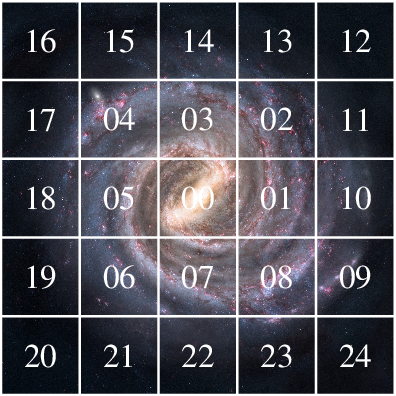
Our pretraining task is feeding in our galaxy images patch-by-patch and predicting the next patch in our galaxy patch sequence. We follow ViT and define a patch as a 16 by 16 pixel square, and feed the galaxy patches in a spiral order:
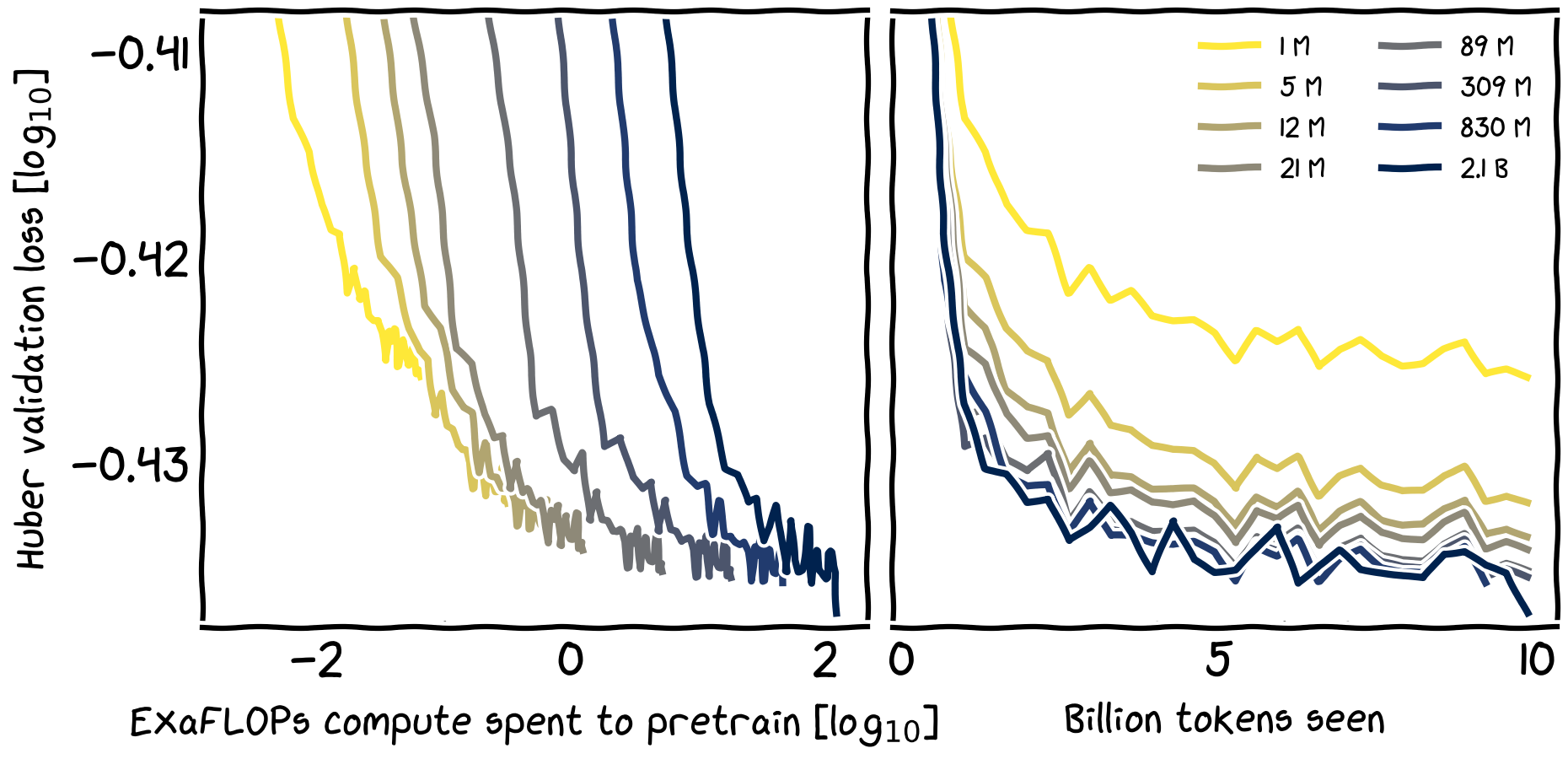
The trained model results are promising -- below we show our full training run
validation losses across a parameter sweep of {1,5,12,21,89,309,830,2100}M
trainable parameters:
We also test our astroPT models on some scientifically-useful downstream tasks by taking the models' penultimate layer outputs and finetuning linear probes to predict emergent physical properties of the galaxies:
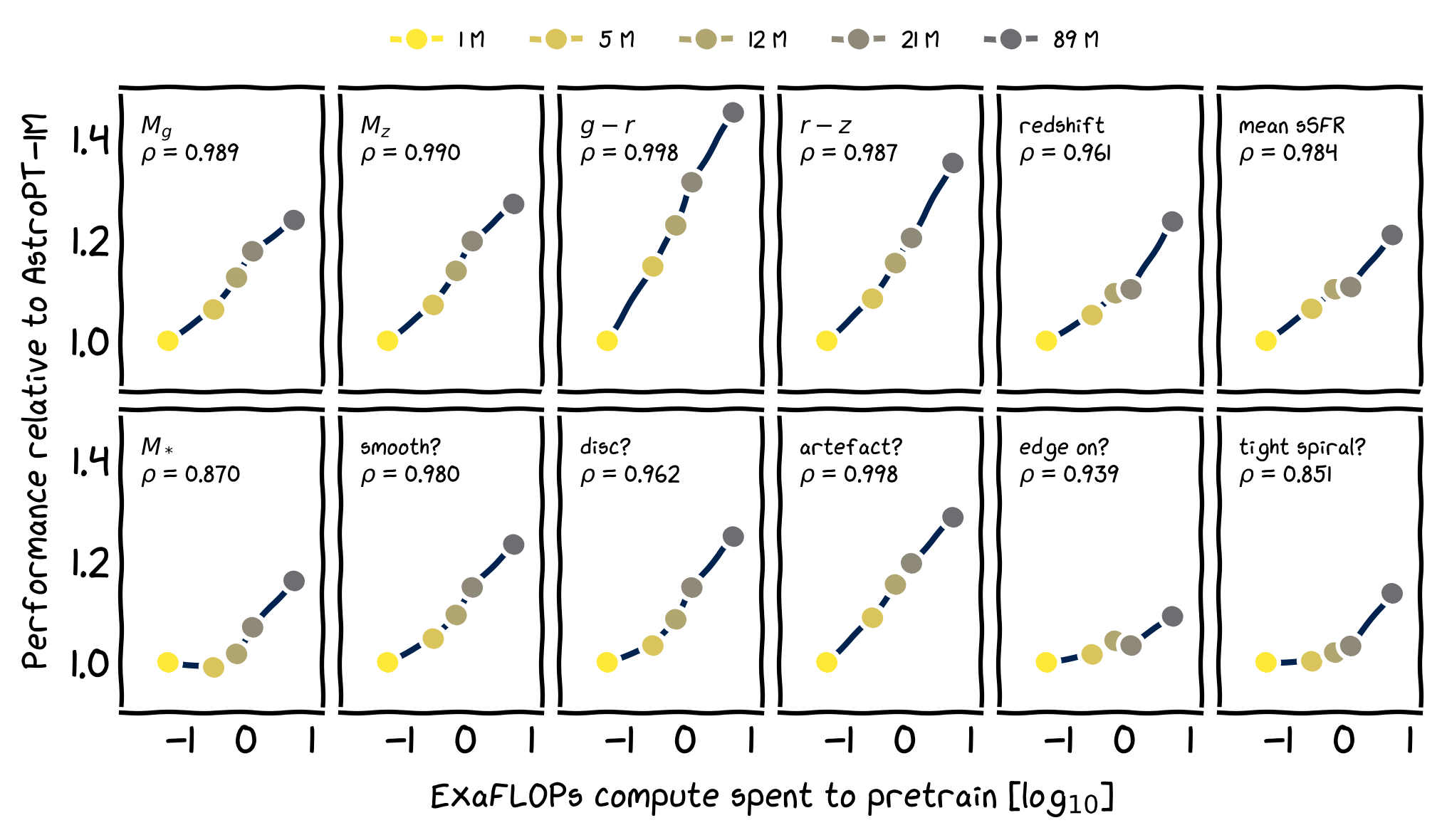
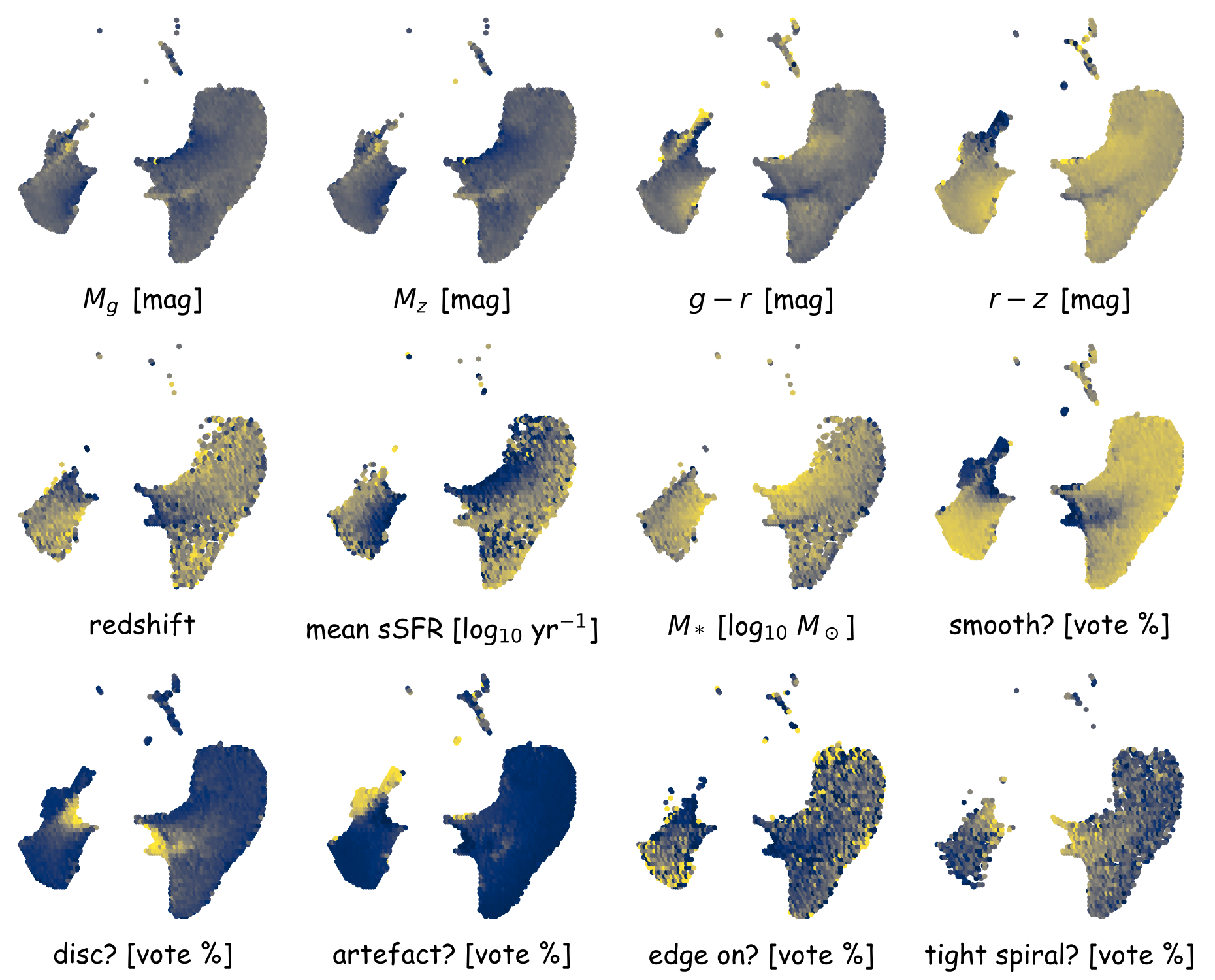
In the above pic, $M_g$ and $M_z$ are the absolute magnitudes (or brightness at a fixed distance) of the galaxies, $g - r$ and $r - z$ are the differences between the observations of different telescope filter bands, redshift is the distance to the galaxies, sSFR is the total mass of new stars born each year in the galaxies per total galaxy mass, and $M_{*}$ is the total mass of stars within the galaxies. "smooth?", "disc?", "artefact?", "edge on?" and "tight spiral?" are morphological properties of the galaxies as described by citizen scientists.
The cool thing to take away from these plots is that the surrogate task loss (predicting the next patch in a sequence of ViT-like galaxy image patches) is correlated with astronomically "useful" downstream tasks 🤯🚀.
Finally, check out our UMAP projection of astroPT-87M's penultimate layer outputs of our validation set. We colour each point with an emergent physical galaxy property described above. The structure suggests that the model has learnt some knowledge about physics simply from our next-token prediction pretraining task!
pretrained weights, and full galaxy dataset
Check out the paper here: https://arxiv.org/abs/2405.14930.
We of course release all our model weights checkpointed across our full training runs on HuggingFace 🤗 here.
We also release our full dataset and galaxy metadata on HuggingFace 🔥.
contributors
 Ryan Roberts 💻 🤔 🖋 |
 Mike Smith 💻 🤔 🖋 🔣 |
 mhuertascompany 🤔 🖋 |
 Malgorzata Siudek 🤔 🖋 💻 🔣 |
 gimarso 🤔 💻 |
||
 Add your contributions
|
||||||
Release history Release notifications | RSS feed


Download files
Download the file for your platform. If you're not sure which to choose, learn more about installing packages.
Source Distribution
Built Distribution
Filter files by name, interpreter, ABI, and platform.
If you're not sure about the file name format, learn more about wheel file names.
Copy a direct link to the current filters
File details
Details for the file astropt-1.0.4.tar.gz.
File metadata
- Download URL: astropt-1.0.4.tar.gz
- Upload date:
- Size: 67.3 MB
- Tags: Source
- Uploaded using Trusted Publishing? No
- Uploaded via: uv/0.7.2
File hashes
| Algorithm | Hash digest | |
|---|---|---|
| SHA256 |
af944a1c60e793d9107d28e3c9794be3ae402edeb28349b872767169a536bfab
|
|
| MD5 |
bd9e8b94f0febcb8ab3a45287febd2fe
|
|
| BLAKE2b-256 |
9b6d98f7b936b0ddf30262e418aced2cdf55f93a4de8697bef39dfe40a5c0bdb
|
File details
Details for the file astropt-1.0.4-py3-none-any.whl.
File metadata
- Download URL: astropt-1.0.4-py3-none-any.whl
- Upload date:
- Size: 15.5 kB
- Tags: Python 3
- Uploaded using Trusted Publishing? No
- Uploaded via: uv/0.7.2
File hashes
| Algorithm | Hash digest | |
|---|---|---|
| SHA256 |
bcebd709266b6c3bce96d744934bcf53ec37314e35a5dfaa10f45ab2d754e833
|
|
| MD5 |
c10c075efe0e406f5c9e232ae02bca6a
|
|
| BLAKE2b-256 |
5f1f2d36036dfabdaafc23e3f7af5ba387c70ac863fefff2b2547957c1dac2ea
|






