


Atlantic - Automated Data Preprocessing Framework for Supervised Machine Learning
Framework Contextualization
The Atlantic project constitutes a comprehensive and objective approach to simplify and automate data processing through the integration and validated application of various preprocessing mechanisms, ranging from feature engineering, automated feature selection, multiple encoding versions and null imputation methods. The optimization methodology of this framework follows an evaluation structured in tree-based model ensembles.
This project aims at providing the following application capabilities:
-
General applicability on tabular datasets: The developed preprocessing procedures are applicable on multiple domains associated with Supervised Machine Learning, regardless of the properties or specifications of the data.
-
Automated treatment of tabular data associated with predictive analysis: It implements a global and carefully validated data processing based on the characteristics of the data input columns.
-
Robustness and improvement of predictive results: The implementation of the
atlanticautomated data preprocessing pipeline aims at improving predictive performance directly associated with the processing methods implemented based on the data properties.
Main Development Tools
Major frameworks used to build this project:
Framework Architecture
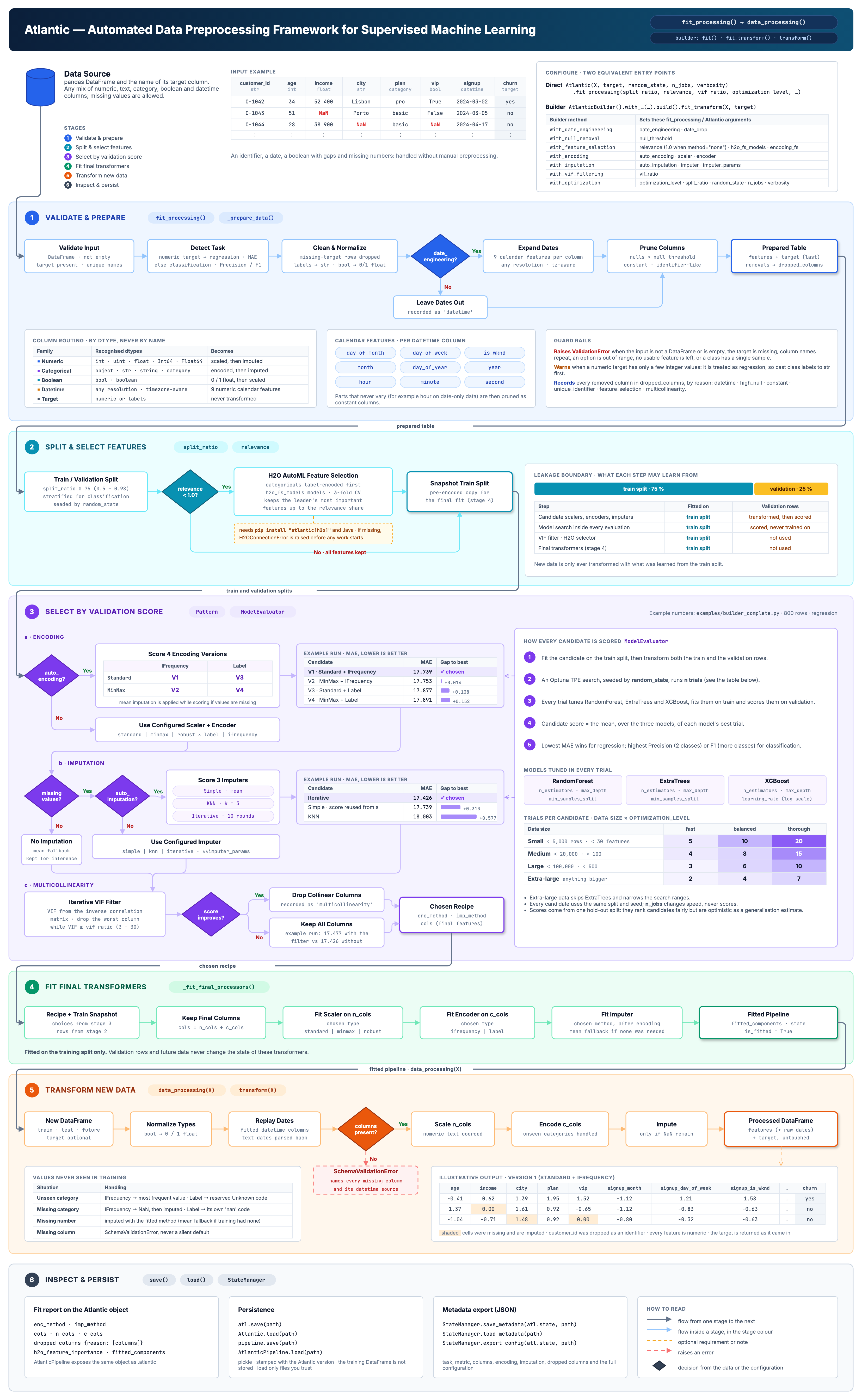
The Atlantic pipeline runs in 6 main stages:
1. Validate & prepare
-
Task detection: the task is inferred from the target column.
Target type Task Evaluation metric Numeric Regression MAE Other, with 2 classes Binary classification Precision Other, with more than 2 classes Multiclass classification F1 -
Data preparation:
- Rows with no target value are dropped.
- Boolean columns become 0/1 features.
- Each datetime column is expanded into nine calendar features.
-
Column removal: high-null, constant and identifier-like columns are removed. Every removal is recorded in
dropped_columns.
2. Split & select features
- Split: the data is divided into a train and a validation split. Classification splits are stratified.
- Feature selection (optional): when
relevance < 1.0, only the features carrying the requested share of H2O AutoML variable importance are kept. This requiresatlantic[h2o].
3. Select by validation score
Preprocessing steps are chosen one at a time:
| Step | Candidates | Applied when |
|---|---|---|
| Encoding | 4 combinations: Standard or MinMax scaler × IFrequency or Label encoder | Always |
| Imputation | Simple (mean), KNN, Iterative | The data has missing values |
| VIF filtering | Iterative removal of features above vif_ratio |
It improves the validation score |
- Evaluation: each candidate is fitted on the train split and scored on the validation split, using tuned RandomForest, ExtraTrees and XGBoost models.
- Trial budget: the number of tuning trials adapts to the data size and to
optimization_level.
4. Fit final transformers
The chosen scaler, encoder and imputer are refitted on the training rows only, so validation rows never influence them.
5. Transform new data
data_processing replays the same steps on any future frame:
- Frames missing a fitted column are rejected with a clear error.
- Unseen categories and missing values are handled.
6. Inspect & persist
- Inspect: the pipeline's decisions are exposed as
enc_method,imp_method,colsanddropped_columns. - Persist: the fitted pipeline can be saved with
saveand reloaded withAtlantic.load.
Where to get it
Binary installer for the latest released version is available at the Python Package Index (PyPI).
Installation
To install this package from Pypi repository run the following command:
pip install atlantic
Usage Examples
1. Atlantic - Automated Data Preprocessing Pipeline
Import the package, load a dataset, split it, and define your target column name. Customize the fit_processing method with the following parameters:
| Parameter | Description | Default |
|---|---|---|
split_ratio |
Train/Validation split ratio for preprocessing evaluation (0.5 - 0.98) | 0.75 |
relevance |
Minimum feature importance percentage for H2O AutoML selection (0.4 - 1.0). 1.0 skips H2O feature selection; lower values require atlantic[h2o] |
0.99 |
h2o_fs_models |
Number of models for H2O AutoML feature selection | 7 |
encoding_fs |
Encode categorical features before H2O selection | True |
vif_ratio |
Variance Inflation Factor threshold (3 - 30) | 10.0 |
optimization_level |
Optimization intensity: "fast", "balanced", "thorough" |
"balanced" |
The Atlantic constructor additionally accepts:
| Parameter | Description | Default |
|---|---|---|
random_state |
Seed for the internal train/validation split and every model evaluation | 42 |
n_jobs |
Parallelism of the evaluation models. None keeps the tree ensembles single-threaded, -1 uses all cores (same results, faster on mid-sized data) |
None |
verbosity |
0 silent, 1 selection summary, 2 detailed |
1 |
Once fitted, use data_processing to transform any future dataframes with the same structure.
Task type. It is inferred from the target column: a numeric target is a regression task, anything else (strings, categories, booleans) a classification task. Integer-coded class labels such as
0/1are therefore treated as regression (a warning is raised) - cast them first:data["Target_Column"] = data["Target_Column"].astype(str).
import pandas as pd
from sklearn.model_selection import train_test_split
from atlantic.pipeline import Atlantic
import warnings
warnings.filterwarnings("ignore", category=Warning)

data = pd.read_csv('csv_directory_path', encoding='latin', delimiter=',')

train, test = train_test_split(data, train_size=0.8)
test, future_data = train_test_split(test, train_size=0.6)

train = train.reset_index(drop=True)
test = test.reset_index(drop=True)
future_data = future_data.reset_index(drop=True)
future_data.drop(columns=["Target_Column"], inplace=True)

### Fit Data Processing
atl = Atlantic(X=train, target="Target_Column")

atl.fit_processing(
    split_ratio=0.75,
    relevance=0.99,      # H2O feature selection (needs atlantic[h2o]); 1.0 skips it
    h2o_fs_models=7,
    vif_ratio=10.0,
    optimization_level="balanced"
)

### Transform Data Processing
train = atl.data_processing(X=train)
test = atl.data_processing(X=test)
future_data = atl.data_processing(X=future_data)

### Inspect what the pipeline decided
print(atl.enc_method, atl.imp_method)   # selected encoding version / imputation method
print(atl.cols)                         # feature columns kept
print(atl.dropped_columns)              # columns removed, grouped by reason

### Export the fitted pipeline (built-in helper — uses pickle under the hood)
### The training data is not stored in the file. Only load pipeline files you trust.
atl.save('fit_atl.pkl')
loaded_atl = Atlantic.load('fit_atl.pkl')

# Or serialize manually with dill (bundled dependency):
# import dill as pickle
# with open('fit_atl.pkl', 'wb') as output:
#     pickle.dump(atl, output)
2. Atlantic - Builder Pattern (Granular Control)
For fine-grained control over preprocessing steps, use the AtlanticBuilder fluent interface:
from sklearn.model_selection import train_test_split
from atlantic.pipeline import AtlanticBuilder

train, test = train_test_split(data, train_size=0.8)
train = train.reset_index(drop=True)
test = test.reset_index(drop=True)

### Build Custom Pipeline
pipeline = (AtlanticBuilder()
    .with_date_engineering(enabled=True, drop=True)
    .with_null_removal(threshold=0.90)
    .with_feature_selection(
        method="h2o",
        relevance=0.95,
        h2o_models=10,
        encoding_fs=True
    )
    .with_encoding(
        scaler="standard",
        encoder="ifrequency",
        auto_select=True
    )
    .with_imputation(
        method="knn",
        auto_select=True
    )
    .with_vif_filtering(threshold=10.0)
    .with_optimization(optimization_level="balanced")
    .build()
)

### Fit and Transform
train_processed = pipeline.fit_transform(train, target="Target_Column")
test_processed = pipeline.transform(test)

### Inspect the fitted result and persist the pipeline
print(pipeline.atlantic.enc_method, pipeline.atlantic.dropped_columns)
pipeline.save('fit_pipeline.pkl')
# from atlantic.pipeline import AtlanticPipeline
# pipeline = AtlanticPipeline.load('fit_pipeline.pkl')
Notes on the builder options:
with_date_engineering(enabled, drop)-enabled=Falseleaves datetime columns out of the features;drop=Falsekeeps the original datetime columns in the transformed output next to the generated features.with_encoding(..., auto_select=True)/with_imputation(..., auto_select=True)select the best option by validation performance and ignore the explicitscaler/encoder/method; withauto_select=Falsethey are applied as given.with_optimization(optimization_level, random_state, split_ratio, n_jobs, verbosity)controls the evaluation budget, reproducibility and console output.
Builder Configuration Presets
| Configuration | Use Case | Key Settings |
|---|---|---|
| Fast | Quick prototyping | h2o_models=3, method="simple", optimization_level="fast" |
| Balanced | General purpose | Default settings |
| Thorough | Best results | h2o_models=15, method="iterative", optimization_level="thorough" |
| High-Null | Missing data >20% | threshold=0.80, scaler="robust", method="iterative" |
| No-H2O | Skip H2O selection | method="none", VIF filtering only |
# Fast Prototyping
fast_pipeline = (AtlanticBuilder()
    .with_feature_selection(method="h2o", relevance=0.85, h2o_models=3)
    .with_encoding(scaler="minmax", encoder="label", auto_select=False)
    .with_imputation(method="simple", auto_select=False)
    .with_optimization(optimization_level="fast")
    .build()
)

# Thorough Optimization
thorough_pipeline = (AtlanticBuilder()
    .with_feature_selection(method="h2o", relevance=0.98, h2o_models=15)
    .with_encoding(auto_select=True)
    .with_imputation(method="iterative", auto_select=True)
    .with_vif_filtering(threshold=8.0)
    .with_optimization(optimization_level="thorough")
    .build()
)

# High-Null Data
high_null_pipeline = (AtlanticBuilder()
    .with_null_removal(threshold=0.80)
    .with_encoding(scaler="robust")
    .with_imputation(method="iterative", auto_select=True)
    .build()
)
3. Atlantic - Preprocessing Components
3.1 Encoding Methods
Encode categorical variables into numerical format. Choose from label encoding (ordinal mapping) or inverse frequency encoding (IDF-based weights) — both preserve the column layout, so you can assign the result back in place. AutoOneHotEncoder expands each categorical column into several binary columns, so it returns a wider frame and must be handled separately (see the note below).
import pandas as pd
from sklearn.model_selection import train_test_split
from atlantic.preprocessing import AutoLabelEncoder, AutoIFrequencyEncoder, AutoOneHotEncoder

train, test = train_test_split(data, train_size=0.8)
train = train.reset_index(drop=True)
test = test.reset_index(drop=True)

from atlantic.utils import get_categorical_columns, get_numeric_columns

target = "Target_Column"
# Detects object, category and string dtype columns on any pandas version.
cat_cols = get_categorical_columns(data, exclude=[target])

### Create Encoder (label or inverse-frequency — same-shape output)
encoder = AutoLabelEncoder()
# encoder = AutoIFrequencyEncoder()

### Fit and Transform
encoder.fit(train[cat_cols])
train[cat_cols] = encoder.transform(train[cat_cols])
test[cat_cols] = encoder.transform(test[cat_cols])

### Inverse Transform (if needed)
train[cat_cols] = encoder.inverse_transform(train[cat_cols])

### One-hot encoding returns a WIDER frame — do not assign back into cat_cols:
# ohe = AutoOneHotEncoder()
# ohe.fit(train[cat_cols])
# train = ohe.transform(train)   # original cat_cols are replaced by binary columns
# test = ohe.transform(test)
3.2 Scalers
Normalize numerical features to improve model convergence. Standard scaler for normal distributions, MinMax for bounded ranges, or Robust scaler for data with outliers.
from atlantic.preprocessing import AutoStandardScaler, AutoMinMaxScaler, AutoRobustScaler
from atlantic.utils import get_numeric_columns

target = "Target_Column"
# Exclude the target: scaling the label column would distort it for regression.
num_cols = get_numeric_columns(train, exclude=[target])

### Create Scaler (choose one)
scaler = AutoStandardScaler()  # Zero mean, unit variance
# scaler = AutoMinMaxScaler()  # Scale to [0, 1]
# scaler = AutoRobustScaler()  # Median/IQR based, outlier-resistant

### Fit and Transform
scaler.fit(train[num_cols])
train[num_cols] = scaler.transform(train[num_cols])
test[num_cols] = scaler.transform(test[num_cols])
3.3 Imputers
Handle missing values using statistical methods. Simple imputation for speed, KNN for local patterns, or iterative modeling for complex dependencies.
from atlantic.preprocessing import AutoSimpleImputer, AutoKNNImputer, AutoIterativeImputer

### Create Imputer (choose one)
imputer = AutoSimpleImputer(strategy='mean', target=target)
# imputer = AutoKNNImputer(n_neighbors=5, target=target)
# imputer = AutoIterativeImputer(max_iter=10, target=target)

### Fit and Transform
imputer.fit(train)
train = imputer.transform(train)
test = imputer.transform(test)
3.4 Feature Selection
Reduce dimensionality by removing redundant or low-importance features. VIF removes multicollinear features, while H2O AutoML identifies the most predictive ones.
Note:
VIFFeatureSelectorevaluates numeric, null-free columns — impute nulls first (it raisesValidationErroron nulls). Non-numeric columns are passed through untouched.vif_thresholdmust be within[3.0, 30.0]. TheH2OFeatureSelectorexample below requires a running H2O cluster (Java); install the optional dependency withpip install atlantic[h2o].
from atlantic.feature_selection import VIFFeatureSelector, H2OFeatureSelector

### VIF-based Selection (expects encoded, imputed, numeric features)
vif_selector = VIFFeatureSelector(target=target, vif_threshold=10.0)
vif_selector.fit(train)
train = vif_selector.transform(train)
test = vif_selector.transform(test)

### H2O AutoML Selection
h2o_selector = H2OFeatureSelector(target=target, relevance=0.95, max_models=7)
h2o_selector.fit(train)
train = h2o_selector.transform(train)
test = h2o_selector.transform(test)
Check out the

For interactive and step by step guideline walkthrough, feel free to explore the

Citation
@article{SANTOS2023100532,
  author = {Luis Fernando Santos and Luis Ferreira},
  title = {Atlantic - Automated data preprocessing framework for supervised machine learning},
  journal = {Software Impacts},
  volume = {17},
  year = {2023},
  issn = {2665-9638},
  doi = {http://dx.doi.org/10.1016/j.simpa.2023.100532},
  url = {https://www.sciencedirect.com/science/article/pii/S2665963823000696}
}
License
Distributed under the MIT License. See LICENSE for more information.
Contact
1 maintainer

Metadata
1 maintainer
Release files for atlantic 2.0.31
For a detailed explanation of source distributions (sdists) and built distributions (wheels), please see the package formats documentation.
Built distribution (wheel)
| File | Interpreter | ABI | Platform | Actions Reset |
|---|---|---|---|---|
| atlantic-2.0.31-py3-none-any.whl | Python 3 | none | any | Details for atlantic-2.0.31-py3-none-any.whl |
Release files / atlantic-2.0.31-py3-none-any.whl
| Download URL | atlantic-2.0.31-py3-none-any.whl |
|---|---|
| Size | 84.3 kB |
| Tags | Python 3 |
|
SHA-256 checksum How to use checksums |
8516bb3bdeacd82ba60396383266cedf41bea799f9a5de96c3b66a569e2526f0
|
|
BLAKE2b-256 checksum How to use checksums |
780ad0190337216c486e28c80342a9e9fcf080c0eb35e2f2551112426f00eb35
|
| Upload date | |
|
Uploaded using Trusted Publishing? What is trusted publishing? |
No |
| Uploaded via |
twine/7.0.0 CPython/3.11.18
|
Security for atlantic 2.0.31
Provenance
Provenance describes where a file came from. On PyPI, provenance is shared via attestations, which provide a verifiable record of the build or publishing details. View details, limitations and caveats.
No provenance found
None of the files in this release were uploaded with provenance metadata.
A note on package security
PyPI is a repository for distributing packages, not a service for auditing them. While third-party security researchers and our staff do their best to detect and remove malicious packages, PyPI cannot guarantee the quality, security or suitability of any given package.
To learn more about protecting yourself from malicious actors, visit our package security documentation.














