

Diverse P&R benchmarks, distilled into one plug-and-play PyTorch environment on the GPU.
Evolve placement and timing-optimization algorithms in minutes, not days.





Install · Why Attar · Roadmap · Two modes · How it works · Gallery
Install
pip install attar
import attar
d = attar.load('after_fp/orfs_asap7/aes', device='cuda')   # downloaded from the zoo on first use
Python 3.8 or newer, with PyTorch (a CUDA GPU for the speed; everything also runs on the CPU). The designs come from
the Attar zoo on the Hugging Face Hub (262 designs, 1.1 GB
in all); attar.zoo(remote=True) lists them. The latest code: pip install git+https://github.com/RayChang987/Attar.
- The first timing run on a GPU machine compiles the timer's Triton kernels (about two minutes, once); later runs reuse them and take seconds.
- With
g++on the path, nets of more than 256 pins get OpenROAD's exact Steiner parasitics (built on first use); without it they fall back to a lumped wire model, with a warning. - No GPU at hand: the demo below runs in Colab (free T4,
g++included):

Why Attar
- Speed decides quality. When AI agents do the research, iteration speed is more than a metric: in our view it decides the quality of results (QoR). An agent that can propose, test and discard an idea in seconds finds what works. When every run takes hours, even the best algorithm starves for feedback.
- Data preparation is painful. Traditional place-and-route (P&R) tools take minutes to hours per run, and every benchmark suite comes in its own format (LEF/DEF, Bookshelf, YAL, GSRC blocks) with its own gaps. Getting a design ready to experiment on is slow, fragmented work, repeated for every suite.
- Attar is the fast loop. Attar distills diverse P&R benchmarks into one plug-and-play PyTorch environment:
attar.loada name, and the design is on the GPU. Each reader hands over only the facts its source has, with their provenance, and nothing missing is made up (a design is a state). The fast loop stays faithful to the full flows without their overhead: its HPWL equals OpenROAD's to 7 digits, its legality equalscheck_placement, its placements route in OpenROAD-flow-scripts with 0 DRC, and HPWL ranks placements as routed wirelength does in 951 routed Innovus runs, once they differ by 2% or more (validation). - GPU-native. Layouts and design features are tensors on the GPU, so researchers, developers and AI agents train, evaluate and debug in the same few lines of Python: exact HPWL of 8.9M pins in 3 ms, a 2.2M-cell design placed and legalized in 49 s. An algorithm is a function from tensors to positions: no database API, no TCL, no file formats.
Roadmap
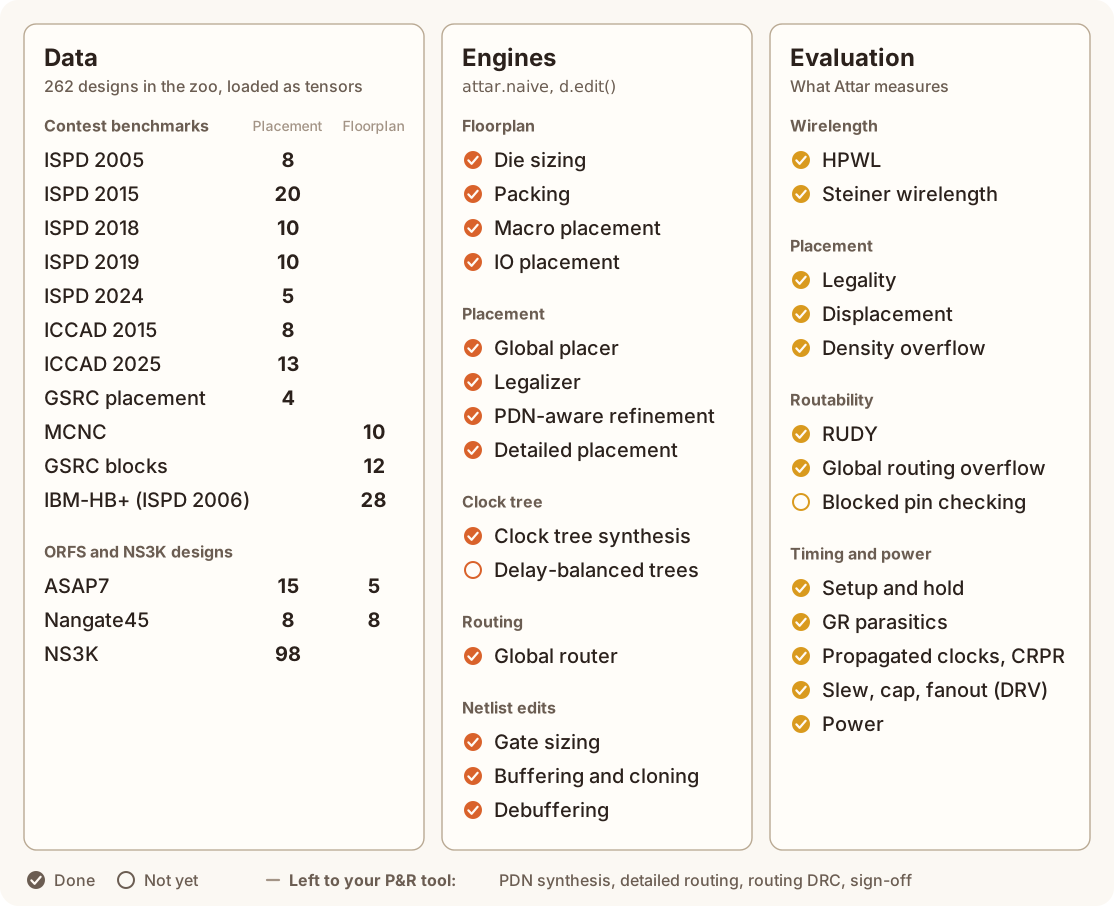
Evaluation
Each evaluator against OpenROAD on the same netlist and placement; full tables in docs/validation.
| Evaluator | Call | Compared with | Accuracy |
|---|---|---|---|
| HPWL | ev.hpwl |
OpenROAD's HPWL from its database; 23 ORFS designs (ASAP7, Nangate45) up to 1.05M cells | within 0.00002% on every design (table) |
| Legality | ev.legality |
OpenROAD check_placement |
same verdict on all 23 ORFS designs and the 62 NS3K floorplans OpenROAD can check; placements broken by half a site rejected by both |
| Timing | d.timing() |
OpenSTA after estimate_parasitics -placement; 31 designs (ASAP7, Nangate45, NS3K) up to 1.05M cells |
WNS median error 0.00% (ORFS) and 0.11% (NS3K), max 0.34%; hold slack MAE at most 0.36 ps; 5-30x faster than OpenSTA |
| Pin and net slack | d.timing().pin_slack(), .net_slack() |
OpenSTA's slack_max of every pin; 8 designs (ASAP7, Nangate45) up to 384k pins |
Pearson at least 0.9995; on the pins with negative slack, MAE at most 1.03 ps; 7-32 ms after a timing run |
| Timing after sizing | d.resize + d.timing() |
OpenROAD replace_cell + OpenSTA, 20% of the cells swapped at random; 16 designs |
WNS error at most 0.23%, TNS at most 0.37% |
| Timing after netlist edits | d.edit(), d.debuffer() + d.timing() |
OpenSTA on the DEF Attar exports: after 1,548 buffers and 443 clones inserted (10 NS3K designs up to 163k cells), and after d.debuffer() removed 45,991 buffers and 83 inverters (10 ORFS designs) |
setup Pearson at least 0.9997, WNS error at most 0.04% after debuffer and 1.18% after the NS3K edits; hold MAE at most 0.36 ps |
| Global routing OVF | d.gr_overflow() |
OpenROAD's gcell capacities and global route; 13 ORFS designs | capacities exact without macros, within 0.16% with them; ranks designs as OpenROAD does (Spearman 0.97); a pre-route estimate: reads mild congestion high and heavy congestion low |
| Global-routing parasitics | d.timing(routes=...) |
OpenSTA after estimate_parasitics -global_routing on OpenROAD's own routes; 14 ORFS designs (ASAP7, Nangate45) |
every net's wire R and C equal OpenROAD's SPEF; WNS error at most 0.08%, setup slack MAE at most 0.02 ps (one latch pin aside) (table) |
| Global routing | d.global_route() |
OpenROAD's global_route on the same placement; 14 designs, and 7 placements each of 7 |
wirelength 0.5-3.6% below OpenROAD's, per net Pearson at least 0.998; orders placements as OpenROAD's routed wirelength does in 100% of pairs 1% or more apart (HPWL: 74-88%), 91% below 1%; 16-41x faster from jpeg up; leaves some overflow OpenROAD does not (table) |
| Steiner wirelength, RUDY, density overflow | ev.steiner_wirelength, ev.rudy, ev.density_overflow |
Naive Engine
| Engine | Mode | Call | What it does |
|---|---|---|---|
| Packing | before_fp |
naive.place_macros(packing=True) |
block-level designs: B*-tree packing, annealed into the core, then for HPWL |
| Macro placement | before_fp |
naive.place_macros |
mixed-size global placement, then macros legalized on their routing tracks with a halo |
| IO placement | before_fp |
naive.place_io |
IO pins on the die boundary, net-aware once cells are placed |
| Placer | both | naive.global_place |
electrostatic (ePlace/DREAMPlace style, Nesterov, CUDA graphs) at the source flow's own target density; routability=True: DREAMPlace's cell inflation |
| Legalizer | after_fp |
naive.legalize |
multi-row-height cells, power-rail parity, signal pins clear of the PDN's via metal; incremental on a placement to repair (cells=: only those move; a legal input comes out unchanged) |
| PDN-aware refinement | after_fp |
inside naive.legalize |
row DP and repair that keep cells clear of the PDN |
| Global router | after_fp |
d.global_route() |
on OpenROAD's gcell grid and capacities: Prim-Dijkstra trees, negotiated Z / L pattern routing, chunked layer assignment; time on its routes with d.timing(routes=...) |
| Detailed placement | after_fp |
naive.detailed_place |
OpenROAD dpo's global swap, vertical swap, local reordering and cell flipping, batched on the GPU; keeps the placement legal |
d.floorplan(utilization=...) sizes the die (naive.make_die), then places the IO pins and the macros;
d.place() is global placement plus legalization.
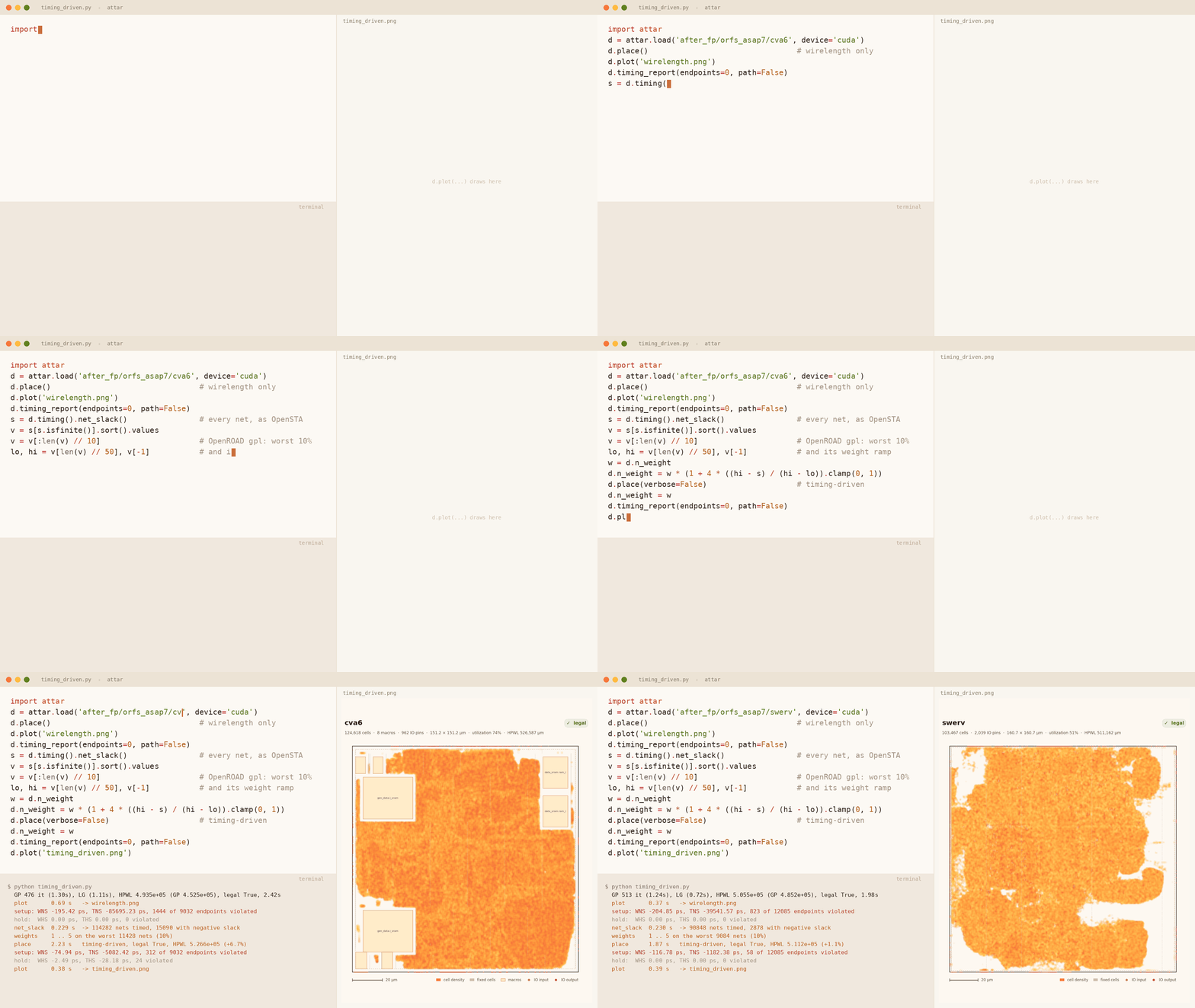
Your algorithm, in fifteen lines (examples/timing_driven.py;
run it in Colab). Real
runs on an RTX 3080 Ti, the same code on two ASAP7 designs: place for wirelength, take every net's slack
(net_slack(), as OpenSTA's), weight the worst 10% of the nets from 1 to 5 by criticality as OpenROAD's
timing-driven global placement does, place again. cva6 (121k cells, 8 SRAMs): WNS -195 to -75 ps, TNS
-85.7k to -5.1k ps, HPWL +6.7%, in 2.2 s. swerv (103k cells): WNS -205 to -117 ps, TNS -39.5k to -1.2k ps,
HPWL +1.1%, in 1.9 s. Both legal.
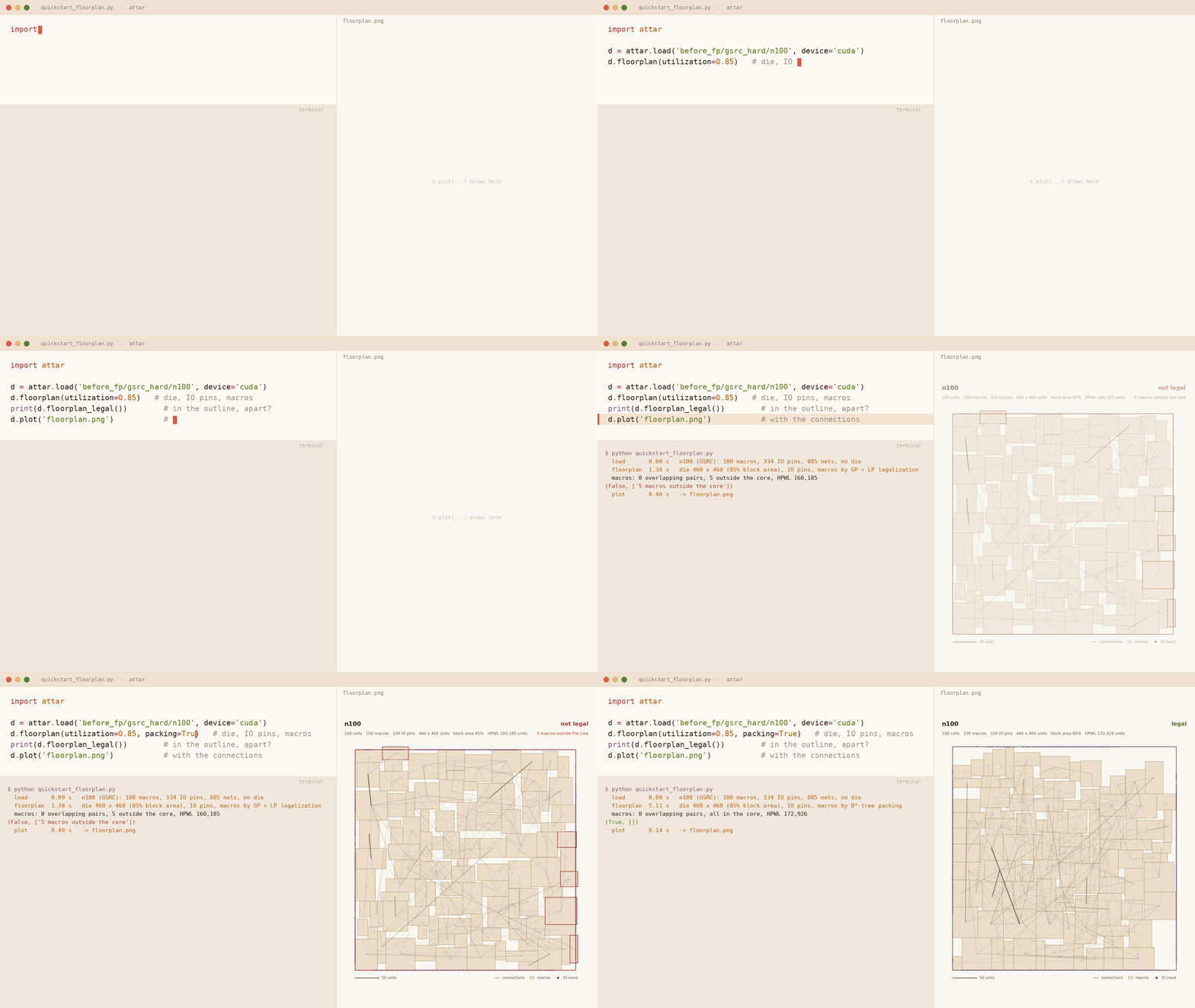
Floorplan mode (before_fp). GSRC n100: 100 hard blocks, no die; Attar sizes one for 85%
block area, places the IO pins and the macros. GP + LP legalization never overlaps macros, but here 5 stick out of
the core: not legal. packing=True (B*-tree, annealed into the core, then for HPWL) fits them all in
5.1 s, at 8% more wire. The lines are the strongest connections between macros and IO pins.
Two modes
In production chip design, the power delivery network (PDN) is the dividing line: once the power grid and the macros
are locked down, the design enters a different phase. Attar splits its problems at that line. It does not synthesize
a PDN, and it should not: a before_fp answer goes to a flow that draws one, and an after_fp problem comes
with the PDN its flow drew.
Before-floorplan (before_fp) |
After-floorplan (after_fp) |
|
|---|---|---|
| given | the netlist (an initial die for ORFS designs) | die, IO pins, macros, rows and PDN: a fixed floorplan |
| the answer | target utilization (the die), IO pin placement, macro placement | standard-cell placement; then timing optimization and global routing on the same floorplan |
| one call | d.floorplan(utilization=0.6) |
d.place() |
| goes out as | a DEF: your flow draws the PDN and places | a DEF: your flow routes and times |
| in the zoo | 63 designs, 7 suites | 199 designs, 17 suites |
Attar measures wirelength, congestion (RUDY, GROV), density, legality and timing; see the roadmap.
How it works
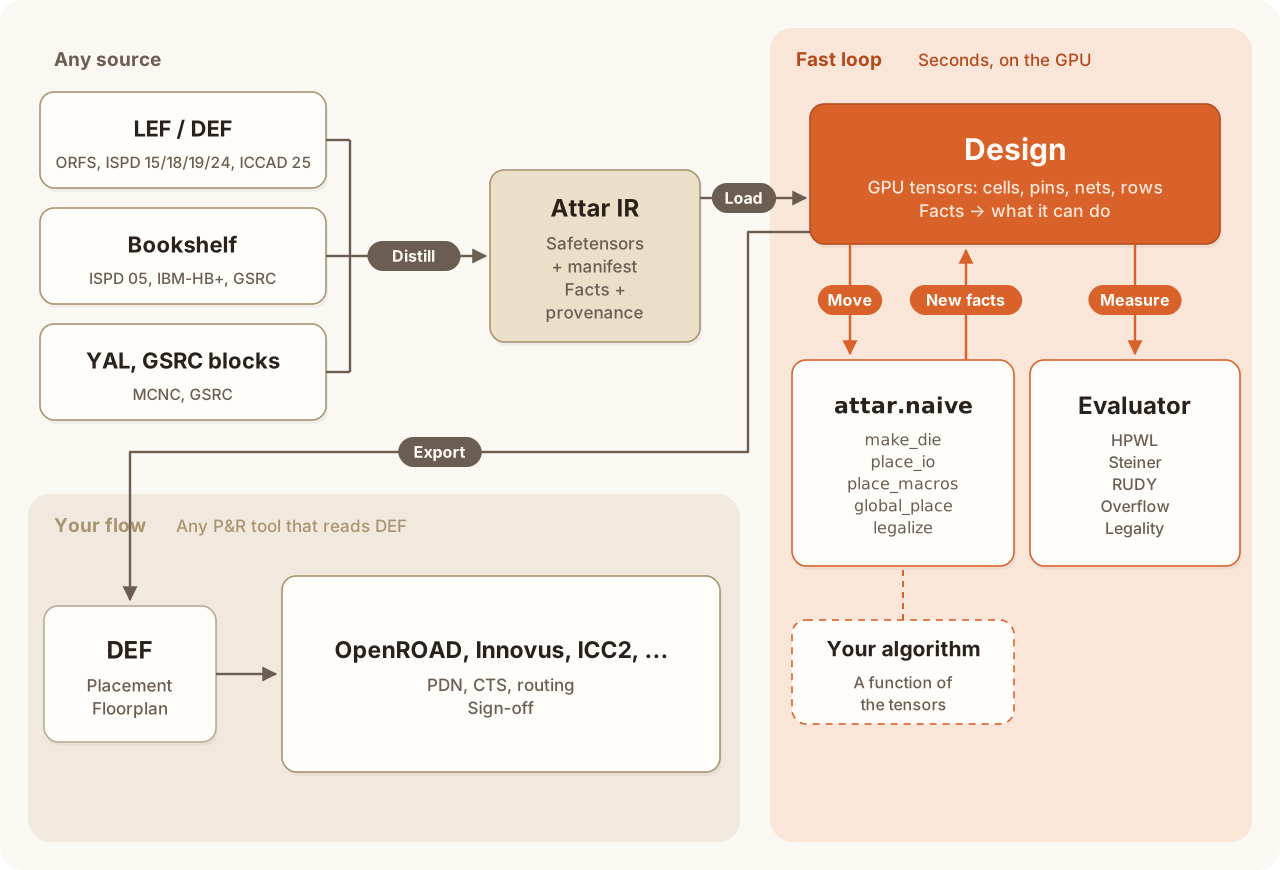
- Distill. A reader turns a benchmark into the Attar IR: integer arrays in a safetensors file, plus a manifest that lists which facts the source provides and where each came from. Readers exist for LEF/DEF, Bookshelf, YAL and GSRC blocks.
- Load.
attar.loadputs the arrays on the GPU as aDesign.d.status()shows each fact, each capability, and what is left before export. - Move. Your algorithm, or the built-in engines (
attar.naive), changes the positions: die, IO pins and macros forbefore_fp, cells forafter_fp. - Measure.
attar.Evaluatorcomputes HPWL (exact, batched), Steiner wirelength, RUDY, density overflow and legality, on the current placement or on any positions you pass. - Export.
d.export(out_def)writes the design back into its source DEF's frame: the PDN, IO pin shapes and fixed cells as they were, the cells and nets from the IR (a changed die, IO pins and macros included). Your own flow (OpenROAD, Innovus, ICC2, ...) takes it from there.
More: concepts · benchmarks · API · validation
Gallery
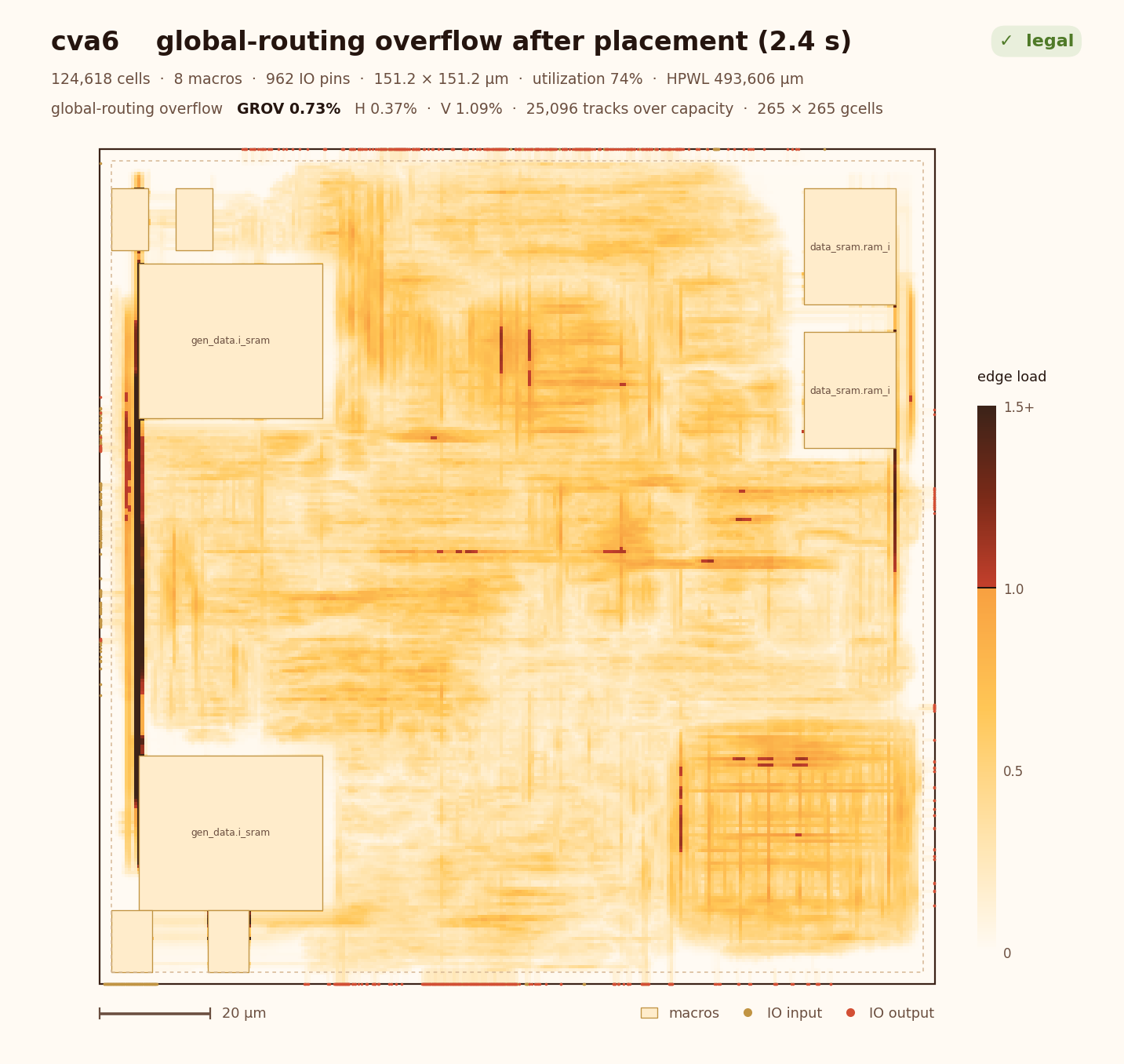
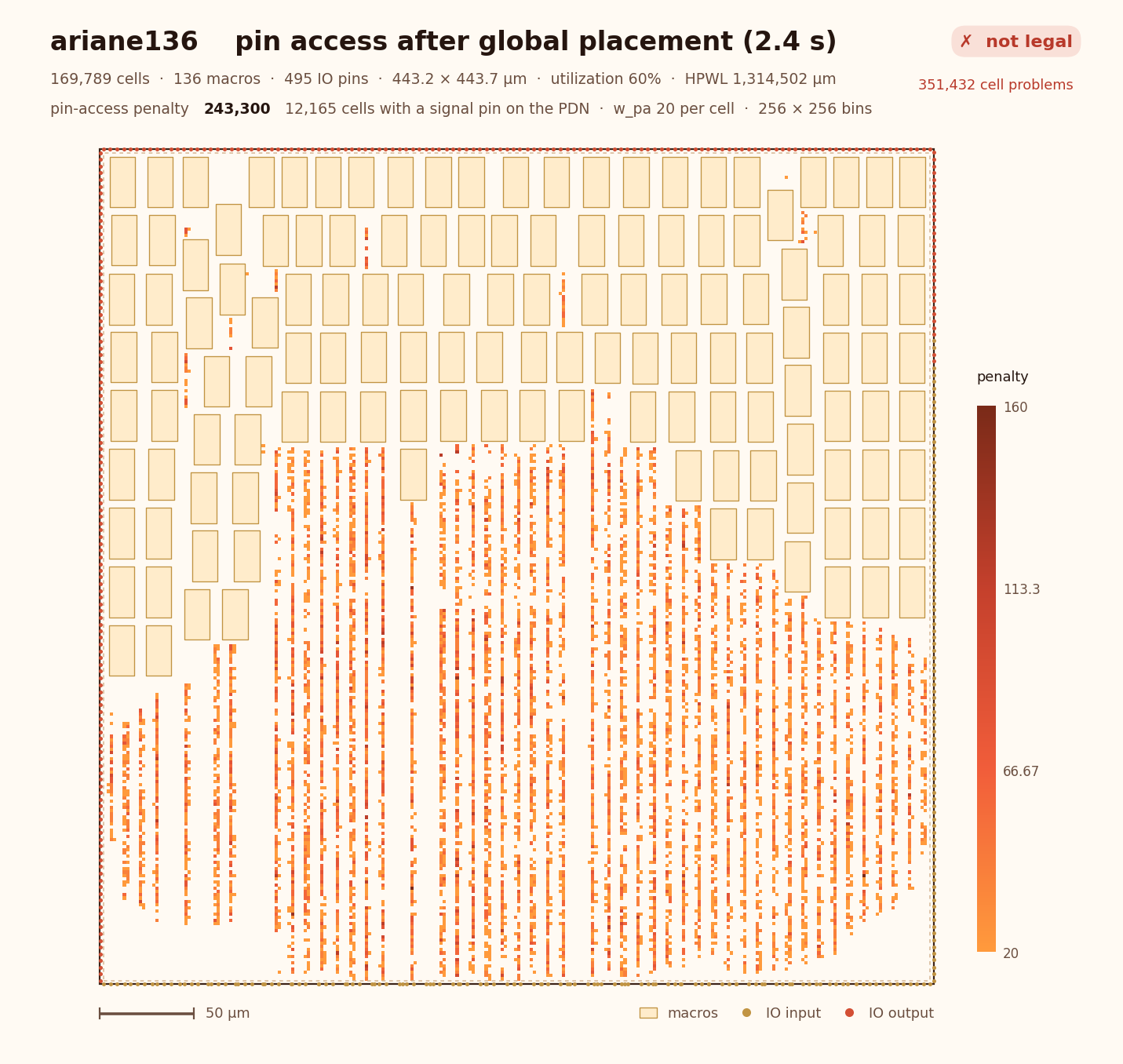
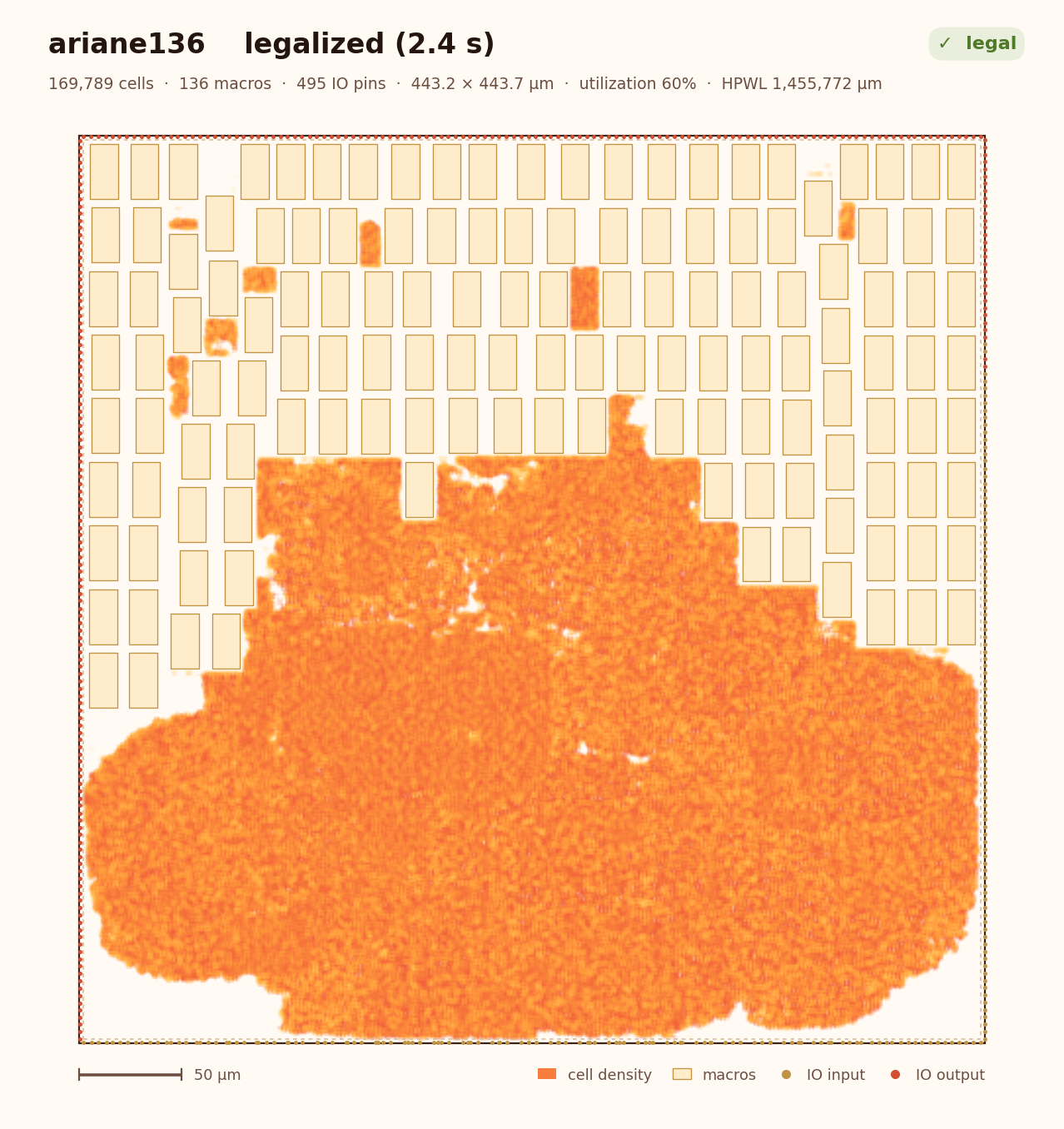
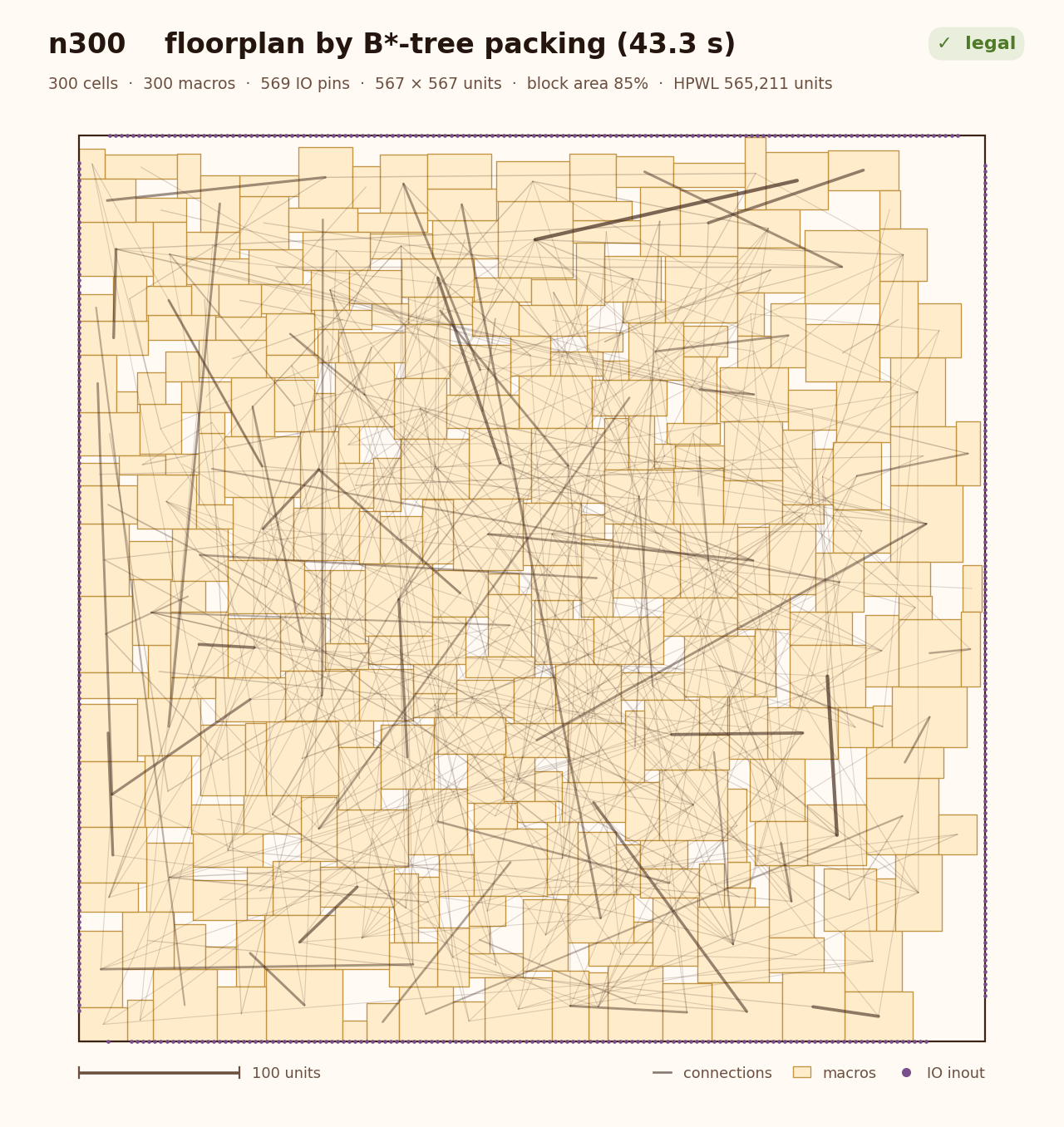
What the Evaluator sees: each view is d.plot(tiles=...) on a real run of attar.naive.
 |
 |
Global-routing overflow (d.gr_overflow(), tiles='gr_overflow'): cva6 (ASAP7)
placed in 2.4 s, RUDY demand against OpenROAD's gcell capacities. GROV 0.73%: the channel left of the SRAMs and
the dense logic at the lower right are where the router will struggle. |
Pin access (tiles='pin_access'): ariane136 (NS3K, 136 SRAMs) right after global
placement. 12,165 cells have a signal pin on the PDN's via metal, in stripes along the power grid: NS3K's via
stacks cross the M1 pin layer. |
 |
 |
Legality (ev.legality()): the same design legalized in 2.4 s. Rows, sites, overlaps,
power-rail parity and the PDN all check out: 0 cells left on the PDN. |
Floorplan legality and connections (d.floorplan_legal(), nets): GSRC n300,
300 hard blocks and 569 IO pins, no die given. Attar sizes one for 85% block area and packs the blocks (B*-tree) in
43 s: legal, HPWL 565k. The lines are the strongest connections between blocks and IO pins. |
A design is a state
>>> d = attar.load('after_fp/orfs_asap7/aes'); d.status()
aes_cipher_top  (orfs/asap7, fidelity F1)
  placement target density 0.71 (orfs 3_3 global_place (GPL-0023))
Problem facts
  ✅ netlist           def             12268 nets, 42885 pins
  ✅ cell_geometry     lef             12420 cells (12009 movable, 0 macros), 56 masters
  ✅ floorplan.die     def             1 die(s), 48.71 x 48.71 um
  ✅ floorplan.io      def             388 IO pins placed
  ✅ rows              def             164 rows, height 0.27 um
  ✅ pdn               def             1815 wire and 4785 via shapes on M1, M2, M3
  ✅ def_frame         def             PDN, pins, fixed cells of the source DEF, kept verbatim (849 kB)
  ...
Solution state
  ❌ placement         12009 movable cells unplaced  (snapshots: reference)
  ...
  -> only a placement is missing: place the design (or restore a snapshot), then d.export("out.def")
Every reader states which facts it provides, and every engine and metric states which facts it needs:
- a Bookshelf design has no cell library, so it does not export to DEF;
- a design with no special nets on the pin layers has no
pdnrule to keep; - a block floorplan has no rows;
- a soft-block benchmark has no cell geometry.
Each can do exactly what its facts allow. Engines add facts with provenance (placement: naive), so it is always
clear which part of a design came from where. See docs/concepts.md.
Acknowledgements
Attar's global placement follows ePlace, DREAMPlace and Xplace, and its routability option DREAMPlace's cell inflation; its rail and PDN checks follow OpenROAD's detailed placer, and its PDN repair the row DP of pa_pdn. Attar is validated against OpenROAD-flow-scripts on the ASAP7 and Nangate45 platforms. Benchmarks are from the ISPD, ICCAD and GSRC contests, MCNC and ORFS.
License

1 maintainer

Metadata
1 maintainer
Release files for attar 1.0.3
For a detailed explanation of source distributions (sdists) and built distributions (wheels), please see the package formats documentation.
Source distribution (sdist)
| File | Size | Uploaded | Provenance | Actions |
|---|---|---|---|---|
| attar-1.0.3.tar.gz | 348.2 kB | Without provenance | Details for attar-1.0.3.tar.gz |
Built distribution (wheel)
| File | Interpreter | ABI | Platform | Actions Reset |
|---|---|---|---|---|
| attar-1.0.3-py3-none-any.whl | Python 3 | none | any | Details for attar-1.0.3-py3-none-any.whl |
Total release size: 686.1 kB
Release files / attar-1.0.3.tar.gz
| Download URL | attar-1.0.3.tar.gz |
|---|---|
| Size | 348.2 kB |
| Tags | Source |
|
SHA-256 checksum How to use checksums |
5639f271eefc7b7ab31ccf9e930d9a99a5ab219d6e82e8dea5a81457bac456d3
|
|
BLAKE2b-256 checksum How to use checksums |
c4bced7fb3841c1e751df3a6e931fa41dc56262b95a95685770fcec0c78df4ac
|
| Upload date | |
|
Uploaded using Trusted Publishing? What is trusted publishing? |
No |
| Uploaded via |
twine/6.1.0 CPython/3.8.10
|
Release files / attar-1.0.3-py3-none-any.whl
| Download URL | attar-1.0.3-py3-none-any.whl |
|---|---|
| Size | 337.9 kB |
| Tags | Python 3 |
|
SHA-256 checksum How to use checksums |
1e7802975699a253f781b7393e6f11b6c3e80c2ec38f88d1bb70e19a1c56033f
|
|
BLAKE2b-256 checksum How to use checksums |
a50f6a5e36a7c7a808310eccdddb491064612ad182d67e96ef9e73731379702b
|
| Upload date | |
|
Uploaded using Trusted Publishing? What is trusted publishing? |
No |
| Uploaded via |
twine/6.1.0 CPython/3.8.10
|
Security for attar 1.0.3
Provenance
Provenance describes where a file came from. On PyPI, provenance is shared via attestations, which provide a verifiable record of the build or publishing details. View details, limitations and caveats.
No provenance found
None of the files in this release were uploaded with provenance metadata.
A note on package security
PyPI is a repository for distributing packages, not a service for auditing them. While third-party security researchers and our staff do their best to detect and remove malicious packages, PyPI cannot guarantee the quality, security or suitability of any given package.
To learn more about protecting yourself from malicious actors, visit our package security documentation.














