
Attune AI
Persistent memory and receipt-verified workflows for Claude Code.
🌐 Docs & guides: attune-ai.dev









Your agent stops starting from zero, its word stops being the evidence, and it asks you with structure instead of prose.
Memory: a stash → recall → promote loop carries decisions, bugs,
and hard-won lessons from one session into the next, and surfaces the
right lesson at the exact moment a prompt needs it. Local-first, from
a plain pip install attune-ai. Recall loads a few hundred
exactly-relevant tokens instead of your whole corpus — 67× fewer
tokens on our own 800+ lesson store, retrieved at P@3 96% on a
frozen benchmark (details).
Receipts: state the outcome you want and how to verify it, and get back a receipt — not a promise:
attune fix "imports resolve after the rename" \
  --workflow fix \
  --scope src/attune/cli_minimal.py \
  --probe "pytest tests/unit/test_cli_minimal.py" \
  --run

The probes are re-run independently of the workflow that claims it finished. Exit 0 means the probes passed — not that the agent felt good about it.
Interactive forms: the agent asks with structure, not prose — a decision card with its recommendation and tradeoffs, a pushback card when it disagrees, a progress report, a ranking or triage — one tap each, validated on the way back. One form renders to whatever surface your client draws: a native dialog, a rich widget, or a plain menu (the vocabulary).
Around that core: 21 workflows and 64 MCP tools dispatching 2–6 domain-specific subagents behind Socratic quality gates, RAG grounding with a citation-per-claim contract, and generation fact-checking — one install, one MCP server. We run our own knowledge base on it: the docs and 800+ engineering lessons at attune-ai.dev are authored, grounded, and maintained by Attune's own stack.
Contents: Install · Costs · Memory · Receipts · Multi-LLM · Workflows & tools · Forms · Accuracy · Install options · Privacy
Get Started in 60 Seconds
Recommended: install both — still free, no API key needed.
claude plugin marketplace add Smart-AI-Memory/attune-ai
claude plugin install attune-ai@attune-ai
pip install attune-ai
Then say "what can attune do?" in Claude Code, and run attune in
your terminal — it shows your next steps (attune validate checks
the setup). The plugin runs on your Claude subscription, and
memory, forms, and hooks never call a model; an API key is only
for direct CLI workflow runs
(What this costs).
Just want the skills? The plugin alone (the first two commands) works standalone — no Python required.
Setup fight you? Tell me where — I'm actively fixing this.
What each layer adds
| Capability | Plugin only | Plugin + pip |
|---|---|---|
| 28 auto-triggering skills | Yes | Yes |
| Security hooks | Yes | Yes |
| Prompt-based analysis | Yes | Yes |
| 64 MCP tools | -- | Yes |
attune CLI + multi-agent workflows |
-- | Yes |
Ops dashboard (attune ops) — run history, cost tiles, telemetry |
-- | Yes |
What this costs
| How you run it | What it costs |
|---|---|
| Plugin in Claude Code (skills, hooks, forms) | Your Claude subscription. No API key, no extra charge. |
attune CLI + MCP tools |
Direct Anthropic API calls — needs ANTHROPIC_API_KEY with API credits. |
The one thing people get wrong: a Claude Pro/Max subscription does not include API credits — they are separate products. If you only use the plugin, this never comes up. Free on either path (they never call a model): elicitation forms, security hooks, path validation, memory storage and recall, and every local transform.
New in 16.2.0 — shared workspaces, fewer ruling steps
Roundtable, Spec, Release Prep, Bug Predict, and the broader command cohort now use one state-bound dynamic workspace renderer. The same canonical action contract reaches rich widgets, Markdown/text fallbacks, and terminal receipts; stale or replayed actions fail closed instead of relying on presentation state.
Roundtable's seven-item promotion review now completes in atomic 3 + 3 + 1
batches: three submissions instead of seven, with the same terminal rulings.
That is 57.143% fewer ruling submissions and 66.667% fewer added navigation
rounds in the measured portable/headless path. These are interaction-mechanics
figures, not claims about human dwell or provider execution time. Consequential
actions use attune-forms 0.12.2's visible inline two-click confirmation, so a
host-blocked native browser dialog cannot make the button appear inert.
Previously new in 16.1.0 — harness-lite lands
16.0.0 executed the destructive half of the harness-lite
architecture ruling: nine dead framework-era modules deleted
(~2,200 lines, each verified caller-free before removal), every
15.x deprecation executed on schedule, and the ceremony
entry-point seams collapsed to direct registration. 16.1.0 closes
the loop on the removal: an extension still declaring the removed
attune.plugins / attune.wizards entry points used to fail by
silent non-loading — now a once-per-process warning names the
package and points at the migration guide.
Upgrading is a no-op if you use the CLI, the plugin, or the MCP tools. The 16.0.0 upgrade guide opens with the one grep that tells you whether any of this touches your code. The constructive half — the extension system — ships later in 16.x.
Previously new in 15.0.0 — one obvious way to do each thing
Every attune surface has exactly one name, one contract, and one
place to register. 15.0.0 completed a consolidation that ran
across several releases: what the docs describe is what the
library has, with no second spelling of it kept alive out of
habit. One name for the MCP server (AttuneMCPServer); one
registration path per extension (collapsed further to direct
registration in 16.0.0); the 1–5 level dial retired from every
public API. A smaller surface to hold in your head, which is the
whole point: less API, and all of it real.
The memory suite — measured
Stash on stop. Recall at the door. Promote what endures.
- Stash — a
Stophook extracts decisions, bugs, and references from the session and writes them to the memory store (local file by default, Redis Agent Memory Server when reachable). - Recall — a
SessionStarthook surfaces the most recent findings for your project;/recall <topic>searches on demand. - Promote — a reviewed stash→curated path lands git-tracked
.mdfiles in your corpus. Files are the store; Redis serves them. - Lessons at the trap moment — hooks retrieve the exact lesson a prompt or tool call needs, budget-capped no matter how large the corpus grows.
Memory is local-first — nothing leaves your machine, and without Redis everything degrades to the file backend with clear guidance. The economics are measured, not promised (2026-07-05 snapshot; ratios improve as the corpus grows):
| Memory-suite recall | Instead of loading | You load | Win |
|---|---|---|---|
| Trap-moment lessons | 202,042 tok (583 lessons) | ≤3,000 tok | 67× fewer tokens |
| SessionStart digest | 16 corpus files (4.6 ms) | one Redis call (0.6 ms) | ~7× faster |
Numbers from benchmarks/memory_savings.py on our dogfood store.
Receipts, not promises
If you know acceptance-test-driven development, this is that rebuilt for agent workflows: acceptance probes are declared up front, and the agent's own word is never the evidence.
- Fix Receipts (
attune fix) — outcome-first fixing. Preview a contract (done conditions, constraints, probes) with nothing executing; add--runfor an attributed diff whose probes are re-run independently. Exit 0 only when the probes pass. - Spec Ladders (
/spec) — spec-driven development, with receipts: the approved spec drives the agents — Claude Code, Codex, or Antigravity alike. Requirements, design, and a gated task ladder the agent executes between your approvals — workflows dispatched, every ruling recorded in a decision file that outlives the session. - Guided intakes —
/fixand/speccompose their contracts through a form: goal pre-filled, scope picker from paths you've touched, probe suggestions from matching tests. - Receipts all the way down — a failed or absent security auditor fails the Security gate; spec-closure claims draw a rotating skeptic seat; risk-class diffs authored by the lead model are reviewed by a different model before promotion.
- Workflows prove they work — a planted-defect harness runs
every catalog workflow against a fixture carrying a known bug (a
real
evalcall, a real CVE pin, a module with no docstrings); finding it is what keeps the workflow's "working" badge, with cost and verdict recorded in a tracked registry. Workflows under repair are hidden from the dashboard, CLI list, and MCP catalog until their probes pass.
Multi-LLM collaboration
As of 10.6.0, attune treats Claude Code, OpenAI Codex, and Google Antigravity as seats at the same table — with the discipline that a claim without a receipt doesn't ship:
/roundtable— the three models deliberate a question on a Redis-backed board; you chair what gets promoted./cross-review— an advisory second opinion on a real diff from a different model than the one that wrote it.- Cross-provider handoff + shared session memory — portable resume briefs and a provider-neutral stash/recall surface with a PII/secrets gate that redacts at rest and fails closed.
- A projected collaboration contract — one master file projects
to
AGENTS.mdand per-provider mirrors.
Codex installs the same plugin from its marketplace
(codex plugin install attune-ai@attune-ai); Antigravity connects
over MCP. The 10.6.1 release exists because a cross-provider receipt
probe caught a protocol bug the primary client silently tolerated.
Workflows and MCP tools
Skills trigger from natural language — "review my code", "scan for
vulns", "generate tests", "plan this feature" — and every workflow
dispatches 2–6 subagents (Opus for deep reasoning, Sonnet for
analysis, Haiku for fast scanning), synthesized by an orchestrator.
Ready-made Claude Code subagents (security-reviewer, spec-author,
refactor-planner, …) appear in your /agents list on install.
All 21 workflows
| Workflow | Agents | What It Does |
|---|---|---|
| code-review | security, quality, perf, architect | 4-perspective code review |
| security-audit | vuln-scanner, secret-detector, auth-reviewer, remediation | Finds vulnerabilities and generates fix plans |
| deep-review | security, quality, test-gap | Multi-pass deep analysis |
| perf-audit | complexity, bottleneck, optimization | Identifies bottlenecks and O(n²) patterns |
| bug-predict | pattern-scanner, risk-correlator, prevention | Predicts likely failure points |
| health-check | dynamic team (2–6) | Project health across tests, deps, lint, CI, docs, security |
| test-gen | identifier, designer, writer | Writes pytest code for untested functions |
| test-audit | coverage, gap-analyzer, planner | Audits coverage and prioritizes gaps |
| doc-gen | outline, content, polish | Generates documentation from source |
| doc-audit | staleness, accuracy, gap-finder | Finds stale docs and drift |
| dependency-check | inventory, update-advisor | Audits outdated packages and advisories |
| refactor-plan | debt-scanner, impact, plan-generator | Plans large-scale refactors |
| simplify-code | complexity, simplification, safety | Proposes simplifications with safety review |
| release-prep | health, security, changelog, assessor | Go/no-go readiness check |
| release-gate | parallel agent team (4 stages) | Release readiness assessment / go-no-go gate |
| release-notes | agent-prep | Drafts release notes + LLM readiness advice |
| doc-orchestrator | inventory, outline, content, polish | Full-project documentation |
| secure-release | security, health, dep-auditor, gater | Release pipeline with risk scoring |
| research-synthesis | summarizer, pattern-analyst, writer | Multi-source research synthesis |
| discovery-sweep | pattern-scanner, verifier | Repo-wide bug-pattern sweep with verification |
| rag-code-gen | retriever, generator | Citation-forced code generation grounded in the local corpus |
| orchestrated-health-check | dynamic team | health-check with explicit meta-orchestration |
| fix | agent-fix | Minimal in-place fix within a contract's scope, verified by a receipt |
All 64 MCP tools — 53 core in 7 categories, plus 11 memory tools registered by the bundled Redis plugin
Workflow (22): security_audit code_review bug_predict
discovery_sweep performance_audit refactor_plan simplify_code
deep_review test_generation test_audit test_gen_parallel
doc_gen doc_audit doc_orchestrator release_notes
health_check dependency_check secure_release
research_synthesis analyze_batch analyze_image
rag_knowledge_query
Help (5): help_lookup help_init help_status help_update
help_maintain
Memory (4): memory_store memory_retrieve memory_search
memory_forget
Personal Memory (4): personal_memory_capture
personal_memory_recall personal_memory_topics
personal_memory_forget
Utility (6): auth_status auth_recommend telemetry_stats
context_get context_set list_capabilities
Elicitation (7): elicitation_ask elicitation_render_form
elicitation_collect_response elicitation_render_widget
chart_render_widget fix_workspace_preview
fix_workspace_collect_action
Handoff (2): handoff_create handoff_resume
Redis memory (11): session_memory_*, redis_memory_*,
redis_health_check
Interactive forms — the agent asks with structure
Agent↔you exchanges are interactive forms, not prose Q&A. The agent presents a decision with its recommendation, rationale, and per-option tradeoffs; disagrees through a pushback card (your approach vs. its alternative, side by side); reports progress as done / in-flight / blocked; and has you rank, triage, confirm, deliberate, or review its assumptions — one tap each. Every question is validated on the way back, so a malformed answer is re-asked, not silently accepted.
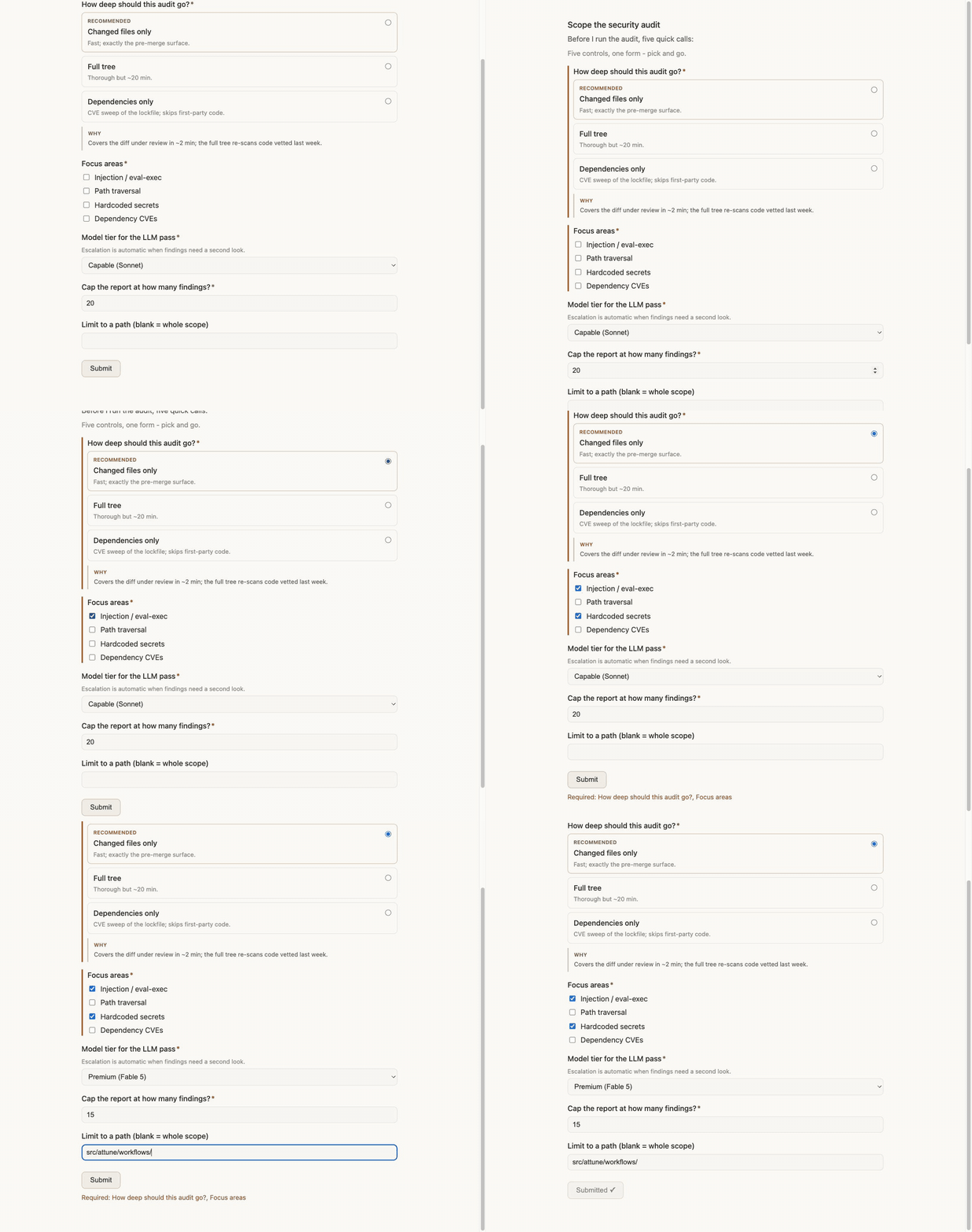
One question, five control types — a recommended decision card with per-option tradeoffs, multi-select, dropdown, bounded number, free text. An empty submit is caught by validation, never silently accepted. Rendered by the production widget pipeline (regenerate); try it live.
One declarative form, written once, renders to the richest surface your
client supports — a native dialog, a rich HTML widget, or a plain
multiple-choice menu on a text-only surface — so the same question
works everywhere and degrades gracefully. The full construct vocabulary
ships via attune-forms 0.7.0 (new in 13.0.0). Chart specs render
through the same sealed SVG kernel (chart_render_widget, nine chart
types).
Accuracy & Faithfulness
RAG generation — powered by the bundled attune-rag engine —
enforces citation-per-claim: 0.97 mean per-claim faithfulness,
CI-gated (40-query golden set, N=20 runs).
The contract was chosen by A/B measurement — the per-query
hallucination bucket rate dropped from 46.7% to 6.7% with it
(methodology).
Retrieved passages are sentinel-wrapped against prompt injection.
The help resolver passes 48/48 benchmark queries at P@1
(golden set).
Installation Options
pip install attune-ai works out of the box — the CLI, all
workflows, the MCP server, RAG (attune-rag and attune-verify are
core dependencies), cross-session memory, and the Agent SDK. Memory
features activate when a Redis Stack server is reachable and degrade
with guidance when not. Add extras only for the surfaces you use:
| You want | Install |
|---|---|
| Everything most users need, incl. Redis memory | pip install attune-ai |
| Claude API mode + optional LangChain/LangGraph interop adapters | pip install 'attune-ai[developer]' |
The ops dashboard (attune ops) |
pip install 'attune-ai[ops]' |
Extras combine — pip install 'attune-ai[developer,ops]'. Keep the
quotes: zsh and bash treat square brackets as glob characters.
Contributing? Clone and install the dev toolchain instead:
git clone https://github.com/Smart-AI-Memory/attune-ai.git
cd attune-ai && pip install -e '.[dev]'
API mode
The CLI and MCP tools call the Anthropic API directly (the plugin never needs this):
export ANTHROPIC_API_KEY="sk-ant-..."      # requires API credits
export REDIS_URL="redis://localhost:6379"  # optional
Model routing assigns Opus/Sonnet/Haiku by task complexity
(ATTUNE_AGENT_MODEL_* to override); depth budgets run $0.50 /
$2.00 / $5.00 (ATTUNE_MAX_BUDGET_USD to override); --cheap
forces pattern-matching workflows onto Haiku. Live spend tiles on
the dashboard (attune ops).
Platform support
| Platform | Support |
|---|---|
| macOS / Linux / WSL2 | Full |
| Windows native + Git Bash | Supported (Bash tool, POSIX-ish syntax) |
| Windows native + PowerShell tool | Limited — security validation fails closed |
Redis has no native Windows build — use Docker
(docker run -d -p 6379:6379 redis:7-alpine). Without reachable
Redis, memory degrades gracefully to the file backend and
attune.memory.session_stash.backend_status() reports
fallback: true.
Ecosystem
| Package | Role | Install |
|---|---|---|
attune-ai |
Developer workflow hub (this package) | pip install attune-ai |
attune-rag |
RAG pipeline (core dep) | bundled |
attune-verify |
Generation fact-checker (core dep) | bundled |
attune.authoring |
Help authoring + staleness detection (absorbed the former attune-author package in 11.0.0) |
bundled |
attune-help |
Progressive-depth template runtime | pip install attune-help |
Security, Privacy & Telemetry
Path traversal protection on all file ops, a PreToolUse guard that blocks eval/exec, MCP rate limiting, prompt sanitization, and automated scanning (CodeQL, bandit, detect-secrets) — details in SECURITY.md.
Usage data is local-first. An opt-in, anonymous usage ping
(OFF by default) carries only package, version, workflow name, OS,
Python version, a resettable anonymous id, and a timestamp — never
paths, code, prompts, or filenames; the payload is frozen in source
and guarded by a regression test. attune telemetry status|enable|disable;
DO_NOT_TRACK=1 always wins.
Links
Apache License 2.0 — Free and open source.
If you find Attune useful, give it a star — it helps others discover the project.
Acknowledgments
- Anthropic — For Claude AI, the Model Context Protocol, and the Agent SDK patterns behind the multi-agent orchestration layer
- Boris Cherny — Creator of Claude Code, whose workflow posts validated Attune's plan-first, multi-agent approach
- Affaan Mustafa — For battle-tested Claude Code configurations that inspired the hook system
Built by Patrick Roebuck using Claude Code.
1 maintainer

Release files for attune-ai 16.2.0
For a detailed explanation of source distributions (sdists) and built distributions (wheels), please see the package formats documentation.
Source distribution (sdist)
| File | Size | Uploaded | |
|---|---|---|---|
| attune_ai-16.2.0.tar.gz | 2.4 MB | Details |
Built distribution (wheel)
| File | Interpreter | ABI | Platform | Reset |
|---|---|---|---|---|
| attune_ai-16.2.0-py3-none-any.whl | Python 3 | none | any | Details |
Total release size: 4.9 MB
Release files / attune_ai-16.2.0.tar.gz
| Download URL | attune_ai-16.2.0.tar.gz |
|---|---|
| Size | 2.4 MB |
| Tags | Source |
|
SHA-256 checksum How to use checksums |
4cb7f0f84abe74b40a198a265b909362046899f22267368474e0c3c82963de2d
|
|
BLAKE2b-256 checksum How to use checksums |
4d1df200fee43b526029f68a78a9a9e8c5824fa4daaf4418ea630956e58b124b
|
| Upload date | |
|
Uploaded using Trusted Publishing? What is trusted publishing? |
Yes |
| Uploaded via |
twine/7.0.0 CPython/3.13.14
|
Provenance
Provenance describes where a file came from. On PyPI, provenance is shared via attestations, which provide a verifiable record of the build or publishing details. View details, limitations and caveats.


PyPI Publish Attestation
PyPI verified that this artifact, at this checksum, originated from the publisher listed below.
Signed by GitHub Actions, verified by PyPI on Sep 3, 2026.
Transparency logRelease files / attune_ai-16.2.0-py3-none-any.whl
| Download URL | attune_ai-16.2.0-py3-none-any.whl |
|---|---|
| Size | 2.5 MB |
| Tags | Python 3 |
|
SHA-256 checksum How to use checksums |
96851a35b6f7190aaf20590de471e861e1de671430723e010c8118e9f5551c5b
|
|
BLAKE2b-256 checksum How to use checksums |
ab38cb4d3d73f04996d57d3e5e7ba97171d004df5f08b00dc6d06b43a16c55c1
|
| Upload date | |
|
Uploaded using Trusted Publishing? What is trusted publishing? |
Yes |
| Uploaded via |
twine/7.0.0 CPython/3.13.14
|
Provenance
Provenance describes where a file came from. On PyPI, provenance is shared via attestations, which provide a verifiable record of the build or publishing details. View details, limitations and caveats.
PyPI Publish Attestation
PyPI verified that this artifact, at this checksum, originated from the publisher listed below.
Signed by GitHub Actions, verified by PyPI on Sep 3, 2026.
Transparency log













