
audient
An experimental audio perception layer for agents: continuous-listening, event-gated, multi-layer classification, and dynamic memory.
LLMs handle text natively. They handle audio when it's speech, via transcription or audio-native models. They don't hear the rest — a bird singing outside while you read, a glass breaking two rooms away, a smoke-alarm ringing. audient gives an agent ears to detect and classify audio events using specialized models and reasoning.
Under the hood it's an MCP server (stdio + HTTP at /mcp) plus
a FastAPI REST + WS + SSE adapter on 127.0.0.1:8089. Drive it
from an MCP-capable agent (Claude Desktop, fast-agent), access the
knowledge through the HTTP/SSE endpoints, or run the bundled
frontend/ UI to watch the loop in real time and close
it in a browser.
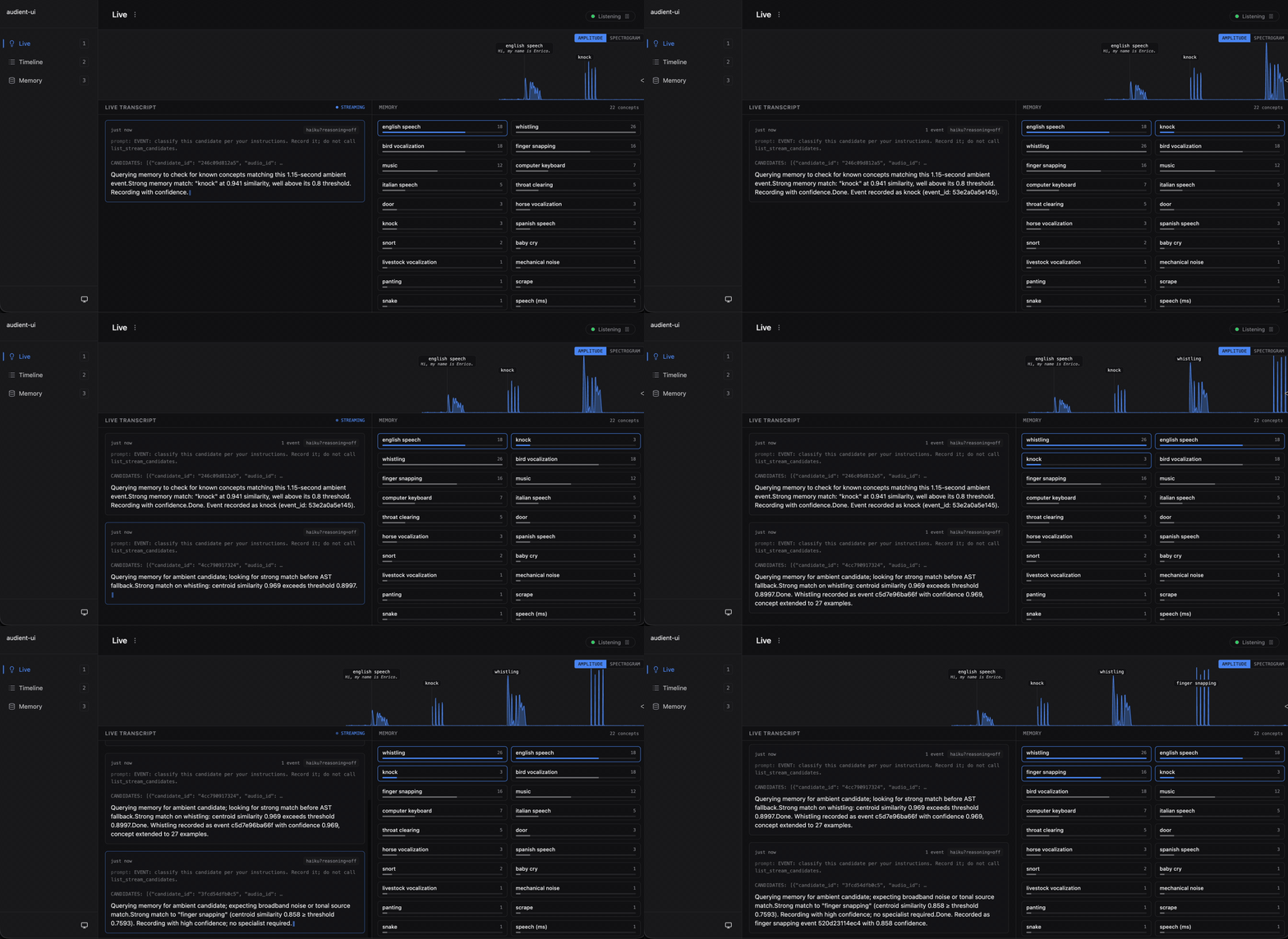
For the story behind the design, the biology parallel, and a walkthrough of the growth loop with screenshots: Let the AI Out: audient — an ambient audio perception layer that grows. For a 90-second demo of the memory going from empty → auto-recognizing in real time: demo on YouTube.
What audio actually needs
An agent that only handles audio-as-speech misses most of what audio carries. Useful things it can't reach today:
- Ambient awareness — what's happening around the agent. Music in another room. Footsteps in the hall. The HVAC kicking on.
- Event detection — alarms, doorbells, a phone ringing two floors down, glass breaking, a baby crying.
- Voice beyond the words — stress in a voice on a call, tone shifts, who's actually speaking, the background of a meeting.
- Anomaly detection — equipment that just changed pitch. A pet that sounds different. Construction next door that wasn't there yesterday.
There ARE specialized models for each of these. The problem isn't models, it's orchestration: today you decide which one to run on which clip and stitch the answers together yourself. The agent isn't in the loop.
What this project aims at: an agent with the audio channel always on. It decides what's worth attending to, recognizes what it's heard before, escalates the rest to whatever specialist fits, and learns the things it didn't know. The longer view: an agent that can deploy new specialists on its own — and eventually train them.
Four stages
    continuous audio
          │
          ▼
  ┌─────────────────────────────────────┐
  │  Gate                               │
  │  energy / novelty / VAD             │
  └──────────────┬──────────────────────┘
                 ▼
  ┌─────────────────────────────────────┐
  │  Fingerprint                        │
  │  CLAP embedding + symbolic features │
  └──────────────┬──────────────────────┘
                 ▼
  ┌─────────────────────────────────────┐
  │  Memory  (top-k cosine)             │
  └──┬──────────────────────────────┬───┘
     │ strong match                 │ weak / miss
     │                              ▼
     │            ┌─────────────────────────────┐
     │            │  Agent                      │
     │            │   AST coarse (+ spectral)   │
     │            │   → Specialist if AST hints │
     │            │     at a known domain       │
     │            │     (e.g. Whisper, BirdNET) │
     │            └─┬───────────────────────┬───┘
     │              │ recognized            │ nothing fits
     ▼              ▼                       ▼
  ┌──────────────────────────┐      ┌──────────────┐
  │  Record event            │      │  Unhandled   │
  │  (extends memory)        │      └──────┬───────┘
  └──────────────────────────┘             │ labeled
                                           ▼
                                       (Memory)
The pipeline coarsely mirrors the way human hearing works.
-
Gate —
detect_events,vad, energy/novelty/spectral segmentation. Trims the continuous signal to candidate regions. Most of the audio never reaches the rest of the system. (Hearing: cochlea + brainstem amplify onsets and transients, attenuate steady background.) -
Fingerprint — each candidate gets a CLAP embedding (dense, comparable) plus a panel of symbolic features (spectral centroid, peaks with prominence, harmonics, noise floor, mains-hum, clipping, temporal stability). Embedding is for retrieval; symbolic features are what the agent reads and reasons about in plain English. (Hearing: primary auditory cortex turns the signal into a representation downstream areas can use.)
-
Recognize — sqlite-vec top-k cosine over learned concepts. Strong match against a calibrated concept → labeled server-side. On a miss, the agent reaches for AST (527-label AudioSet classifier) as broad routing, sometimes alongside spectral features for disambiguation. AST is coarse — the agent chains a narrow specialist (e.g. Whisper for speech, BirdNET for bird vocs; the set is arbitrary) when AST hints at a known domain. (Hearing: specialized regions — speech, music, environmental sound — see the fingerprint in parallel, each with its own memory; "recognize" is what lights up where.)
-
Unhandled — if nothing recognizes it, the event lands in
list_unhandledwith whatever the system thinks it heard. Someone (an agent or a person) labels it once vialabel_unhandled; that label becomes a concept; next time the memory check matches. (Hearing: you don't recognize it; you look at the source or ask. Once you have a label, you recognize it next time.)
The agent always perceives — every event flows out as it happens, whichever stage produced it. What varies is who's classifying: the server for strong memory matches (cheap, no LLM call), the agent for everything else.
Stage 1 also has a fast lane for speech. Silero VAD runs in parallel with energy/novelty segmentation; when it fires, the region skips CLAP → memory → specialist routing and goes straight to Whisper. This treats VAD as a frozen, always-on "speech" concept — the analog of recognizing a familiar voice before parsing the words. If Whisper returns a transcript, the event is recorded as speech directly. If Whisper returns nothing usable (silence, or non-speech audio that fooled VAD — music, animal calls, sustained tones), the region falls through to the same ambient classifier path everything else takes; no audio is silently dropped.
Three ways to reason about a sound
The agent reasons over symbolic representations, never raw audio. Three layers are exposed for it to reason across:
- The signal.
summarize,spectrum,statsreturn plain numbers — RMS, SNR, noise floor, spectral centroid, rolloff, bandwidth, flatness, top spectral peaks with prominence in dB, harmonic ratio, zero-crossing rate, mains-hum harmonics, kurtosis, clipping, and a temporal-stability block. The agent reads these as JSON and reasons about them the way an audio engineer would. - The embedding. The agent never sees the CLAP vector itself.
It sees the similarity score against everything in concept
memory —
query_memoryreturns the top-k matches with cosine similarity, threshold, and recognizer kind. - The labels. Specialists return structured labels. Whisper
transcripts. BirdNET species with confidence. AST's coarse guess
across 527 categories. The agent hands a sound off via
invoke_specialistand reads back the structured answer alongside the specialist's plain-English contract for interpretation.
The agent can disagree with any single layer — override an embedding similarity if the labels suggest divergent categories, override a specialist if the signal features don't fit. No single layer is authoritative.
Install
From PyPI (usual path)
Requires Python 3.12 or 3.13 on macOS or Linux. The wheel bundles both the server and the browser UI, so one install gets you everything.
pip install audient
export ANTHROPIC_API_KEY=sk-...   # only for --classifier=internal (default)
audient --no-stdio
Then open http://127.0.0.1:8089/ and grant microphone permission. First run downloads ~600MB of model weights from Hugging Face; expect 20–40s of warm-up on cold cache.
Skip the API key by running the server without the built-in classifier (memory-first fast path still works for promoted concepts; new sounds land in the unhandled bucket for later labeling):
audient --no-stdio --classifier=external
From source (dev workflow)
Clone + make demo for the two-process dev setup with Vite hot
reload and the server side-by-side.
git clone https://github.com/es617/audient
cd audient
(cd server && uv sync)
(cd frontend && pnpm install)
export ANTHROPIC_API_KEY=sk-...
make demo
Server on :8089, Vite dev on :5173. Open http://localhost:5173/
for the hot-reloading UI. For server-only smoke tests, headless mic
mode, or the run-mode matrix, see
server/README.md; for the per-surface
frontend walkthrough, see frontend/README.md.
Driving audient from Claude Code (or any stdio MCP client)
The default entry point (uv run audient) speaks stdio MCP, which is
what Claude Code and most MCP hosts consume. Add it to your client
config:
{
  "mcpServers": {
    "audient": {
      "command": "uv",
      "args": ["--directory", "/absolute/path/to/audient/server", "run", "audient"]
    }
  }
}
The agent gets the full MCP tool surface — load_audio, summarize,
spectrum, detect_events, vad, invoke_specialist,
query_memory, record_event, teach, list_unhandled,
label_unhandled, etc. Tool calls land server-side and modify the
SQLite concept memory.
A couple of caveats worth knowing:
- Claude Code does not surface MCP server notifications. The
protocol supports
ResourceUpdatedNotification(and audient fires them on new events / candidates), but Claude Code's UI doesn't render them as in-conversation messages. To see "what happened since I last asked," have the agent calllist_eventsorlist_stream_candidates. - The bundled frontend still works in parallel. The FastAPI / SSE
adapter on
127.0.0.1:8089is part of the same process. So anything Claude Code writes (a new event, a corrected label, a taught concept) shows up live in the frontend timeline the moment it lands. The two clients drive the same server; only Claude Code is blind to live push.
Known limitations
audient is experimental. It's been lightly evaluated on recorded data during development; no formal benchmark suite or public-dataset numbers yet. Other limitations:
-
Single-source assumption. The pipeline treats each detected region as one event. Overlapping sounds — a bird call while music plays, a doorbell mid-conversation — are classified as whichever signal dominates the embedding or wins the VAD fast lane. The non-dominant event is lost. Source separation isn't wired up.
-
macOS-first. Everything has been tested on macOS. The dependencies (torch, transformers, faster-whisper, sounddevice/portaudio) all have Linux wheels, so Linux should work with minimal fuss; I just haven't verified. Windows needs a Windows branch added to the BirdNET dep gate in
pyproject.tomland probably a look at the mic-source path; nothing about the models themselves is Windows-incompatible. The WebSocket/ingestendpoint and the bundled frontend's browser-mic capture are platform-agnostic, so a Windows user can drive audient through a browser today — the backend side is the friction. -
Classifier prompt tuned for Anthropic. The in-process classifier runs through fast-agent, so any supported provider (Anthropic, OpenAI, Gemini, Ollama-local) will execute, but the prompt was written and validated against Claude models. Switching providers may need prompt adjustments.
Acknowledgements
audient stands on a lot of other people's work. The load-bearing pieces:
- MCP + agent infra — FastMCP (Jeremiah Lowin), fast-agent (Shaun Smith / Evalstate).
- Models — LAION-CLAP for audio embeddings; AST (Yuan Gong et al) as the AudioSet coarse classifier; Whisper (OpenAI) via faster-whisper; BirdNET (Cornell Lab of Ornithology) via birdnetlib; Silero VAD.
- Model hosting — Hugging Face +
transformersfor CLAP loading. - Storage — sqlite-vec (Alex Garcia).
- Audio infra — librosa, soundfile, sounddevice.
- UI (
frontend/) — React, Vite, Tailwind, TanStack Query, shadcn/ui, Zustand.
License
Apache License 2.0 — see LICENSE.
1 maintainer

Metadata
1 maintainer
Release files for audient 0.1.0
For a detailed explanation of source distributions (sdists) and built distributions (wheels), please see the package formats documentation.
Source distribution (sdist)
| File | Size | Uploaded | Provenance | |
|---|---|---|---|---|
| audient-0.1.0.tar.gz | 9.5 MB | With provenance | Details |
Built distribution (wheel)
| File | Interpreter | ABI | Platform | Reset |
|---|---|---|---|---|
| audient-0.1.0-py3-none-any.whl | Python 3 | none | any | Details |
Total release size: 9.9 MB
Release files / audient-0.1.0.tar.gz
| Download URL | audient-0.1.0.tar.gz |
|---|---|
| Size | 9.5 MB |
| Tags | Source |
|
SHA-256 checksum How to use checksums |
0169bb48e0eca811d66dc17af18c5831ece4a9a6b40d27708544fc21536bd052
|
|
BLAKE2b-256 checksum How to use checksums |
ae1aba7f33b8908b99684f532ac138cbedc21e788af7ec42599ac1c9fae30605
|
| Upload date | |
|
Uploaded using Trusted Publishing? What is trusted publishing? |
Yes |
| Uploaded via |
twine/6.1.0 CPython/3.13.12
|
Provenance
Provenance describes where a file came from. On PyPI, provenance is shared via attestations, which provide a verifiable record of the build or publishing details. View details, limitations and caveats.


PyPI Publish Attestation
PyPI verified that this artifact, at this checksum, originated from the publisher listed below.
Signed by GitHub Actions, verified by PyPI on Jul 14, 2026.
Transparency logRelease files / audient-0.1.0-py3-none-any.whl
| Download URL | audient-0.1.0-py3-none-any.whl |
|---|---|
| Size | 440.8 kB |
| Tags | Python 3 |
|
SHA-256 checksum How to use checksums |
15e37d53e224f32e4bd2b59e482c6a78591e0488c3233d8d9f40d0b8789dcc78
|
|
BLAKE2b-256 checksum How to use checksums |
27e46564f06b7e703276bab91a3409dfc6b24bf53547a278fb6c89a74135ac00
|
| Upload date | |
|
Uploaded using Trusted Publishing? What is trusted publishing? |
Yes |
| Uploaded via |
twine/6.1.0 CPython/3.13.12
|
Provenance
Provenance describes where a file came from. On PyPI, provenance is shared via attestations, which provide a verifiable record of the build or publishing details. View details, limitations and caveats.
PyPI Publish Attestation
PyPI verified that this artifact, at this checksum, originated from the publisher listed below.
Signed by GitHub Actions, verified by PyPI on Jul 14, 2026.
Transparency logSecurity for audient 0.1.0
Provenance
Provenance describes where a file came from. On PyPI, provenance is shared via attestations, which provide a verifiable record of the build or publishing details. View details, limitations and caveats.
Full provenance
All 2 files in this release have been uploaded with provenance metadata.
Attestation for audient-0.1.0.tar.gz
PyPI Publish Attestation
PyPI verified that this artifact, at this checksum, originated from the publisher listed below.
Signed by GitHub Actions, verified by PyPI on Jul 14, 2026.
Transparency logA note on package security
PyPI is a repository for distributing packages, not a service for auditing them. While third-party security researchers and our staff do their best to detect and remove malicious packages, PyPI cannot guarantee the quality, security or suitability of any given package.













