
Audio Intelligence MCP Server




Latest release notes: CHANGELOG.md · ▶ Watch with sound (MP4, 29 s)
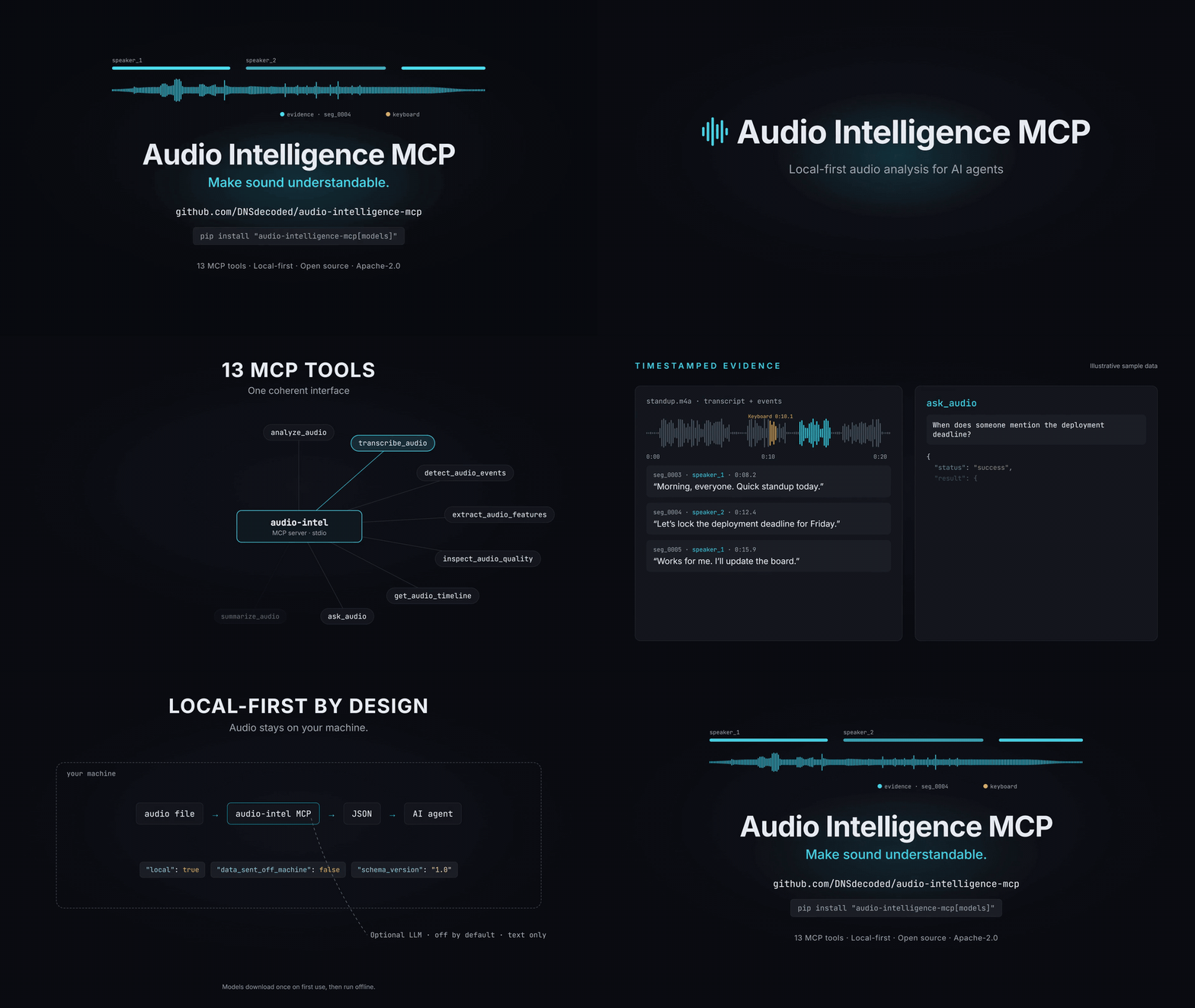
A local-first Model Context Protocol server that lets AI agents analyze audio: transcripts with word timings, speakers, sound events, acoustic measurements, quality diagnosis, timelines, evidence-grounded answers, comparisons, library search, streaming, and exports.
Everything runs on your machine. Audio never leaves it. An LLM is optional, off by default, and only ever
receives text (transcript snippets and event labels); every response reports data_sent_off_machine.
Every tool returns the same JSON envelope:
{
  "status": "success | partial | processing | error",
  "audio_id": "aud_0123456789abcdef",
  "result": { "...": "tool-specific (analyze_audio uses \"analysis\")" },
  "warnings": [{"code": "OVERLAP_UNSUPPORTED", "message": "..."}],
  "errors": [{"code": "STAGE_FAILED", "stage": "events", "message": "...", "retryable": false}],
  "processing": {"duration_seconds": 2.4, "stages_run": ["vad", "transcription"], "stages_skipped": [],
                 "cache_hits": [], "models_used": [{"stage": "transcription", "name": "faster-whisper",
                 "version": "small", "local": true}], "data_sent_off_machine": false, "schema_version": "1.0"}
}
Validation failures use {"status": "error", "error": {"code", "message", "retryable"}}. Times are seconds
(3 decimals), levels dBFS, frequencies Hz. confidence appears only when a model or rule produced it, always
with confidence_kind (model_probability or heuristic; none are calibrated).
Requirements
- Windows, macOS or Linux (CI runs the test suite on all three)
- Python 3.12 or 3.13 and uv
- ffmpeg and ffprobe on
PATH(or setffmpeg_path/ffprobe_path):- Windows:
winget install Gyan.FFmpeg - macOS:
brew install ffmpeg - Debian/Ubuntu:
sudo apt-get install ffmpeg
- Windows:
- CPU is enough. CUDA is used automatically when available (
device = "auto").
Install
From PyPI with uv pip, into a virtual environment:
uv venv --python 3.12
uv pip install "audio-intelligence-mcp[models]"            # local models (faster-whisper, PANNs, SpeechBrain, silero-vad, MiniLM)
uv pip install "audio-intelligence-mcp[models,llm]"        # + optional Claude backend (anthropic SDK)
uv pip install "audio-intelligence-mcp[models,pyannote]"   # + optional pyannote diarization (needs HF_TOKEN)
Then start the server with .venv/bin/audio-mcp (macOS/Linux) or .venv\Scripts\audio-mcp (Windows), or activate
the environment first and run audio-mcp. Plain pip install "audio-intelligence-mcp[models]" works the same way.
Run without installing anything (uv fetches and caches the package):
uvx --from "audio-intelligence-mcp[models]" audio-mcp
From source:
git clone https://github.com/DNSdecoded/audio-intelligence-mcp.git
cd audio-intelligence-mcp
uv sync --extra models            # local models (faster-whisper, PANNs, SpeechBrain, silero-vad, MiniLM)
uv sync --extra models --extra llm        # + optional Claude backend (anthropic SDK)
uv sync --extra models --extra pyannote   # + optional pyannote diarization (needs HF_TOKEN)
Without --extra models the server still starts: model-backed stages are reported in stages_skipped with the
reason, and the DSP tools (features, quality, integrity, comparison) work.
First-run downloads (cached in models_dir, then fully offline): Whisper small ≈ 460 MB, PANNs CNN14 ≈
330 MB, SpeechBrain ECAPA ≈ 80 MB, all-MiniLM-L6-v2 ≈ 90 MB. Silero VAD ships inside its package.
Connect a client
Claude Code (from PyPI, no install step):
claude mcp add audio-intel -- uvx --from "audio-intelligence-mcp[models]" audio-mcp
Claude Code (source checkout):
claude mcp add audio-intel -- uv --directory /path/to/audio-intelligence-mcp run audio-mcp
Claude Desktop (claude_desktop_config.json), from PyPI:
{
  "mcpServers": {
    "audio-intel": {
      "command": "uvx",
      "args": ["--from", "audio-intelligence-mcp[models]", "audio-mcp"],
      "env": {"AUDIO_MCP_ALLOWED_ROOTS": "[\"/path/to/your/audio\"]"}
    }
  }
}
From a source checkout, use "command": "uv" with
"args": ["--directory", "/path/to/audio-intelligence-mcp", "run", "audio-mcp"] instead.
On Windows, use forward slashes or escaped backslashes in JSON paths ("C:/audio" or "C:\audio").
Only files under allowed_roots can be read (default: your home directory). Paths are resolved, symlinks
included, before the check.
Tools
| Tool | What it does |
|---|---|
analyze_audio |
Task list or "auto" (plans from speech ratio, duration, goal text and budget; plan returned with reasons) |
transcribe_audio |
Segments + word timestamps, language runs, optional speakers, code-switching, English translation |
detect_audio_events |
AudioSet sound events (PANNs) as time intervals, filterable by category or label |
extract_audio_features |
Level, silence, SNR estimate, spectral shape, bands, pitch, tempo/onsets, with units |
inspect_audio_quality |
Clipping, low level, silence, noise, hum, echo, bandwidth, DC; optional preprocessed variant |
get_audio_timeline |
Event graph: speech, turns, events, silence, overlaps, transitions + relation edges |
ask_audio |
Question answering with timestamped evidence and support: direct / inferred / insufficient |
summarize_audio |
Extractive summary, topics, key moments, every sentence linked to evidence ids |
compare_audio |
Pairwise measured differences, or baseline z-score anomalies localized in time |
search_audio_library |
Persistent SQLite FTS5 + vector library: index files/folders, search by text/filters/example clip |
analyze_audio_stream |
Chunked sessions (PCM or self-contained files), provisional results, final reconciliation |
export_audio_analysis |
json, markdown, srt, vtt, csv, rttm (optional redaction) |
get_job |
Status/progress/cancel for async jobs (long audio runs as a job automatically) |
Full schemas and example success/error responses: docs/tools.md. What is implemented, partial, or future: docs/capabilities.md.
Example workflows
Meeting. analyze_audio {"source": {"type": "file_path", "path": "/audio/standup.m4a"}, "goal": "meeting"}
plans transcription, language, diarization, events, summary, timeline and uncertainty. Then reuse the returned
audio_id (cached, nothing recomputed): ask_audio {"source": {"type": "audio_id", "audio_id": "aud_..."}, "question": "When does someone mention the deadline?"} and export_audio_analysis {"audio_id": "aud_...", "format": "srt"}.
Machine baseline. compare_audio {"sources": [<today.wav>], "baseline": [<healthy_1.wav>, <healthy_2.wav>]}
returns per-feature z-scores and the seconds where the target departs from the baseline distribution;
interpretations are labelled as such and never stated as causes.
Environmental recording. detect_audio_events {"source": ..., "categories": ["animal", "vehicle"]}, then
get_audio_timeline and ask_audio "What happens immediately before the alarm sounds?".
Library. search_audio_library {"action": "index", "paths": ["/audio/calls"]}, then
{"action": "search", "query": "refund request", "filters": {"language": "en"}} or search by an example clip
with "query_audio".
Streaming. analyze_audio_stream with start (chunk_format: "pcm" + rate/channels/sample format, or
"file"), repeated push (base64 data or path), then finish for the full analysis and a reconciliation of
provisional vs final results.
Configuration
TOML file (AUDIO_MCP_CONFIG=/path/config.toml, see config.example.toml) and/or env vars
AUDIO_MCP_<NAME>. Full table: docs/configuration.md. Key settings:
| Setting | Default | |
|---|---|---|
allowed_roots |
home dir | folders audio may be read from |
data_dir / temp_dir / export_dir / models_dir |
platform user-data dir; others under it | storage locations (a blank value means the default) |
max_file_mb / max_upload_mb / max_duration_seconds |
500 / 50 / 7200 | input limits |
allow_url_fetch |
false | URL sources (private/loopback/metadata IPs always blocked) |
asr_model |
small |
faster-whisper size (tiny … large-v3) |
async_threshold_seconds |
600 | longer audio runs as a job (async_mode: "auto") |
vad_threshold / vad_min_silence_ms / vad_speech_pad_ms |
0.35 / 300 / 150 | speech detection (tuned on AMI dev meetings; see Evaluation) |
max_concurrent_jobs |
1 | analyses running models at once (sync calls, jobs and stream pushes share it) |
retention / retention_ttl_hours |
ttl / 24 |
stored audio and results are deleted after the TTL |
llm_provider |
none |
anthropic, openai_compatible, or ollama (text only, opt-in) |
redact_outputs |
false | redact emails, phone numbers, card numbers (+ your patterns) in all outputs |
Privacy
- Audio is processed locally and never sent anywhere.
- The only outbound traffic is (a) model downloads on first use (Hugging Face, Zenodo, GitHub) and (b) the LLM,
if you enable one. A local Ollama/OpenAI-compatible server on localhost counts as local; any other host sets
processing.data_sent_off_machine: trueon that response. - Stored audio copies and cached results live under
data_dirand are swept afterretention_ttl_hours(retention = "none"deletes everything at shutdown). The search library is persistent (library_retention = "keep") and stores derived data and file paths, never audio. - Exports written by
export_audio_analysistoexport_dirare yours to keep: retention never deletes them. They are redacted when the call setsredact: trueor the server setsredact_outputs = true. - Logs go to stderr (and
log_file) and never contain transcript text unlesslog_sensitive = true. - Integrity indicators are signal observations only; the server never states that audio is authentic, edited or synthetic, and never infers emotion.
Supported input
Any audio ffmpeg can decode: WAV, FLAC, MP3, OGG/Opus, M4A/AAC, WebM, AIFF, WMA, and more; any sample rate and
channel count (models get a 16 kHz mono mix; measurements use the native signal). Sources: file_path,
base64, url (off by default), audio_id. Playlist and concat inputs (HLS .m3u8, ffconcat, DASH, image
sequences) are rejected because they make ffmpeg read other files.
Limits and memory: audio longer than max_duration_seconds (default 7200 s = 2 h) is rejected. Decoded audio is
held in RAM as float32 at the native rate plus a 16 kHz mono copy: about 1.6 GB per hour of 48 kHz stereo
(about 0.9 GB per hour of 44.1 kHz mono), with transient peaks of roughly 2-3x that during decoding and feature
extraction. The two most recently used recordings stay decoded in memory. Raise the limit only with RAM to match.
Language coverage follows Whisper (≈ 99 languages); translation is to English only.
Evaluation
Measured on public datasets with the default local models on a 4-core CPU (Whisper small int8, PANNs CNN14, ECAPA). Full tables, per-file JSON and before/after numbers: docs/eval/RESULTS.md; method, datasets and caveats: docs/evaluation.md.
| Capability | Dataset | Result |
|---|---|---|
| Transcription | LibriSpeech test-clean / test-other | 4.1 % / 6.1 % WER (Whisper small published: 3.4 % / 7.6 %) |
| Noise robustness | LibriSpeech + real ambient noise, 20 / 10 / 5 / 0 dB SNR | 4.3 / 5.0 / 8.4 / 14.5 % WER |
| Formats | 12 containers/codecs/rates (wav 8–48 kHz, flac, mp3, ogg, opus, m4a, aac, webm, aiff, wma) | all decode; 0.6 % WER |
| Multilingual | FLEURS en / es / de / fr / zh / ar / hi / te | 6.7 / 5.7 / 12.9 / 13.7 / 24.6 (CER) / 37.7 / 58.8 / 103 % WER; language detected 88–100 % |
| Speaker diarization | AMI test meetings (real, with overlap) | 38.2 % DER (30.4 % with 0.25 s collar); most error is overlapped speech |
| Sound events | ESC-50, 200 clips, zero-shot | 73 % clip recall, 65 % top-1 (lenient AudioSet labels) |
| Quality diagnosis | 90 files with 8 injected defects | 88 % exact issue set; per-issue recall 100 % |
| Speed | 10-min file, CPU | transcription 0.58× real time, events 0.23×, diarization 0.57×; peak 2.1 GB RAM |
Low-resource languages (Arabic, Hindi, Telugu) are not usable with asr_model = "small"; use a larger model and
pass language.
Troubleshooting
| Symptom | Fix |
|---|---|
MODEL_UNAVAILABLE: ffmpeg/ffprobe not found |
Install ffmpeg (above) or set ffmpeg_path / ffprobe_path |
A stage in stages_skipped with "not installed (uv sync --extra models)" |
Install the models extra |
stages_skipped with a model load error |
First-run download failed (network/proxy); check models_dir is writable and retry |
| SpeechBrain symlink / privilege error on Windows | Already handled (models are copied, not symlinked); update and retry |
PANNs tries to run wget |
The server pre-seeds ~/panns_data/class_labels_indices.csv; make sure the home dir is writable |
| Slow on CPU | Use asr_model = "base" or "tiny", budget: "fast", or a CUDA GPU; long files run as jobs |
PATH_NOT_ALLOWED |
Add the folder to allowed_roots |
| Client reports a broken connection | Nothing may print to stdout; the server redirects stray library prints to stderr — report any that leak |
Development
uv sync --extra dev --extra models
uv run pytest -m "not slow and not long"   # fast suite: fake backends, no downloads
uv run pytest -m slow                      # real models
uv run pytest -m long                      # 30-minute file / async path
uv run python scripts/gen_tool_docs.py --write-examples   # refresh docs/tools.md + examples
Releasing: bump the version in pyproject.toml and src/audio_mcp/__init__.py, add a CHANGELOG.md entry, then
push a vX.Y.Z tag. .github/workflows/publish.yml builds the package and uploads it to PyPI through trusted
publishing (no API token stored). Release notes: CHANGELOG.md.
Evaluation and benchmarks: docs/evaluation.md. Design spec, implementation plan, and build notes (design rulings and known limits): docs/superpowers/.
Project layout:
src/audio_mcp/
  server.py         MCP entry point (stdio), tool registration, lifespan
  tools/            request schemas and tool handlers
  ingest/           source resolution, path/URL guards, ffmpeg probe and decode
  store/            content-addressed audio store, result cache, retention
  pipeline/         stage DAG, auto planner, runner
  backends/         model adapters (Whisper, PANNs, ECAPA, Silero, MiniLM, LLMs) + fake backends for tests
  dsp/              features, quality, preprocessing, integrity, speech characteristics
  analysis/ timeline/ reasoning/ compare/ library/ stream/ export/ eval/
scripts/            benchmark, evaluate, docs generator
tests/              unit, integration, e2e (stdio)
Known limitations
- Confidence values are raw model probabilities or heuristics, never calibrated.
- Default diarization (ECAPA clustering) does not detect overlapping speech; install the
pyannoteextra for that. - Accuracy on low-resource languages with the default
smallmodel is poor (see Evaluation). - Translation is to English only (Whisper).
- Integrity indicators are signal heuristics, not a deepfake or tamper detector.
- Malformed tool arguments are rejected by the MCP layer before the server sees them, so they come back as MCP tool errors rather than the JSON envelope.
Full list: docs/capabilities.md and docs/superpowers/build-notes.md.
License
The code in this repository is released under the Apache License 2.0 (see also NOTICE).
Third-party models and data keep their own licenses, which the Apache License does not cover:
faster-whisper (MIT) and Whisper weights (MIT); PANNs code (MIT) and CNN14 weights (CC BY 4.0, trained on
AudioSet); SpeechBrain (Apache-2.0) and spkrec-ecapa-voxceleb (Apache-2.0); all-MiniLM-L6-v2 (Apache-2.0);
silero-vad (MIT); pyannote.audio (MIT) with gated model terms; AudioSet ontology labels (CC BY 4.0). Test
fixtures: speech_es.ogg is a LibriVox public-domain excerpt; the English fixtures are synthesized locally;
details in tests/fixtures/audio/SOURCES.md. Check each model's terms before
commercial use.
1 maintainer

Metadata
1 maintainer
Release files for audio-intelligence-mcp 0.1.1
For a detailed explanation of source distributions (sdists) and built distributions (wheels), please see the package formats documentation.
Source distribution (sdist)
| File | Size | Uploaded | Provenance | |
|---|---|---|---|---|
| audio_intelligence_mcp-0.1.1.tar.gz | 7.8 MB | With provenance | Details |
Built distribution (wheel)
| File | Interpreter | ABI | Platform | Reset |
|---|---|---|---|---|
| audio_intelligence_mcp-0.1.1-py3-none-any.whl | Python 3 | none | any | Details |
Total release size: 7.9 MB
Release files / audio_intelligence_mcp-0.1.1.tar.gz
| Download URL | audio_intelligence_mcp-0.1.1.tar.gz |
|---|---|
| Size | 7.8 MB |
| Tags | Source |
|
SHA-256 checksum How to use checksums |
e2abcacf25dfeab5fa0f0a74c4d2c64cc5962c9760df761c62ccb50511cdd1d6
|
|
BLAKE2b-256 checksum How to use checksums |
88cbac671d54705ef805a0d0755d10b4b79e4169491c7304b157e30c8cf7ff8c
|
| Upload date | |
|
Uploaded using Trusted Publishing? What is trusted publishing? |
Yes |
| Uploaded via |
twine/7.0.0 CPython/3.13.14
|
Provenance
Provenance describes where a file came from. On PyPI, provenance is shared via attestations, which provide a verifiable record of the build or publishing details. View details, limitations and caveats.


PyPI Publish Attestation
PyPI verified that this artifact, at this checksum, originated from the publisher listed below.
Signed by GitHub Actions, verified by PyPI on Oct 19, 2026.
Transparency logRelease files / audio_intelligence_mcp-0.1.1-py3-none-any.whl
| Download URL | audio_intelligence_mcp-0.1.1-py3-none-any.whl |
|---|---|
| Size | 119.9 kB |
| Tags | Python 3 |
|
SHA-256 checksum How to use checksums |
d08ee431145920937ef04378b28ca05c63682a1be07c81eb0ac8103ea7bce9d9
|
|
BLAKE2b-256 checksum How to use checksums |
9ed1f80ab05544e66abbf4d025e6294ad43cd030f8437b489e34abd1864336e1
|
| Upload date | |
|
Uploaded using Trusted Publishing? What is trusted publishing? |
Yes |
| Uploaded via |
twine/7.0.0 CPython/3.13.14
|
Provenance
Provenance describes where a file came from. On PyPI, provenance is shared via attestations, which provide a verifiable record of the build or publishing details. View details, limitations and caveats.
PyPI Publish Attestation
PyPI verified that this artifact, at this checksum, originated from the publisher listed below.
Signed by GitHub Actions, verified by PyPI on Oct 19, 2026.
Transparency logSecurity for audio-intelligence-mcp 0.1.1
Provenance
Provenance describes where a file came from. On PyPI, provenance is shared via attestations, which provide a verifiable record of the build or publishing details. View details, limitations and caveats.
Full provenance
All 2 files in this release have been uploaded with provenance metadata.
Attestation for audio_intelligence_mcp-0.1.1.tar.gz
PyPI Publish Attestation
PyPI verified that this artifact, at this checksum, originated from the publisher listed below.
Signed by GitHub Actions, verified by PyPI on Oct 19, 2026.
Transparency logA note on package security
PyPI is a repository for distributing packages, not a service for auditing them. While third-party security researchers and our staff do their best to detect and remove malicious packages, PyPI cannot guarantee the quality, security or suitability of any given package.














