
 AudioNormalizer
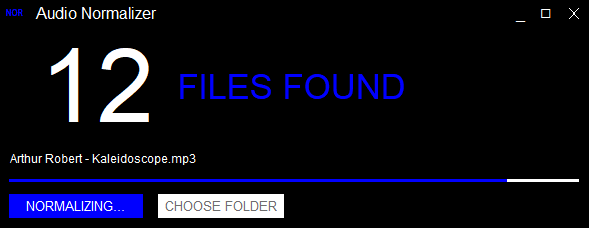
This is a normalizer for mp3 and wav files. Its a final project for Havard CS50P.
The approach in this program to normalize audio differs in comparison to most other programs that implement this task. Most normalizers amplify an audio signal until the highest transient reaches 0 dB. The downside of this approach is that the audio signal can only be amplified based on a single maximum transient. In other words, the whole normalizing process depends on one transient, which is inefficient.
This program, however, doesn't depend on a single transient. It rather splits the original signal into four separate signals (left positive, left negative, right positive, and right negative). Then it uses an algorithm that finds several transients that exceed a calculated value based on the audio file's duration and actual volume. For each split signal, a copy is being created, a dummy signal. In the dummy signals, the found transients are turned into the value of zero. The next task is to find the new maximum transient in each modified dummy signal like any other simple normalizer. The new maximum value is then saved for the final amplification.
At this stage, the program finds all amplitudes in the original split signals where the previously found transients are sitting. The split audio signals are then amplified based on the new maximum transient. All amplitudes that exceed (clip) above 0 dB are lowered to 0 dB without manipulating the original signal except for the volume.
Finally, all the amplified split signals are merged together and are saved as the original file name and type. All the ID3 tags, including the album cover, are also maintained in the new normalized file.
As a result, the user gets an audiofile normalized to 0 dB without losing noticeable dynamic range or the overall audio quality.
Installation
pip install audio_normalizer
Usage
import audio_normalizer

audio_normalizer.open_window()
1 maintainer

Metadata
1 maintainer
Release files for audio-normalizer 1.3.1
For a detailed explanation of source distributions (sdists) and built distributions (wheels), please see the package formats documentation.
Source distribution (sdist)
| File | Size | Uploaded | Provenance | |
|---|---|---|---|---|
| audio_normalizer-1.3.1.tar.gz | 22.1 kB | Without provenance | Details |
Built distribution (wheel)
| File | Interpreter | ABI | Platform | Reset |
|---|---|---|---|---|
| audio_normalizer-1.3.1-py3-none-any.whl | Python 3 | none | any | Details |
Total release size: 44.1 kB
Release files / audio_normalizer-1.3.1.tar.gz
| Download URL | audio_normalizer-1.3.1.tar.gz |
|---|---|
| Size | 22.1 kB |
| Tags | Source |
|
SHA-256 checksum How to use checksums |
9201a85625cfc3d89c156ecbca816ec011bbb680761837ec7d0117ec44c82925
|
|
BLAKE2b-256 checksum How to use checksums |
621d6e7752d4bedce0beedb65d1fd49c903bf3edbe85b26c660f0e691cf119bb
|
| Upload date | |
|
Uploaded using Trusted Publishing? What is trusted publishing? |
No |
| Uploaded via |
twine/4.0.2 CPython/3.9.13
|
Release files / audio_normalizer-1.3.1-py3-none-any.whl
| Download URL | audio_normalizer-1.3.1-py3-none-any.whl |
|---|---|
| Size | 22.0 kB |
| Tags | Python 3 |
|
SHA-256 checksum How to use checksums |
d4e583a3fce05b31907bfac506167d8c39555abac5dfa43f5fc69d372fa2a2d9
|
|
BLAKE2b-256 checksum How to use checksums |
cbc50f58face520ea0337ddb4acfb3f3619f93ddb59de2e20fd5481c6769d0e7
|
| Upload date | |
|
Uploaded using Trusted Publishing? What is trusted publishing? |
No |
| Uploaded via |
twine/4.0.2 CPython/3.9.13
|
Security for audio-normalizer 1.3.1
Provenance
Provenance describes where a file came from. On PyPI, provenance is shared via attestations, which provide a verifiable record of the build or publishing details. View details, limitations and caveats.
No provenance found
None of the files in this release were uploaded with provenance metadata.
A note on package security
PyPI is a repository for distributing packages, not a service for auditing them. While third-party security researchers and our staff do their best to detect and remove malicious packages, PyPI cannot guarantee the quality, security or suitability of any given package.














