









Audio Studio MCP gives Claude Code, Claude Desktop, Cursor and any other MCP client a sound studio that runs on your own Mac or Windows PC. Ask for background music or a sound effect in plain language; the model generates it locally with Stable Audio 3. Then it can loop it, normalize the loudness and export it for your game engine or video editor. There is no cloud service and no API key, and generating doesn't cost anything.
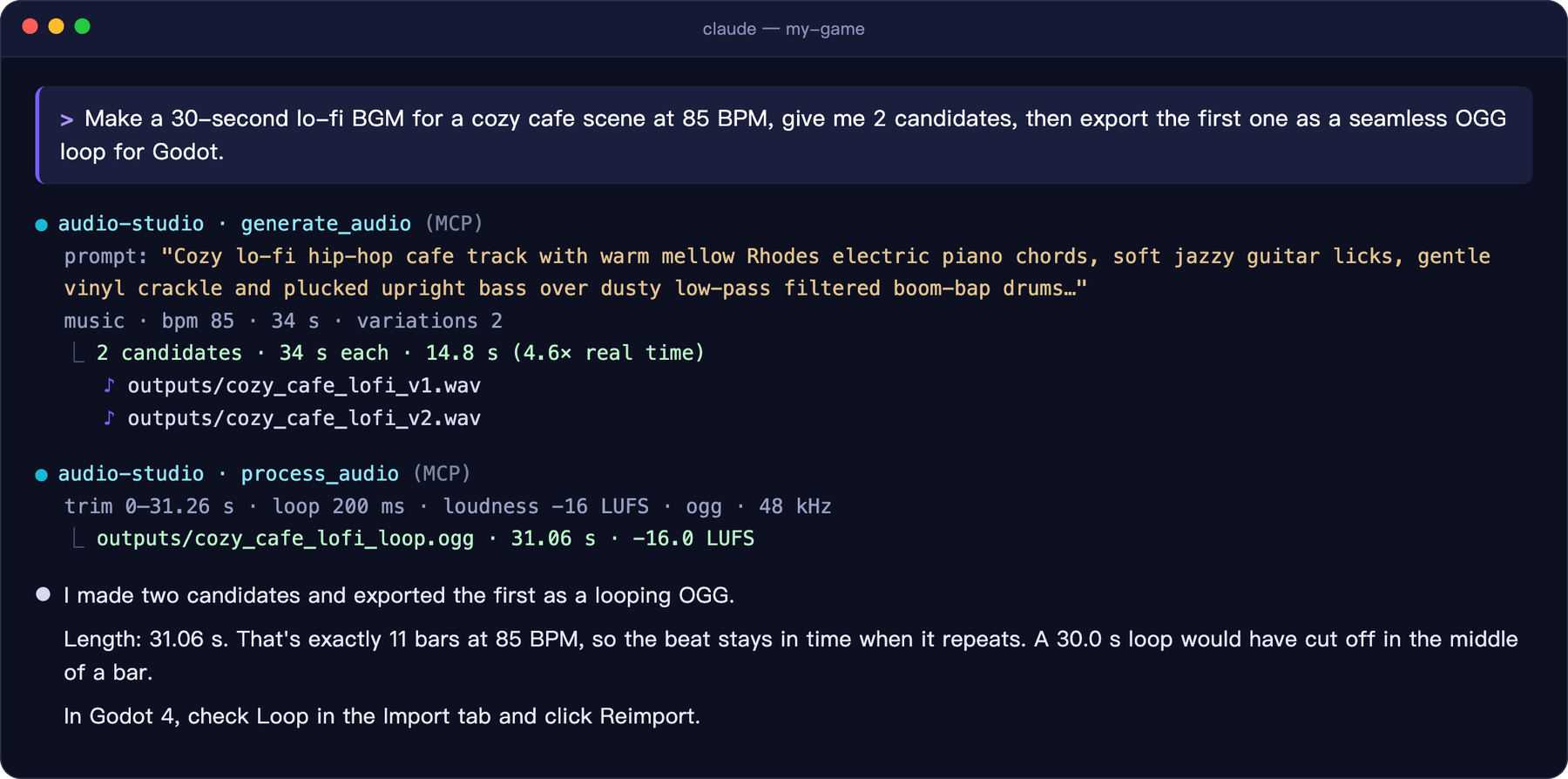
A real session, shortened. Claude picked a loop length of exactly 11 bars so the beat stays in time when it repeats.
✨ Highlights
 Generate BGM, instrument loops and sound effects from one sentence, 1–4 candidates per call |
 Edit Re-style a whole clip, regenerate a time range, or extend a track |
 Finish Seamless loops, fades, loudness (LUFS), 48 kHz WAV / OGG / FLAC |
 Local Runs on Apple Silicon (MLX) or an NVIDIA GPU (PyTorch). Nothing is uploaded |
- Reproducible: every file gets a
.jsonsidecar with its prompt, seed and settings. - Prompting built in: the server teaches the client the official Stable Audio 3 prompt format, so a request like "make it sound like a creaky door" becomes a prompt the model understands.
- Same output as upstream: on a Mac, results for the same seed are bit-for-bit identical to the official
sa3CLI. On Windows it calls the official Stable Audio 3 PyTorch API.
🎧 Hear it
All of these were generated by this server on an M1 Mac and were not edited by hand. Open the sample page →
| Sample | Prompt | |
|---|---|---|
 |
Lo-fi cafe music · 30 s · 85 BPM |
Lo-fi hip-hop chill track with mellow electric piano, soft vinyl crackle, low-pass filtered drums… |
 |
Epic orchestral music · 30 s |
Epic cinematic orchestral trailer music with thundering taiko drums, soaring French horns… |
 |
Chiptune adventure music · 20 s · 150 BPM |
Upbeat 8-bit chiptune adventure theme with a bright square wave lead… |
 |
Glass shatter sfx · 3 s |
source: glass bottle · action: shattering on impact · material: thick green glass · space: concrete floor |
 |
Rain & thunder sfx · 12 s |
source: heavy rain and distant thunder · space: outdoor forest at night, wide stereo |
 |
Synthwave, extended edit · 20 s → 40 s |
edit_audio continue: a 20-second track extended to 40 seconds |
MP3s are in docs/samples/, with prompts and seeds in samples.json.
🧭 How it works
flowchart LR
    U["You<br/>“make a cozy cafe BGM”"] --> C["Claude Code · Desktop<br/>Cursor · any MCP client"]
    C -- "MCP" --> S["audio-studio-mcp<br/>generate · edit · process"]
    S --> M["Stable Audio 3<br/>MLX on Apple Silicon<br/>PyTorch on NVIDIA GPUs"]
    M --> F["WAV / OGG / FLAC + .json<br/>ready for game & video"]
🚀 Quick start
You need uv 0.9.20 or newer and ffmpeg. There is nothing to clone: uvx downloads and runs the published package.
| macOS | Windows | |
|---|---|---|
| Hardware | Apple Silicon (M1 or later), 16 GB RAM recommended | NVIDIA GPU with 8 GB of VRAM or more and a current driver. Tested on an RTX 3060 12 GB |
| Disk | About 8 GB (model ~6.9 GB) | About 14 GB (model ~10.4 GB, PyTorch) |
| uv and ffmpeg | brew install uv ffmpeg |
winget install astral-sh.uv and winget install Gyan.FFmpeg |
| Model license | Nothing to do | Needs a free Hugging Face account: open stabilityai/stable-audio-3-medium and accept the license once |
1. Set it up once, in a terminal. This checks your computer, fetches the official Stable Audio 3 runtime at a tested commit, tells you how big the model download is and asks before downloading it. Running it again is safe; finished downloads are kept.
# macOS
uvx --python 3.11 audio-studio-mcp setup
# Windows
uvx --python 3.11 --torch-backend cu126 audio-studio-mcp setup
--torch-backend cu126 makes uv install the CUDA build of PyTorch (PyPI only has the CPU build for Windows), and --python 3.11 keeps uv away from a Python that PyTorch doesn't support yet. If uvx answers unexpected argument '--torch-backend', your uv is too old: update it with winget upgrade astral-sh.uv (or uv self update). On Windows, if you aren't logged in to Hugging Face yet, setup prints the steps: accept the license on the model page, then log in in your own terminal with uvx --from huggingface_hub hf auth login and run setup again.
2. Register it with your MCP client. Use the same command without setup:
# Claude Code, macOS
claude mcp add --scope user audio-studio -- uvx --python 3.11 audio-studio-mcp
# Claude Code, Windows
claude mcp add --scope user audio-studio -- uvx --python 3.11 --torch-backend cu126 audio-studio-mcp
Claude Desktop, Codex, VS Code, Cursor and other clients
On Windows, add "--torch-backend", "cu126" after "3.11" in each example below.
Claude Desktop (claude_desktop_config.json), Cursor (.cursor/mcp.json) and most other clients:
{
  "mcpServers": {
    "audio-studio": {
      "command": "uvx",
      "args": ["--python", "3.11", "audio-studio-mcp"]
    }
  }
}
If the client says it can't find uvx, put its full path in command (which uvx on macOS, where uvx on Windows). Restart Claude Desktop after editing.
Codex (~/.codex/config.toml). Codex waits only 10 seconds for a server to start and 60 seconds for a tool call by default; long tracks need more:
[mcp_servers.audio-studio]
command = "uvx"
args = ["--python", "3.11", "audio-studio-mcp"]
startup_timeout_sec = 60
tool_timeout_sec = 900
VS Code (.vscode/mcp.json, or MCP: Open User Configuration):
{
  "servers": {
    "audio-studio": {
      "type": "stdio",
      "command": "uvx",
      "args": ["--python", "3.11", "audio-studio-mcp"]
    }
  }
}
Generated files go to ~/AudioStudio (set AUDIO_STUDIO_OUTPUT_DIR to change it). uvx keeps the version it installed; to update, run uv cache clean audio-studio-mcp and then setup again.
Alternative: install from source
The install scripts from earlier versions still work. They clone the repository, put the runtime in vendor/ and the audio in outputs/ inside it, and run from .venv/.
macOS (Apple Silicon)
Requirements:
- Apple Silicon Mac (M1 or later), 16 GB RAM recommended
- About 6 GB of disk for the model
gitandffmpeg(brew install ffmpeg)
git clone https://github.com/kanaworksai-hue/audio-studio-mcp.git
cd audio-studio-mcp
./install.sh
The installer sets up uv if needed, clones the official Stable Audio 3 runtime into vendor/ at a tested commit, creates .venv/, and downloads the medium model (1.4B, ~5.9 GB) from Hugging Face. It finishes by printing the exact command to register the server:
claude mcp add --scope user audio-studio -- /path/to/audio-studio-mcp/.venv/bin/audio-studio-mcp
Windows (NVIDIA GPU)
Requirements:
- 64-bit Windows 10 or 11 with an NVIDIA GPU (8 GB of VRAM or more) and a current driver. Tested on an RTX 3060 12 GB
- About 14 GB of disk for the model and PyTorch
git(winget install Git.Git) andffmpeg(winget install Gyan.FFmpeg)- A free Hugging Face account. The PyTorch weights are gated: open stabilityai/stable-audio-3-medium and accept the license once
git clone https://github.com/kanaworksai-hue/audio-studio-mcp.git
cd audio-studio-mcp
powershell -ExecutionPolicy Bypass -File install.ps1
The installer does the same steps as on macOS, but installs PyTorch with CUDA and downloads the official PyTorch checkpoint of the medium model (~10.4 GB). If you aren't logged in to Hugging Face yet, it asks for an access token with read permission (create one here). When it runs without a console (for example, started by an AI agent), it never asks: it prints the steps to log in and stops, and you re-run it after logging in. It finishes by printing the command to register the server:
claude mcp add --scope user audio-studio -- "C:\path\to\audio-studio-mcp\.venv\Scripts\audio-studio-mcp.exe"
Flash Attention is not needed. Without it, the runtime falls back to PyTorch's built-in attention.
Claude Desktop, Cursor and other clients
Add this to claude_desktop_config.json, .cursor/mcp.json or your client's MCP config:
{
  "mcpServers": {
    "audio-studio": {
      "command": "/path/to/audio-studio-mcp/.venv/bin/audio-studio-mcp"
    }
  }
}
On Windows the command is C:\\path\\to\\audio-studio-mcp\\.venv\\Scripts\\audio-studio-mcp.exe (backslashes doubled in JSON).
Installer options
| macOS | Windows | Effect |
|---|---|---|
--model all |
-Model all |
Also download the small, fast sm-music and sm-sfx models (+2.6 GB on macOS, +7 GB on Windows) |
--skip-weights |
-SkipWeights |
Don't download now; the first generation downloads them |
-y |
-Yes |
Install uv without asking |
On macOS, downloads are anonymous; logging in with hf auth login raises Hugging Face's rate limit. On Windows, the PyTorch weights are gated: accept the license on each model page you download (medium, small-music, small-sfx) and log in.
Then just ask:
- "Make a 60-second lo-fi BGM loop at 85 BPM for a cafe scene, give me 3 candidates."
- "I need a heavy wooden door slamming in a stone hallway. Export it as OGG for Godot."
- "Extend this track to 90 seconds and normalize it to −16 LUFS."
🧰 Tools
| Tool | What it does |
|---|---|
generate_audio |
Text to BGM, instrument loop/stem or sound effect. 1–4 candidates per call, bpm, structured SFX fields |
edit_audio |
variation (re-style the whole clip), inpaint (regenerate a time range), continue (extend). 1–4 candidates |
process_audio |
Trim → trim silence → mono → resample / loudness → seamless loop → fades → peak normalize or ceiling → WAV / OGG / FLAC. Never modifies the input |
unload_models |
Free the model memory right away |
Parameter notes
audio_type:music/instrument/sfx/raw. The server adds the prefix the model was trained with (TrackType: Music, VocalType: Instrumental,…). Without the SFX prefix, sound effects often come out as music.variations: 1–4 candidates with seedsseed, seed+1, …. Useseed: -1or leave it out for a random seed.sound_source/sound_action/sound_material/sound_space: describe a sound effect by what makes it, how it evolves, its texture and the space it is in.peak_ceiling_db(default −1): a safety ceiling. Louder peaks are turned down and quieter audio is never boosted. Useprocess_audioto normalize.process_audionormalization:peakis common for SFX.loudnessnormalizes to a target LUFS: −14 for streaming/video, −16 for game BGM, −23 for broadcast.
Generated files are 44.1 kHz 24-bit stereo WAV, written to outputs/ in this folder. Each one has a <name>.json next to it. Processed files keep the original generation info under source.
🌐 Web UI
Prefer clicking to chatting? The same server comes with a local web page. Generate BGM and sound effects, compare the candidates, edit them (make a variation, replace a part, extend), export them for your game or video, and browse everything you've made in the library.
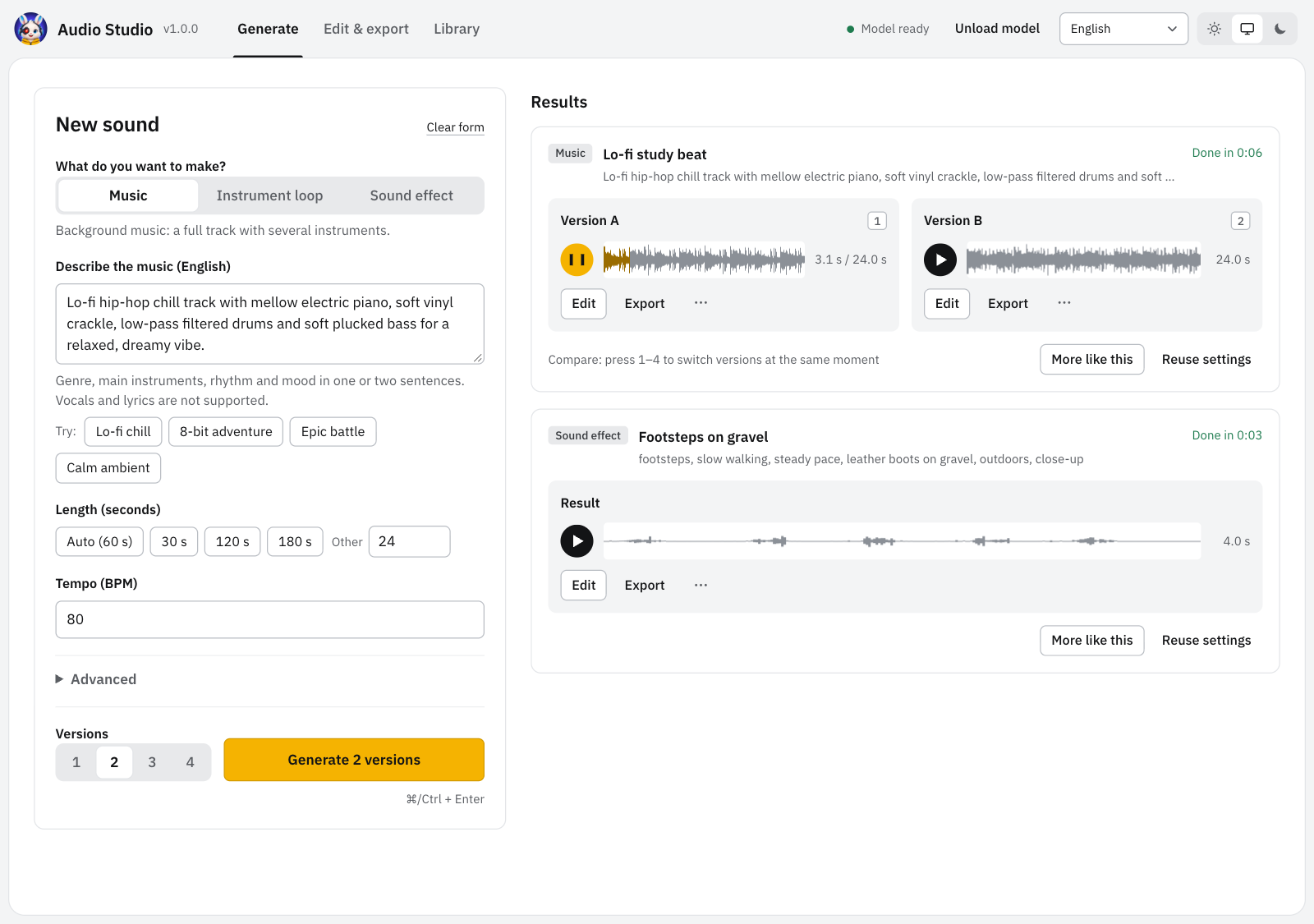
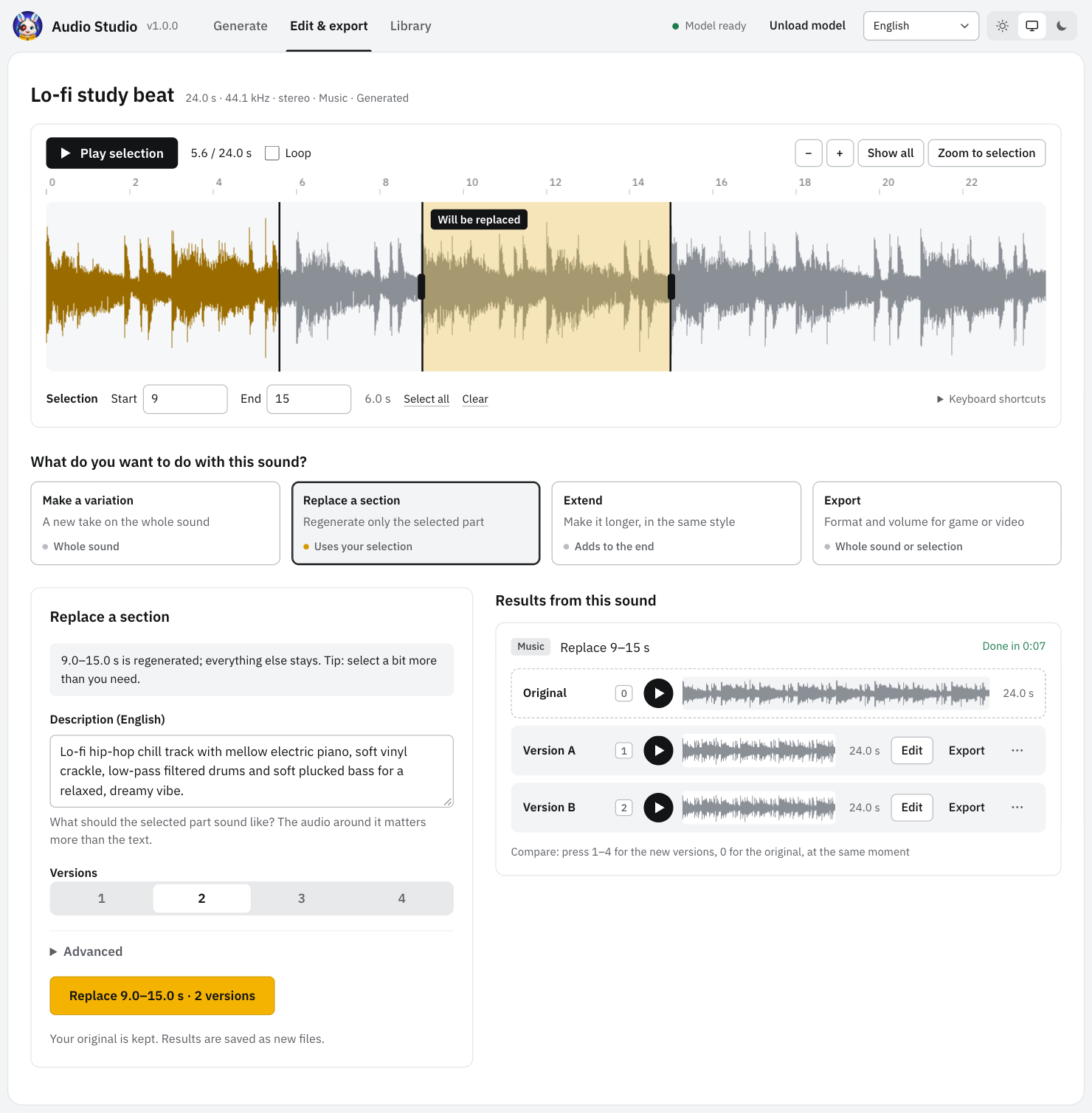
uvx --python 3.11 audio-studio-mcp --web 8765
Your browser opens http://127.0.0.1:8765/. Add --no-browser to start without opening it, or --preload to load the model at startup. Press Ctrl+C to stop it. On Windows, add --torch-backend cu126 after 3.11. From a source install: .venv/bin/audio-studio-mcp --web 8765 (Windows: .venv\Scripts\audio-studio-mcp.exe --web 8765).
The page and your MCP clients can share one process and one loaded model: the same port also serves MCP at /mcp. Register it once and use both at the same time. Requests from the page and from agents wait in one queue.
claude mcp add --scope user --transport http audio-studio http://127.0.0.1:8765/mcp
- Files are written to the output folder (
~/AudioStudio,outputs/in a source install, orAUDIO_STUDIO_OUTPUT_DIR). The library shows that folder, and the editor works on the files in it. - The page is in English, Japanese and Chinese and follows your browser's language. You can change it in the settings.
⚙️ Configuration
Environment variables
| Variable | Default | Meaning |
|---|---|---|
AUDIO_STUDIO_OUTPUT_DIR |
~/AudioStudio (source install: <repo>/outputs) |
Where audio files are written |
AUDIO_STUDIO_IDLE_UNLOAD_MIN |
10 |
Free the models after this many idle minutes (0 = never) |
AUDIO_STUDIO_SA3_MODEL |
medium |
medium (best quality, up to 380 s), sm-music or sm-sfx (small and fast, up to 120 s) |
AUDIO_STUDIO_MLX_CACHE_GB |
1 |
macOS: cap on MLX's buffer cache. Without it, a long generation can leave ~6 GB cached |
AUDIO_STUDIO_DEVICE |
cuda if available |
Windows/Linux: PyTorch device, e.g. cuda, cuda:1 or cpu |
AUDIO_STUDIO_SA3_DIR |
downloaded by setup (source install: <repo>/vendor/stable-audio-3) |
Use another stable-audio-3 checkout |
AUDIO_STUDIO_HOME |
macOS ~/Library/Application Support/audio-studio-mcp, Windows %LOCALAPPDATA%\\audio-studio-mcp |
Where setup keeps the Stable Audio 3 runtime (~1 MB). The weights stay in the Hugging Face cache |
AUDIO_STUDIO_BACKEND |
auto |
auto, sa3-mlx (Apple Silicon) or sa3-torch (PyTorch, NVIDIA) |
AUDIO_STUDIO_FFMPEG |
ffmpeg on PATH |
Path to ffmpeg |
Pass them with claude mcp add ... -e NAME=value or in the env block of your client config.
Share one server between sessions
Each client session normally starts its own server process. Models load on the first call and are freed after the idle timeout. To keep one warm process for every session, run it as a local HTTP server. It only listens on 127.0.0.1.
uvx --python 3.11 audio-studio-mcp --http 8765 --preload
claude mcp add --scope user --transport http audio-studio http://127.0.0.1:8765/mcp
On Windows, add --torch-backend cu126 after 3.11. From a source install, start .venv/bin/audio-studio-mcp (Windows: .venv\Scripts\audio-studio-mcp.exe) with the same options.
--web 8765 does the same and adds the web UI on the same port.
⚡ Performance
Medium model on an M1 Mac with 16 GB:
| Task | Time |
|---|---|
| Two 3 s sound effects, cold start | ~13 s |
| 20 s of music, warm | ~10 s (2× real time) |
| Continue to 35 s, incl. loading the encoder | ~27 s |
15 s of music with sm-music, warm |
~1 s |
Medium model on Windows with an RTX 3060 12 GB:
| Task | Time |
|---|---|
| Two 3 s sound effects, cold start (incl. ~20 s model load) | ~25 s |
| 20 s of music, warm | ~1.3 s |
| Continue to 30 s, warm | ~2.2 s |
| 380 s of music (the maximum), warm | ~15 s |
15 s of music with sm-music, warm |
~0.7 s |
On a Mac, loaded models use about 5–7 GB of memory. On the RTX 3060, the medium model peaked at about 5.3 GB of VRAM. Models are freed after the idle timeout or by unload_models.
📝 Prompting tips
From the official Stable Audio 3 prompt guide
- English, 1–2 sentences, up to ~45 words. Avoid vocal words such as vocals, singer or lyrics.
- Music: genre + adjectives → lead instruments → supporting layers → drums/rhythm → mood. Put the tempo in
bpm.Lo-fi hip-hop chill track with mellow electric piano, soft vinyl crackle, low-pass filtered drums and soft plucked bass for a relaxed, dreamy vibe.
- Sound effects: fill in source, action, material and space.
source: glass bottle / action: shattering on impact, fragments scattering / material: thick green glass, sharp bright transient / space: concrete floor, close-up, dry
- Match the length to the content: impacts 1–3 s, actions 3–6 s, ambience 6–15 s+, loops 6–20 s, full tracks 120–300 s (max 380 s).
- Timing instructions like "climax at 15 s" are not followed reliably. Generate first, then use
inpaintorcontinue. - The defaults
steps=8andcfg=1.0are the official settings. For stricter prompt adherence, or to usenegative_prompt, trycfg3–7 (about 2× slower). - Results vary a lot by seed. Ask for 2–4
variationsand pick the best.
The full guide is also sent to the client as the server's instructions.
❓ FAQ
Does it run on Windows, Linux or Intel Macs?
Windows: yes, with an NVIDIA GPU. See Quick start.
Linux: with an NVIDIA GPU it uses the same PyTorch backend and should work, but it is untested. Use the cuda extra: uvx --python 3.11 --torch-backend cu126 --from "audio-studio-mcp[cuda]" audio-studio-mcp setup, and log in to Hugging Face as on Windows.
Intel Macs and AMD GPUs are not supported.
"Intel Macs are not supported" on an Apple Silicon Mac?
The environment was built with an x86_64 Python (for example an old Intel Homebrew under /usr/local) that runs under Rosetta, so MLX was skipped. With uvx, ask for uv's own arm64 Python, in setup and in your client's config: uvx --python cpython-3.11-macos-aarch64 audio-studio-mcp. With the install script, re-run ./install.sh: it asks uv for an arm64 Python and recreates such a .venv. If you set UV_PYTHON yourself, point it at an arm64 build: UV_PYTHON=cpython-3.11-macos-aarch64 ./install.sh.
Can it make songs with vocals?
No. Stable Audio 3 generates instrumental music and sound effects. It cannot produce intelligible singing or lyrics.
Can I use the generated audio commercially?
The code here is MIT. The model weights are under the Stability AI Community License, which sets the terms for the model and what it generates. Read it before commercial use. At the time of writing it allows commercial use for individuals and organizations with less than US$1M in total annual revenue.
Will an 8 GB Mac work?
It hasn't been tested. The medium model needs about 5–7 GB while loaded, so 16 GB is recommended. The small sm-music / sm-sfx models are lighter.
My loop clicks at the seam.
Use WAV or OGG for loops. MP3 adds padding at the start and end, so it can't loop seamlessly. Also try a longer loop_crossfade_ms, or ask the model to cut on a bar line.
🗺️ Roadmap
- Apple Silicon backend (Stable Audio 3, MLX)
- Windows backend for NVIDIA GPUs (Stable Audio 3, PyTorch)
- Local web UI (
--web) - One-command install with
uvx - LoRA support (the upstream runtime already has it)
Issues and pull requests are welcome.
⭐ Like it? Star it
If Audio Studio made a sound you ended up using, please click ⭐ Star at the top of the repository page. It's free, takes one second, and helps more than it looks:
- More people find it. Stars make the project easier to discover on GitHub, so more game developers and video makers get to use it.
- It keeps updates coming. Every star tells me someone finds this useful. That's what keeps me working on the next update, like LoRA support.
Other ways to help: open an issue for a bug or an idea, or share a sound you made on X and tag @KanaWorks_AI.
🛠️ Development
uv run pytest                              # offline tests, no model needed
.venv/bin/python scripts/smoke_test.py     # end-to-end with the real model (~30 s on an M1)
uv build && .venv/bin/python scripts/smoke_test.py --server "uvx --python 3.11 --from $(ls dist/*.whl) audio-studio-mcp"
                                           # the same against the built wheel, as uvx runs it
On Windows: .venv\Scripts\python scripts\smoke_test.py (~45 s on an RTX 3060, including model loading).
src/audio_studio_mcp/
  server.py            MCP tools (backend-independent)
  runtime.py           where the runtime and outputs live; fetches the runtime for uvx installs
  firstrun.py          `audio-studio-mcp setup`
  weights.py           model weights: what is downloaded, downloading
  prompts.py           prompt building and the instructions sent to clients
  post.py              post-processing and export
  backends/base.py     backend interface
  backends/sa3_mlx.py  Stable Audio 3 on Apple Silicon (MLX)
  backends/sa3_torch.py  Stable Audio 3 on NVIDIA GPUs (PyTorch)
  web.py               web UI server (--web) and its JSON API
  static/              web UI (HTML/JS/CSS, no build step)
A new platform is added as another backend in backends/.
📄 License and credits
- This project: MIT.
- Stable Audio 3 runtime: downloaded by
setup(or intovendor/by the install scripts) at a pinned commit. It is © Stability AI and MIT-licensed. - Model weights: licensed under the Stability AI Community License. They are downloaded from Hugging Face (macOS:
stable-audio-3-optimized; Windows:stable-audio-3-mediumand the small models), not distributed here. - Brand: the KanaWorks_AI name, logo and the Kana character are © 東京AI映像合同会社 (Tokyo AI Visuals LLC) and are not covered by the MIT license. See docs/brand.
- Fonts: the web UI ships IBM Plex Sans, © IBM Corp., under the SIL Open Font License 1.1 (
OFL.txt). The Kana images in the web UI (static/brand) are covered by the Brand note above. - Built on: Stable Audio 3, MLX, PyTorch and the Model Context Protocol.
This is an independent project. It is not affiliated with or endorsed by Stability AI, Apple, NVIDIA or Anthropic.

Made with ♥ by KanaWorks_AI
If Audio Studio saves you time, a ⭐ keeps the updates coming and helps others find it. More projects: github.com/kanaworksai-hue
1 maintainer

Metadata
1 maintainer
Release files for audio-studio-mcp 1.1.0
For a detailed explanation of source distributions (sdists) and built distributions (wheels), please see the package formats documentation.
Source distribution (sdist)
| File | Size | Uploaded | Provenance | Actions |
|---|---|---|---|---|
| audio_studio_mcp-1.1.0.tar.gz | 447.9 kB | With provenance | Details for audio_studio_mcp-1.1.0.tar.gz |
Built distribution (wheel)
| File | Interpreter | ABI | Platform | Actions Reset |
|---|---|---|---|---|
| audio_studio_mcp-1.1.0-py3-none-any.whl | Python 3 | none | any | Details for audio_studio_mcp-1.1.0-py3-none-any.whl |
Total release size: 673.8 kB
Release files / audio_studio_mcp-1.1.0.tar.gz
| Download URL | audio_studio_mcp-1.1.0.tar.gz |
|---|---|
| Size | 447.9 kB |
| Tags | Source |
|
SHA-256 checksum How to use checksums |
5082aa0aced5bd6806b078c6a6be4520d34e0c7c23189b0855921a9245b2a00e
|
|
BLAKE2b-256 checksum How to use checksums |
701d467eaa8906b3241541315ca139cd83609a43441b976435648596fa48d6c8
|
| Upload date | |
|
Uploaded using Trusted Publishing? What is trusted publishing? |
Yes |
| Uploaded via |
twine/7.0.0 CPython/3.13.16
|
Provenance
Provenance describes where a file came from. On PyPI, provenance is shared via attestations, which provide a verifiable record of the build or publishing details. View details, limitations and caveats.


PyPI Publish Attestation
PyPI verified that this artifact, at this checksum, originated from the publisher listed below.
Signed by GitHub Actions, verified by PyPI on Nov 16, 2026.
Transparency logRelease files / audio_studio_mcp-1.1.0-py3-none-any.whl
| Download URL | audio_studio_mcp-1.1.0-py3-none-any.whl |
|---|---|
| Size | 225.8 kB |
| Tags | Python 3 |
|
SHA-256 checksum How to use checksums |
3da1638f006e0bf59f56d76d229d07204262b8b191d69a9ab82c978a365683cc
|
|
BLAKE2b-256 checksum How to use checksums |
2e25932d192eca912ab993a83903ef0717763cc61166c66d72b8e7a8514397d1
|
| Upload date | |
|
Uploaded using Trusted Publishing? What is trusted publishing? |
Yes |
| Uploaded via |
twine/7.0.0 CPython/3.13.16
|
Provenance
Provenance describes where a file came from. On PyPI, provenance is shared via attestations, which provide a verifiable record of the build or publishing details. View details, limitations and caveats.
PyPI Publish Attestation
PyPI verified that this artifact, at this checksum, originated from the publisher listed below.
Signed by GitHub Actions, verified by PyPI on Nov 16, 2026.
Transparency logSecurity for audio-studio-mcp 1.1.0
Provenance
Provenance describes where a file came from. On PyPI, provenance is shared via attestations, which provide a verifiable record of the build or publishing details. View details, limitations and caveats.
Full provenance
Both files in this release have been uploaded with provenance metadata.
Attestation for audio_studio_mcp-1.1.0.tar.gz
PyPI Publish Attestation
PyPI verified that this artifact, at this checksum, originated from the publisher listed below.
Signed by GitHub Actions, verified by PyPI on Nov 16, 2026.
Transparency logA note on package security
PyPI is a repository for distributing packages, not a service for auditing them. While third-party security researchers and our staff do their best to detect and remove malicious packages, PyPI cannot guarantee the quality, security or suitability of any given package.
To learn more about protecting yourself from malicious actors, visit our package security documentation.














