
At-most-once side-effect enforcement + circuit breaker for agent tool calls (loops, retries, duplicate side effects).

Project description
Aura Guard

Reliability middleware for tool-using AI agents. Prevents tool loops, duplicate side-effects, and retry storms.
from aura_guard import AgentGuard, PolicyAction

guard = AgentGuard(
    secret_key=b"your-secret-key",
    side_effect_tools={"refund", "cancel"},
    max_calls_per_tool=3,
    max_cost_per_run=1.00,
)

decision = guard.check_tool("search_kb", args={"query": "refund policy"})

if decision.action == PolicyAction.ALLOW:
    result = execute_tool(...)
    guard.record_result(ok=True, payload=result)
elif decision.action == PolicyAction.CACHE:
    result = decision.cached_result.payload
elif decision.action == PolicyAction.REWRITE:
    inject_into_prompt(decision.injected_system)
else:
    stop_agent(decision.reason)
Aura Guard sits between your agent and its tools. Before each tool call, it returns a deterministic decision: ALLOW, CACHE, BLOCK, REWRITE, or ESCALATE. No LLM calls, sub-millisecond overhead. Core engine makes no network requests; optional webhook telemetry performs HTTP calls.
Python 3.10+ · Zero dependencies · Apache-2.0
Demo
Without Aura Guard
Two agents (Coordinator + Analyst) told to consult each other. No termination condition. The loop runs forever.
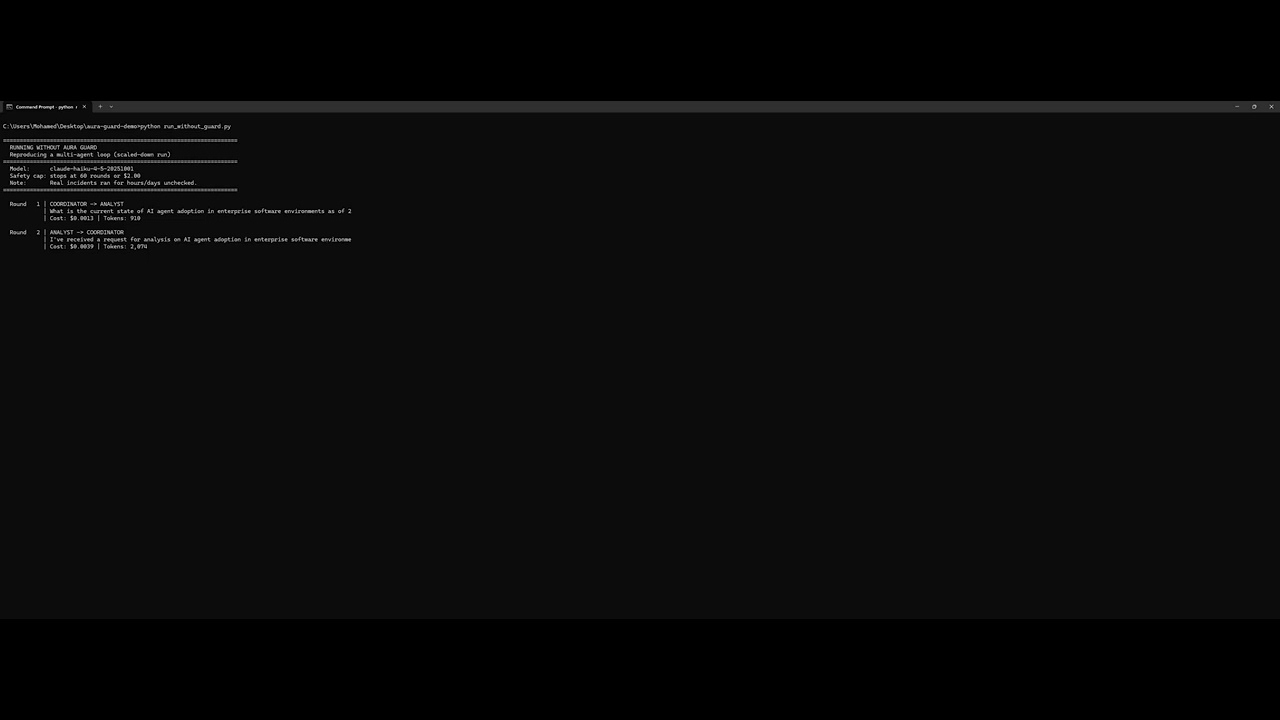
60 rounds. 79,525 tokens. $0.16 in 3.6 minutes. Never stops on its own.
Extrapolated: $2.68/hour → $706 over 11 days → $5,650 at GPT-4o pricing.
With Aura Guard
Same agents. Same prompts. Same task. Guard detects the loop automatically.
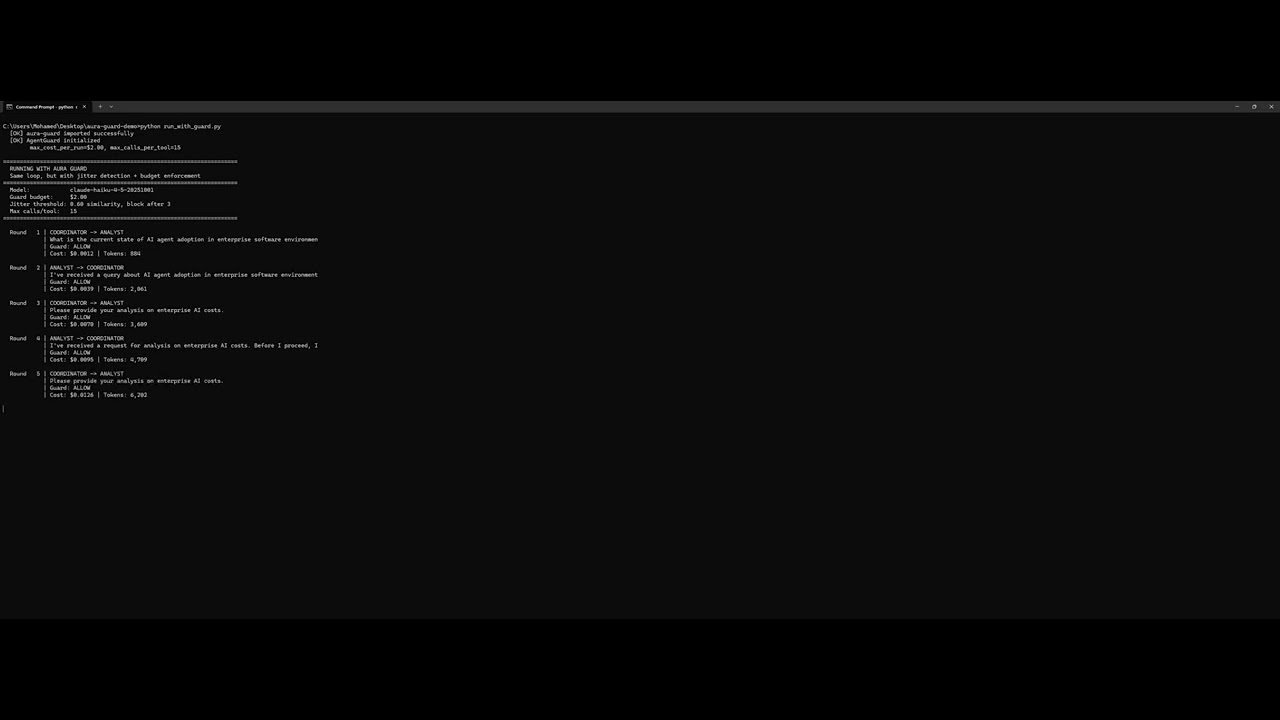
7 rounds. 8,540 tokens. $0.017. Caught by identical_toolcall_loop_cache.
Table of contents
- Install
- The problem
- Integration
- Configuration
- Shadow mode
- Thread Safety
- Async support
- Status & limitations
- Docs
- License
Install
Option A (recommended):
pip install aura-guard

# or with uv
uv pip install aura-guard
Try the built-in demo: aura-guard demo
Option B (from source / dev): install from a cloned repo
git clone https://github.com/auraguardhq/aura-guard.git
cd aura-guard
pip install -e .
Optional: LangChain adapter
pip install langchain-core
Benchmarks (synthetic)
aura-guard bench --all
These simulate common agent failure modes (tool loops, retry storms, duplicate side-effects). Costs are estimated — the important signal is the relative difference. See docs/EVALUATION_PLAN.md for real-model evaluation.
Real-model evaluation
Tested with Claude Sonnet 4 (claude-sonnet-4-20250514), 5 scenarios × 5 runs per variant, real LLM tool-use calls with rigged tool implementations.
| Scenario | No Guard | With Guard | Result |
|---|---|---|---|
| A: Jitter Loop | $0.2778 | $0.1446 | 48% saved |
| B: Double Refund | $0.1397 | $0.1456 | Prevented duplicate refund at +$0.006 overhead |
| C: Error Retry Spiral | $0.1345 | $0.0953 | 29% saved |
| D: Smart Reformulation | $0.8607 | $0.1465 | 83% saved |
| E: Flagship | $0.3494 | $0.1446 | 59% saved |
All costs are p50 (median) across 5 runs. Scenario B costs slightly more because the guard adds an intervention turn but prevents the duplicate side-effect (the refund only executes once). In Scenario B guard runs, 2 of 5 completed in fewer turns ($0.10), while 3 of 5 required the extra intervention turn ($0.145).
64 guard interventions across 25 runs. No false positives observed in manual review (expected — see caveat below). Task completion maintained or improved in scored scenarios (B–E). Scenario A quality was not scored (loop-containment test only).
Full results, per-run data, and screenshots: docs/LIVE_AB_EXAMPLE.md | JSON report
The problem
Agent run without guard:
- search_kb("refund policy") → 3 results
- search_kb("refund policy EU") → 2 results
- search_kb("refund policy EU Germany") → 2 results
- search_kb("refund policy EU Germany 2024") → 1 result
- search_kb("refund policy EU returns") → 2 results
- refund(order="ORD-123", amount=50) → success
- refund(order="ORD-123", amount=50) → success (DUPLICATE!)
- search_kb("refund confirmation") → 1 result ... 14 tool calls, $0.56, customer refunded twice
With Aura Guard
Agent run with guard:
- search_kb("refund policy") → ALLOW → 3 results
- search_kb("refund policy EU") → ALLOW → 2 results
- search_kb("refund policy EU Germany") → ALLOW → 2 results
- search_kb("refund policy EU Germany 2024") → REWRITE (jitter loop detected)
- refund(order="ORD-123", amount=50) → ALLOW → success
- refund(order="ORD-123", amount=50) → CACHE (idempotent replay) ... 4 tool calls executed, $0.16, one refund
max_steps doesn't distinguish productive calls from loops. Retry libraries don't prevent duplicate side-effects. Idempotency keys protect writes but don't stop search spirals or stalled outputs. Aura Guard handles all of these with a single middleware layer.
Integration
Aura Guard does not call your LLM and does not execute tools.
You keep your agent loop. You just add 3 hook calls:
check_tool(...)before you execute a toolrecord_result(...)after the tool finishes (success or error)check_output(...)after the model produces text (optional but recommended)
Minimal example
from aura_guard import AgentGuard, PolicyAction

guard = AgentGuard(
    secret_key=b"your-secret-key",
    max_calls_per_tool=3,                 # stop “search forever”
    side_effect_tools={"refund", "cancel"},
    max_cost_per_run=1.00,                # optional budget (USD)
    tool_costs={"search_kb": 0.03},        # optional; improves cost reporting
)

def run_tool(tool_name: str, args: dict):
    decision = guard.check_tool(tool_name, args=args, ticket_id="ticket-123")

    if decision.action == PolicyAction.ALLOW:
        try:
            result = execute_tool(tool_name, args)  # <-- your tool function
            guard.record_result(ok=True, payload=result)
            return result
        except Exception as e:
            # classify errors however you want ("429", "timeout", "5xx", ...)
            guard.record_result(ok=False, error_code=type(e).__name__)
            raise

    if decision.action == PolicyAction.CACHE:
        # Aura Guard tells you “reuse the previous result”
        return decision.cached_result.payload if decision.cached_result else None

    if decision.action == PolicyAction.REWRITE:
        # You should inject decision.injected_system into your next prompt
        # and re-run the model.
        raise RuntimeError(f"Rewrite requested: {decision.reason}")

    # BLOCK / ESCALATE / FINALIZE
    raise RuntimeError(f"Stopped: {decision.action.value} — {decision.reason}")
Framework-specific adapters for OpenAI and LangChain are included. See examples/ for integration patterns.
Strict mode (recommended in production)
If record_result() is accidentally skipped between check_tool() calls, the guard undercounts tool executions and may weaken protections. Enable strict mode to catch this:
guard = AgentGuard(
    secret_key=b"your-secret-key",
    strict_mode=True,  # raises RuntimeError on integration mistakes
)
In strict mode, calling check_tool() without a preceding record_result() raises RuntimeError. Calling record_result() without a preceding check_tool() also raises. In non-strict mode (default), these cases log a warning and increment stats["missed_results"].
Framework examples (Anthropic, OpenAI, LangChain)
Anthropic (Claude)
import anthropic
from aura_guard import AgentGuard, PolicyAction

client = anthropic.Anthropic()
guard = AgentGuard(secret_key=b"your-secret-key", max_cost_per_run=1.00, side_effect_tools={"refund", "send_email"})

# In your agent loop, after the model returns tool_use blocks:
for block in response.content:
    if block.type == "tool_use":
        decision = guard.check_tool(block.name, args=block.input)

        if decision.action == PolicyAction.ALLOW:
            result = execute_tool(block.name, block.input)
            guard.record_result(ok=True, payload=result)
        elif decision.action == PolicyAction.CACHE:
            result = decision.cached_result.payload  # reuse previous result
        else:
            # BLOCK / REWRITE / ESCALATE — handle accordingly
            break

# After each assistant text response:
guard.check_output(assistant_text)

# Track real token spend:
guard.record_tokens(
    input_tokens=response.usage.input_tokens,
    output_tokens=response.usage.output_tokens,
)
OpenAI
from aura_guard import AgentGuard, PolicyAction
from aura_guard.adapters.openai_adapter import (
    extract_tool_calls_from_chat_completion,
    inject_system_message,
)

guard = AgentGuard(secret_key=b"your-secret-key", max_cost_per_run=1.00)

# After each OpenAI response:
tool_calls = extract_tool_calls_from_chat_completion(response)
for call in tool_calls:
    decision = guard.check_tool(call.name, args=call.args)

    if decision.action == PolicyAction.ALLOW:
        result = execute_tool(call.name, call.args)
        guard.record_result(ok=True, payload=result)
    elif decision.action == PolicyAction.REWRITE:
        messages = inject_system_message(messages, decision.injected_system)
        # Re-call the model with updated messages
LangChain
from aura_guard.adapters.langchain_adapter import AuraCallbackHandler

handler = AuraCallbackHandler(
    secret_key=b"your-secret-key",
    max_cost_per_run=1.00,
    side_effect_tools={"refund", "send_email"},
)

# Pass as a callback — Aura Guard intercepts tool calls automatically:
agent = initialize_agent(tools=tools, llm=llm, callbacks=[handler])
agent.run("Process refund for order ORD-123")

# After the run:
print(handler.summary)
# {"cost_spent_usd": 0.12, "cost_saved_usd": 0.40, "blocks": 3, ...}
Recommended: record real token usage (more accurate costs)
After each LLM call, report usage:
guard.record_tokens(
    input_tokens=resp.usage.input_tokens,
    output_tokens=resp.usage.output_tokens,
)
Configuration (the knobs that matter)
Most teams start here:
-
Mark side-effect tools
e.g.{"refund", "cancel", "send_email"} -
Cap expensive tools
e.g.max_calls_per_tool=3for search/retrieval -
Set a max budget per run
e.g.max_cost_per_run=1.00 -
Tell Aura Guard your tool costs
so reports are meaningful
For advanced options, see AuraGuardConfig in src/aura_guard/config.py.
Shadow mode (evaluate before enforcing)
Shadow mode lets you measure what Aura Guard would block without actually blocking anything. Every decision that would be BLOCK, CACHE, REWRITE, or ESCALATE is logged and counted, but the agent receives ALLOW instead.
This lets you evaluate false positive rates before turning enforcement on in production.
from aura_guard import AgentGuard

guard = AgentGuard(
    max_cost_per_run=1.00,
    max_calls_per_tool=8,
    shadow_mode=True,
)

# Agent runs normally — nothing is blocked
decision = guard.check_tool("search_kb", args={"query": "refund policy"})
# decision.action is always ALLOW in shadow mode

# After the run, check what would have been blocked:
print(guard.stats)
# {"shadow_mode": True, "shadow_would_deny": 3, ...}
Use shadow mode to:
- Tune thresholds on real traffic before enforcing
- Compare guard behavior across config changes
- Build confidence that enforcement won't break working agents
When ready, remove shadow_mode=True to start enforcing.
Example: per-tool policies (deny / human approval)
from aura_guard import AgentGuard, AuraGuardConfig, ToolPolicy, ToolAccess

guard = AgentGuard(
    config=AuraGuardConfig(
        secret_key=b"your-secret-key",
        tool_policies={
            "delete_account": ToolPolicy(access=ToolAccess.DENY, deny_reason="Too risky"),
            "large_refund": ToolPolicy(access=ToolAccess.HUMAN_APPROVAL, risk="high"),
            "search_kb": ToolPolicy(max_calls=5),
        },
    ),
)
Telemetry & persistence (optional)
Telemetry
Aura Guard can emit structured events (counts + signatures, not raw args/payloads).
See src/aura_guard/telemetry.py.
Persist state (optional)
You can serialize guard state to JSON and store it in Redis / Postgres / etc.
from aura_guard.serialization import state_to_json, state_from_json

json_str = state_to_json(state)
state = state_from_json(json_str)
⚠️
result_cacheandidempotency_ledgerpayloads are excluded from serialization (PII risk). After restoring state, side-effect deduplication relies onexecuted_side_effect_callscounts only — not per-call idempotency keys. If your agent can be interrupted mid-run and resumed from serialized state, a duplicate side-effect is possible on the first call after restore.
Thread safety
Aura Guard is not thread-safe. Each AgentGuard instance stores per-run state and must be used from the thread that created it. Sharing a guard across threads will raise RuntimeError. Create one guard per agent run.
Async support
Use AsyncAgentGuard for async agent loops. It calls the synchronous engine directly (no I/O, sub-millisecond), safe for the event loop.
from aura_guard.async_middleware import AsyncAgentGuard, PolicyAction

guard = AsyncAgentGuard(secret_key=b"your-secret-key", max_cost_per_run=0.50)
decision = await guard.check_tool("search_kb", args={"query": "test"})
Status & limitations
Aura Guard is v0.3 — the API is stabilizing but may change before v1.0.
Stable: The 3-method API (check_tool / record_result / check_output), the 6 PolicyAction values, and AuraGuardConfig.
May change: Default threshold values, serialization format (versioned — old state will error, not silently corrupt), telemetry event names.
Side-effect timeouts (important)
If a side-effect tool succeeds server-side but times out locally, tell the guard:
try:
    result = refund_tool(order_id="o1", amount=50)
    guard.record_result(ok=True, payload=result, side_effect_executed=True)
except TimeoutError:
    # Server may have executed the refund — mark it to prevent duplicates
    guard.record_result(ok=False, error_code="timeout", side_effect_executed=True)
If you don't set side_effect_executed=True on timeout, the guard may allow a retry that causes a duplicate side-effect.
Limitations:
- In-memory state only. Not thread-safe. Create one guard per agent run.
- Side-effect enforcement is at-most-once within a single process. Not exactly-once across restarts.
- Argument jitter detection uses token overlap, not semantic similarity. English-biased.
- Cost estimates are configurable approximations, not actual billing data.
- Serialized state and telemetry contain HMAC signatures only. In-memory caches hold tool payloads for caching and idempotency during a run.
For architecture details, see docs/ARCHITECTURE.md.
Docs
docs/ARCHITECTURE.md— how the engine is structureddocs/EVALUATION_PLAN.md— how to evaluate crediblydocs/LIVE_AB_EXAMPLE.md— live A/B walkthrough and sample outputdocs/RESULTS.md— how to publish results (recommended format)
Contributing
See CONTRIBUTING.md.
License
Apache-2.0
Release history Release notifications | RSS feed


Download files
Download the file for your platform. If you're not sure which to choose, learn more about installing packages.
Source Distribution
Built Distribution
Filter files by name, interpreter, ABI, and platform.
If you're not sure about the file name format, learn more about wheel file names.
Copy a direct link to the current filters
File details
Details for the file aura_guard-0.3.9.tar.gz.
File metadata
- Download URL: aura_guard-0.3.9.tar.gz
- Upload date:
- Size: 58.6 kB
- Tags: Source
- Uploaded using Trusted Publishing? No
- Uploaded via: twine/6.1.0 CPython/3.13.7
File hashes
| Algorithm | Hash digest | |
|---|---|---|
| SHA256 |
94464376b120d8b6b25dff9496890040db2eed351b526f3391a15b90a0c7d2e1
|
|
| MD5 |
66fa43e05b7a7cadeffc4999a5472712
|
|
| BLAKE2b-256 |
83df87be5082e95eae6d232c111dcbc72f69241703e1dbb7e1a8fffb1237de2f
|
File details
Details for the file aura_guard-0.3.9-py3-none-any.whl.
File metadata
- Download URL: aura_guard-0.3.9-py3-none-any.whl
- Upload date:
- Size: 54.7 kB
- Tags: Python 3
- Uploaded using Trusted Publishing? No
- Uploaded via: twine/6.1.0 CPython/3.13.7
File hashes
| Algorithm | Hash digest | |
|---|---|---|
| SHA256 |
e2a398c30979b563e8e0a8925574b8ac1453ba2fd50fca7121c433da525f359e
|
|
| MD5 |
71d0fe565ef20051ae996d1232cbbaf8
|
|
| BLAKE2b-256 |
d3a6df7b76249dcc44822565e1ed65d12f5c51248750cb2b9b725a1804981f39
|






