
auriga-floss
Temporary, packaging-only downstream snapshot. auriga-floss packages the Apache-2.0-licensed FLARE Obfuscated
String Solver from upstream commit
7e1e6e5d3cff6d4a39fa85a0aa508ad3370baa30,
which is 1,009 commits newer than upstream release v3.1.1. This package is not an official Google or Mandiant
release and is not supported by those organizations. No additional feature changes are introduced by this packaging;
the original authorship and Apache 2.0 license are retained. Users can return to flare-floss when upstream publishes
a newer PyPI release.
Install the downstream package from PyPI or a synchronized pip mirror:
python -m pip install auriga-floss
The Python import namespace and command remain floss. Do not install auriga-floss and flare-floss in the same
environment because both distributions provide the same floss package and command; use a dedicated virtual
environment when switching between them.






FLARE Obfuscated String Solver
The FLARE Obfuscated String Solver (FLOSS, formerly FireEye Labs Obfuscated String Solver) uses advanced
static analysis techniques to automatically extract and deobfuscate all strings from
malware binaries. You can use it just like strings.exe to enhance the
basic static analysis of unknown binaries.
Obfuscated Strings
Rather than heavily protecting backdoors with hardcore packers, many
malware authors evade heuristic detections by obfuscating only key
portions of an executable. Often, these portions are strings and resources
used to configure domains, files, and other artifacts of an infection.
These key features will not show up as plaintext in the output of the strings.exe utility
that we commonly use during basic static analysis.
FLOSS extracts all the following string types:
- static strings: "regular" ASCII and UTF-16LE strings
- stack strings: strings constructed on the stack at run-time
- tight strings: a special form of stack strings, decoded on the stack
- decoded strings: strings decoded in a function
Please review the theory behind FLOSS here.
Our blog post talks more about the motivation behind FLOSS and details how the tool works.
FLOSS version 2.0 updates are detailed in this blog post.
Language-specific Strings
Not all compilers use string formats that the classic strings.exe algorithm supports. For example, if strings are UTF-8 encoded or stored without a NULL-terminator. FLOSS can identify and extract strings from programs compiled from the following languages:
- Go
- Rust
The strings FLOSS extracts specific to a compiler are much easier to inspect by humans.
Please consult the documentation to learn more about the language-specific string extraction.
Layout-aware static strings
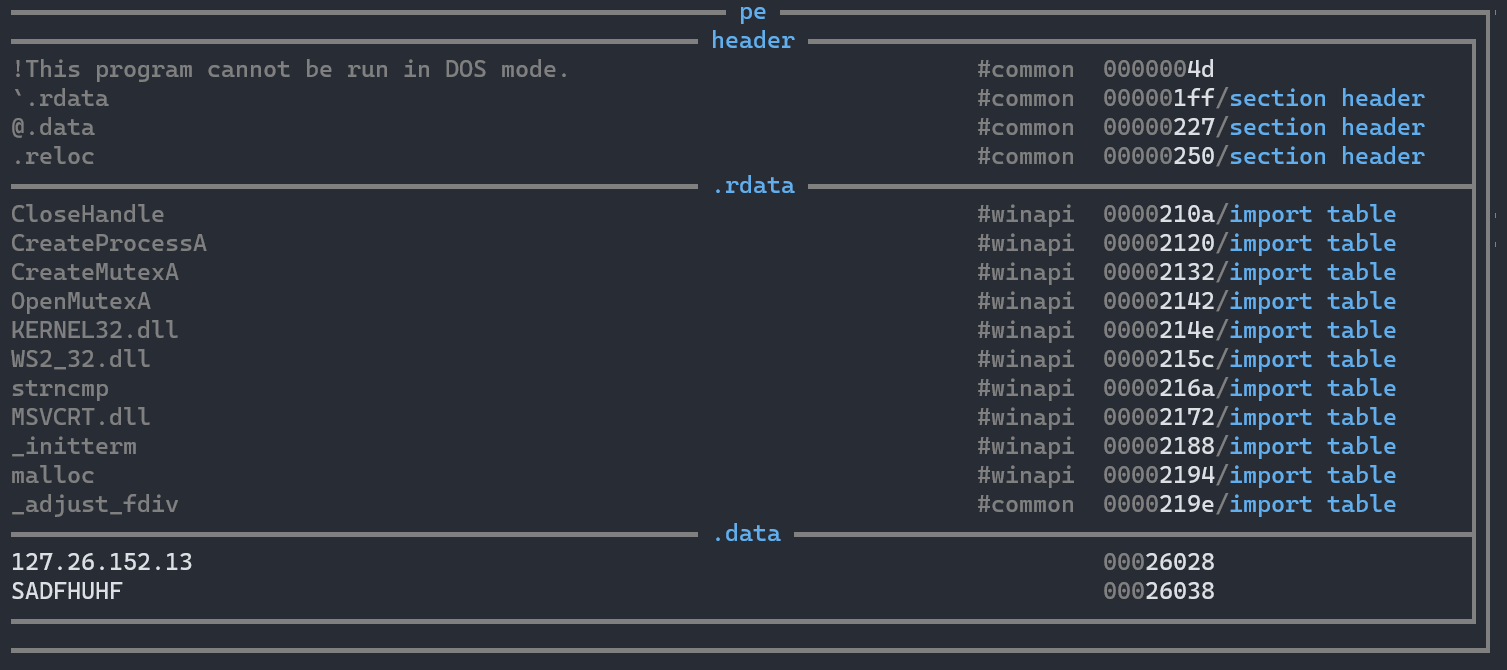
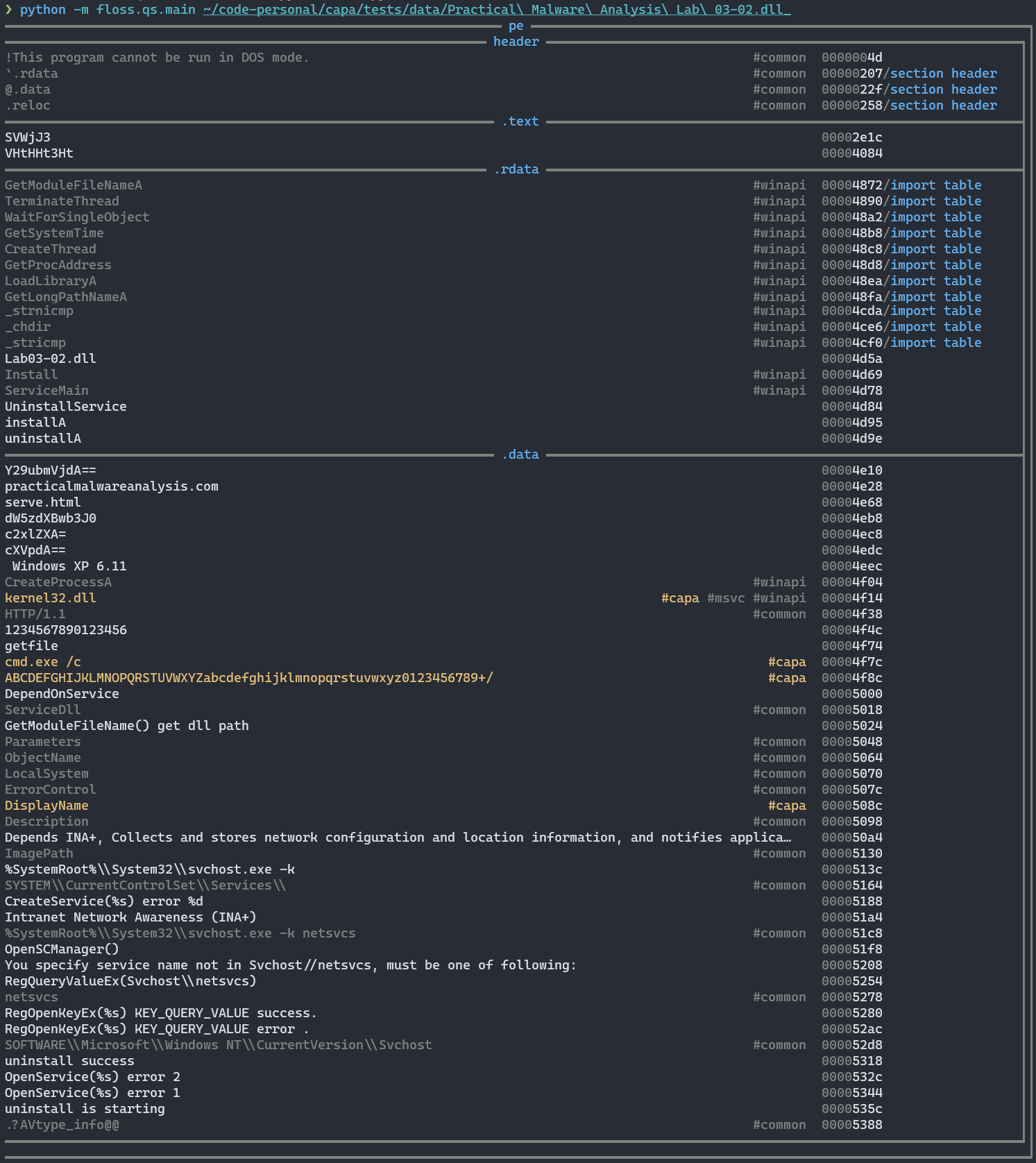
FLOSS enriches static strings by default with file structure context and tags (global prevalence, open-source libraries, expert rules, and more). Stack, tight, and decoded strings still appear after the layout-aware static listing when deobfuscation is enabled.
$ floss sample.exe
$ floss sample.exe -j
Features:
- extract ASCII and UTF-16LE strings
- show strings next to right-aligned, colored context, including tags and file offset
- render strings within PE section range delimiters
- annotate strings from known PE structures, like the import table
- don't show junk strings that overlap with instructions
- mute strings known to be globally prevalent, via an embedded database
- mute strings from popular open source libraries, via embedded databases
- highlight strings that match expert rules, via embedded databases
Tag databases and FLIRT signature files are tracked with Git LFS; contributors
cloning the repo may need Git LFS installed to fetch those files. Maintenance of
tag databases is documented in scripts/tags/README.md
and the per-database notes under floss/tags/data/.
Installation
Install this downstream distribution from PyPI or a synchronized pip mirror:
python -m pip install auriga-floss
For upstream standalone executables, use the upstream releases page: https://github.com/mandiant/flare-floss/releases
See the installation documentation for a detailed description of all methods to install FLOSS.
Usage Examples
Extract obfuscated strings from a malware binary:
$ floss malware.exe
Only extract stack and tight strings:
$ floss --string-type stack tight -- suspicious.exe
Do not extract static strings:
$ floss --no-string-type static -- backdoor.exe
Display the help/usage screens:
$ floss -h # show all supported arguments
Enable tab completion for flags, choice values, and file paths with floss --print-completion bash
(also zsh, fish); installation instructions are in doc/usage.md.
For a detailed description of using FLOSS, review the documentation here.
Scripts
FLOSS also contains additional Python scripts in the scripts directory which can be used to load its output into other tools such as Binary Ninja or IDA Pro. For detailed description of these scripts review the documentation here.
Graphical viewer
Explore floss -j output in the hosted web viewer:
upload the JSON, filter strings by search term, minimum length, tags, or
structures, and copy what you keep. You can also build it yourself into a single,
self-contained offline HTML file that opens directly in a browser, see
viewer/README.md.
Documentation
- doc/usage.md — CLI usage: extraction, filtering, rendering, and environment variables
- doc/results_document.md — the versioned JSON results schema
- doc/tags.md — the semantic tag system and its tag families
- doc/language_specific_strings.md — Go and Rust string extraction
- doc/theory.md — the deobfuscation algorithm
- doc/installation.md — all installation methods
- doc/test.md — how to build and run the test suite
- viewer/README.md — web viewer development
Mailing List
Subscribe to the FLARE mailing list for community announcements by sending an email with the subject "subscribe" to flare-external@google.com.
1 maintainer

Download files
Download the file for your platform. If you're not sure which to choose, learn more about installing packages.
Source Distribution
Built Distribution
Filter files by name, interpreter, ABI, and platform.
If you're not sure about the file name format, learn more about wheel file names.
Copy a direct link to the current filters
File details
Details for the file auriga_floss-2026.8.30.tar.gz.
File metadata
- Download URL: auriga_floss-2026.8.30.tar.gz
- Upload date:
- Size: 28.5 MB
- Tags: Source
- Uploaded using Trusted Publishing? No
- Uploaded via:
twine/7.0.0 CPython/3.12.13
File hashes
| Algorithm | Hash digest | |
|---|---|---|
| SHA256 |
3958f9b12ec9f63279dea5e5d7e7417cb00aa0d8b271f6df59dd1a579a9a0bea
|
|
| MD5 |
066e70219fa1d572c447ee8b01c74e41
|
|
| BLAKE2b-256 |
11f9047f277d917268a6c773e98f6bfc66facd7c39e4f914de95752a5aaf6fb9
|
File details
Details for the file auriga_floss-2026.8.30-py3-none-any.whl.
File metadata
- Download URL: auriga_floss-2026.8.30-py3-none-any.whl
- Upload date:
- Size: 28.5 MB
- Tags: Python 3
- Uploaded using Trusted Publishing? No
- Uploaded via:
twine/7.0.0 CPython/3.12.13
File hashes
| Algorithm | Hash digest | |
|---|---|---|
| SHA256 |
b8185e3630f90d62f3f304a671a834484d60d2d6842bcc7155a0ab7c64007c18
|
|
| MD5 |
5cab88e58ec43637b3e0887a95ae685e
|
|
| BLAKE2b-256 |
e0396d59442dcc90bb4010d9978f8595fd6deff6e829cedf71e6b58f865006a3
|













