
auto-keyword-ranker


A lightweight Python library to automatically extract and rank the most relevant keywords and keyphrases from text.
Goal: Provide a single-line call to obtain ranked keywords for articles, blog posts, or short documents. Uses TF-IDF by default, with optional re-ranking via sentence-transformer embeddings.
Installation
pip install auto-keyword-ranker
With optional embedding-based re-ranking:
pip install auto-keyword-ranker[embed]
Quickstart
from autokeyword import rank_keywords

text = """
Artificial intelligence is transforming industries by enabling new capabilities
such as natural language processing, computer vision, and advanced data analytics.
Companies across healthcare, finance, and manufacturing are investing heavily in AI
to automate decision-making, enhance efficiency, and unlock new insights from
large datasets.
"""

# Simple TF-IDF keyword ranking
keywords = rank_keywords(text, top_n=10)
print(keywords)
Output
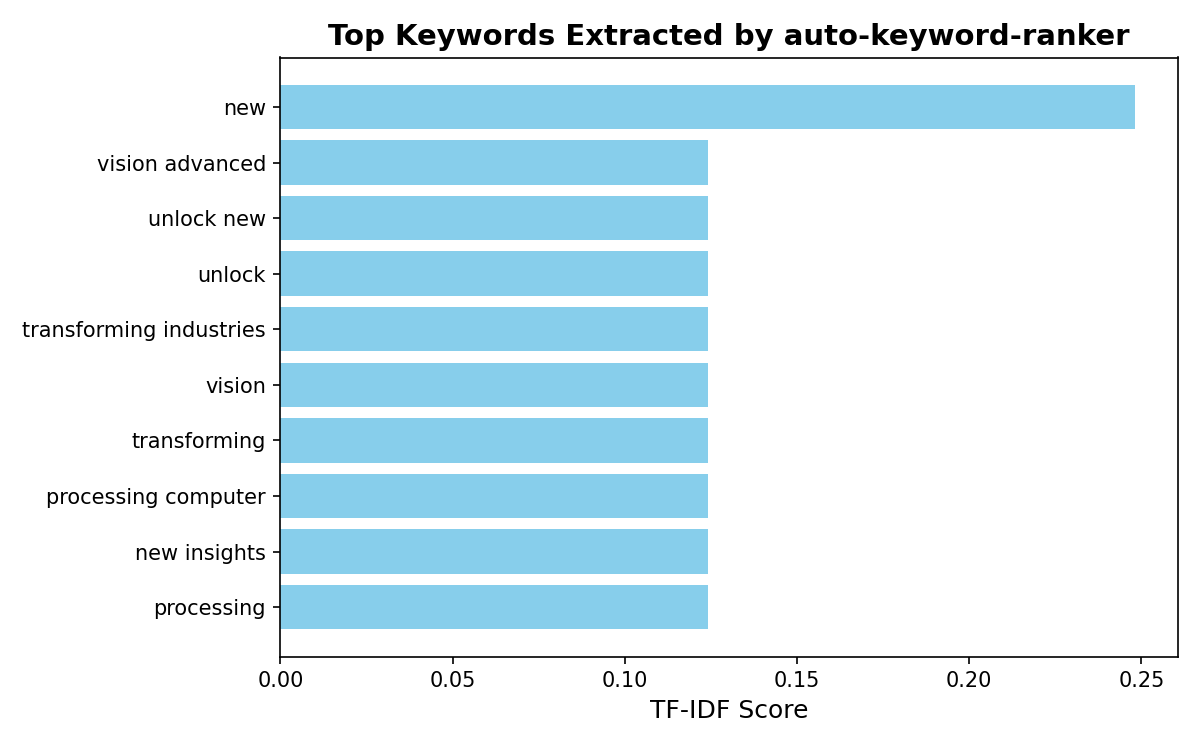
A list of (keyword, score) pairs, for example:
[('new', 0.25),
 ('vision advanced', 0.12),
 ('unlock new', 0.12),
 ('unlock', 0.12),
 ('transforming industries', 0.12),
 ('vision', 0.12),
 ('transforming', 0.12),
 ('processing computer', 0.12),
 ('new insights', 0.12),
 ('processing', 0.12)]
API
rank_keywords(
    texts,
    top_n=10,
    method='tfidf',
    ngram_range=(1,2),
    stop_words=True,
    use_embeddings=False,
    embedding_model=None,
    combine_score_alpha=0.6
)
See docstrings in core.py for full parameter descriptions.
CLI
You can also run the CLI (after installation):
python -m autokeyword.cli --text "Your article text here" --top 10
How It Works
TF-IDF scoring formula:
$$ \text{TF-IDF}(t, d) = \text{TF}(t, d) \times \log \frac{N}{1 + \text{DF}(t)} $$
Where:
- ( t ) = term
- ( d ) = document
- ( N ) = total number of documents
Use Cases
- SEO keyword extraction for blog posts
- Automatic tagging in content management systems
- Quick summarization of research papers
- Preprocessing for search or recommendation engines
License
MIT License © 2025 Reya Oberoi
1 maintainer

Metadata
1 maintainer
Release files for auto-keyword-ranker 0.1.10
For a detailed explanation of source distributions (sdists) and built distributions (wheels), please see the package formats documentation.
Source distribution (sdist)
| File | Size | Uploaded | Provenance | Actions |
|---|---|---|---|---|
| auto_keyword_ranker-0.1.10.tar.gz | 5.9 kB | Without provenance | Details for auto_keyword_ranker-0.1.10.tar.gz |
Built distribution (wheel)
| File | Interpreter | ABI | Platform | Actions Reset |
|---|---|---|---|---|
| auto_keyword_ranker-0.1.10-py3-none-any.whl | Python 3 | none | any | Details for auto_keyword_ranker-0.1.10-py3-none-any.whl |
Total release size: 12.4 kB
Release files / auto_keyword_ranker-0.1.10.tar.gz
| Download URL | auto_keyword_ranker-0.1.10.tar.gz |
|---|---|
| Size | 5.9 kB |
| Tags | Source |
|
SHA-256 checksum How to use checksums |
beefaa87f818a1e2233c1d89824338d4dd8e128ebac3624d9c22f053133e73d9
|
|
BLAKE2b-256 checksum How to use checksums |
e47b748634eb3cc5d1487f389ca4daaff44f99989f959d0b1f55cf2651e1e9a8
|
| Upload date | |
|
Uploaded using Trusted Publishing? What is trusted publishing? |
No |
| Uploaded via |
twine/6.2.0 CPython/3.10.9
|
Release files / auto_keyword_ranker-0.1.10-py3-none-any.whl
| Download URL | auto_keyword_ranker-0.1.10-py3-none-any.whl |
|---|---|
| Size | 6.5 kB |
| Tags | Python 3 |
|
SHA-256 checksum How to use checksums |
b9d707526529e754933156e3712b56da683d6f6d84cc5ece3eb7b7b9b4aa6752
|
|
BLAKE2b-256 checksum How to use checksums |
3700b1de56d31a057c5541f4e96a62acd2421c269bbd108969d826cacff3dfb2
|
| Upload date | |
|
Uploaded using Trusted Publishing? What is trusted publishing? |
No |
| Uploaded via |
twine/6.2.0 CPython/3.10.9
|
Security for auto-keyword-ranker 0.1.10
Provenance
Provenance describes where a file came from. On PyPI, provenance is shared via attestations, which provide a verifiable record of the build or publishing details. View details, limitations and caveats.
No provenance found
None of the files in this release were uploaded with provenance metadata.
A note on package security
PyPI is a repository for distributing packages, not a service for auditing them. While third-party security researchers and our staff do their best to detect and remove malicious packages, PyPI cannot guarantee the quality, security or suitability of any given package.
To learn more about protecting yourself from malicious actors, visit our package security documentation.














