
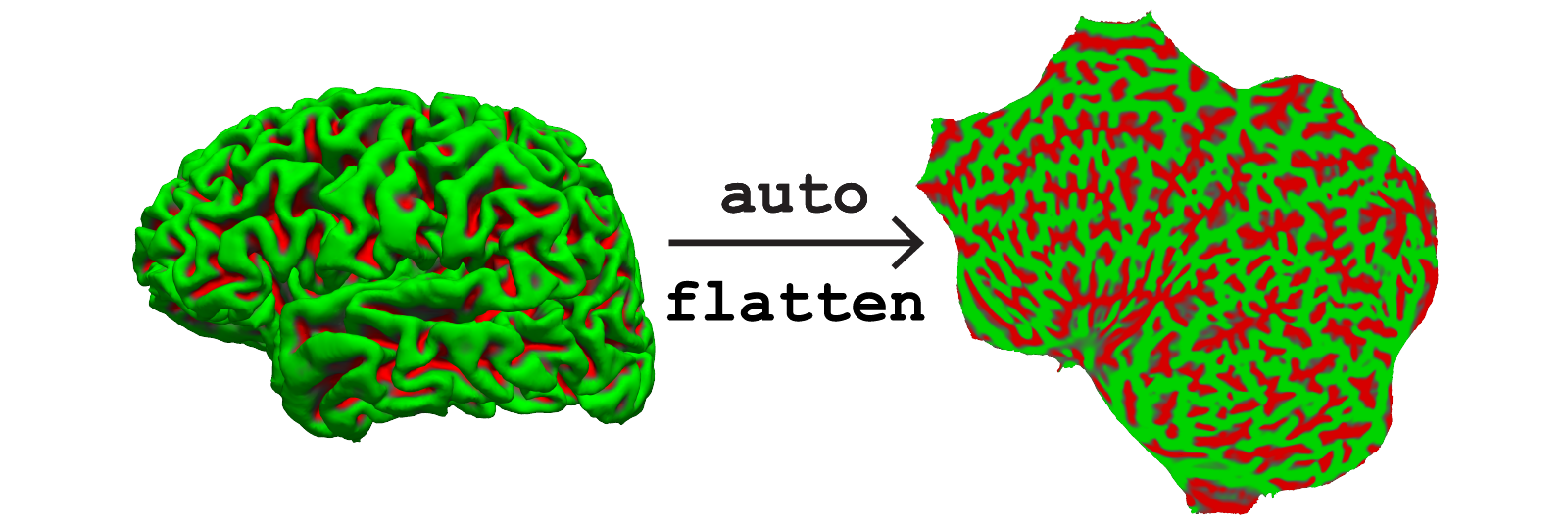






autoflatten: automatically create cortical flatmaps from FreeSurfer surfaces
autoflatten is a Python pipeline for 🌟automatically🌟 flattening cortical surfaces generated by FreeSurfer
TL;DR: run autoflatten /path/to/your/freesufer/subject; done.
Features
- Automatic cut mapping from a template to individual subjects
- Two flattening backends: JAX-accelerated pyflatten (default) or FreeSurfer's
mris_flatten - Visualization with area distortion metrics
- Animation of the flattening process — capture snapshots and render videos
Quick Start
# Install
pip install autoflatten

# Run on a FreeSurfer subject (requires FreeSurfer 6.0+ for projection)
autoflatten /path/to/subjects/sub-01
Documentation
For full documentation, usage examples, and configuration options, visit the autoflatten website.
See example outputs to preview what autoflatten produces.
Citation
If you use autoflatten in your research, please cite both autoflatten and the original FreeSurfer flattening method:
Visconti di Oleggio Castello, M., & Gallant, J. L. (2025). autoflatten: automatically create cortical flatmaps from FreeSurfer surfaces. Zenodo. https://doi.org/10.5281/zenodo.17933205
@software{visconti_di_oleggio_castello_2025_autoflatten,
  author       = {Visconti di Oleggio Castello, Matteo and Gallant, Jack L.},
  title        = {autoflatten: automatically create cortical flatmaps from FreeSurfer surfaces},
  year         = 2025,
  publisher    = {Zenodo},
  doi          = {10.5281/zenodo.17933205},
  url          = {https://doi.org/10.5281/zenodo.17933205}
}
Fischl, B., Sereno, M. I., & Dale, A. M. (1999). Cortical surface-based analysis II: Inflation, flattening, and a surface-based coordinate system. NeuroImage, 9(2), 195-207. https://doi.org/10.1006/nimg.1998.0396
@article{fischl1999cortical,
  author       = {Fischl, Bruce and Sereno, Martin I. and Dale, Anders M.},
  title        = {Cortical surface-based analysis {II}: Inflation, flattening, and a surface-based coordinate system},
  journal      = {NeuroImage},
  year         = 1999,
  volume       = 9,
  number       = 2,
  pages        = {195--207},
  doi          = {10.1006/nimg.1998.0396}
}
License
BSD 2-Clause License. See LICENSE file for details.
Acknowledgments
- Default fsaverage template cuts by Mark Lescroart and Natalia Bilenko
- Geodesic refinement step inspired by code from Bhavin Gupta and Alex Huth
1 maintainer

Metadata
1 maintainer
Release files for autoflatten 1.0.7
For a detailed explanation of source distributions (sdists) and built distributions (wheels), please see the package formats documentation.
Source distribution (sdist)
| File | Size | Uploaded | |
|---|---|---|---|
| autoflatten-1.0.7.tar.gz | 204.2 kB | Details |
Built distribution (wheel)
| File | Interpreter | ABI | Platform | Reset |
|---|---|---|---|---|
| autoflatten-1.0.7-py3-none-any.whl | Python 3 | none | any | Details |
Total release size: 412.8 kB
Release files / autoflatten-1.0.7.tar.gz
| Download URL | autoflatten-1.0.7.tar.gz |
|---|---|
| Size | 204.2 kB |
| Tags | Source |
|
SHA-256 checksum How to use checksums |
34e8a8b6650ae78af8dbbe8f4bbc0bfffd4a5dadb299386d7139e4024524b0f9
|
|
BLAKE2b-256 checksum How to use checksums |
d3d0739297e7fa924f5c556cd0ea12dfc0041fc1fba886ffae40dad0f4966ac3
|
| Upload date | |
|
Uploaded using Trusted Publishing? What is trusted publishing? |
Yes |
| Uploaded via |
twine/7.0.0 CPython/3.13.14
|
Provenance
Provenance describes where a file came from. On PyPI, provenance is shared via attestations, which provide a verifiable record of the build or publishing details. View details, limitations and caveats.


PyPI Publish Attestation
PyPI verified that this artifact, at this checksum, originated from the publisher listed below.
Signed by GitHub Actions, verified by PyPI on Sep 20, 2026.
Transparency logRelease files / autoflatten-1.0.7-py3-none-any.whl
| Download URL | autoflatten-1.0.7-py3-none-any.whl |
|---|---|
| Size | 208.6 kB |
| Tags | Python 3 |
|
SHA-256 checksum How to use checksums |
df862676ba993a116e2b352d832ed5ce016a19ac85c7cf1f3ee96e9a4e18a362
|
|
BLAKE2b-256 checksum How to use checksums |
ccc55c303087ba05c85659d8c16fcda86959af4fba1b4f1c1fdb9a685ea494d5
|
| Upload date | |
|
Uploaded using Trusted Publishing? What is trusted publishing? |
Yes |
| Uploaded via |
twine/7.0.0 CPython/3.13.14
|
Provenance
Provenance describes where a file came from. On PyPI, provenance is shared via attestations, which provide a verifiable record of the build or publishing details. View details, limitations and caveats.
PyPI Publish Attestation
PyPI verified that this artifact, at this checksum, originated from the publisher listed below.
Signed by GitHub Actions, verified by PyPI on Sep 20, 2026.
Transparency log













