
PyAutoGalaxy: Automated, Autodifferentiable and Autonomous Galaxy Modelling
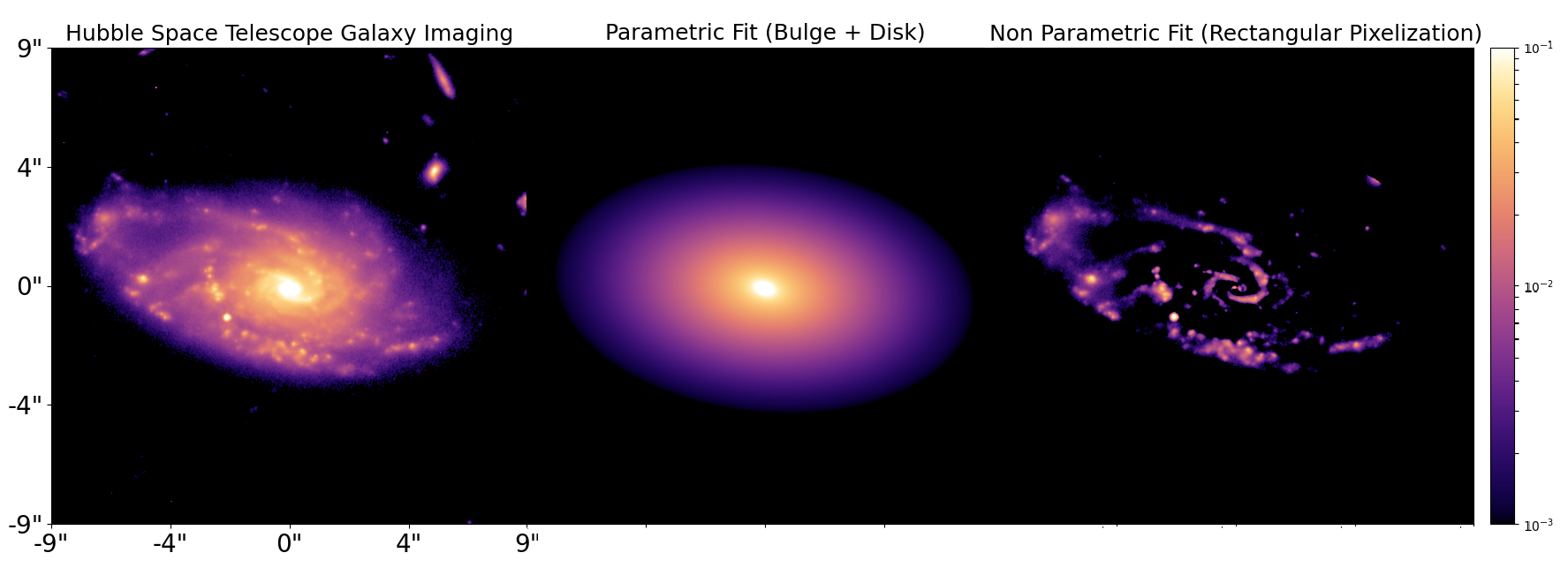
PyAutoGalaxy models galaxy structure and morphology, from bulge–disc decomposition to comparisons across wavebands. Its JAX numerical backend provides automatic differentiation and GPU acceleration, while the PyAutoGalaxy Assistant helps you develop and run analyses through conversation.
Getting Started
Explore It Yourself
- Start Here — discover PyAutoGalaxy and work through your first example.
- Try it in your browser — run the introductory notebook without installing anything.
- Install PyAutoGalaxy — get set up on your computer.
Visit the workspace to find examples for your data and science goals.
Explore with AI
The PyAutoGalaxy AI Assistant helps you learn galaxy modeling, run examples and analyse your own data through conversation. To get started, paste this prompt into your AI coding agent:
I want to study galaxy structure and morphology with PyAutoGalaxy
(https://github.com/PyAutoLabs/PyAutoGalaxy) and the
autogalaxy_assistant (https://github.com/PyAutoLabs/autogalaxy_assistant).

First clone the assistant repository, cd into it and follow its AGENTS.md.
Begin the "start here" guide for a new user.
See AI Options for tools and setup guidance.
Learn Galaxy Modeling
HowToGalaxy teaches galaxy modeling and Bayesian inference through worked notebooks, starting from undergraduate level.
The PyAutoGalaxy documentation covers the software’s features and how to use them in your own analysis.
Community and Contributing
Ask questions, suggest improvements and share your work in PyAutoLabs Discussions, or chat with us on Slack.
To contribute or explore community projects, visit the PyAutoGalaxy community page.
Citations
If you use PyAutoGalaxy in your research, see the citation guide.
License
See the license.


Release files for autogalaxy 2026.11.22.1
For a detailed explanation of source distributions (sdists) and built distributions (wheels), please see the package formats documentation.
Source distribution (sdist)
| File | Size | Uploaded | Provenance | Actions |
|---|---|---|---|---|
| autogalaxy-2026.11.22.1.tar.gz | 24.2 MB | Without provenance | Details for autogalaxy-2026.11.22.1.tar.gz |
Built distribution (wheel)
| File | Interpreter | ABI | Platform | Actions Reset |
|---|---|---|---|---|
| autogalaxy-2026.11.22.1-py3-none-any.whl | Python 3 | none | any | Details for autogalaxy-2026.11.22.1-py3-none-any.whl |
Total release size: 24.7 MB
Release files / autogalaxy-2026.11.22.1.tar.gz
| Download URL | autogalaxy-2026.11.22.1.tar.gz |
|---|---|
| Size | 24.2 MB |
| Tags | Source |
|
SHA-256 checksum How to use checksums |
dcdb5bacd65c1f1313d7caaf2fdb21f6f8a1aea23f5eeb0f239f578e7f3b2c0a
|
|
BLAKE2b-256 checksum How to use checksums |
3766b7da7692d46d758d7720bb9829ef5e5a4595d4ac9dcbd340f0263dafda71
|
| Upload date | |
|
Uploaded using Trusted Publishing? What is trusted publishing? |
No |
| Uploaded via |
twine/6.0.1 CPython/3.12.16
|
Release files / autogalaxy-2026.11.22.1-py3-none-any.whl
| Download URL | autogalaxy-2026.11.22.1-py3-none-any.whl |
|---|---|
| Size | 543.8 kB |
| Tags | Python 3 |
|
SHA-256 checksum How to use checksums |
2cae1ef5195745d00b6947ad30a8839e00337f155640c0d500f059566bfa83a6
|
|
BLAKE2b-256 checksum How to use checksums |
8e2020205cfd83208502786eb474a4e67dee8fdeb9d5ce514776732335c14f14
|
| Upload date | |
|
Uploaded using Trusted Publishing? What is trusted publishing? |
No |
| Uploaded via |
twine/6.0.1 CPython/3.12.16
|
Security for autogalaxy 2026.11.22.1
Provenance
Provenance describes where a file came from. On PyPI, provenance is shared via attestations, which provide a verifiable record of the build or publishing details. View details, limitations and caveats.
No provenance found
None of the files in this release were uploaded with provenance metadata.
A note on package security
PyPI is a repository for distributing packages, not a service for auditing them. While third-party security researchers and our staff do their best to detect and remove malicious packages, PyPI cannot guarantee the quality, security or suitability of any given package.
To learn more about protecting yourself from malicious actors, visit our package security documentation.














