autoreject



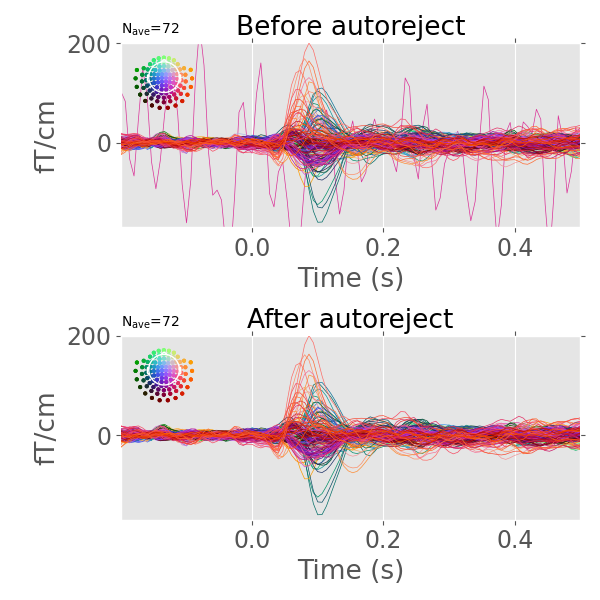
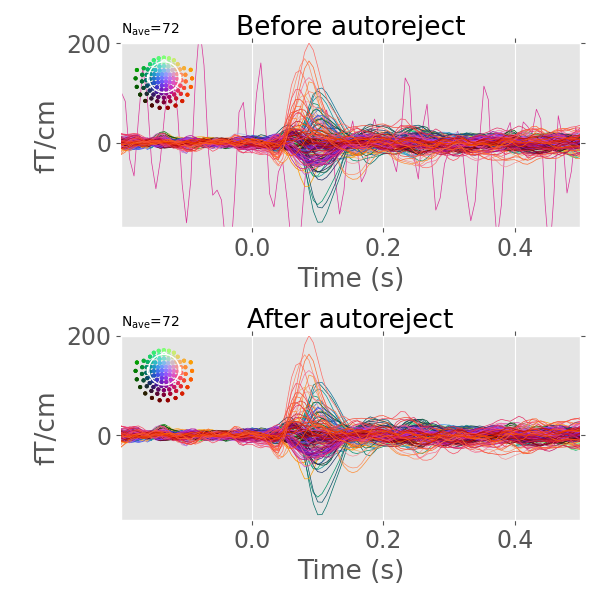
This is a library to automatically reject bad trials and repair bad sensors in magneto-/electroencephalography (M/EEG) data.
The documentation can be found under the following links:
for the stable release
for the latest (development) version
Installation
We recommend the Anaconda Python distribution and a Python version >= 3.11. We furthermore recommend that you install autoreject into an isolated Python environment. To obtain the stable release of autoreject, you can use pip:
pip install -U autoreject
Or conda:
conda install -c conda-forge autoreject
If you want the latest (development) version of autoreject, use:
pip install https://github.com/autoreject/autoreject/archive/refs/heads/main.zip
To check if everything worked fine, you can do:
python -c 'import autoreject'
and it should not give any error messages.
Below, we list the dependencies for autoreject. All required dependencies are installed automatically when you install autoreject.
mne (>=1.5.0)
numpy (>=1.21.2)
scipy (>=1.7.1)
scikit-learn (>=1.0.0)
joblib
matplotlib (>=3.5.0)
Optional dependencies are:
openneuro-py (>= 2021.10.1, for fetching data from OpenNeuro.org)
Quickstart
The easiest way to get started is to copy the following three lines of code in your script:
>>> from autoreject import AutoReject
>>> ar = AutoReject()
>>> epochs_clean = ar.fit_transform(epochs)  # doctest: +SKIP
This will automatically clean an epochs object read in using MNE-Python. To get the rejection dictionary, simply do:
>>> from autoreject import get_rejection_threshold
>>> reject = get_rejection_threshold(epochs)  # doctest: +SKIP
We also implement RANSAC from the PREP pipeline (see PyPREP for a full implementation of the PREP pipeline). The API is the same:
>>> from autoreject import Ransac
>>> rsc = Ransac()
>>> epochs_clean = rsc.fit_transform(epochs)  # doctest: +SKIP
For more details check out the example to automatically detect and repair bad epochs.
Bug reports
Please use the GitHub issue tracker to report bugs.
Cite
[1] Mainak Jas, Denis Engemann, Federico Raimondo, Yousra Bekhti, and Alexandre Gramfort, “Automated rejection and repair of bad trials in MEG/EEG”. In 6th International Workshop on Pattern Recognition in Neuroimaging (PRNI), 2016.
[2] Mainak Jas, Denis Engemann, Yousra Bekhti, Federico Raimondo, and Alexandre Gramfort. 2017. “Autoreject: Automated artifact rejection for MEG and EEG data”. NeuroImage, 159, 417-429.
3 maintainers


Metadata
3 maintainers
Release files for autoreject 0.5.2
For a detailed explanation of source distributions (sdists) and built distributions (wheels), please see the package formats documentation.
Source distribution (sdist)
| File | Size | Uploaded | Provenance | Actions |
|---|---|---|---|---|
| autoreject-0.5.2.tar.gz | 33.5 kB | Without provenance | Details for autoreject-0.5.2.tar.gz |
Built distribution (wheel)
| File | Interpreter | ABI | Platform | Actions Reset |
|---|---|---|---|---|
| autoreject-0.5.2-py3-none-any.whl | Python 3 | none | any | Details for autoreject-0.5.2-py3-none-any.whl |
Total release size: 66.5 kB
Release files / autoreject-0.5.2.tar.gz
| Download URL | autoreject-0.5.2.tar.gz |
|---|---|
| Size | 33.5 kB |
| Tags | Source |
|
SHA-256 checksum How to use checksums |
b5ad629f9a644cb851ba90754cc33fd1b97e7a8b496f996357205c69fd06eb7f
|
|
BLAKE2b-256 checksum How to use checksums |
071f4d503732f4ddd668d08a3b9b39c2a18a5a9b582279a2d4ec812ea8762a78
|
| Upload date | |
|
Uploaded using Trusted Publishing? What is trusted publishing? |
No |
| Uploaded via |
twine/7.0.0 CPython/3.14.9
|
Release files / autoreject-0.5.2-py3-none-any.whl
| Download URL | autoreject-0.5.2-py3-none-any.whl |
|---|---|
| Size | 33.0 kB |
| Tags | Python 3 |
|
SHA-256 checksum How to use checksums |
d17035621f0447caaf35f507bf337c358acf09ff4cb28ed86466ed7f0b1f814e
|
|
BLAKE2b-256 checksum How to use checksums |
ad3bf7e1bbe8505ddce1d51315713f29ab7f928cd3d1153f4a9ceabfece6440d
|
| Upload date | |
|
Uploaded using Trusted Publishing? What is trusted publishing? |
No |
| Uploaded via |
twine/7.0.0 CPython/3.14.9
|
Security for autoreject 0.5.2
Provenance
Provenance describes where a file came from. On PyPI, provenance is shared via attestations, which provide a verifiable record of the build or publishing details. View details, limitations and caveats.
No provenance found
None of the files in this release were uploaded with provenance metadata.
A note on package security
PyPI is a repository for distributing packages, not a service for auditing them. While third-party security researchers and our staff do their best to detect and remove malicious packages, PyPI cannot guarantee the quality, security or suitability of any given package.
To learn more about protecting yourself from malicious actors, visit our package security documentation.