
AutoTinker




Thinks of an idea. Tries it. Keeps what works.
A self-improving agent for tabular ML. Give AutoTinker a table and a column to predict. It writes a readable scikit-learn pipeline, runs it in a sandbox, and keeps improving it until it can show the remaining gains are just noise. You get code you own, a record of every experiment and why it was kept or rejected, and one honest score on a test split the agent never saw. Try it in the browser at autotinker.sakalya.si.
Formerly AutoTabML. v2 is a ground-up rewrite under the new name.
There are two ways to use it:
- Web app (autotinker.sakalya.si): paste a link to a CSV, watch the agents work live, steer or stop them, and download the model. Nothing to install.
- Python package (
pip install autotinker): the same engine as a CLI and an SDK, running on your machine.
Install
pip install autotinker                 # Python 3.11+
pip install "autotinker[boost]"        # + LightGBM, XGBoost, CatBoost as model options
Other extras: parquet (pyarrow, for .parquet files), openml (openml:<id> sources), kaggle (kaggle:<owner>/<dataset> sources), otel (OpenTelemetry spans). On macOS, LightGBM also needs brew install libomp. If it can't load, AutoTinker leaves it out of the allowed imports.
Quickstart
The agentic run (a free API key, or bring your own)
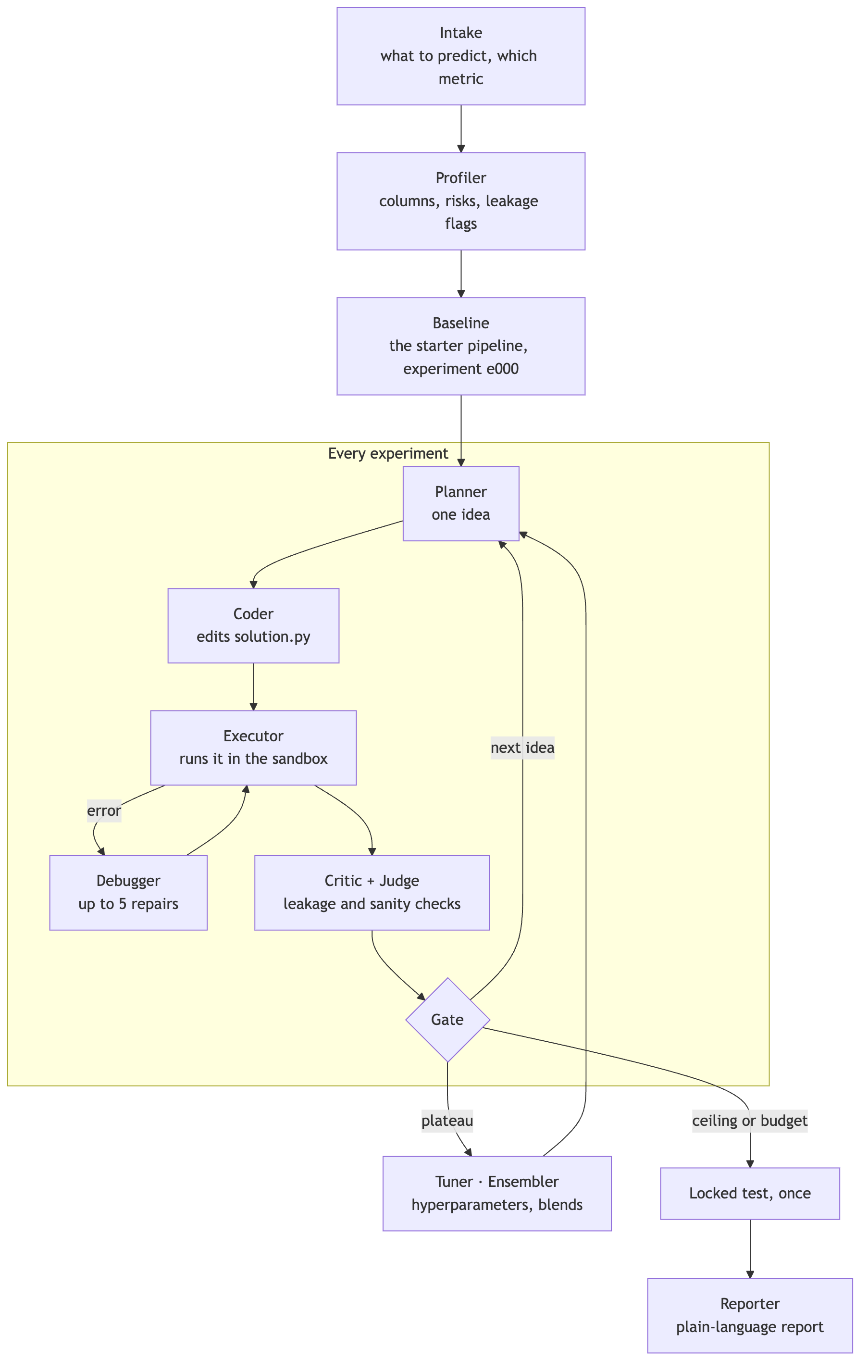
autotinker run is what the web app runs. A team of agent roles (intake, profiler, planner, coder, critic, judge, tuner, ensembler, reporter) plans, codes, debugs, tunes and ensembles, until the ceiling or a budget is reached.
export GROQ_API_KEY=...        # free: https://console.groq.com
export GEMINI_API_KEY=...      # free: https://aistudio.google.com (optional, a fallback)

autotinker run https://raw.githubusercontent.com/mwaskom/seaborn-data/master/penguins.csv \
    --target species --goal "predict the penguin species" --max-experiments 3
- Sources: an
https://link (GitHub, Google Drive / Sheets and Hugging Face share links are rewritten to direct downloads), a local.csv/.tsv/.parquetpath,openml:<id>, orkaggle:<owner>/<dataset>. - Target:
--targetis optional; if you leave it out, the intake agent picks one from your--goal. - Budgets:
--max-experiments(default 10),--max-timein seconds (default 2400) and--max-tokens(default 400 000) cap the run. - CSV format: delimiter, encoding and decimal mark are detected. Override them with
--delimiter ";"(, ; |or tab),--encoding(utf-8,utf-8-sig,cp1252,latin-1) or--decimal ",". - Other options:
--metric,--out(defaultruns/) and--seed. - Keys: read from the environment or a
.envfile in the current directory.
Which LLM it uses: free by default, or bring your own
Out of the box, run uses free tiers, so a run costs $0:
| provider | key | role |
|---|---|---|
| Groq (gpt-oss-120b) | GROQ_API_KEY |
main model for coding and reasoning |
| Gemini (Flash-Lite) | GEMINI_API_KEY |
fast calls, and the fallback when Groq's free quota runs out |
| Cerebras | CEREBRAS_API_KEY |
off by default; enable with AUTOTINKER_DISABLED_PROVIDERS="" |
Gemini's free tier may train on its inputs, so requests that contain data rows are never sent to it. Only the intake and profiler agents see sample rows; every other agent sees column summaries.
Bring any LLM and key. Pass --llm provider:model (or set AUTOTINKER_LLM) with that provider's key, and every agent uses your model instead of the free pool:
export OPENAI_API_KEY=...
autotinker run data.csv --target churn --llm openai:gpt-4.1-mini --max-cost 5

export ANTHROPIC_API_KEY=...
autotinker run data.csv --target churn --llm anthropic:claude-sonnet-5-5

# any OpenAI-compatible server: vLLM, LM Studio, a company gateway, ...
AUTOTINKER_LLM_API_KEY=... autotinker run data.csv --llm "compat:my-model@https://llm.example.com/v1"

# a local model with Ollama, no key at all
autotinker run data.csv --llm ollama:qwen3:14b
--llm |
key | endpoint |
|---|---|---|
openai:<model> |
OPENAI_API_KEY |
api.openai.com |
anthropic:<model> |
ANTHROPIC_API_KEY |
Anthropic's OpenAI-compatible API |
groq:<model> |
GROQ_API_KEY |
api.groq.com |
gemini:<model> |
GEMINI_API_KEY |
Gemini's OpenAI-compatible API |
openrouter:<model> |
OPENROUTER_API_KEY |
openrouter.ai (hundreds of models behind one key) |
together:<model> |
TOGETHER_API_KEY |
api.together.xyz |
mistral:<model> |
MISTRAL_API_KEY |
api.mistral.ai |
deepseek:<model> |
DEEPSEEK_API_KEY |
api.deepseek.com |
cerebras:<model> |
CEREBRAS_API_KEY |
api.cerebras.ai |
ollama:<model> |
none | localhost:11434 (override with OLLAMA_BASE_URL) |
compat:<model>@<base_url> |
AUTOTINKER_LLM_API_KEY (optional) |
any OpenAI-compatible server |
- Tool calling: the judge agent uses tool (function) calling, so pick a model that supports it. Current hosted models from these providers do; for a local model, choose one with tool support.
- A cheaper second model:
--fast-llm provider:model(orAUTOTINKER_FAST_LLM) serves the quick, low-stakes calls, while--llmhandles planning and coding. - Spending cap: a run stops at $0.50 of actual spend by default. A paid model may reach that before the experiment budget, so raise it with
--max-cost 5when you use one. Free tiers (Groq, Gemini, Cerebras) count as $0, and other models are priced at list price when known. - Your data: the intake and profiler agents send your model a few sample rows, as they do with Groq. Set
AUTOTINKER_NO_ROWS=1to send column summaries only, with any provider. - What's been run live: Groq and Gemini, natively and through
compat:. The others speak the same OpenAI-compatible API and are covered by tests that mock their HTTP responses.
Offline, no API key: evolve
autotinker evolve is the single-agent hill-climbing loop. With --llm heuristic it needs no LLM at all: an offline proposer mutates the pipeline from a fixed bank of ideas, and runs are labelled that way.
autotinker evolve https://raw.githubusercontent.com/mwaskom/seaborn-data/master/penguins.csv \
    --target species --llm heuristic --max-experiments 5
autotinker replay runs/<run-id>            # the experiment ledger and the stop report
evolve stops when the ceiling is reached (--until ceiling, the default) or at a budget: --max-experiments (default 50), --max-cost in USD (default 5), or --max-time. --gate naive keeps any improvement, autoresearch-style, for ablations.
To use an LLM, pass --llm provider:model, for example anthropic:claude-sonnet-5-5 (ANTHROPIC_API_KEY), openai:gpt-4o-mini (OPENAI_API_KEY), groq:<model> (GROQ_API_KEY), openrouter:<model> (OPENROUTER_API_KEY), or compat:<model>@<base_url> for any OpenAI-compatible server. Without --llm, evolve uses Anthropic if ANTHROPIC_API_KEY is set and the offline proposer otherwise. Unlike run, evolve doesn't read .env, and --target is required.
Python SDK
import pandas as pd
from autotinker import AutoTinker, load_run

at = AutoTinker(llm="heuristic", workdir="runs")      # or "anthropic:claude-sonnet-5-5", "groq:…", …
run = at.evolve("train.csv", target="variety", max_experiments=20, until="ceiling")

run.leaderboard        # DataFrame: every experiment, CV mean ± SE, select score, decision, reason
run.best.code          # the winning solution.py
run.stop_report        # which ceiling signals fired, with numbers
run.test_score         # the locked test split, scored once (oriented: higher is better)
run.predict(new_df)    # refit the best pipeline in-process and predict (runs the generated code unsandboxed)
run.export("model/")   # solution.py, train.py, requirements.txt, profile.json, run.json, README.md
load_run("runs/<run-id>")   # reload a finished run
The agentic loop is autotinker.api.agentic_run, the function the run command calls (it needs a provider key):
from autotinker.api import agentic_run

run = agentic_run("data.csv", target="price", goal="predict the sale price", max_experiments=10)
run = agentic_run("data.csv", target="price", llm="openai:gpt-4.1-mini")   # bring your own model
What you get
Every run writes a directory under runs/<run-id>/:
run.json: the replayable record: every experiment's code, diff, scores, decision and reason, plus tokens and cost. Inspect it withautotinker replay.events.jsonl: the typed event stream (schema).ledger.jsonl: one line per experiment.best_solution.py: the winningbuild_pipeline(profile).
An agentic run also writes report.json (a plain-language summary of what was tried and why) and assets/:
model.joblib: the final model, fitted on dev + select and scored once on the test split.predict.py: a standalone script,python predict.py new_rows.csv -o predictions.csv. It writes predictions and, for classifiers, class probabilities.pipeline.py: the final solution source.requirements.txt: the exact library versions the model was trained with.model_card.json: the target, metric, classes, feature columns with dtypes, and the test score.
evolve doesn't write assets/; use Run.export() for a standalone project instead.
How it works
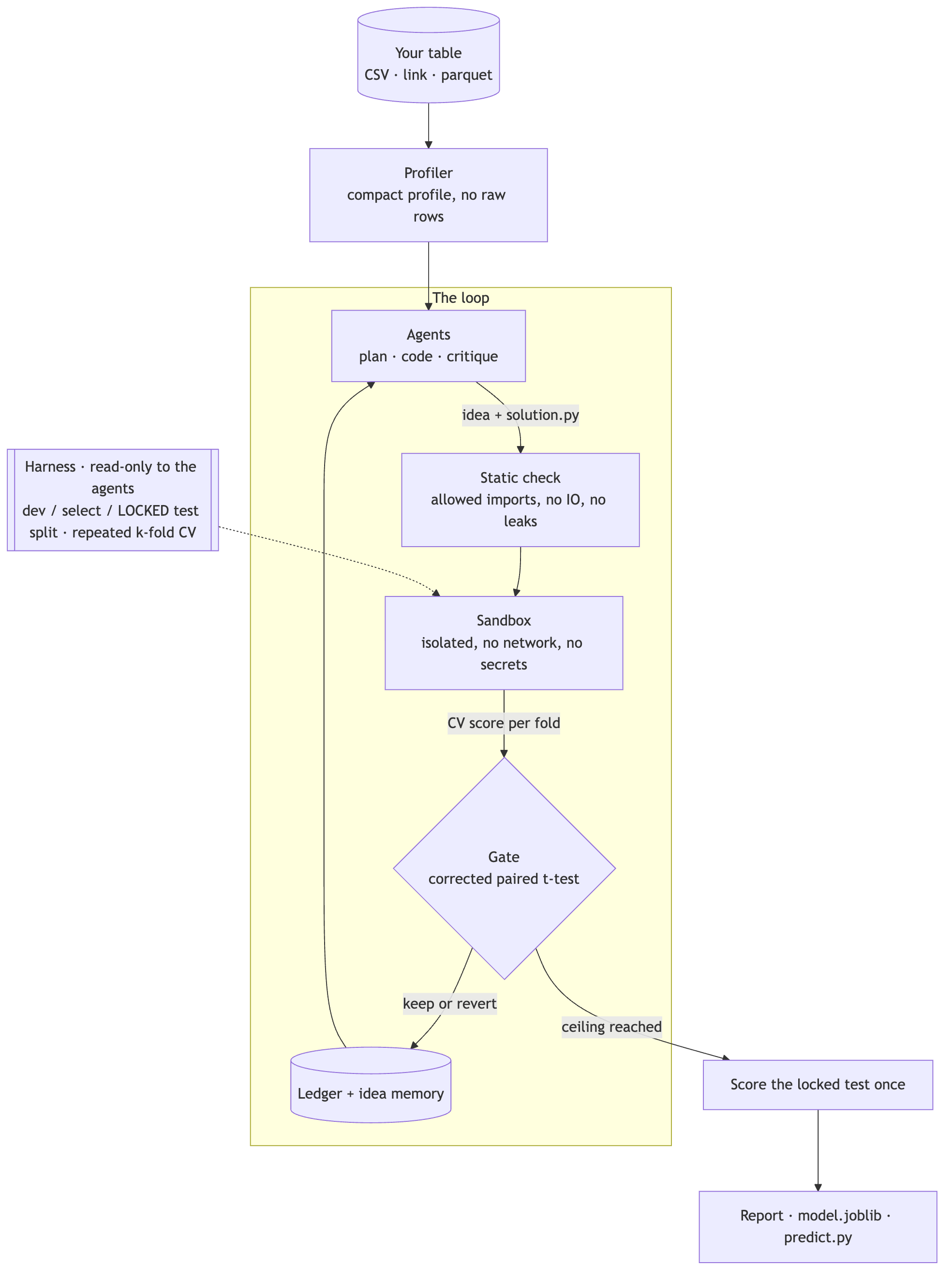
It takes the loop from Karpathy's autoresearch (a fixed harness, one file the agent may edit, keep or revert, repeat) and applies it to tabular data. It adds the two things that loop lacks:
- A keep/revert rule that doesn't overfit. A change is kept only if it wins a corrected paired t-test across identical CV folds. The gain must also be bigger than the noise, and the change must not get worse on a separate selection holdout.
- A principled stopping point. The loop stops when the "ceiling" signals agree that more experiments won't help, and writes a report explaining why.
A locked test split is scored once, at the very end. The optimism gap (selection score minus test score) shows how much the loop fooled itself.
The agentic run splits the agent into roles. Each experiment goes through the same path, and the loop ends with one look at the locked test:
| Part | What it does |
|---|---|
| Profiler | Column types, missing values, cardinality, skew, target balance, and flags for ID-like or leaky columns. Agents work from this summary, not the table. |
| Solution contract | The agent edits one file, solution.py, which defines build_pipeline(profile) -> sklearn estimator. The harness does all fitting and scoring, so the agent never touches the data files and can't score its own splits. |
| Static check | AST checks against an import allowlist. They block file and network IO, eval/exec, dunder tricks, and .fit calls outside the pipeline (a common cause of leakage). |
| Sandbox | A separate process group with a wall-clock timeout, a memory watchdog, network blocked, an environment with no secrets, and a fresh temp directory. The worker returns only predictions; labels for the select and test splits never leave the parent process. |
| Gate | Keep only if all three hold: the Nadeau–Bengio corrected paired t-test gives p < 0.1; the gain is at least 0.5 × the best's CV SE; and the select holdout doesn't get worse. A simplicity rule also keeps "same score, clearly simpler or faster" changes. |
| Stop rule | Stop when all of these fire: (1) recent kept gains are below the CV SE; (2) a fitted a − b·e^(−ct) curve predicts less than one SE of remaining gain; (3) K radical attempts since the last keep have failed; (4) the score is within ε of an external reference, if one is given. Budgets always cap the run. |
| Observability | Every step emits a typed JSONL event; every run writes a replayable run.json. OpenTelemetry spans with the otel extra. |
The web app (and self-hosting it)
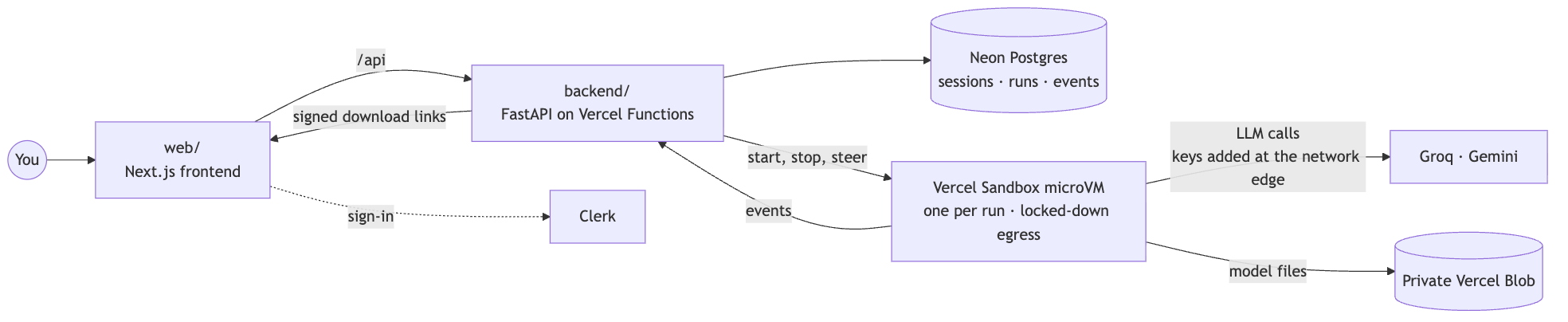
The live site is two Vercel services deployed together from the root vercel.json:
web/: a frontend-only Next.js app. Paste a link to a CSV, watch a live run, steer it and stop it, download the model; or watch a recorded run (score chart with the noise band, the ledger with code diffs, the stop report). Sign-in is Clerk.backend/: a FastAPI service for sessions, runs, the SSE event stream and link previews, on Neon Postgres. On Vercel each run is a Vercel Sandbox microVM with locked-down network egress. In local development a run is a local engine process.
uv sync && uv sync --project backend && (cd web && npm install)
make migrate      # apply backend/migrations to DATABASE_URL (repo-root .env)
make dev          # API on :8000, web on :3000
Configuration: backend/.env.example and web/README.md.
Benchmarks
benchmarks/run.py compares four systems on the same splits: the starter pipeline, evolve with the statistical gate, evolve with the naive gate (both a fixed 40 experiments), and evolve stopping at the ceiling.
First results (offline heuristic proposer, one seed, small datasets). Treat them as a smoke test, not evidence. Full table: benchmarks/results/heuristic.md.
| dataset (rows) | metric | starter | evolve, stat gate (40) | evolve, naive gate (40) | evolve, until ceiling |
|---|---|---|---|---|---|
| iris + NAs (150) | log loss ↓ | 0.167 | 0.107 | 0.074 | 0.107 (stopped at 21) |
| housing (545) | RMSE ↓ | 1.09M | 0.996M | 0.919M | 1.00M (stopped at 19) |
| breast cancer (569) | ROC-AUC ↑ | 0.983 | 0.994 | 0.993 | 0.994 (stopped at 37) |
| wine (178) | log loss ↓ | 0.051 | 0.019 | 0.059 | 0.023 (stopped at 15) |
| diabetes (442) | RMSE ↓ | 70.7 | 66.0 | 60.4 | 65.3 (stopped at 12) |
What this does and doesn't show:
- Evolving beats the starter on every dataset, on a test split the loop never saw.
- The ceiling rule used 104 experiments in total instead of 200 (48% fewer), with test scores that matched or nearly matched the 40-experiment statistical-gate runs.
- The statistical gate does not yet beat the naive gate. Naive wins on 3 of 5 datasets. A heuristic proposer mostly makes small hyperparameter tweaks; the naive gate builds up many small gains that the strict gate rejects. On datasets this small, single-split test scores are themselves noisy, which is also why many optimism gaps are negative.
The proper test needs larger datasets (OpenML), several seeds, an LLM proposer and strong baselines. That is benchmark v1, Phase 3 of the roadmap. Reproduce the table from a clone: uv run python benchmarks/run.py --llm heuristic --max-experiments 40 (about 25 minutes on a laptop CPU).
Develop
uv sync && uv run pytest -q && uv run ruff check src tests benchmarks && uv run mypy
cd backend && uv sync && uv run pytest -q && uv run ruff check . && uv run mypy      # needs postgres or TEST_DATABASE_URL
cd web && npm ci && npm run lint && npm test && npm run build
The diagrams in this README are Mermaid. PyPI can't render Mermaid, so the package page uses README.pypi.md, generated from this file with each diagram as an image. After editing a diagram or this README, run python tools/readme_assets.py render and python tools/readme_assets.py pypi; a test fails if they're out of date.
The layout: src/autotinker/{data,harness,agent,evolve,obs}, api.py (SDK), cli.py; backend/ (FastAPI); web/ (Next.js); benchmarks/; schema/ (generated JSON Schemas).
Further reading: the roadmap, how releases are published, and the changelog.
Author
Built by Sakalya Mitra.
License
MIT
1 maintainer

Metadata
1 maintainer
Release files for autotinker 0.2.0
For a detailed explanation of source distributions (sdists) and built distributions (wheels), please see the package formats documentation.
Source distribution (sdist)
| File | Size | Uploaded | |
|---|---|---|---|
| autotinker-0.2.0.tar.gz | 141.5 kB | Details |
Built distribution (wheel)
| File | Interpreter | ABI | Platform | Reset |
|---|---|---|---|---|
| autotinker-0.2.0-py3-none-any.whl | Python 3 | none | any | Details |
Total release size: 307.9 kB
Release files / autotinker-0.2.0.tar.gz
| Download URL | autotinker-0.2.0.tar.gz |
|---|---|
| Size | 141.5 kB |
| Tags | Source |
|
SHA-256 checksum How to use checksums |
06bb45ba0d90c5f969dbab5a3cf0a219511d4d4c7699273cc684cf1ba261546d
|
|
BLAKE2b-256 checksum How to use checksums |
a567ad9a58b699c5bf0ab411a3b3f19672d41a8fd6ac0076288253bb1feb16e8
|
| Upload date | |
|
Uploaded using Trusted Publishing? What is trusted publishing? |
Yes |
| Uploaded via |
twine/7.0.0 CPython/3.13.14
|
Provenance
Provenance describes where a file came from. On PyPI, provenance is shared via attestations, which provide a verifiable record of the build or publishing details. View details, limitations and caveats.


PyPI Publish Attestation
PyPI verified that this artifact, at this checksum, originated from the publisher listed below.
Signed by GitHub Actions, verified by PyPI on Oct 10, 2026.
Transparency logRelease files / autotinker-0.2.0-py3-none-any.whl
| Download URL | autotinker-0.2.0-py3-none-any.whl |
|---|---|
| Size | 166.4 kB |
| Tags | Python 3 |
|
SHA-256 checksum How to use checksums |
9e6c98f5a608c9c2751461e8f6331415c42e6018ccf9be279769c438b1fb2ab0
|
|
BLAKE2b-256 checksum How to use checksums |
deed664c5bd770ce6fe9e382282313f48880b2713bda70e6876e3562e91bd79a
|
| Upload date | |
|
Uploaded using Trusted Publishing? What is trusted publishing? |
Yes |
| Uploaded via |
twine/7.0.0 CPython/3.13.14
|
Provenance
Provenance describes where a file came from. On PyPI, provenance is shared via attestations, which provide a verifiable record of the build or publishing details. View details, limitations and caveats.
PyPI Publish Attestation
PyPI verified that this artifact, at this checksum, originated from the publisher listed below.
Signed by GitHub Actions, verified by PyPI on Oct 10, 2026.
Transparency log












