















Welcome to aws_stepfunction Documentation
Why this Library?
aws_stepfunction provides AWS StepFunction developer a “smooth”, “interruption free”, “enjoyable” development experience.
If your mind set matches most of the following, aws_stepfunction is the right tool for you:
I love the AWS StepFunction Visual Editor
I love Python
I don’t want to spent much time learning the Amazon State Machine JSON DSL (Domain Specific Language)
I can’t memorize the code syntax
I respect code readability and maintainability
Talk is cheap, show me the code
The following code snippet is an equivalent of the below Workflow in the Visual Editor
import aws_stepfunction as sfn
from boto_session_manager import BotoSesManager

# Declare a workflow object
workflow = sfn.Workflow(comment="The power of aws_stepfunction library!")

# Define some tasks and states
task_invoke_lambda = sfn.actions.lambda_invoke(func_name="stepfunction_quick_start")
succeed = sfn.Succeed()
fail = sfn.Fail()

# Orchestrate the Workflow
(
    workflow.start_from(task_invoke_lambda)
    .choice([
        (  # define condition
            sfn.not_(sfn.Var("$.body").string_equals("failed!"))
            .next_then(succeed)
        ),
        (  # define condition
            sfn.Var("$.body").string_equals("failed!")
            .next_then(fail)
        ),
    ])
)

# Declare an instance of State Machine
state_machine = sfn.StateMachine(
    name="stepfunction_quick_start",
    workflow=workflow,
    role_arn="arn:aws:iam::111122223333:role/my_lambda_role",
)

# Deploy state machine
bsm = BotoSesManager(profile_name="my_aws_profile", region_name="us-east-1")
state_machine.deploy(bsm)

# Execute state machine with custom payload
state_machine.execute(bsm, payload={"name": "alice"})

# delete step function
state_machine.delete(bsm)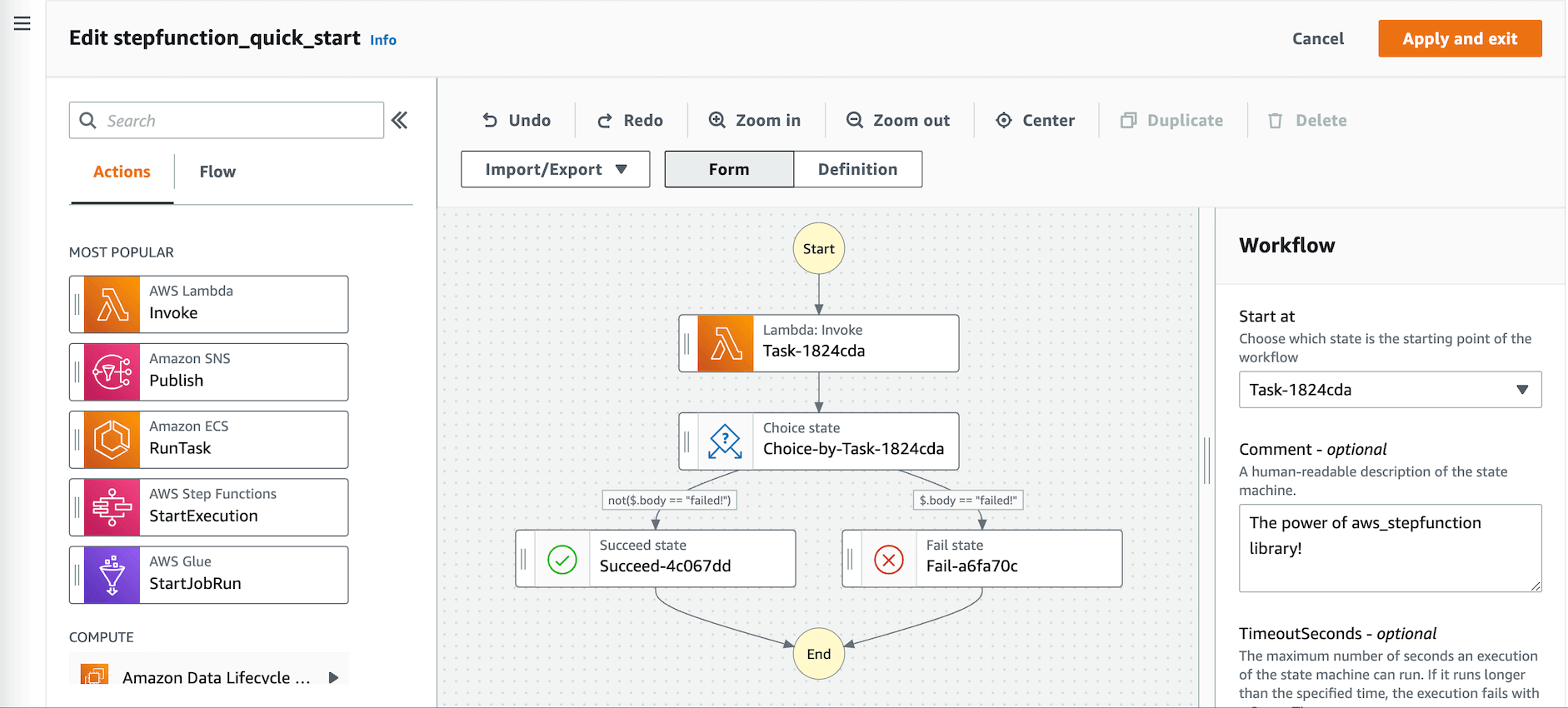
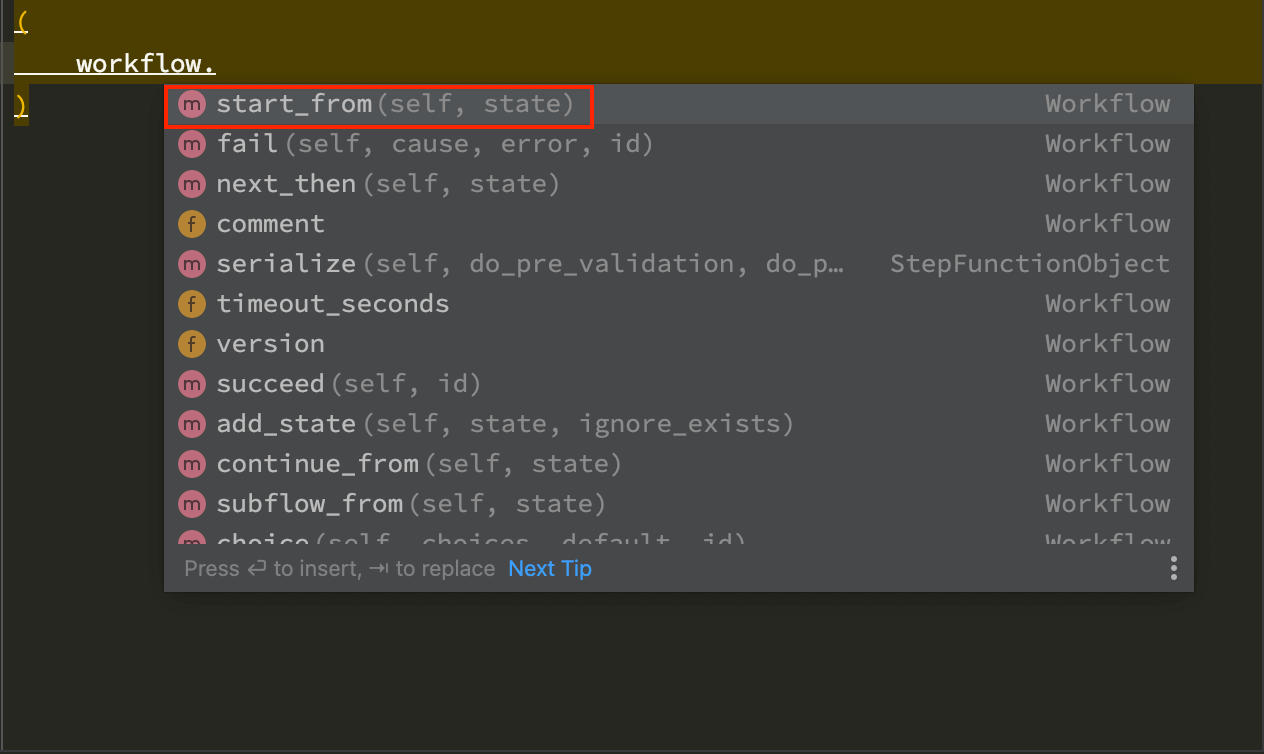
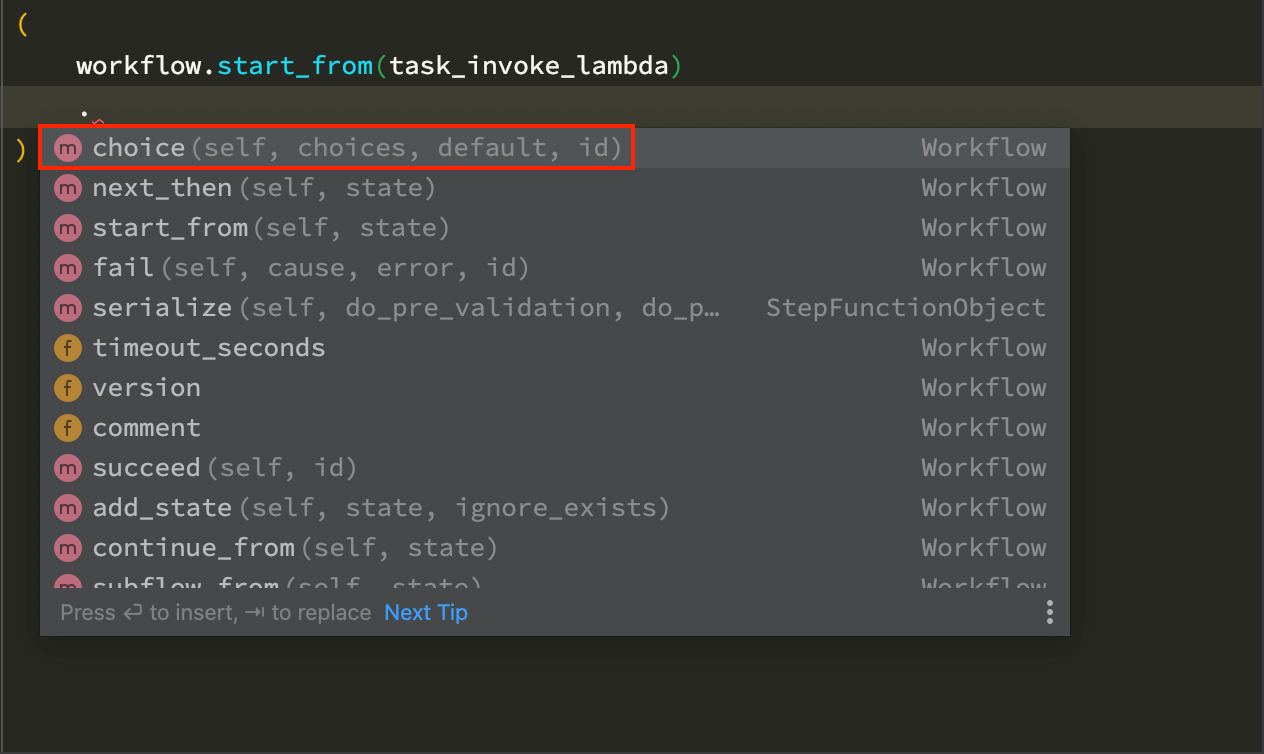
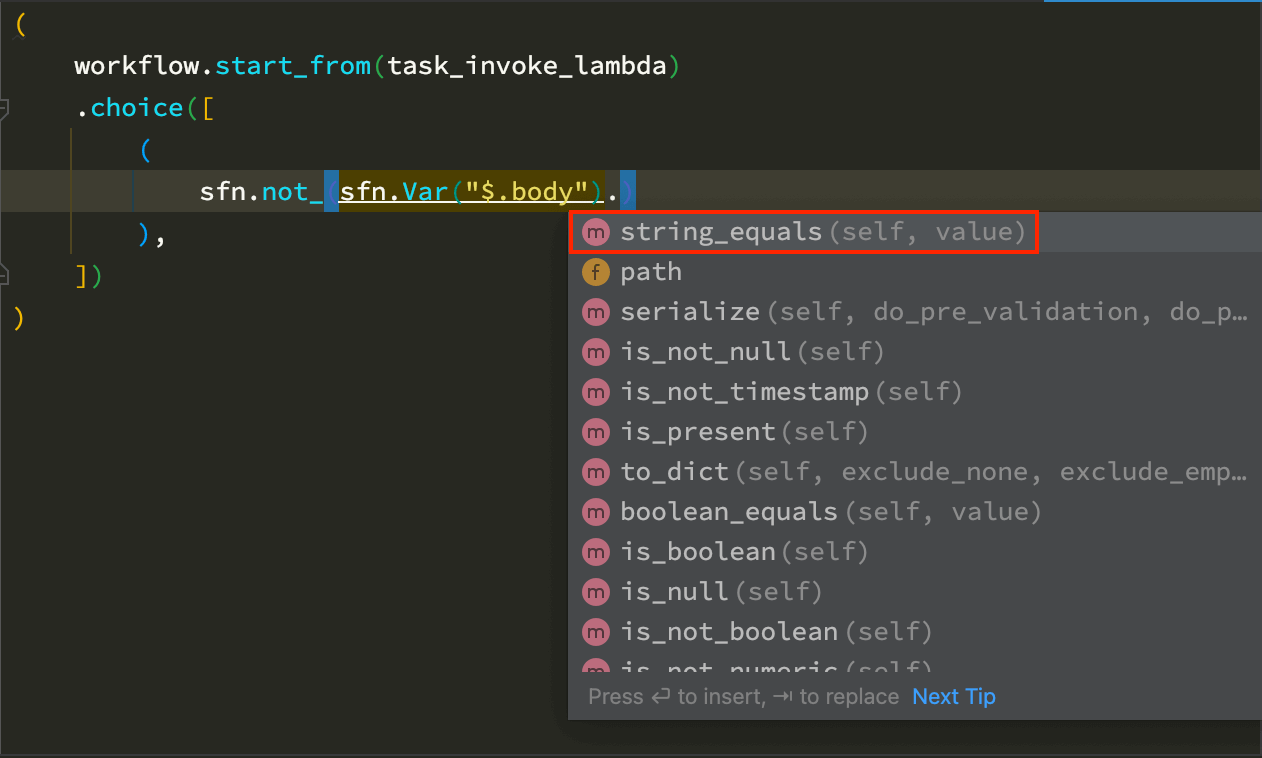
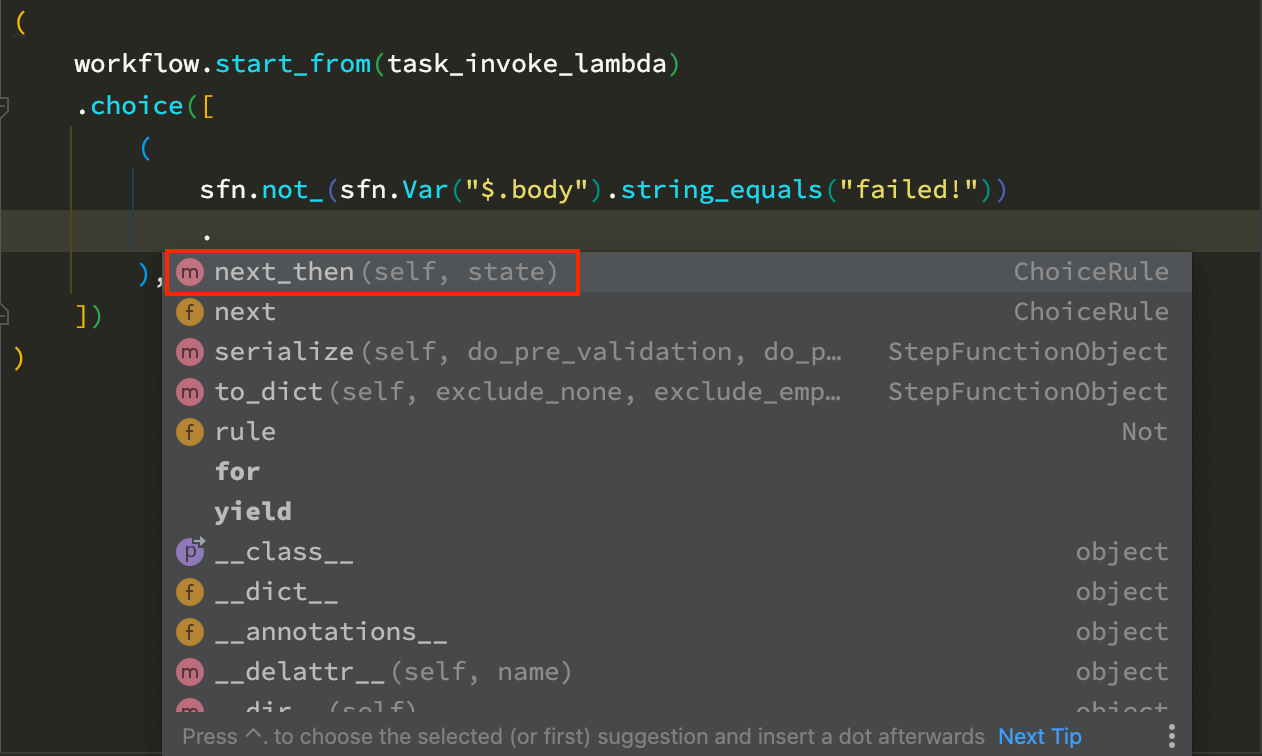
You mentioned “Smooth Development Experiment”?
I guess “a picture is worth a thousand words”:
Install
aws_stepfunction is released on PyPI, so all you need is:
$ pip install aws_stepfunctionTo upgrade to latest version:
$ pip install --upgrade aws_stepfunction1 maintainer

Metadata
1 maintainer
Release files for aws-stepfunction 0.0.5
For a detailed explanation of source distributions (sdists) and built distributions (wheels), please see the package formats documentation.
Source distribution (sdist)
| File | Size | Uploaded | Provenance | Actions |
|---|---|---|---|---|
| aws_stepfunction-0.0.5.tar.gz | 41.9 kB | Without provenance | Details for aws_stepfunction-0.0.5.tar.gz |
Built distribution (wheel)
| File | Interpreter | ABI | Platform | Actions Reset |
|---|---|---|---|---|
| aws_stepfunction-0.0.5-py2.py3-none-any.whl | Python 3, Python 2 | none | any | Details for aws_stepfunction-0.0.5-py2.py3-none-any.whl |
Total release size: 88.2 kB
Release files / aws_stepfunction-0.0.5.tar.gz
| Download URL | aws_stepfunction-0.0.5.tar.gz |
|---|---|
| Size | 41.9 kB |
| Tags | Source |
|
SHA-256 checksum How to use checksums |
d544b12d89595f613c53a15d0381f4461cc465bc30191ba3d7cbab1798700509
|
|
BLAKE2b-256 checksum How to use checksums |
6c10a958b4ddf893271a21711ffdf8a71ff99e85973ce912d38adc17136780a1
|
| Upload date | |
|
Uploaded using Trusted Publishing? What is trusted publishing? |
No |
| Uploaded via |
twine/4.0.1 CPython/3.8.11
|
Release files / aws_stepfunction-0.0.5-py2.py3-none-any.whl
| Download URL | aws_stepfunction-0.0.5-py2.py3-none-any.whl |
|---|---|
| Size | 46.3 kB |
| Tags | Python 2 Python 3 |
|
SHA-256 checksum How to use checksums |
a0fc8e34fc567dca74b286b773af05a4c0808c4b5d830335e0ba247a2461196d
|
|
BLAKE2b-256 checksum How to use checksums |
299acf650e58e86467453484dfb749bbf2a2631a5ddc920176ee3894dd7d62c9
|
| Upload date | |
|
Uploaded using Trusted Publishing? What is trusted publishing? |
No |
| Uploaded via |
twine/4.0.1 CPython/3.8.11
|
Security for aws-stepfunction 0.0.5
Provenance
Provenance describes where a file came from. On PyPI, provenance is shared via attestations, which provide a verifiable record of the build or publishing details. View details, limitations and caveats.
No provenance found
None of the files in this release were uploaded with provenance metadata.
A note on package security
PyPI is a repository for distributing packages, not a service for auditing them. While third-party security researchers and our staff do their best to detect and remove malicious packages, PyPI cannot guarantee the quality, security or suitability of any given package.
To learn more about protecting yourself from malicious actors, visit our package security documentation.














