
Axiolex



Centralized tool discovery and execution gateway for AI clients, coding tools, enterprise applications, copilots, and agents.
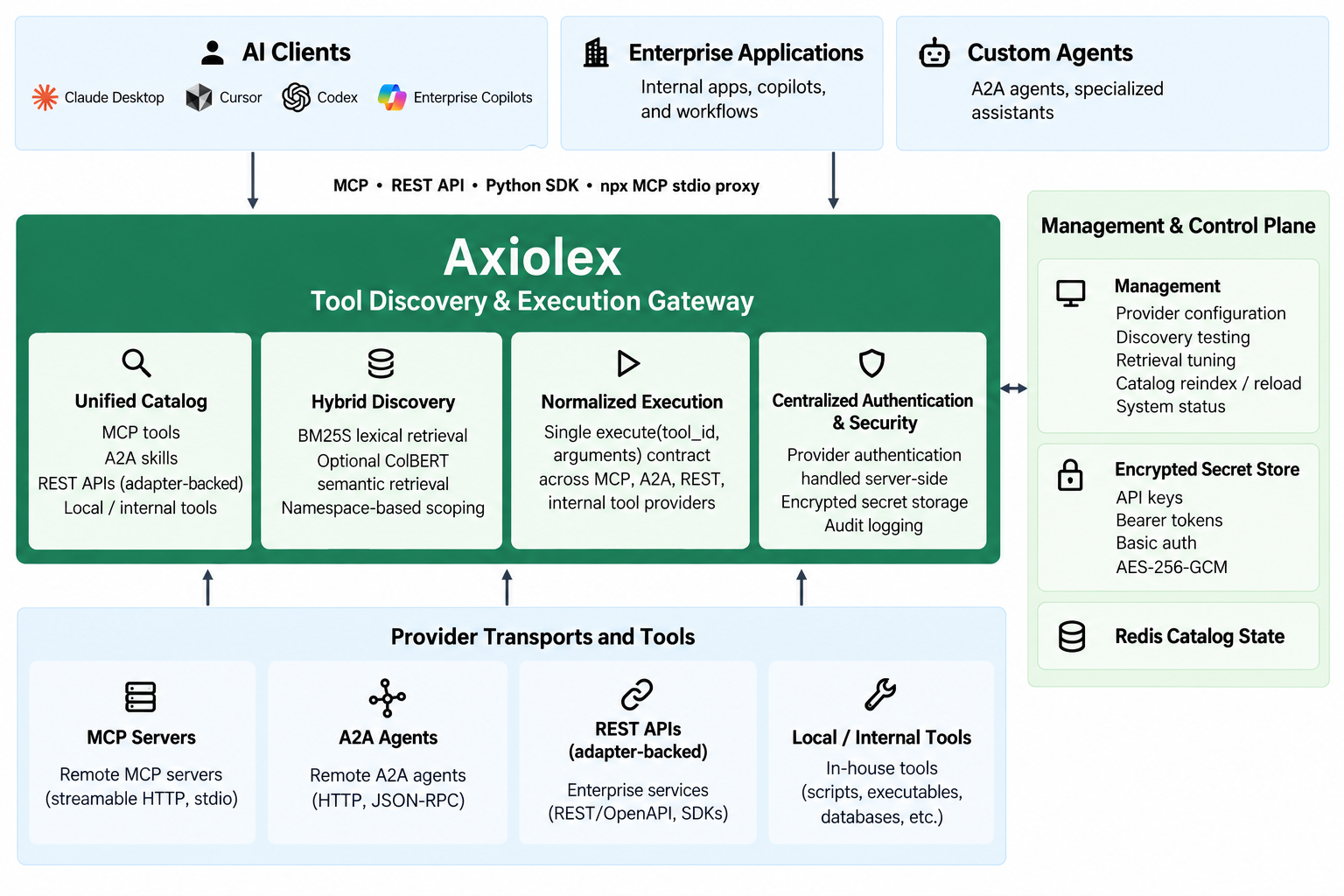
Axiolex connects MCP tools, A2A agent skills, REST APIs, and internal enterprise services through a shared catalog and execution layer. Claude Desktop, Cursor, Codex, Microsoft Copilot, enterprise applications, and custom agents can access relevant capabilities without configuring every downstream provider, endpoint, or credential directly.
- Unified Tool Catalog: index MCP tools, A2A skills, REST APIs, and local/internal tools in one searchable catalog.
- Intent-Driven Discovery: rank the Top-K relevant tools using BM25S and optional ColBERT, with namespace-based business-domain scoping.
- Normalized Execution: use one
execute(tool_id, arguments)contract while Axiolex handles transport, endpoint resolution, authentication, and response normalization. - Enterprise Provider Integration: connect MCP servers and A2A agents directly; REST-based providers integrate through MCP adapters (included example:
atlassian_rest_to_mcpJira adapter). - Flexible Access: Python SDK (
pip install axiolex), REST API, and MCP access — including the stdio MCP gateway proxy vianpx(@axiolex/mcp-gateway) for Claude Desktop and Cursor integration. - Management Dashboard: configure providers, namespaces, credentials, retrieval settings, and test discovery and execution from the web UI.
Why Axiolex?
As tool catalogs grow, loading every tool definition into every AI client becomes expensive and difficult to manage.
Anthropic documented a five-server setup with 58 tools consuming ~55K tokens before the conversation starts, with Jira alone accounting for ~17K tokens in that example. Anthropic: Advanced Tool Use
Whether for a power user connecting multiple MCP servers or an enterprise team exposing internal tools and services to AI agents and applications, Axiolex provides:
- Relevant tools only: a small ranked Top-K set instead of the full catalog.
- Focused tool selection: fewer competing capabilities for the LLM to evaluate.
- Centralized integration: connect providers once rather than maintaining them across individual clients and applications.
- Governed execution: normalize stdio, HTTP, and A2A behind one gateway with server-side authentication and audit logging; REST-only systems integrate through MCP adapters.
Axiolex Tool Catalog
Axiolex organizes tools, MCP services, A2A endpoints, and internal services by business domain so discovery can be scoped to the parts of the enterprise relevant to a user query or application request.
| User query | Search scope |
|---|---|
| "Show which business units have the largest variance between forecast and actual revenue." | Finance |
| "Check whether the Acme Inc NDA covers product evaluation." | Legal |
| "What health insurance options are available for dependents?" | HR Employee Services |
"Explain what is driving the predicted supplier lead time up for SAMSUNG_HBM3e_LINES." |
Supply Chain |
| "Which deals expected to close this quarter are still waiting for contract approval?" | Sales + Legal |
A calling application or AI client can use single-scope discovery, multi-scope discovery, or full-catalog discovery, depending on the request.
Axiolex represents these search scopes as namespaces, such as
finance,legal,sales,hr.recruiting,hr.employee_services, andsupply_chain. A request can search one namespace, multiple namespaces, or the full catalog.
How AI Clients and Applications Use Axiolex
Applications and AI clients discover and execute tools dynamically using query intent and optional namespace scoping.
User Request --> Query Intent + Optional Scope --> axiolex_discover_tools() --> Top-K Relevant Tools
Access surfaces
The same Axiolex catalog, discovery engine, and execution layer are available through:
- MCP tools:
list_namespaces(),axiolex_discover_tools(),axiolex_execute_tool() - REST API:
POST /discover,POST /execute - Python SDK:
results = client.discover(
    query="contract approval status",
    namespaces=["legal"],
    top_k=7,
)
Integration patterns
Enterprise applications: custom applications can control their own orchestration and use Axiolex for discovery and execution.
AI clients and agents: Claude Desktop, Cursor, Codex, copilots, and custom agents can discover and execute tools without loading the full enterprise tool inventory into the client.
Full-catalog discovery: when a workflow needs to search across all available domains, omit the namespace filter.
results = client.discover(
    query="analyze supplier lead-time risk for MICRON_HBM3E in Q4 2026",
)
Retrieval guidance
Multi-domain scoping: search multiple namespaces when one request spans related business areas.
results = client.discover(
    query="deals waiting for contract approval",
    namespaces=["sales", "legal"],
)
Compound requests: when a prompt contains distinct tasks, the calling LLM or application can decompose it into focused discovery queries.
"Show open HR roles and summarize Q3 revenue variance"
       ├──> discover("open engineering roles", namespaces=["hr"])
       └──> discover("Q3 revenue variance", namespaces=["finance"])
Query expansion: conversational requests can be translated into more retrieval-specific intent before discovery.
"How is Apple doing lately?"
       ↓
"Apple AAPL recent stock price performance and market data"
       ↓
axiolex_discover_tools(...)
Axiolex ranks the query it receives; it does not rewrite, expand, decompose, or orchestrate the request. Execution sequencing also remains with the caller, including workflows such as discover → execute → discover.
For details on catalog synchronization, tools/list_changed, and discovery evaluation, see the Technical Architecture.
Unified Tool Execution: One Contract, Any Transport
Axiolex executes discovered tools through a single contract:
execute(tool_id, arguments)
The caller does not manage downstream endpoints, authentication, or transport mechanics. Axiolex resolves them server-side and returns a normalized response shape:
{ "content": [], "is_error": false }
Axiolex currently supports MCP Streamable HTTP, MCP stdio, and A2A directly. REST-only enterprise systems can participate through adapters that expose them through a supported execution path.
Protocol and provider normalization
| Aspect | MCP Streamable HTTP | MCP stdio | A2A |
|---|---|---|---|
| Discovery | tools/list over MCP session |
tools/list over subprocess stdio |
GET /.well-known/agent-card.json |
| Catalog unit | MCP tool with inputSchema |
MCP tool with inputSchema |
A2A skill mapped to tool with prompt input |
| Execution | tools/call over HTTP/SSE |
tools/call over stdio pipes |
JSON-RPC 2.0 SendMessage |
| Required header | Mcp-Session-Id |
— | A2A-Version: 1.0 |
| Session | Stateful | Stateful | Stateless |
| Response | CallToolResult with content[] |
CallToolResult with content[] |
Task with artifacts[].parts[].text |
| Arguments | Structured key-value matching schema | Structured key-value matching schema | Natural-language prompt as text part |
| Execution mode | Synchronous | Synchronous | Synchronous within UPSTREAM_TIMEOUT |
The caller sees the same Axiolex execution contract regardless of the underlying protocol.
Provider configuration examples
Configure remote MCP servers, A2A agents, and local stdio MCP servers in source_files/mcp_providers.yaml:
# 1. Remote MCP server
- id: tavily_mcp
  name: Tavily
  transport: streamable-http
  endpoint: https://mcp.tavily.com/mcp
  auth:
    type: api_key
    key_param: tavilyApiKey
    secret_env: TAVILY_API_KEY
  enabled: true
  namespaces: ["research.web"]

# 2. A2A agent
- id: veris_finance_a2a
  name: Veris Finance Research
  transport: a2a
  endpoint: http://localhost:8100/agents/veris-finance-research-agent/
  auth:
    type: none
  enabled: true
  namespaces: ["veris.research"]

# 3. REST-only enterprise system via stdio MCP adapter
- id: jira
  name: Jira
  transport: stdio
  command: python
  args: ["stdio_servers/jira/atlassian_rest_to_mcp.py"]
  auth:
    type: basic
    key_param: api_key
    secret_env: JIRA_API_TOKEN
    username: ${JIRA_USERNAME}
  enabled: true
  namespaces: ["product_management"]
The Jira example uses the atlassian_rest_to_mcp adapter to expose a REST-only enterprise system through the same Axiolex discovery and execution path. The same adapter pattern can be used for other REST-based systems.
End-to-end example
from axiolex import Axiolex

client = Axiolex("http://localhost:9700")

# Discover
tools = client.discover("financial research on Nvidia", top_k=5)

# Execute
result = client.execute(
    "veris_finance_a2a:financial_research",
    {"prompt": "What was Nvidia revenue in 2024?"}
)

for item in result["result"]["content"]:
    print(item["text"])
A2A execution is currently synchronous: Axiolex sends the request, waits within the configured timeout, and returns a normalized response. Long-running asynchronous task workflows are a future extension.
For full architecture details, see docs/technical_architecture.md and docs/api-reference.md.
Integration Surfaces & Client Access
Applications and AI clients access Axiolex through three front-door surfaces. All three use the same catalog, discovery engine, and execution layer.
Python application  ──►  Python SDK  ──┐
                                       │
HTTP application    ──►  REST API   ──┼──►  Axiolex Server  ──►  Catalog, Discovery & Execution
                                       │
AI client / agent   ──►  MCP Server ──┘
Access options
| Capability | Python SDK | REST API | MCP Interface |
|---|---|---|---|
| List namespaces | client.list_namespaces() |
GET /namespaces |
list_namespaces() |
| Discover tools | client.discover(...) |
POST /discover |
axiolex_discover_tools(...) |
| Execute tool | client.execute(...) |
POST /execute |
axiolex_execute_tool(...) |
Python SDK
For Python applications, orchestration pipelines, and batch workflows.
from axiolex import Axiolex

client = Axiolex("http://localhost:9700")

tools = client.discover(
    "get stock earnings",
    namespaces=["finance"],
    top_k=5,
)

result = client.execute(
    tools["tools"][0]["tool_id"],
    {"symbol": "AAPL"},
)
The PyPI package is a thin HTTP client — no Redis, ColBERT, or server-side ML dependencies are required on the client.
REST API
Language-agnostic access for enterprise applications, microservices, and non-Python clients.
curl -X POST http://localhost:9700/discover \
  -H "Content-Type: application/json" \
  -d '{"query": "contract approval status", "namespaces": ["legal"]}'
MCP interface
Claude Desktop, Cursor, Codex, and compatible AI clients can connect directly to Axiolex through MCP.
Streamable HTTP:
{
  "mcpServers": {
    "axiolex": {
      "url": "http://localhost:9700/mcp"
    }
  }
}
For clients requiring stdio, use the @axiolex/mcp-gateway proxy:
{
  "mcpServers": {
    "axiolex": {
      "command": "npx",
      "args": [
        "-y",
        "@axiolex/mcp-gateway",
        "--endpoint",
        "http://localhost:9700/mcp"
      ]
    }
  }
}
The proxy is available through npx and requires no local Axiolex Python installation.
Control plane boundary
Provider registration, namespace management, index refreshes, and credential configuration are administrative functions managed through the Axiolex Web UI, REST administration endpoints, or CLI rather than client-facing discovery and execution interfaces.
Namespace Model
Namespaces organize tools by business domain and define which capabilities are eligible for discovery when a scope is supplied.
| Namespace | Capability area |
|---|---|
finance |
Financial planning, forecasting, reporting, revenue, costs, and related finance capabilities |
legal |
Contracts, agreements, legal review, and related legal capabilities |
sales |
Opportunities, accounts, pipeline, and related sales capabilities |
hr.recruiting |
Recruiting, open roles, candidates, requisitions, and hiring workflows |
hr.employee_services |
Benefits, insurance, leave, compensation, payroll, and employee support |
supply_chain |
Suppliers, procurement, inventory, logistics, and related supply-chain capabilities |
A tool can belong to multiple namespaces. A request can search one namespace, multiple namespaces, or the full catalog. When namespaces are supplied, they form a hard discovery boundary; only tools within those scopes are eligible for ranking.
User Request
     ↓
Query Intent + Optional Namespace Scope
     ↓
Eligible Tool Set
     ↓
BM25S + Optional ColBERT
     ↓
Ranked Top-K Tools
     ↓
Application / AI Client
The calling application, LLM, or orchestrator decides which returned tools are added to model context or executed.
Multi-domain and multi-step requests
For a request spanning multiple domains, the caller can either search multiple namespaces together or decompose the request into focused discovery calls.
"Show open orders from Acme for HBM3E memory
and check whether Acme is covered under a current NDA."
                    ↓
            LLM / Orchestrator
                    ↓
"Find open Acme orders for HBM3E memory"
    → sales
    → axiolex_discover_tools(...)

"Check current NDA coverage for Acme"
    → legal
    → axiolex_discover_tools(...)
Conversational requests can also be expanded into more retrieval-specific intent before discovery.
Axiolex does not rewrite, decompose, or orchestrate the request itself. It ranks tools against the query and namespace scope it receives. Execution sequencing also remains with the caller, including workflows such as discover → execute → discover.
Retrieval Engine & Schema Contracts
Axiolex ranks tools within the eligible namespace scope using BM25S lexical retrieval with optional ColBERT semantic retrieval, returning a normalized relevance score from 0.0 to 1.0.
Query Intent
    ↓
Namespace Scope
    ↓
BM25S + Optional ColBERT
    ↓
Ranked Top-K Tools
Retrieval mode, ranking weights, and ColBERT configuration are deployment settings. See the Application Reference for tuning details.
Discovery result contract
axiolex_discover_tools() and POST /discover return execution-ready tool specifications with runtime metadata, input schemas, and relevance scores.
{
  "query": "market quote",
  "tools": [
    {
      "tool_id": "aina_markets:get_stock_quote",
      "name": "get_stock_quote",
      "description": "Get the latest stock quote (current price) for a single symbol.",
      "params": {
        "symbol": { "type": "string", "description": "A single US stock ticker symbol." }
      },
      "inputSchema": {
        "type": "object",
        "properties": {
          "symbol": { "type": "string" }
        }
      },
      "endpoint": "http://localhost:9001/mcp",
      "transport": "streamable-http",
      "provider": "aina_markets",
      "namespaces": ["finance.market_data"],
      "rank": 1,
      "relevance_score": 0.63,
      "bm25_score": 1.46,
      "colbert_score": 20.78,
      "hybrid_score": 0.63
    }
  ],
  "count": 1,
  "search_mode": "hybrid"
}
Execution contract
Tool execution through axiolex_execute_tool() or POST /execute requires only the stable tool_id returned during discovery and arguments matching the tool schema.
| Field | Type | Required | Description |
|---|---|---|---|
tool_id |
string | Yes | Stable Axiolex identifier returned during discovery |
arguments |
object | Yes | Arguments validated against the current tool schema |
idempotency_key |
string | No | Optional client key for request de-duplication |
timeout_ms |
integer | No | Execution timeout override, subject to the server limit |
{
  "status": "success",
  "tool_id": "aina_markets:get_stock_quote",
  "execution_id": "55a735b2bfea4d7593890511d5162297",
  "result": {
    "content": [
      {
        "type": "text",
        "text": "AAPL: $224.23 (+1.2%)"
      }
    ]
  },
  "error": null
}
Standardized execution errors
Axiolex normalizes execution failures across supported transports.
| Error code | Description | Retryable |
|---|---|---|
TOOL_NOT_FOUND |
tool_id does not resolve in the current catalog |
No |
TOOL_UNAVAILABLE |
Tool transport is disabled or unavailable | No |
INVALID_ARGUMENTS |
Arguments failed schema validation | No |
UPSTREAM_TIMEOUT |
Downstream provider exceeded the execution timeout | Yes |
UPSTREAM_ERROR |
Downstream provider returned a runtime error | Depends |
RATE_LIMITED |
Axiolex or downstream provider rate limit reached | Yes |
INTERNAL_ERROR |
Server-side execution failure | Yes |
Observability and artifact metadata
Discovery and execution activity can be logged for routing diagnostics, security review, and relevance evaluation.
Captured metadata includes:
- query and namespace scope
- ranked Top-K candidates and relevance scores
- execution latency
- caller identifiers
- tool and provider identifiers
Tools that produce visual or structured artifacts can also return artifact-aware metadata so host applications can route rendered output to the UI while keeping compact semantic results in the LLM context.
Install & Quick Start
Axiolex runs as a shared FastAPI service backed by Redis for catalog state.
1. Install locally
git clone https://github.com/vrraj/axiolex.git
cd axiolex

make install
make start
This installs Axiolex with BM25 lexical retrieval and starts Redis and the Axiolex services.
For optional ColBERT semantic retrieval:
make colbert
Then enable hybrid retrieval in .env:
AXIOLEX_HYBRID_ENABLED=true
The dashboard is available at:
http://localhost:9700/
2. Run with Docker
make docker-up
Verify the service:
curl http://localhost:9700/status
ColBERT model cache can be bind-mounted through AXIOLEX_COLBERT_CACHE_HOST_DIR so model downloads persist across container rebuilds.
3. Connect an AI client
Axiolex exposes MCP at:
http://localhost:9700/mcp
Claude Desktop, Cursor, Codex, and other MCP-compatible clients can connect directly through Streamable HTTP or through the @axiolex/mcp-gateway stdio proxy.
See Integration Surfaces & Client Access for configuration examples.
4. Use the Python SDK
from axiolex import Axiolex

client = Axiolex("http://localhost:9700")

tools = client.discover(
    query="contract approval status",
    namespaces=["legal"],
    top_k=5,
)
5. Use the REST API
curl -X POST http://localhost:9700/discover \
  -H "Content-Type: application/json" \
  -d '{"query": "contract approval status", "namespaces": ["legal"]}'
Optional installation extras
| Extra | Command | Purpose |
|---|---|---|
server |
pip install "axiolex[server]" |
FastAPI, Uvicorn, BM25S, Redis, MCP SDK, cryptography |
colbert |
pip install "axiolex[colbert]" |
FastEmbed, ONNX Runtime, NumPy, ColBERT hybrid retrieval |
dev |
pip install "axiolex[dev]" |
pytest, black, ruff |
ColBERT is optional.
make installprovides a working BM25-based server. Runmake colbertand enableAXIOLEX_HYBRID_ENABLED=trueto add semantic retrieval.
Web UI & Operational Control
The Axiolex Web UI (default: http://localhost:9700) provides a control plane for managing providers, maintaining the tool catalog, evaluating discovery quality, tuning retrieval, and monitoring system health.
Provider Registration & Access
Manage MCP providers (stdio and Streamable HTTP), A2A agents, and local tool definitions from a single interface.
- Register, edit, enable, disable, and refresh providers.
- Configure transport, endpoints, authentication, and namespace assignments.
- Manage Basic auth, Bearer tokens, and API keys through AES-256-GCM encrypted secret storage.
- Create, edit, and assign namespaces to define business-domain discovery boundaries.
Catalog Management
Maintain the catalog as provider definitions change.
- Reindex the catalog to rebuild BM25S and ColBERT retrieval indexes.
- Reload catalog state from cache.
- Inspect provider tools, schemas, namespace assignments, and catalog version.
Tool Discovery & Testing
Test how Axiolex resolves real user and application requests before exposing changes to AI clients and agents.
- Run natural-language discovery queries across single, multiple, or full-catalog scopes.
- Adjust namespace scope,
top_k, and hybrid-search behavior. - Inspect ranked tools, relevance scores, schemas, and provider metadata.
Retrieval Evaluation & Tuning
Evaluate retrieval quality and tune ranking behavior across the catalog.
- Compare BM25S lexical retrieval with ColBERT semantic retrieval.
- Adjust temperature, softmax cutoff, and
top_k. - Inspect rank and relevance-score behavior across namespaces and query types.
System Status
Monitor operational state from the same interface.
- Service health
- Document count
- Retriever status
- Hybrid search status
The Web UI operates against the same Axiolex REST API and catalog used by the Python SDK and MCP interface.

Security Overview
Axiolex separates security into two boundaries: clients accessing Axiolex and Axiolex accessing downstream providers.
┌─────────────────┐    Authenticated Boundary    ┌─────────────────┐    Server-Side Secrets    ┌──────────────────┐
│ Client / Agent  │ ───────────────────────────► │ Axiolex Gateway │ ───────────────────────► │ Provider / Tool  │
│ Claude / Cursor │   OAuth / OIDC / mTLS / Keys │                 │    Service Credentials   │ Jira / Tavily ... │
└─────────────────┘                              └─────────────────┘                          └──────────────────┘
Client Access
Client authentication is handled at the enterprise deployment boundary (reverse proxy, API gateway, or service mesh) using mechanisms such as OAuth/OIDC, mTLS, or API keys. Axiolex does not enforce client authentication in the current release; the FastAPI middleware layer is extensible to add authentication directly when needed.
Consuming applications and AI clients never receive downstream provider credentials.
Downstream Provider Credentials
Axiolex resolves and injects provider credentials server-side.
- Encrypted secret store: secrets are stored in
source_files/mcp_secrets.encusing AES-256-GCM encryption. The master key is supplied throughAXIOLEX_SECRET_MASTER_KEY. - Credential resolution: Axiolex checks configured environment variables first and falls back to the encrypted secret store.
- Runtime injection: provider credentials are injected only when needed for execution, including into stdio provider processes through environment variables where applicable.
- Redaction: credentials are stripped from logs, REST payloads, and Redis metadata.
Provider Auth Types
The following authentication methods are currently supported and applied based on provider transport:
| Auth Type | MCP HTTP | MCP stdio | A2A |
|---|---|---|---|
| API Key | ✅ Appends to URL query | ✅ Passed as env var | ✅ Appends to URL query |
| Bearer Token | ✅ Authorization: Bearer header |
✅ Passed as env var | ✅ Authorization: Bearer header |
| Basic Auth | ❌ | ✅ Username + token as env vars | ❌ |
| None | ✅ | ✅ | ✅ |
The auth adapter layer is extensible — additional methods such as OAuth client credentials or AWS Signature v4 can be added without changing the discovery or execution contracts.
Identity & Credential Model
| Dimension | Current Phase | Future Phase |
|---|---|---|
| Provider credentials | Centralized service account per provider | Per-user credential mapping or delegated OAuth |
| Client configuration | Axiolex server connection only | Axiolex server connection only |
| User authentication | Enterprise boundary | Enterprise boundary |
| Downstream audit identity | Shared service account | Individual user identity |
The current model supports centrally governed enterprise service accounts. Per-user delegated identity and token exchange are future extensions.
For provider authentication configuration and secret-store details, see the Technical Architecture.
API Reference
Interactive OpenAPI / Swagger documentation is available from a running Axiolex instance at:
http://localhost:9700/docs
Core API & SDK Mapping
| Operation | REST endpoint | Python SDK | Purpose |
|---|---|---|---|
| Discovery | POST /discover |
client.discover() |
Search and rank relevant tools using BM25S / ColBERT |
| Execution | POST /execute |
client.execute() |
Execute a discovered tool using its tool_id |
| Namespaces | GET /namespaces |
client.list_namespaces() |
List available business-domain discovery scopes |
| System status | GET /status |
client.health() |
Check service health, uptime, and Redis status |
Management & Administration
| Method | Path | Purpose |
|---|---|---|
GET/POST/PUT/DELETE |
/mcp-providers |
Manage MCP providers, A2A agents, and provider definitions |
POST/GET/DELETE |
/mcp-providers/{id}/secret |
Store, inspect availability of, or remove encrypted provider credentials |
POST/PUT/DELETE |
/namespaces/{id} |
Create and manage namespace scopes |
For complete request/response schemas, configuration options, and CLI commands, see the Application Reference.
Development
For local installation and runtime setup, see Install & Quick Start.
MCP Tool Descriptions
Axiolex exposes three MCP tools to AI clients:
| Tool | Purpose |
|---|---|
list_namespaces |
List enabled tool domains and namespace descriptions |
axiolex_discover_tools |
Discover tools relevant to a natural-language request |
axiolex_execute_tool |
Execute a discovered tool using its tool_id and arguments |
Tool descriptions are defined in axiolex/mcp/server.py as:
- Contract (
_*_CONTRACT) — defines what the tool does and should remain stable. - Behavior (
_*_BEHAVIOR) — controls guidance presented to the AI client and can be customized.
The final MCP description combines both:
description = CONTRACT + " " + BEHAVIOR
After changing behavior text, restart Axiolex:
make stop && make start
MCP Gateway Development
The stdio proxy is published as @axiolex/mcp-gateway. Its version is managed independently from the Axiolex Python package.
cd mcp-gateway
npm install
node index.js --endpoint http://localhost:9700/mcp
To publish a new gateway version:
npm publish --access public
Common Makefile Targets
| Target | Purpose |
|---|---|
make install |
Install Axiolex with BM25 lexical retrieval |
make colbert |
Add optional ColBERT retrieval dependencies |
make start |
Start Redis, refresh the catalog, and run Axiolex |
make stop |
Stop local services |
make docker-up |
Run Axiolex and Redis in Docker |
make docker-down |
Stop Docker services |
make index-refresh |
Rebuild the catalog and retrieval indexes |
make test |
Run the test suite |
make format |
Format code and run lint fixes |
make type-check |
Run static type checks |
make build |
Build Python package artifacts |
make clean |
Remove build and Python cache artifacts |
Docker Development Commands
make docker-logs
make docker-restart
make docker-build
make docker-down-volumes
For full Docker configuration, Redis deployment options, environment variables, and internal architecture, see the Technical Architecture.
Documentation & License
Documentation
- GitHub Repository
- PyPI Package
- API Documentation
- Technical Architecture — system layers, request lifecycle, subsystems, deployment
- Application Reference — installation, SDK, REST endpoints, CLI, configuration, MCP integration
- Claude Desktop Setup — connecting Claude Desktop to Axiolex through MCP
- Medium: Context Engineering for Tool-Heavy Agents
Third-Party Model Notice
Optional hybrid retrieval uses the pinned colbert-ir/colbertv2.0 checkpoint through FastEmbed.
The model is not included in the Axiolex repository or package. Its model card declares the MIT License; see the upstream model card for current metadata and licensing details.
License
Axiolex is available under the GNU GPLv3.
You may clone, explore, modify, and build with Axiolex under the terms of GPLv3.
Commercial licensing is also available for organizations interested in incorporating Axiolex into proprietary products or custom solutions.
Contact: ai-musings99@gmail.com
1 maintainer

Download files
Download the file for your platform. If you're not sure which to choose, learn more about installing packages.
Source Distribution
Built Distribution
Filter files by name, interpreter, ABI, and platform.
If you're not sure about the file name format, learn more about wheel file names.
Copy a direct link to the current filters
File details
Details for the file axiolex-2.0.1.tar.gz.
File metadata
- Download URL: axiolex-2.0.1.tar.gz
- Upload date:
- Size: 278.7 kB
- Tags: Source
- Uploaded using Trusted Publishing? No
- Uploaded via:
uv/0.11.28 {"installer":{"name":"uv","version":"0.11.28","subcommand":["publish"]},"python":null,"implementation":{"name":null,"version":null},"distro":{"name":"macOS","version":null,"id":null,"libc":null},"system":{"name":null,"release":null},"cpu":null,"openssl_version":null,"setuptools_version":null,"rustc_version":null,"ci":null}
File hashes
| Algorithm | Hash digest | |
|---|---|---|
| SHA256 |
0debccd8142f6dbaf70dc57fa51f7da462be8c720ca3b56478411969dfcc24ef
|
|
| MD5 |
9d129541e90bf139ae9e223693c79f38
|
|
| BLAKE2b-256 |
35439942537479abf6719d85040233e4cc42f1ceadcd30674e5f3785128b68b4
|
File details
Details for the file axiolex-2.0.1-py3-none-any.whl.
File metadata
- Download URL: axiolex-2.0.1-py3-none-any.whl
- Upload date:
- Size: 141.4 kB
- Tags: Python 3
- Uploaded using Trusted Publishing? No
- Uploaded via:
uv/0.11.28 {"installer":{"name":"uv","version":"0.11.28","subcommand":["publish"]},"python":null,"implementation":{"name":null,"version":null},"distro":{"name":"macOS","version":null,"id":null,"libc":null},"system":{"name":null,"release":null},"cpu":null,"openssl_version":null,"setuptools_version":null,"rustc_version":null,"ci":null}
File hashes
| Algorithm | Hash digest | |
|---|---|---|
| SHA256 |
e4a7b2cc871fa1042190075431f800f574a6397de40f3189e9dac62a15763bc8
|
|
| MD5 |
e8d25d10ff16469c1ceaedb7dcc6f871
|
|
| BLAKE2b-256 |
846678a133c68350cbcbb735cf043d722be6ae5242f44c4a5158f30771d7db14
|














