
axioms-drf-py 

OAuth2/OIDC authentication and authorization for Django REST Framework APIs. Supports authentication and claim-based fine-grained authorization (scopes, roles, permissions) using JWT tokens. Works with access tokens issued by various authorization servers including AWS Cognito, Auth0, Okta, Microsoft Entra, Keyclock, etc.
Using Flask or FastAPI? This package is specifically for Django REST Framework. For Flask applications, use axioms-flask-py. For FastAPI applications, use axioms-fastapi.










When to use axioms-drf-py?
Use axioms-drf-py in your Django REST Framework backend to securely validate JWT access tokens issued by OAuth2/OIDC authorization servers like AWS Cognito, Auth0, Okta, Microsoft Entra, Keyclock etc. Clients - such as single-page applications (React, Vue), mobile apps, or AI agents—obtain access tokens from the authorization server and send them to your backend. In response, axioms-drf-py fetches JSON Web Key Set (JWKS) from the issuer, validates token signatures, enforces audience/issuer claims, and provides scope, role, and permission-based authorization for your API endpoints.
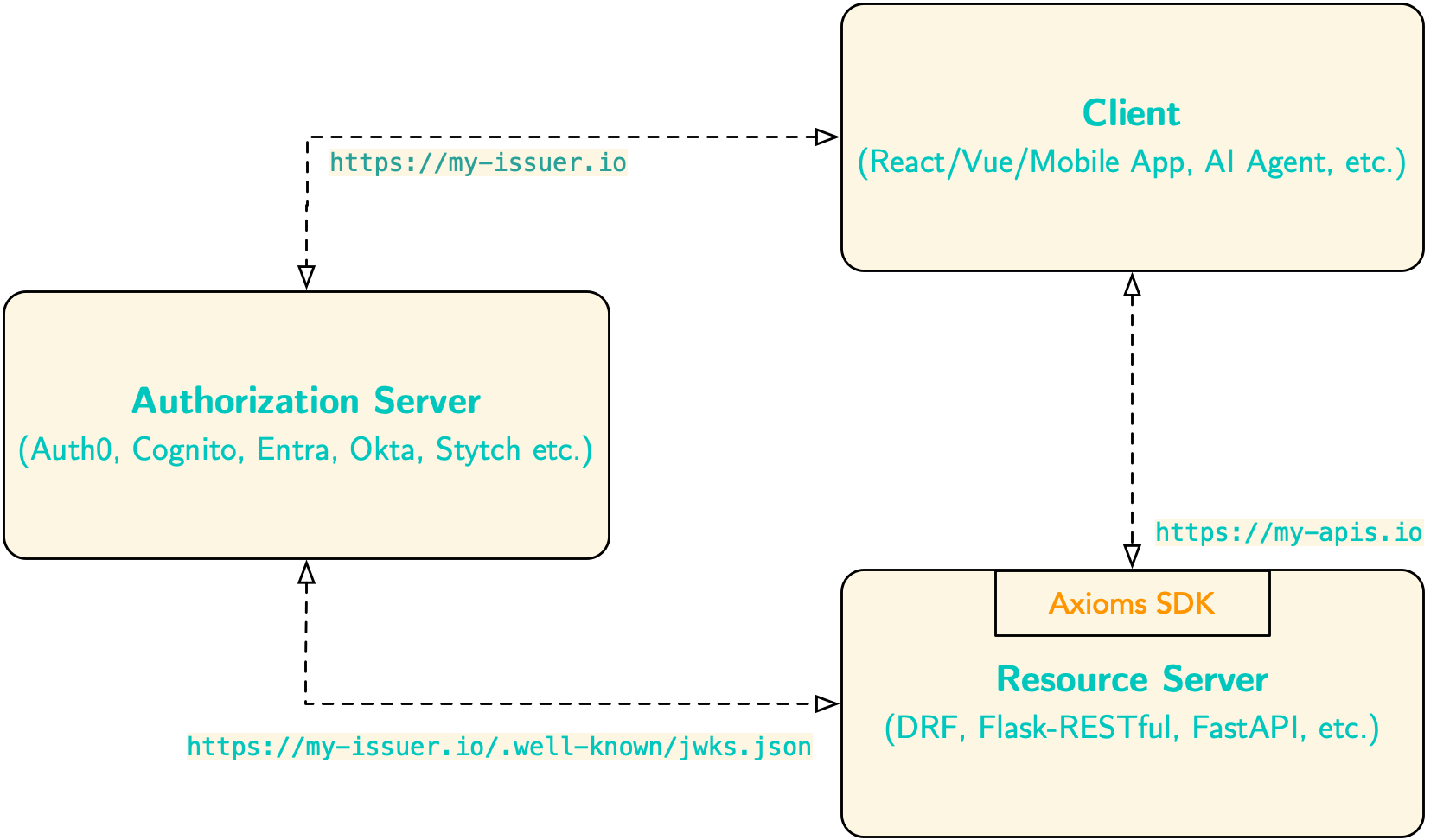
How it is different?
Unlike other DRF plugins, axioms-drf-py focuses exclusively on protecting resource servers, by letting authorization servers do what they do best. This separation of concerns raises the security bar by:
- Delegates authorization to battle-tested OAuth2/OIDC providers
- Works seamlessly with any OAuth2/OIDC ID with simple configuration
- Enterprise-ready defaults using current JWT and OAuth 2.1 best practices
Features
- JWT token validation with automatic public key retrieval from JWKS endpoints
- Algorithm validation to prevent algorithm confusion attacks (only secure asymmetric algorithms allowed)
- Issuer validation (
issclaim) to prevent token substitution attacks - Authentication classes for standard DRF integration
- Permission classes for claim-based authorization:
scopes,roles, andpermissions - Object-level permission classes for resource ownership verification
- Support for both OR and AND logic in authorization checks
- Middleware for automatic token extraction and validation
- Flexible configuration with support for custom JWKS and issuer URLs
- Simple integration with Django REST Framework Resource Server or API backends
- Support for custom claim and/or namespaced claims names to support different authorization servers
Prerequisites
- Python 3.10+
- Django 3.2+
- Django REST Framework 3.12+
- An OAuth2/OIDC authorization server (AWS Cognito, Auth0, Okta, Microsoft Entra, etc.) that can issue JWT access tokens
Installation
Install the package using pip:
pip install axioms-drf-py
Quick Start
1. Add Middleware
Add the middleware to your Django settings:
MIDDLEWARE = [
    'axioms_drf.middleware.AccessTokenMiddleware',
    # ... other middleware
]
2. Configuration
The SDK supports the following configuration options in your Django settings:
| Setting | Required | Description |
|---|---|---|
AXIOMS_AUDIENCE |
Yes | Expected audience claim in the JWT token. |
AXIOMS_DOMAIN |
No | Axioms domain name. Used as the base to construct AXIOMS_ISS_URL if not explicitly provided. This is the simplest configuration option for standard OAuth2/OIDC providers. |
AXIOMS_ISS_URL |
No | Full issuer URL for validating the iss claim in JWT tokens (e.g., https://auth.example.com/oauth2). If not provided, constructed as https://{AXIOMS_DOMAIN}. Used to construct AXIOMS_JWKS_URL if that is not explicitly set. Recommended for security to prevent token substitution attacks. |
AXIOMS_JWKS_URL |
No | Full URL to JWKS endpoint (e.g., https://auth.example.com/.well-known/jwks.json). If not provided, constructed as {AXIOMS_ISS_URL}/.well-known/jwks.json |
Configuration Hierarchy:
The SDK uses the following construction order:
AXIOMS_DOMAIN→ constructs →AXIOMS_ISS_URL(if not explicitly set)AXIOMS_ISS_URL→ constructs →AXIOMS_JWKS_URL(if not explicitly set)
Note: You must provide at least one of:
AXIOMS_DOMAIN,AXIOMS_ISS_URL, orAXIOMS_JWKS_URL. For most use cases, setting onlyAXIOMS_DOMAINis sufficient.
3. Configure Settings
Option A: Using .env file
Create a .env file in your project root:
AXIOMS_AUDIENCE=your-api-audience

# Set Issuer and JWKS URLs directly (optional, but recommended for security)
AXIOMS_ISS_URL = 'https://your-auth.domain.com'
AXIOMS_JWKS_URL = 'https://your-auth.domain.com/.well-known/jwks.json'

# Optionally, you can set the auth domain and let the SDK construct the URLs
# AXIOMS_DOMAIN = 'your-auth.domain.com'
Then load in your settings.py:
import environ

env = environ.Env()
environ.Env.read_env()

# Required
AXIOMS_AUDIENCE = env('AXIOMS_AUDIENCE')


AXIOMS_ISS_URL = env('AXIOMS_ISS_URL', default=None)
AXIOMS_JWKS_URL = env('AXIOMS_JWKS_URL', default=None)

# AXIOMS_DOMAIN = env('AXIOMS_DOMAIN', default=None)
Option B: Direct Configuration
Configure directly in your settings.py:
# Required settings
AXIOMS_AUDIENCE = 'your-api-audience'

AXIOMS_ISS_URL = 'https://your-auth.domain.com'
AXIOMS_JWKS_URL = 'https://your-auth.domain.com/.well-known/jwks.json'

# AXIOMS_DOMAIN = 'your-auth.domain.com'  # Simplest option - constructs issuer and JWKS URLs
4. Enable JWKS Manager (Recommended)
For optimal performance with automatic background refresh of JWKS keys, add the JWKS manager app to your INSTALLED_APPS:
For WSGI applications (standard Django):
INSTALLED_APPS = [
    # ... other apps
    'axioms_drf.apps.JWKSManagerWSGIConfig',  # Add this line
    # ... your apps
]
For ASGI applications (async Django):
INSTALLED_APPS = [
    # ... other apps
    'axioms_drf.apps.JWKSManagerASGIConfig',  # Add this line for ASGI
    # ... your apps
]
Optional Configuration:
Customize JWKS caching behavior in settings.py:
# Optional: JWKS manager configuration (defaults shown)
AXIOMS_JWKS_REFRESH_INTERVAL = 3600  # Refresh JWKS every 1 hour (seconds)
AXIOMS_JWKS_CACHE_TTL = 7200          # Cache JWKS for 2 hours (must be >= 2x refresh_interval)
Note: If you don't add the JWKS manager app, the SDK will automatically fall back to on-demand fetching with simple caching. This works but isn't optimal for production.
5. Use Authentication and Permission Classes
Protect your API views using authentication and permission classes:
from rest_framework.views import APIView
from rest_framework.response import Response
from axioms_drf.authentication import HasValidAccessToken
from axioms_drf.permissions import HasAccessTokenScopes

class ProtectedView(APIView):
    authentication_classes = [HasValidAccessToken]
    permission_classes = [HasAccessTokenScopes]
    access_token_scopes = ['read:data']

    def get(self, request):
        return Response({'message': 'This is protected'})
Guard Your DRF Views
Authentication Classes
| Class | Description |
|---|---|
HasValidAccessToken |
Validates JWT access token from Authorization header. Performs token signature validation, expiry datetime validation, token audience validation, and issuer validation (if configured). |
IsAccessTokenAuthenticated |
Alias for HasValidAccessToken. |
IsAnyPostOrIsAccessTokenAuthenticated |
Allows POST requests without authentication, requires valid token for other methods. |
IsAnyGetOrIsAccessTokenAuthenticated |
Allows GET requests without authentication, requires valid token for other methods. |
Permission Classes
Claim-Based Permissions
| Class | Description | View Attributes |
|---|---|---|
HasAccessTokenScopes |
Check scopes in scope claim of the access token. |
access_token_scopes or access_token_any_scopes (OR logic)access_token_all_scopes (AND logic) |
HasAccessTokenRoles |
Check roles in roles claim of the access token. |
access_token_roles or access_token_any_roles (OR logic)access_token_all_roles (AND logic) |
HasAccessTokenPermissions |
Check permissions in permissions claim of the access token. |
access_token_permissions or access_token_any_permissions (OR logic)access_token_all_permissions (AND logic) |
Method-Level Authorization: All claim-based permission classes support method-level and ViewSet action-specific authorization using Python's
@propertydecorator. This allows you to define different authorization requirements for each HTTP method (GET, POST, PATCH, DELETE) on the View or different permissions for each action (list, retrieve, create, update, destroy) of ViewSet. See the Method-Level Permissions and Action-Specific Permissions sections for implementation details.
Object-Level Permissions
| Class | Description | View Attributes |
|---|---|---|
IsSubOwner |
Verifies that the token's sub claim matches a specified attribute on the object. Use for owner-only resource access. |
owner_attribute - Name of the object attribute to compare with sub claim (default: 'user') |
IsSubOwnerOrSafeOnly |
Allows safe methods (GET, HEAD, OPTIONS) for all authenticated users, restricts unsafe methods (POST, PUT, PATCH, DELETE) to owners only. | owner_attribute - Name of the object attribute to compare with sub claim (default: 'user')safe_methods - Tuple of safe HTTP methods (default: ('GET', 'HEAD', 'OPTIONS')) |
OR vs AND Logic
Permission classes support both OR logic (any claim) and AND logic (all claims) through different view attributes. You can also combine both for complex authorization requirements.
OR Logic (Default) - Requires ANY of the specified claims:
from rest_framework.views import APIView
from rest_framework.response import Response
from axioms_drf.authentication import HasValidAccessToken
from axioms_drf.permissions import HasAccessTokenScopes

class DataView(APIView):
    authentication_classes = [HasValidAccessToken]
    permission_classes = [HasAccessTokenScopes]
    access_token_scopes = ['read:data', 'write:data']  # OR logic

    def get(self, request):
        # User needs EITHER 'read:data' OR 'write:data' scope
        return Response({'data': 'success'})
AND Logic - Requires ALL of the specified claims:
class SecureView(APIView):
    authentication_classes = [HasValidAccessToken]
    permission_classes = [HasAccessTokenScopes]
    access_token_all_scopes = ['read:data', 'write:data']  # AND logic

    def post(self, request):
        # User needs BOTH 'read:data' AND 'write:data' scopes
        return Response({'status': 'created'})
Mixed Logic - Combine OR and AND requirements:
class MixedView(APIView):
    authentication_classes = [HasValidAccessToken]
    permission_classes = [HasAccessTokenScopes]
    access_token_any_scopes = ['read:data', 'read:all']  # Needs read:data OR read:all
    access_token_all_scopes = ['openid', 'profile']       # AND needs BOTH openid AND profile

    def get(self, request):
        # User needs: (read:data OR read:all) AND (openid AND profile)
        return Response({'data': 'complex authorization'})
Examples
Scope-Based Authorization
Check if openid or profile scope is present in the token:
from rest_framework.views import APIView
from rest_framework.response import Response
from rest_framework import status
from axioms_drf.authentication import HasValidAccessToken
from axioms_drf.permissions import HasAccessTokenScopes

class ProfileView(APIView):
    authentication_classes = [HasValidAccessToken]
    permission_classes = [HasAccessTokenScopes]
    access_token_scopes = ['openid', 'profile']  # OR logic

    def get(self, request):
        return Response({'message': 'All good. You are authenticated!'}, status=status.HTTP_200_OK)
Role-Based Authorization
Check if sample:role role is present in the token:
from rest_framework.views import APIView
from rest_framework.response import Response
from rest_framework import status
from axioms_drf.authentication import HasValidAccessToken
from axioms_drf.permissions import HasAccessTokenRoles

class SampleRoleView(APIView):
    authentication_classes = [HasValidAccessToken]
    permission_classes = [HasAccessTokenRoles]
    access_token_roles = ['sample:role']

    def get(self, request):
        return Response({'message': 'Sample read.'}, status=status.HTTP_200_OK)

    def post(self, request):
        return Response({'message': 'Sample created.'}, status=status.HTTP_201_CREATED)

    def patch(self, request):
        return Response({'message': 'Sample updated.'}, status=status.HTTP_200_OK)

    def delete(self, request):
        return Response({'message': 'Sample deleted.'}, status=status.HTTP_204_NO_CONTENT)
Method-Level Permissions
Check permissions at the API method level using properties:
from rest_framework.views import APIView
from rest_framework.response import Response
from rest_framework import status
from axioms_drf.authentication import HasValidAccessToken
from axioms_drf.permissions import HasAccessTokenPermissions

class SamplePermissionView(APIView):
    authentication_classes = [HasValidAccessToken]
    permission_classes = [HasAccessTokenPermissions]

    @property
    def access_token_permissions(self):
        method_permissions = {
            'GET': ['sample:read'],
            'POST': ['sample:create'],
            'PATCH': ['sample:update'],
            'DELETE': ['sample:delete']
        }
        return method_permissions[self.request.method]

    def get(self, request):
        return Response({'message': 'Sample read.'}, status=status.HTTP_200_OK)

    def post(self, request):
        return Response({'message': 'Sample created.'}, status=status.HTTP_201_CREATED)

    def patch(self, request):
        return Response({'message': 'Sample updated.'}, status=status.HTTP_200_OK)

    def delete(self, request):
        return Response({'message': 'Sample deleted.'}, status=status.HTTP_204_NO_CONTENT)
Action-Specific Permissions
Apply different permissions for each ViewSet action (list, retrieve, create, update, destroy):
from rest_framework import viewsets
from rest_framework.response import Response
from rest_framework import status
from axioms_drf.authentication import HasValidAccessToken
from axioms_drf.permissions import HasAccessTokenScopes

class BookViewSet(viewsets.ModelViewSet):
    """Books API with action-specific scope requirements."""
    authentication_classes = [HasValidAccessToken]
    permission_classes = [HasAccessTokenScopes]
    queryset = Book.objects.all()
    serializer_class = BookSerializer

    @property
    def access_token_scopes(self):
        """Return required scopes based on the current action."""
        action_scopes = {
            'list': ['book:read'],             # GET /books/
            'retrieve': ['book:read'],         # GET /books/{id}/
            'create': ['book:create'],         # POST /books/
            'update': ['book:update'],         # PUT /books/{id}/
            'partial_update': ['book:update'], # PATCH /books/{id}/
            'destroy': ['book:delete'],        # DELETE /books/{id}/
        }
        return action_scopes.get(self.action, [])
Public Endpoints
Allow unauthenticated access for specific HTTP methods:
from rest_framework.views import APIView
from rest_framework.response import Response
from axioms_drf.authentication import IsAnyGetOrIsAccessTokenAuthenticated

class PublicReadView(APIView):
    authentication_classes = [IsAnyGetOrIsAccessTokenAuthenticated]

    def get(self, request):
        # Anyone can read (no authentication required)
        return Response({'articles': []})

    def post(self, request):
        # Requires valid JWT token to create
        return Response({'status': 'created'})
Object-Level Permissions
Restrict access to resources based on ownership using the sub claim from the JWT token:
from rest_framework import viewsets
from axioms_drf.authentication import HasValidAccessToken
from axioms_drf.permissions import IsSubOwner

class ArticleViewSet(viewsets.ModelViewSet):
    authentication_classes = [HasValidAccessToken]
    permission_classes = [IsSubOwner]
    owner_attribute = 'author_sub'  # Compare token sub with article.author_sub

    def perform_create(self, serializer):
        # Automatically set the author from the token's sub claim
        serializer.save(author_sub=self.request.user)
Allow anyone to read, but only the owner can update or delete:
from rest_framework import viewsets
from axioms_drf.authentication import HasValidAccessToken
from axioms_drf.permissions import IsSubOwnerOrSafeOnly

class ArticleViewSet(viewsets.ModelViewSet):
    authentication_classes = [HasValidAccessToken]
    permission_classes = [IsSubOwnerOrSafeOnly]
    owner_attribute = 'author_sub'  # Compare token sub with article.author_sub

    def perform_create(self, serializer):
        serializer.save(author_sub=self.request.user)
Complete Example
For a complete working example, check out the example folder in this repository or checkout our docs.
1 maintainer

Metadata
1 maintainer
Release files for axioms-drf-py 0.0.12
For a detailed explanation of source distributions (sdists) and built distributions (wheels), please see the package formats documentation.
Source distribution (sdist)
| File | Size | Uploaded | Provenance | |
|---|---|---|---|---|
| axioms_drf_py-0.0.12.tar.gz | 75.1 kB | With provenance | Details |
Built distribution (wheel)
| File | Interpreter | ABI | Platform | Reset |
|---|---|---|---|---|
| axioms_drf_py-0.0.12-py3-none-any.whl | Python 3 | none | any | Details |
Total release size: 96.0 kB
Release files / axioms_drf_py-0.0.12.tar.gz
| Download URL | axioms_drf_py-0.0.12.tar.gz |
|---|---|
| Size | 75.1 kB |
| Tags | Source |
|
SHA-256 checksum How to use checksums |
d726909da8cad8c374e5500472a5716e68434365aeed6364b2dcc61cb8f3cee5
|
|
BLAKE2b-256 checksum How to use checksums |
d37461b4c97695ad5def783f9a2badb2b5ed69f791e979e38fde5b336366f5b0
|
| Upload date | |
|
Uploaded using Trusted Publishing? What is trusted publishing? |
Yes |
| Uploaded via |
twine/6.1.0 CPython/3.13.7
|
Provenance
Provenance describes where a file came from. On PyPI, provenance is shared via attestations, which provide a verifiable record of the build or publishing details. View details, limitations and caveats.


PyPI Publish Attestation
PyPI verified that this artifact, at this checksum, originated from the publisher listed below.
Signed by GitHub Actions, verified by PyPI on Nov 24, 2025.
Transparency logRelease files / axioms_drf_py-0.0.12-py3-none-any.whl
| Download URL | axioms_drf_py-0.0.12-py3-none-any.whl |
|---|---|
| Size | 20.9 kB |
| Tags | Python 3 |
|
SHA-256 checksum How to use checksums |
e3cf93d1386940a0507bf19299e9a5af8db21fb738692f9f3a79a0e3cf51b728
|
|
BLAKE2b-256 checksum How to use checksums |
2c097f68ef0acc341fc5b264a492fd576a56153408aaa99c1dacb8d88c230360
|
| Upload date | |
|
Uploaded using Trusted Publishing? What is trusted publishing? |
Yes |
| Uploaded via |
twine/6.1.0 CPython/3.13.7
|
Provenance
Provenance describes where a file came from. On PyPI, provenance is shared via attestations, which provide a verifiable record of the build or publishing details. View details, limitations and caveats.
PyPI Publish Attestation
PyPI verified that this artifact, at this checksum, originated from the publisher listed below.
Signed by GitHub Actions, verified by PyPI on Nov 24, 2025.
Transparency logSecurity for axioms-drf-py 0.0.12
Provenance
Provenance describes where a file came from. On PyPI, provenance is shared via attestations, which provide a verifiable record of the build or publishing details. View details, limitations and caveats.
Full provenance
All 2 files in this release have been uploaded with provenance metadata.
Attestation for axioms_drf_py-0.0.12.tar.gz
PyPI Publish Attestation
PyPI verified that this artifact, at this checksum, originated from the publisher listed below.
Signed by GitHub Actions, verified by PyPI on Nov 24, 2025.
Transparency logA note on package security
PyPI is a repository for distributing packages, not a service for auditing them. While third-party security researchers and our staff do their best to detect and remove malicious packages, PyPI cannot guarantee the quality, security or suitability of any given package.














