
Agent-agnostic context network — same context across any AI coding agent

Project description
AXON
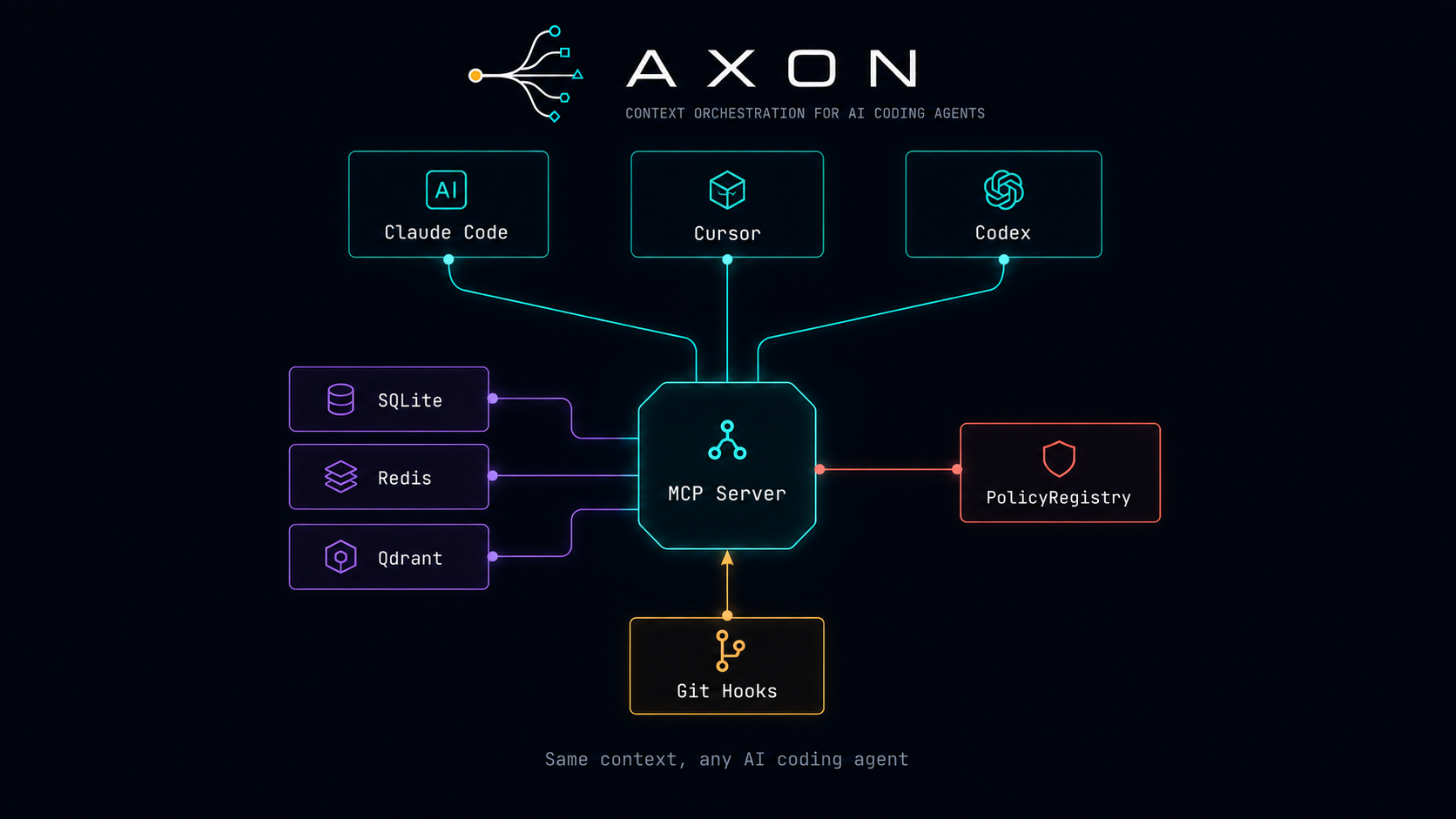
Same context, any AI coding agent.
Agent-agnostic eXecution and cONtext Network.
Every time you switch coding agents — from Claude Code to Codex to Cursor — or
resume a project after a few days away, your AI assistant starts blank. AXON
solves this by capturing context at the moments it crystallises (git commits,
session boundaries) and surfacing it on demand over MCP or a plain
.axon/context.md file that any agent can read. One install, continuous memory,
any agent.
The stack
AXON is the front of a three-part, self-hosted context stack — install one thing, get all three:
| Layer | Role | Project |
|---|---|---|
| AXON | Cross-agent memory + MCP orchestration (this repo) | axon |
| GLYPH | Graph-aware retrieval — decides what context to bring | glyph-kg, pulled in via pip |
| rtkx | Context compression + reversible store — decides how compact | rtkx, installed via axon rtk-install |
GLYPH and rtkx are clean, independently-tested dependencies, not a monolith.
The compressed context stays in the LLM window; the full pre-compression
original is one restore_context MCP call away (opt-in via
AXON_RTK_REVERSIBLE). Bundled compression layers like Headroom cover adjacent
ground — including reversible retrieval (its CCR cache) — but as one broad
engine. AXON instead keeps each tier narrow-and-deep and independently
swappable, so the graph (GLYPH) and compression (rtkx) layers can evolve, be
benchmarked, or be replaced on their own without touching the rest of the stack.
Quickstart
AXON is not yet on PyPI. Install from source:
git clone https://github.com/sammyjdev/axon.git
cd axon
pip install -e .
This pulls in GLYPH automatically. Install the rtkx compression engine too
(downloads a prebuilt binary into ~/.axon/bin, no Rust toolchain needed):
axon rtk-install
axon doctor then reports the whole stack (axon, rtkx, caveman, GLYPH).
Initialize AXON in a repo (installs git hooks and indexes the code):
axon init /path/to/your-repo
Register the MCP server with your coding agent. For Claude Code, add this to
your project's .claude/settings.json:
{
  "mcpServers": {
    "axon": {
      "command": "axon",
      "args": ["serve"]
    }
  }
}
axon serve runs the MCP server over stdio. Once registered, the tools
axon_get_context, axon_capture, axon_handoff, axon_search,
axon_export_now, axon_validation_stats, and axon_health are available
inside your agent session.
Every tool is classified by risk (read / write / destructive) and
emits structured trace records under a shared trace_id for tool-latency
and success-rate dashboards. The two destructive tools — axon_export_now
and axon_mark_done — require AXON_ALLOW_DESTRUCTIVE=1 (or true /
yes / on) as a consent token. Writes to a RESTRICTED context
(ctx=work) are always denied with DENY_RESTRICTED_TOOL_WRITE. See
ADR-013
and dec-109.
Provider profiles
AXON routes cloud calls through a profile chosen by AXON_PROVIDER_PROFILE.
Two are built in:
| Profile | Models | When to use |
|---|---|---|
free (default) |
Groq Llama 3.1/3.3 + NVIDIA NIM Llama 3.1 70B (free tiers) | No API spend; rate-limited; fine on a 16 GB laptop without local models |
paid |
OpenRouter Claude Haiku/Sonnet/Opus (D2 tiers) + Groq paid | Higher quality and quotas; unified billing via OpenRouter |
Minimum setup (free):
export AXON_PROVIDER_PROFILE=free
export GROQ_API_KEY=gsk_...
export NVIDIA_NIM_API_KEY=nvapi-...
Each provider has a rate-limit gate (defaults: Groq 25/min and 13000/day,
NIM 50/min and 950/day) configurable via AXON_<PROVIDER>_MAX_RPM /
AXON_<PROVIDER>_MAX_RPD. When a cap is hit, calls fail with
DENY_RATE_LIMIT instead of being swallowed as model failures. See
dec-106 and
.env.example for the full configuration surface.
Local Ollama is opt-in as of dec-106 (AXON_PROVIDER_OLLAMA=1). It remains
supported for users with capable hardware; D3 is unchanged.
How it works
flowchart LR
    subgraph Capture
        GE[git events\npost-commit / post-push / init]
        SH[session hooks\nstart / end]
    end

    subgraph Storage
        PG[(PostgreSQL + pgvector\nsessions, decisions, graph, vectors)]
    end

    subgraph Recall
        MCP[MCP tools\naxon_get_context\naxon_search\naxon_handoff]
        CF[.axon/context.md\nfile fallback]
    end

    subgraph Agents
        CC[Claude Code]
        CX[Codex]
        CU[Cursor]
    end

    GE --> PG
    SH --> PG
    PG --> MCP
    PG --> CF
    MCP --> CC
    MCP --> CX
    MCP --> CU
    CF  --> CX
    CF  --> CU
Capture is event-driven only — git commit/push/init and agent session start/end. No background timer, no idle cost (see dec-104).
Storage is a single PostgreSQL instance with pgvector for embeddings: sessions, decisions, ADRs, the code-dependency graph, and code vectors all live in Postgres (dec-121). SQLite, Redis, Qdrant, and mem0 were retired as part of that consolidation. Neo4j was evaluated and dropped separately (dec-101).
The primary transport is MCP (stdio). A .axon/context.md file in the repo
is kept in sync as a fallback for agents without MCP support
(dec-103).
Use cases
Agent handoff without context loss
You spend an afternoon with Claude Code, push a branch, then continue the work
in Codex the next day. Without AXON, Codex starts cold. With AXON, the MCP tool
axon_handoff supplies Codex with the decisions, open questions, and code
index from the previous session — no copy-pasting required.
Multi-day project continuity
On a project that spans weeks, the important context is not your last five
messages but the architectural decisions made three sprints ago. AXON captures
decisions from commit messages and session summaries into Postgres, so axon search and axon_get_context return what actually matters, not stale history.
Auto-generated architecture docs
AXON's LLM judge infers architectural decisions from commits and session events.
axon export adr and axon export architecture write structured Markdown notes
to an Obsidian vault, turning captured context into living documentation without
any manual ADR writing.
How AXON compares
The closest tools are other cross-agent memory/compression layers, not the editing agents (Aider, Cline) whose histories are built-in and single-agent:
| AXON | claude-mem | Headroom | Supermemory | |
|---|---|---|---|---|
| Primary goal | Decision capture + cross-agent continuity | Auto-capture of all session activity | Token compression layer | Hosted cross-agent memory API |
| What it captures | Decisions at crystallisation points (git / session) | Every tool use, continuously | Whatever passes through (compresses it) | Facts / observations via API |
| Reversible compression | Yes (restore_context, rtkx) |
No | Yes (CCR cache) | No |
| Decision / ADR inference | Yes (LLM judge → Obsidian) | No | No (failure-driven learn) |
No |
| Governance | Per-tool risk class + restricted ctx (ADR-013) | <private> tags |
A/B holdouts / measured savings | Access controls |
| Works across agents | Yes (MCP + file fallback) | Yes (MCP) | Yes (wrap / proxy) | Yes (plugins) |
| Self-hosted | Yes | Yes | Yes | Hosted-first |
The crowded part of this space is raw recall — tools like agentmemory and Hindsight publish strong LongMemEval scores and optimise for that directly. AXON does not compete on that axis. Its defensible niche is the intersection none of the above combine: capturing decisions (not every keystroke) at git and session boundaries, inferring ADRs from them, keeping compression reversible, and gating every MCP tool by risk class with a full audit trail. If you want the best raw recall benchmark, those tools win; if you want decisions and architecture to survive across agents and months, auditably, that is AXON.
Token savings
AXON's numbers are measured by GNOMON with 95% confidence intervals, and every claim names its counterfactual (gnomon-eval ADR-0011):
- Quality uplift from recall (vs no memory at all - A/B, N=17, judge x8, 2026-07-02): faithfulness rises from 0.40-0.52 (no recall) to 0.72-0.76 (recall on) at +2,151 input tokens per turn. After the retrieval ladder of 2026-07-04 (index hygiene, skeleton-chunk suppression, hybrid lexical search), the recall arm reaches faithfulness 0.775 [0.735, 0.814] on the same cases.
- Session cost (vs re-sending the conversation - 10-turn sessions, 3 stable runs, 2026-07-04): cost parity (pooled +4%), crossing to net savings at turn 6-9, with final-turn faithfulness at parity or better.
- Real-usage savings (vs reading each source file in full): 90.7% - 32,298 tokens returned where the Read workflow would have cost 346,081 (100 instrumented requests).
Retired: an earlier version of this section cited 52.3% token savings.
That figure was a deterministic projection against an assumed 87,000-token
baseline - a model, never a measurement. It is kept in
benchmarks/model.py for provenance; the
projection-vs-measurement story is documented in gnomon-eval ADR-0011.
Measured compression telemetry from running the real pipeline (phi3:mini
via Ollama, caveman + RTK) over 69 representative technical context windows
(source and docs drawn from this repo), in the committed
data/compression/stats.jsonl: p50 = 85.5%,
mean = 78.8%, p95 = 95.5%, max = 97.0% over n=69 compressed
windows (75,258 → 15,778 tokens; 59,480 saved). Engines: 60
caveman/phi3+rtk, 9 caveman/phi3. This is a committed local snapshot over
representative context, not production usage.
Reproduce with:
python -m axon.observability.compression_telemetry
The pipeline is gated by strategy.enable_compression and skips inputs too
small to benefit; see the issue tracker for active work on extending the
gate's coverage (T-105).
Documentation
| Document | Contents |
|---|---|
docs/SECOND_BRAIN.md |
Run AXON as a low-cost second brain in Claude Code |
CLAUDE.md |
Architecture decisions, code conventions, agent rules |
docs/ADR.md |
Active architectural decision records |
docs/METRICS.md |
Recomputed performance metrics manifest (dated) |
docs/ARD.md |
Architectural requirements |
docs/USAGE_GUIDE.md |
CLI workflows |
docs/VAULT_SETUP.md |
Obsidian vault bootstrap |
docs/decisions/ |
Individual decision records (dec-100 to dec-120) |
docs/decisions/dec-106-routing-profiles.md |
FREE/PAID provider profiles + rate limit gate |
docs/decisions/dec-109-tool-tracing-and-risk-gating.md |
Tool risk classes, policy gate, tracing middleware |
benchmarks/README.md |
Token savings benchmark |
Contributing
Start from tests. The repo uses TDD: bugfixes begin with a regression test, features need testable acceptance criteria before implementation.
pytest tests/ -q
See CLAUDE.md for code conventions and agent rules.
License
Apache-2.0 — see LICENSE.
Release history Release notifications | RSS feed

Download files
Download the file for your platform. If you're not sure which to choose, learn more about installing packages.
Source Distribution
Built Distribution
Filter files by name, interpreter, ABI, and platform.
If you're not sure about the file name format, learn more about wheel file names.
Copy a direct link to the current filters
File details
Details for the file axon_context_mcp-0.1.1.tar.gz.
File metadata
- Download URL: axon_context_mcp-0.1.1.tar.gz
- Upload date:
- Size: 1.9 MB
- Tags: Source
- Uploaded using Trusted Publishing? No
- Uploaded via: twine/6.2.0 CPython/3.11.5
File hashes
| Algorithm | Hash digest | |
|---|---|---|
| SHA256 |
6a3d51c8b417a11dc13cecf1a2800d81c5df631c5d94c7761946f3f0b4e0dbc1
|
|
| MD5 |
385b5266fc30359efe1b4a236ae10a58
|
|
| BLAKE2b-256 |
6abad26dcc7b8e0dcae6d10fc12b60317a2220eebd0769b16e4f90aeb910ef25
|
File details
Details for the file axon_context_mcp-0.1.1-py3-none-any.whl.
File metadata
- Download URL: axon_context_mcp-0.1.1-py3-none-any.whl
- Upload date:
- Size: 306.5 kB
- Tags: Python 3
- Uploaded using Trusted Publishing? No
- Uploaded via: twine/6.2.0 CPython/3.11.5
File hashes
| Algorithm | Hash digest | |
|---|---|---|
| SHA256 |
dc552e835e4ff23fff8d5ba226e86b91633524ccf75853ebbdb9730e3392da70
|
|
| MD5 |
ae324758700d451640a983b2b3d0847c
|
|
| BLAKE2b-256 |
51daec40ec2cd8c4b015b85f53d1dd2ff87bfc5afffc706245d2534612b7e74b
|






