
Boolean Algebra Toolkit
- Truth Table to Boolean Expression and Logic Diagram Generator
- Boolean Expression Evaluator and Truth Table Generator
Installation
pip install balg
Usage
| Token | Equivalent |
|---|---|
| & | AND |
| ^ | XOR |
| + | OR |
| ~ | NOT |
| [A-z] | Variable |
from balg.boolean import Boolean
booleanObject = Boolean()
- To generate an expression's truth table:
input_expression: str = "~(A & B & C)+(A & B)+(B & C)"
tt: str = booleanObject.expr_to_tt(input_expression)
- To generate an expression given the minterms and variables:
variables: List[str] = ['A', 'B', 'C']
minterms: List[int]  = [0, 1, 3, 7]
expression: str   = booleanObject.tt_to_expr(variables, minterms)
- To generate a logic diagram given an expression:
input_expression: str = "~(A & B & C)+(A & B)+(B & C)"
file_name: str = "logic_diagram12"
format: str = "png"
directory: str = "examples" # stores in the current directory by default
booleanObject.expr_to_dg(input_expression, file_name, directory, format)
- To generate a logic diagram given variables and minterms
variables: List[str] = ['A', 'B', 'C']
minterms: List[int]  = [0, 1, 3, 7]
file_name: str = "logic_diagram12"
directory: str = "examples"
format: str = "png"
booleanObject.tt_to_dg(variables, minterms, file_name, directory, format)
- To assert equality for expressions
expressions_list = ["(A & ~B) + (~A & B)", "(A ^ B)", "(A + B) & ~(A & B)"]
ret = booleanObject.expr_cmp(expression_list) # returns True
- To simplify expressions (ambiguous):
simplified_expr: str = booleanObject.expr_simplify("~(A) + ~(B)")
- To generate random expressions:
#generating a single expression
expression: str = boolean.generate_expression(max_depth=4, max_identifiers=5)

#generating multiple expressions
expression: List[str] = boolean.generate_expressions(max_depth=4, max_identifiers=5, count=100)

#max_depth refers to nesting depth:
expression = "A" #nesting_depth = 0
expression = "(((4)))"  #nesting_depth = 3

#max_identifiers refers to the number of identifiers allowed in an expression
expression = "A + B + C" # has 3 identifiers
Example Diagrams
((A & B) & C) + (~C)
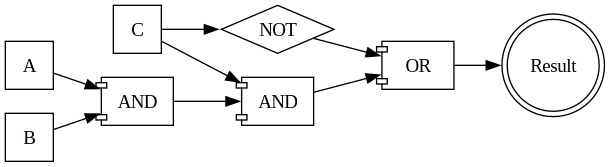
(A & B) + (~(A & B) & ~C) + (C & B)
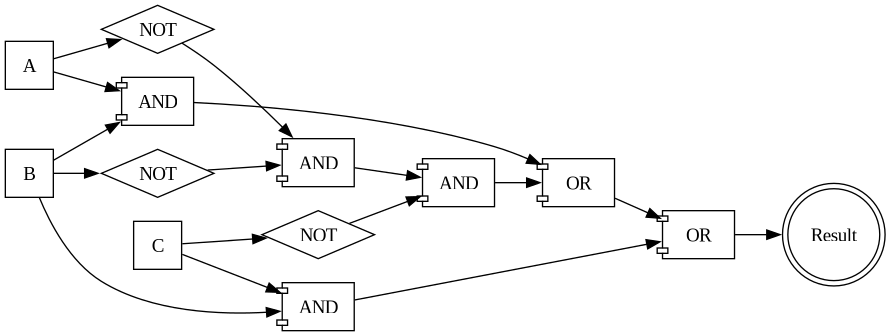
Other diagrams can be found in the diagrams/ directory
Explanation of the Quine-McCluskey Algorithm
This section deals with converting a given truth table to a minimized boolean expression using the Quine-McCluskey algorithm and producing a logic diagram.
Overview
- Initialize variables & Minterms
- Identify essential Prime implicants
- Minimize & Synthesize the boolean function
Initialization
- The synthesizer is initialized with a list of character variables and minterms:
- Minterms refer to values for which the output is 1.
- Prime implicants are found by repeatedly combining minterms that differ by only one variable:
The Quine-McCluskey Algorithm
               The Quine-McCluskey Algorithm

+-----------------------------------+
| initialize variables and minterms |
| variables := [A, B, C]            |
| minterms  := [0, 3, 6, 7]         |
| minters   := [000, 011, 110, 111] |
+-----------------------------------+
                |
                /
               /
               |
               V
        +-----------------------+
        | find prime_implicants |
        | | A | B | C |  out |  |
        | |---|---|---|------|  |
        | | 0 | 0 | 0 |  1   |  |
        | | 0 | 0 | 1 |  0   |  |
        | | 0 | 1 | 0 |  0   |  |
        | | 0 | 1 | 1 |  1   |  |
        | | 1 | 0 | 0 |  0   |  |
        | | 1 | 0 | 1 |  0   |  |
        | | 1 | 1 | 0 |  1   |  |
        | | 1 | 1 | 1 |  1   |  |
        +-----------------------+
                 |
                 |
                  \
                   |
                   V
+----------------------------------+
|  | group | minterm | A | B | C | |
|  |-------|---------|---|---|---| |
|  |   0   | m[0]    | 0 | 0 | 0 | |
|  |   2   | m[1]    | 0 | 1 | 1 | |
|  |       | m[2]    | 1 | 1 | 0 | |
|  |   3   | m[3]    | 1 | 1 | 1 | |
|  |-------|---------|---|---|---| |
+----------------------------------+
                    \
                     \
                      |
                      V
        +-------------------------------------------+
        | find pair where only one variable differs |
        | | group | minterm    | A | B | C |  expr  |
        | |-------|------------|---|---|---|--------|
        | |   0   | m[0]       | 0 | 0 | 0 | ~(ABC) |
        | |   2   | m[1]-m[3]  | _ | 1 | 1 |  BC    |
        | |       | m[2]-m[3]  | 1 | 1 | _ |  AB    |
        +-------------------------------------------+
                        |
                       /
                      |
                      V
    +-------------------------------------------+
    |  since the bit-diff between pairs in each |
    |  class is > 1, we move onto the next step |
    |                                           |
    |   |  expr  | m0  | m1  | m2  | m3   |     |
    |   |--------|-----|-----|-----|------|     |
    |   | ~(ABC) | X   |     |     |      |     |
    |   |   BC   |     |  X  |     |      |     |
    |   |   AB   |     |     |  X  |      |     |
    |   |--------|-----|-----|-----|------|     |
    +-------------------------------------------+
                            |
                            |
                           /
                          |
                          V
              +-----------------------------------------+
              | If each column contains one element     |
              | the expression can't be eliminated.     |
              | Therefore, the resulting expression is: |
              |         ~(ABC) + BC + AB                |
              +-----------------------------------------+
Tips
- Use parentheses when the order of operations is ambiguous.
- The precedence is as follows, starting from the highest: NOT -> OR -> (AND, XOR)
Documentation (for developers)
class TruthTableSynthesizer(variables: List[str], minterms: List[int])
class BooleanExpression(expression: str)
class Boolean()
class BooleanExpressionGenerator(max_identifiers: int = 5, max_depth: int = 5)
TruthTableSynthesizer.decimal_to_binary(num: int) -> str
TruthTableSynthesizer.combine_implicants(implicants: List[Set[str]]) -> Set[str]
TruthTableSynthesizer.get_prime_implicants() -> Set[str]
TruthTableSynthesizer.covers_minterm(implicant: str, minterm: str) -> bool
TruthTableSynthesizer.get_essential_prime_implicants(prime_implicants: Set[str]) -> Set[str]
TruthTableSynthesizer.minimize_function(prime_implicants: Set[str], essential_implicants: Set[str]) -> List[str]
TruthTableSynthesizer.implicant_to_expression(implicant: str) -> str
TruthTableSynthesizer.synthesize() -> str

BooleanExpression.to_postfix(inifx: str) -> List[str]
BooleanExpression.evaluate(values: Dict[str, bool]) -> bool
BooleanExpression.tt() -> List[Tuple[Dict[str, bool], bool]]
BooleanExpression.fmt_tt() -> str
BooleanExpression.generate_logic_diagram() -> graphviz.Digraph

BooleanExpressionGenerator.generate_expression() -> str
BooleanExpressionGenerator.generate_expressions(number: int = 1) -> List[str]

Boolean.expr_to_tt(input_expression: str) -> str
Boolean.tt_to_expr(variables: List[str], minterms: List[int]) -> str
Boolean.tt_to_dg(variables: List[str], minterms: List[int], file: str | None = None, directory: str | None = None, format: str = "png") -> str
Boolean.expr_to_dg(input_expression: str, file: str | None = None, directory: str | None = None, format: str = "png") -> str
Boolean.expr_simplify(input_expression: str) -> str
Boolean.expr_cmp(expressions: List[str]) -> bool
Boolean.generate_expression(max_identifiers: int=5, max_depth: int=4) -> str
Boolean.generate_expressions(max_identifiers: int=5, max_depth: int=4, number: int) -> List[str]
TODO
- Optimize functions 0.5. LaTeX interface
- NAND, NOR, XNOR
- Implication (X -> Y) and bi-implication (X <-> Y)
- Add support for constants (1, 0)
- Implement functional completeness testing
Expression comparison by comparing minterms (grammar agnostic)- (improbable) implement Quantum Gates
- (improbable) potential integration with Verilog systems
1 maintainer

Release files for balg 0.0.6
For a detailed explanation of source distributions (sdists) and built distributions (wheels), please see the package formats documentation.
Source distribution (sdist)
| File | Size | Uploaded | |
|---|---|---|---|
| balg-0.0.6.tar.gz | 193.4 kB | Details |
Built distribution (wheel)
| File | Interpreter | ABI | Platform | Reset |
|---|---|---|---|---|
| balg-0.0.6-py3-none-any.whl | Python 3 | none | any | Details |
Total release size: 203.9 kB
Release files / balg-0.0.6.tar.gz
| Download URL | balg-0.0.6.tar.gz |
|---|---|
| Size | 193.4 kB |
| Tags | Source |
|
SHA-256 checksum How to use checksums |
b1a53c862497d8a4e952a5aa6bb99f2f336353b781138059a0f84e4d71250bed
|
|
BLAKE2b-256 checksum How to use checksums |
61d2450b5ba0631e6496d85e27e6a1bc0680820a189d8dea0e969db1ef4cf3c6
|
| Upload date | |
|
Uploaded using Trusted Publishing? What is trusted publishing? |
No |
| Uploaded via |
twine/5.1.1 CPython/3.12.5
|
Release files / balg-0.0.6-py3-none-any.whl
| Download URL | balg-0.0.6-py3-none-any.whl |
|---|---|
| Size | 10.5 kB |
| Tags | Python 3 |
|
SHA-256 checksum How to use checksums |
d266cc55b19852f05a6c1231723df0d5b8c547888c3494ce2e98d9369bbb8355
|
|
BLAKE2b-256 checksum How to use checksums |
4296b869070690dbc073e50f18cf5aa0c599efefa6c0e66aee5fa6fd43d50146
|
| Upload date | |
|
Uploaded using Trusted Publishing? What is trusted publishing? |
No |
| Uploaded via |
twine/5.1.1 CPython/3.12.5
|














