
Query-aware context trimming for LLM requests. Your context could use a trim.

Project description
barber
Query-aware context trimming for LLM requests.
Your context could use a trim. 33% off the top.



The 30-second pitch
Retrieved context is mostly irrelevant to any single question. Your RAG stack fetches ten paragraphs, the question needs two, and you pay for all ten on every request.
barber embeds the chunks and the question, keeps what matters, and drops the rest. Nothing is rewritten or summarized: chunks survive verbatim or vanish. No model calls at trim time, no required dependencies, deterministic output.
In the published benchmark that locked barber's defaults, that meant 31.8 to 34.1% of context tokens gone with answer quality within noise of full context (numbers below).
Install
pip install barber-llm
The PyPI name is barber-llm; the import name is barber. Zero required
dependencies. Extras when you want them:
| Extra | Pulls in | Gives you |
|---|---|---|
barber-llm[semantic] |
sentence-transformers |
semantic scoring, paraphrase-safe |
barber-llm[tokens] |
tiktoken |
exact token counts in TrimResult |
barber-llm[eval] |
datasets, openai, tiktoken |
the barber-eval benchmark harness |
JavaScript is a first-class citizen too. The npm package is a zero-dependency port of the same algorithm with the same defaults, kept decision-identical to this package by golden fixtures regenerated from the Python implementation and replayed in CI (js/):
npm install barber-llm
or one-shot from the shell:
npx barber-llm --keep 0.6 < messages.json > trimmed.json
Quickstart
Zero-dependency lexical mode, runnable as pasted:
from barber import trim

context = "\n\n".join(f"Passage {i}: facts about topic {i}." for i in range(40))  # your RAG block
messages = [{"role": "user", "content": context},
            {"role": "user", "content": "What do the passages say about topic 7?"}]

result = trim(messages)   # keep=0.6, lexical fallback, zero deps
print(result.tokens_saved, result.chunks_dropped, result.changed)
# result.messages is the same conversation, fewer tokens; send it to your LLM
tokens_saved is signed. Each dropped run costs about 20 tokens of marker, so
on blocks with many small, scattered chunks the markers can cost more than the
drops save. A negative number is barber telling you this shape is not worth
trimming, so skip it or raise keep.
Semantic mode, the configuration the benchmark shipped with:
from barber import trim, embedders

embed = embedders.sentence_transformers("llm-semantic-router/mmbert-embed-32k-2d-matryoshka")
result = trim(messages, keep=0.6, embedder=embed)
The lexical fallback is deterministic and dependency-free, but it matches
words, not meaning. For production traffic use the semantic embedder above
(32K context window) or BAAI/bge-small-en-v1.5 as the lightweight
alternative; the two tied on quality in the published runs. There is also
embedders.endpoint(base_url, model, api_key) for any OpenAI compatible
/v1/embeddings server (vLLM, TEI), which needs the openai package.
Multi-turn pipelines use the transform form. Pass a shared cache and a block is decided once, then replayed byte-identically on every later turn, so your provider prompt cache stays warm:
from barber import make_transform, Cache

cache = Cache()                          # bounded LRU, safe for a long-running process
name, fn = make_transform(embedder=embed, keep=0.6, cache=cache)
messages, changed = fn(messages)         # call this every turn
A plain dict works too, but it never evicts: one entry per distinct context
block for the life of the process. Cache bounds it and is thread-safe, so a
threaded server can share one. Two things to size against:
- An entry holds one whole trimmed block, so the bound is a count, not a byte
budget. At
maxsize=4096with large RAG blocks that is hundreds of megabytes per process. Lower it if your blocks are big. - Keep
maxsizeabove your live-conversation count. Evicting a block means the next turn decides it again against the then-current question, which is the prefix churn the cache exists to prevent.
When barber does nothing
trim() returns changed=False and leaves your messages untouched unless some
message meets every one of these:
| Requirement | Why |
|---|---|
Role is user, tool, or function |
System and assistant messages are never touched. |
| Not the latest user message | That message is the question, and the question is never trimmed. |
content is a string, or text/tool_result parts |
Other parts (images, tool_use inputs) pass through untouched. |
| At least 800 characters | Anything shorter is not retrieved context. |
| At least 4 chunks | Below that there is nothing to choose between. |
The common surprise is the single-message shape. This is a no-op, because the only message present is the question:
messages = [{"role": "user", "content": f"Context:\n{docs}\n\nQuestion: {q}"}]
Give the context its own message and barber has something to work with:
messages = [{"role": "user", "content": docs},
            {"role": "user", "content": q}]
Most APIs accept consecutive user messages. If yours does not, put the context
in a tool or function message, which is where retrieved context usually
arrives anyway.
Coding agents
A coding-agent transcript is not a RAG block, and two of its habits defeat
plain trim():
- Its context lives in content parts. A tool result is a
tool_resultblock, not a string, and that is where the big text is.trim()now walks into text andtool_resultparts (tool_useinputs and images are passed through untouched). - Its output has no blank lines. A file read, a grep, an
ls, a diff — the paragraph splitter finds one chunk and selection declines the block. barber now falls back to line structure when, and only when, nothing else found any: a line-numbered read is chunked on the blank lines of the underlying file, a diff on its hunks, flat output on line windows. A JSON body is never line-chunked, because half a JSON object does not parse.
Selection still only guesses relevance. In an agent transcript, most of the dead weight does not need a guess at all — it is content the transcript itself proves is no longer true:
from barber import trim
from barber.agent import sweep

result = sweep(trim(messages).messages)
sweep() drops three things, each provable from the transcript, each marked
with the file path so the agent can just read it again:
| Dropped | Because |
|---|---|
| A file body written before the same file was fully rewritten | It is not the file any more. A later Edit does not count: the file still holds that body. |
A Read result for a file modified since |
It is not the file any more. |
| A byte-identical repeat of an earlier tool result | It says nothing new. |
Blocks are emptied, never removed: a request rejects a tool_use with no
matching tool_result, so the structure survives even when the content does
not.
sweep() rewrites history, and trim() deliberately does not. The
freeze-on-first-sight cache exists to keep the prefix byte-stable so the
provider prompt cache stays warm; sweep() edits messages in the middle of the
conversation, so everything after the earliest edit is re-primed once. That is
a good trade at a compaction point with many turns left to amortize it, and a
bad one on turn three — which is why it is a call you make, not something
trim() does behind your back.
Tell it how many turns are left and it will do that arithmetic for you:
sweep(messages, remaining_turns=50)
An edit at position P costs re-writing every token after P at 1.25x instead of
reading it back at 0.1x, and buys those removed tokens never being re-read
again. With T tokens after the cut and S of them removed, it only pays once
S/T > 1.15 / (1.15 + 0.1 * remaining_turns)
— 53% of the tail at 10 turns, 19% at 50, 10% at 100. Editing later costs less
and saves less, so sweep() scores every candidate cut point and keeps only
the edits at or after the best one; everything before it is left alone and
stays cached. When nothing clears the bar it changes nothing and says so. The
15.7% of tool tokens the sweep can find needs roughly 62 remaining turns to pay
for itself if you claim all of it from the front of the transcript.
Left unset, remaining_turns edits everything it finds — right only when the
cache is already cold.
Measured on six real Claude Code sessions (1.16M tokens of transcript), in quota units that charge cache reads at 0.1x and cache writes at 1.25x, and paying the sweep's re-prime cost in full:
| Tokens removed | Quota saved | |
|---|---|---|
trim() before this (content-parts guard) |
0.0% | 0.0% |
trim() |
11.5% | 14.9% |
trim() + sweep() |
19.5% | 23.7% |
That is 1.31x the turns per unit of quota. Your mileage varies with what your
session does: the spread across those six sessions was 1.18x to 1.68x, and the
sessions that gain most are the ones that rewrite the same files repeatedly.
sweep() is Python-only for now; the JS port has the trim() half.
The prompt cache
Providers bill a cached token at a fraction of a fresh one — Anthropic reads at 0.1x and writes at 1.25x — and the cache is a prefix match: change one byte at position N and everything after N is billed as new. That single fact decides what each part of barber is allowed to do.
| Disturbs the cached prefix | What it costs | |
|---|---|---|
trim() with a shared Cache |
no | nothing; decisions are frozen and replayed byte-identically |
trim() with no cache |
yes, every turn | each block is re-decided against the current question, so the prefix churns |
sweep() |
yes, from the earliest edit | one re-prime of everything after it — priced when you pass remaining_turns |
contrib/claude_code_hook.py |
no | nothing; it rewrites tool output before it ever enters context |
Three rules follow from the table:
- Pass a shared
Cachein any multi-turn loop. Without one,trim()still removes tokens but re-decides every block each turn, and a prefix that changes shape each turn is a prefix nobody caches. This is the single cheapest thing on this page. - Prefer trimming at admission over trimming in hindsight. An agent re-sends its whole conversation every turn, so a token removed before it enters context is saved once per remaining turn, while the same token removed afterwards costs a re-prime to collect. Both are worth doing; only one is free.
- Treat
sweep()as a spend, not a saving, until you have counted the turns. It is the only call here that rewrites history, which is why it is explicit and whyremaining_turnsexists.
One caveat worth stating plainly: a cached token is cheap, not free, and it still occupies the context window. Trimming the stable prefix of a long session is a context-quality decision, not a cost decision — do not expect the quota numbers above to follow.
The benchmark
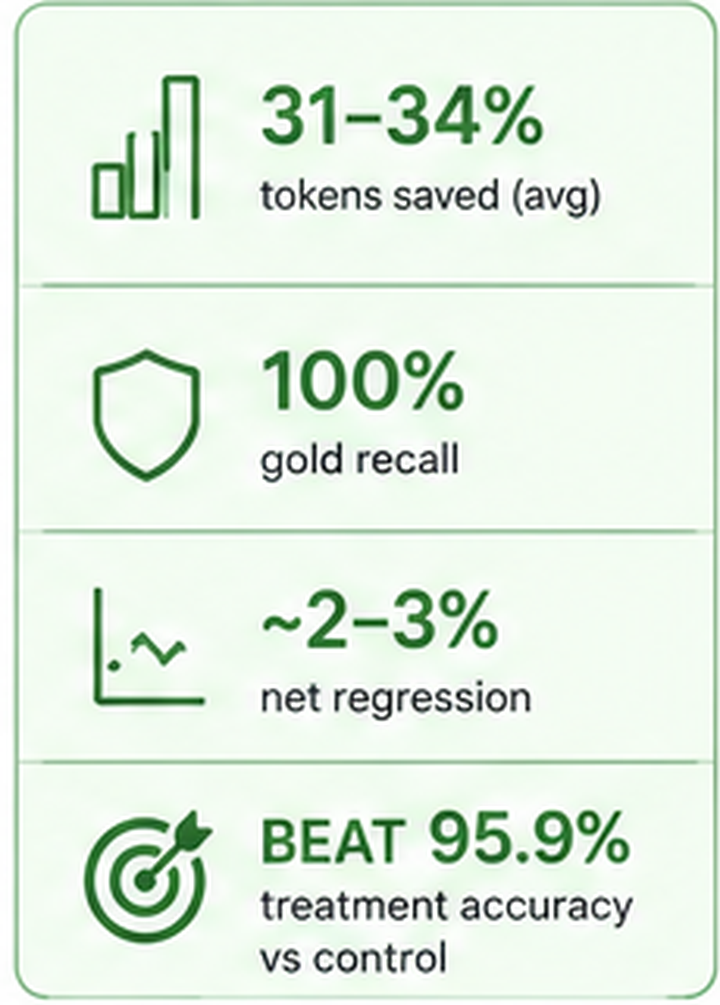
barber's defaults were locked by a paired A/B on HotpotQA (distractor config): answer each question with full context and with trimmed context, then have a blind judge grade both answers against the gold reference.
| Medium (~6K tok) | Large (~14K tok) | |
|---|---|---|
| Tokens saved | 31.8% | 34.1% |
| Answer-paragraph retention | 100% | 100% |
| Full-context accuracy | 97.2% | 94.8% |
| Trimmed-context accuracy | 96.0% | 95.9% |
About 350 judged pairs, MiniMax M3 as the blind judge, answers graded against
gold references, keep=0.6. On large contexts trimmed beat full: selection
removes the distractors models trip over.
Full write-up: the benchmark post. Full protocol: docs/methodology.md. Reproduce it:
pip install "barber-llm[eval]" && barber-eval --n 200 --keep 0.6 --size large
How it works
-
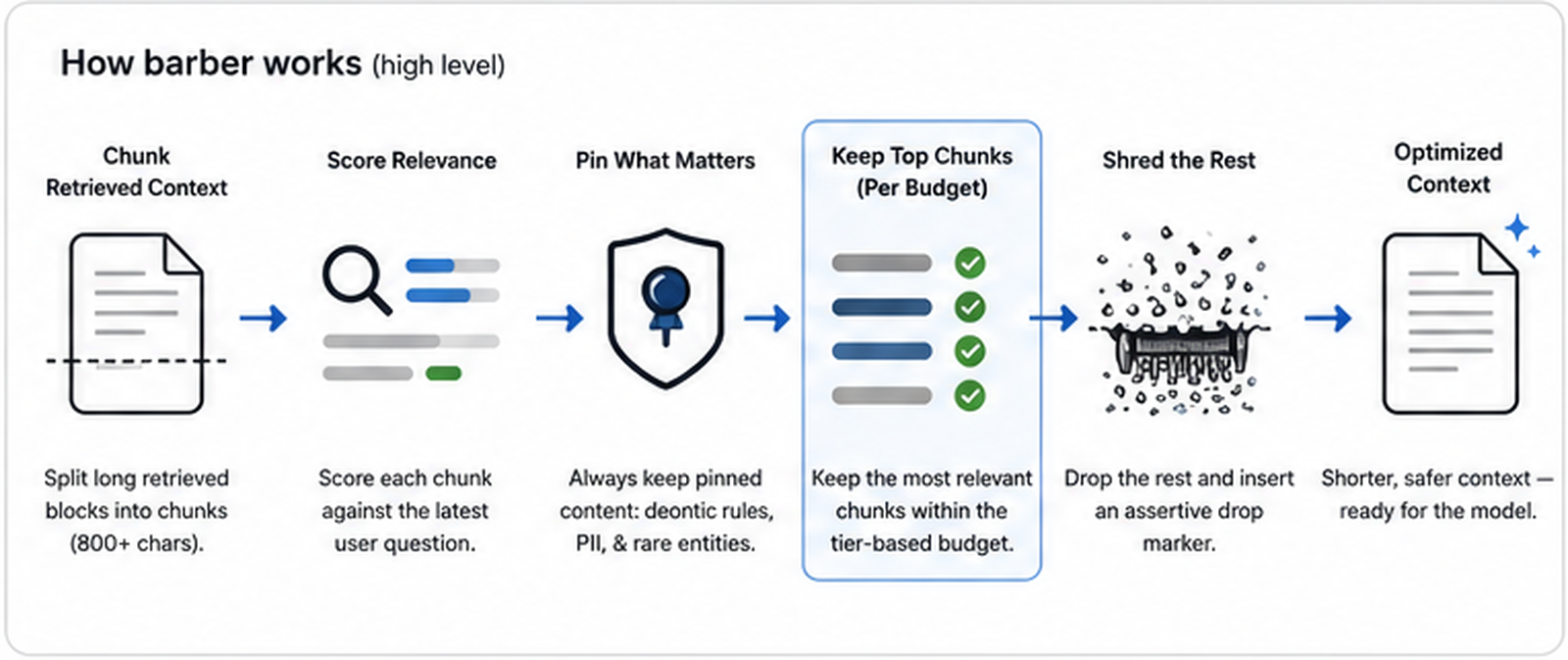
Query. The latest user message is the question. It is never trimmed.
-
Candidate blocks. Large user, tool, and function messages (800+ chars, 4+ chunks). System and assistant messages are never candidates.
-
Chunk. Split each block on blank lines,
---rules, headings, and[n]citation markers, the boundaries RAG concatenations already have. Falls back to sentences for a single wall of prose. -
Score. Embed every chunk plus the question, cosine each chunk against the question, keep the top
keepfraction. -
Guards. Pinned chunks bypass the budget entirely, the first and last chunk always survive, and a relevance floor drops pure noise even when the budget would keep it. Details below.
-
Marker. Each dropped run collapses into one line, so the model knows the cut happened and doesn't go looking for missing text:
[… 4 passage(s) omitted as not relevant to this question — the remaining context is sufficient …]The assertive wording is deliberate and benchmark-locked: it won our marker ablation. The working theory is that a neutral "lower-relevance passages omitted" invites the model to hedge, while this one tells it to proceed. Re-run the ablation yourself with
barber-eval --marker neutral.
Decisions are memoized on the block hash alone, never the query. The first turn to see a block decides it; every later turn replays the decision byte-identically. Your history prefix stays stable and your provider prompt cache keeps hitting.
What barber does not do
- No summarization. Chunks survive verbatim or vanish. A summary is a rewrite, and rewrites can silently invent or lose facts.
- No letter tricks. Dropping vowels, truncating words, gzip-then-base64: in the same benchmark, every character-level scheme cost MORE tokens, not fewer. Letter removal measured 1.34x to 1.69x the tokens; classic compression 3.2x to 3.7x. Tokenizers are already compressors; fighting them backfires. The numbers.
- No history compaction. Providers do that natively now, and re-writing old turns busts their prompt caches. barber targets fresh retrieved context only.
- No model calls at trim time. Scoring is an embedding pass (or pure
lexical math). Nothing is sent anywhere unless you opt into the
endpoint()embedder.
Guards, or why your answers survive
The failure mode of context pruning is silent: drop the one chunk that held the answer and nothing errors, the model just answers worse. barber ships with every guard on:
- Deontic and PII pinning. Chunks with constraint language ("must", "never", "do not", "don't", "shall not", "prohibited", "required", "only if") or sensitive-data markers (PII, HIPAA, PCI, SSN, password, secret, API key) are never dropped.
- Rare-query-entity pinning. A query term that appears in only one or two chunks of a block is a strong "this chunk answers the question" signal. Those chunks are never dropped, which is what protects multi-hop questions.
- Lead and tail keep. The first and last chunk of every block survive: headers, conclusions, and the lost-in-the-middle mitigation.
- Relevance floor (0.35). A chunk scoring far below the block's top chunk is noise even if the budget has room for it.
- Never touched at all: the latest user message, system messages, assistant messages, non-string content, any message under 800 chars, any block under 4 chunks. See when barber does nothing.
In the benchmark these guards held answer-paragraph retention at 100% in both published sizes (table above).
Evaluate it on your data
Published numbers are an existence proof, not a guarantee for your traffic. The harness that produced them ships in the package:
pip install "barber-llm[eval]"
export JUDGE_API_KEY=sk-...     # any OpenAI compatible judge; MiniMax by default

barber-eval --baseline --n 25   # sanity-check generator + judge first
barber-eval --n 200 --keep 0.6 --size large
The number to gate on is the regression rate: how often trimming turned a
right answer wrong. Hold it under 1 to 2%, then take the most aggressive
keep that stays under your bar. Tokens saved is the payoff, not the gate.
The exact judge prompt ships in
barber/eval/JUDGE_PROMPT.md, including a
reference-free variant for chat data without gold answers. Judge and generator
are swappable via JUDGE_* and GEN_* env vars
(details).
Credits
- The MiniMax team: MiniMax M3 was the generator and the blind judge for the entire eval, about 2,000 model calls on well under $20 of credit.
- The vLLM Semantic Router team: their mmbert-embed-32k-2d-matryoshka is the recommended embedder, picked for its 32K window.
Want this tier-aware, quality-monitored in production, and billed only on verified savings? That's Nadir.


Download files
Download the file for your platform. If you're not sure which to choose, learn more about installing packages.
Source Distribution
Built Distribution
Filter files by name, interpreter, ABI, and platform.
If you're not sure about the file name format, learn more about wheel file names.
Copy a direct link to the current filters
File details
Details for the file barber_llm-0.3.1.tar.gz.
File metadata
- Download URL: barber_llm-0.3.1.tar.gz
- Upload date:
- Size: 65.6 kB
- Tags: Source
- Uploaded using Trusted Publishing? No
- Uploaded via: twine/6.2.0 CPython/3.12.13
File hashes
| Algorithm | Hash digest | |
|---|---|---|
| SHA256 |
ed76b0040702ec3bbfcfc8aed35f6fabc1624026627a46d47a7fd4b4d06ffe0d
|
|
| MD5 |
40f4e14b729a93b6f7bc5a19a44a1b37
|
|
| BLAKE2b-256 |
b1bee6ffc645cbd3afaa45ede5d6385e6d7ffcc62310d5d147180f0695687fbd
|
File details
Details for the file barber_llm-0.3.1-py3-none-any.whl.
File metadata
- Download URL: barber_llm-0.3.1-py3-none-any.whl
- Upload date:
- Size: 38.5 kB
- Tags: Python 3
- Uploaded using Trusted Publishing? No
- Uploaded via: twine/6.2.0 CPython/3.12.13
File hashes
| Algorithm | Hash digest | |
|---|---|---|
| SHA256 |
96f727f6c82c6a143f3f4cb0c7659090864d31888514c23c7b8cf05b381d7963
|
|
| MD5 |
267abf6aeb5c72b7d52551850d954777
|
|
| BLAKE2b-256 |
79167194cdb60ab1dec6266c919a4c4ec36f1fb48d6d3249ff11a37df2ed79cf
|






