
Simple scripting language for LIFX lights

Project description

Bardolph Project
Bardolph Automation, Inc. - info@bardolphauto.com
Bardolph is a facility for controlling LIFX (https://www.lifx.com) lights through a simple scripting language. It is targeted at people who would like to control or experiment with their lights in an automated way, using a minimal amount of coding.
Using their names, you can control individual lights, groups or locations. Or, just pick a color for all the lights on your network. If you have any multi-zone lights, the language allows you to set colors for specific zones.
The program does not use the Internet to access the bulbs, and no login is required; all of its communication occurs over the local WiFi network. You can edit scripts with a basic text editor and run them from the command line.
The language may be missing some constructs you might expect, such as arrays, string manipulation, and data structures, but it's still under development and you will probably find it very useful.
Quick Examples
Here is a script, named all_on.ls, that will turn on all your lights:
duration 1.5 on all
You run it with:
lsrun all_on.ls
In this case, lsrun is a bash shell script that become available after you
install Bardolph.
The duration parameter says to slowly shut off the
lights over a period of 1.5 seconds, which is a much nicer experience than
abruptly turning them off with no dimming.
Another example, red.ls, sets all the lights to a deep shade of red:
duration 1.5 hue 350 saturation 80 brightness 80 kelvin 2700
set all
To run it:
lsrun red.ls
The application executes in the foreground as long as a script is running. In this example, the application will run for 5 minutes.
As a convenience, you can pass a script as a command-line parameter using
lsrun -s, followed by the script code in a quoted string. For example, to
turn off all the lights from the keyboard:
lsrun -s 'off all'
Web Server
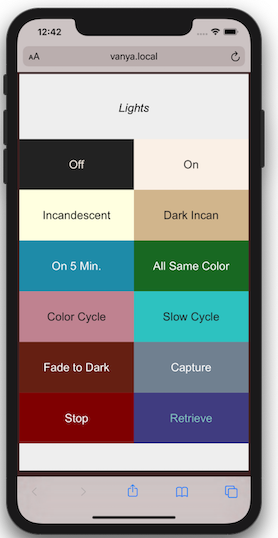
The web server component makes scripts available in a user-friendly manner. It implements a simple web page that lists available scripts and provides a 1:1 mapping betwen scripts and URL's. The server is designed to run locally, on your WiFi network.
For example, if have a machine with the hostname
myserver.local, you could launch the all_on.ls script by going to
http://myserver.local/all-on with any browser on your WiFi network.
Because scripts can run over a long period of time, even indefinitely,
a cheap, dedicated device like a Raspberry Pi is an ideal way to host the
web server.
Python API
We've attempted to make it easy to use Bardolph scripts in your Python code. For some uses, this may be significantly easier than learning and using a full-purpose Python library. For example, here's a complete program that waits 5 seconds, turns all the lights off, and turns them on again after another 5 seconds:
from bardolph.controller import ls_module

ls_module.configure()
ls_module.queue_script('time 5 off all on all')
System Requirements
The program has been tested on Python versions at or above 3.10.
Because we haven't done any stress testing, I don't know the limits on script size. Note that the application loads the encoded script into memory before executing it.
We've tested the program on MacOS Monterey 12.0.1, a Raspberry Pi Zero W controlling 6 devices, a Raspberry Pi 3, Raspberry Pi 4, and Raspberry Pi 5.
Go Try It
For full documentation and download options, please see the main website.
Release history Release notifications | RSS feed


Download files
Download the file for your platform. If you're not sure which to choose, learn more about installing packages.
Source Distribution
Built Distribution
Filter files by name, interpreter, ABI, and platform.
If you're not sure about the file name format, learn more about wheel file names.
Copy a direct link to the current filters
File details
Details for the file bardolph-0.3.0.tar.gz.
File metadata
- Download URL: bardolph-0.3.0.tar.gz
- Upload date:
- Size: 832.3 kB
- Tags: Source
- Uploaded using Trusted Publishing? No
- Uploaded via: twine/6.2.0 CPython/3.11.2
File hashes
| Algorithm | Hash digest | |
|---|---|---|
| SHA256 |
171795b283d0233a063b8bac3457ff942f9f5a0ce6d0c78c79d910f368bf76fa
|
|
| MD5 |
a757e87e30203896908d920a5556c03a
|
|
| BLAKE2b-256 |
4d98ba868a2c493f34c8a418e2c97a216d01f5a336ee12f052b6f5c1f8c83c62
|
File details
Details for the file bardolph-0.3.0-py3-none-any.whl.
File metadata
- Download URL: bardolph-0.3.0-py3-none-any.whl
- Upload date:
- Size: 119.7 kB
- Tags: Python 3
- Uploaded using Trusted Publishing? No
- Uploaded via: twine/6.2.0 CPython/3.11.2
File hashes
| Algorithm | Hash digest | |
|---|---|---|
| SHA256 |
2960bcb1f06d9f87da422eff83aba256c295bc007ab13b05334267fa632a91f6
|
|
| MD5 |
728adc1afee622aa12035de9b69a0e84
|
|
| BLAKE2b-256 |
72d7bf2a1149e654c3e3e76b5845020fd05cb41f6465fb9e256a6ec07259ce9c
|






