
Gantry streamlines running Python experiments in Beaker by managing containers and boilerplate for you


Project description




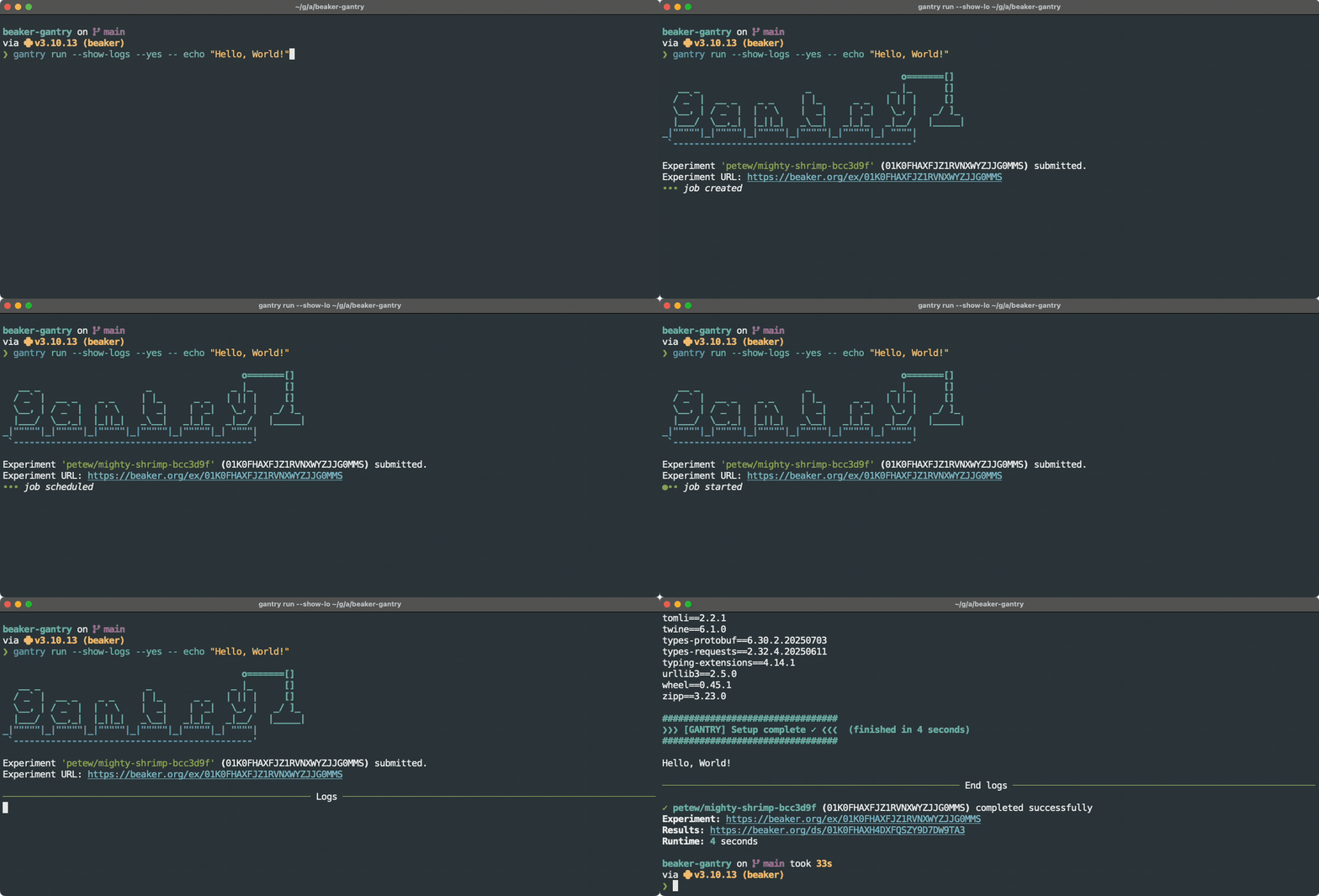
⚡️Easy to use
- No Docker required! 🚫 🐳
- No writing Beaker YAML experiment specs.
- Easy setup.
- Simple CLI.
🏎 Fast
- Fire off Beaker experiments from your laptop instantly!
- No local image build or upload.
🪶 Lightweight
- Pure Python (built on top of beaker's Python client).
- Minimal dependencies.
Who is this for?
Gantry is for both new and seasoned Beaker users who need to run batch jobs (as opposed to interactive sessions) from a rapidly changing repository, especially Python-based jobs.
Without Gantry, this workflow usually looks like this:
- Add a Dockerfile to your repository.
- Build the Docker image locally.
- Push the Docker image to Beaker.
- Write a YAML Beaker experiment spec that points to the image you just uploaded.
- Submit the experiment spec.
- Make changes and repeat from step 2.
This requires experience with Docker, experience writing Beaker experiment specs, and a fast and reliable internet connection.
With Gantry, on the other hand, that same workflow simplifies down to this:
- (Optional) Write a
pyproject.toml/setup.pyfile, a PIPrequirements.txtfile, a or condaenvironment.ymlfile to specify your Python environment. - Commit and push your changes.
- Submit and track a Beaker experiment with the
gantry runcommand. - Make changes and repeat from step 2.
In this README
- 💾 Installing
- 🚀 Quick start
- ❓ FAQ
Additional info
👋 Examples
💻 For developers
Installing
Installing with pip
Gantry is available on PyPI. Just run
pip install beaker-gantry
Installing globally with uv
Gantry can be installed and made available on the PATH using uv:
uv tool install beaker-gantry
With this command, beaker-gantry is automatically installed to an isolated virtual environment.
Installing from source
To install Gantry from source, first clone the repository:
git clone https://github.com/allenai/beaker-gantry.git
cd beaker-gantry
Then run
pip install -e .
Quick start
One-time setup
-
Create and clone your repository.
If you haven't already done so, create a GitHub repository for your project and clone it locally. Every
gantrycommand you run must be invoked from the root directory of your repository. -
Configure Gantry.
If you've already configured the Beaker command-line client, Gantry will find and use the existing configuration file (usually located at
$HOME/.beaker/config.yml). Otherwise just set the environment variableBEAKER_TOKENto your Beaker user token.Some gantry settings can also be specified in a
pyproject.tomlfile under the section[tool.gantry]. For now those settings are:workspace- The default Beaker workspace to use.gh_token_secret- The name of the Beaker secret with your GitHub API token.budget- The default Beaker budget to use.log_level- The (local) Python log level. Defaults to "warning".quiet- A boolean. If true the gantry logo won't be displayed on the command line.
For example:
# pyproject.toml
[tool.gantry]
workspace = "ai2/my-default-workspace"
gh_token_secret = "GITHUB_TOKEN"
budget = "ai2/my-teams-budget"
log_level = "warning"
quiet = false
The first time you call
gantry run ...you'll also be prompted to provide a GitHub personal access token with thereposcope if your repository is private. This allows Gantry to clone your private repository when it runs in Beaker. You don't have to do this just yet (Gantry will prompt you for it), but if you need to update this token later you can use thegantry config set-gh-tokencommand. -
(Optional) Specify your Python environment.
Typically you'll have to create one of several different files to specify your Python environment. There are three widely used options:
- A
pyproject.tomlorsetup.pyfile. - A PIP
requirements.txtfile. - A conda
environment.ymlfile.
Gantry will automatically find and use these files to reconstruct your Python environment at runtime. Alternatively you can provide a custom Python install command with the
--installoption togantry run, or skip the Python setup completely with--no-python. - A
Submit your first experiment with Gantry
Let's spin up a Beaker experiment that just prints "Hello, World!" from Python.
First make sure you've committed and pushed all changes so far in your repository. Then (from the root of your repository) run:
gantry run --show-logs -- python -c 'print("Hello, World!")'
❗Note: Everything after the -- is the command + arguments you want to run on Beaker. It's necessary to include the -- if any of your arguments look like options themselves (like -c in this example) so gantry can differentiate them from its own options.
In this case we didn't request any GPUs nor a specific cluster, so this could run on any Beaker cluster.
We can use the --gpu-type and --gpus options to get GPUs. For example:
gantry run --show-logs --gpu-type=h100 --gpus=1 -- python -c 'print("Hello, World!")'
Or we can use the --cluster option to request clusters by their name or aliases. For example:
gantry run --show-logs --cluster=ai2/jupiter --gpus=1 -- python -c 'print("Hello, World!")'
Try gantry run --help to see all of the available options.
FAQ
Can I use my own Docker/Beaker image?
Click to expand 💬
You sure can! Just set the --beaker-image TEXT or --docker-image TEXT option.
Gantry can use any image that has bash, curl, and git installed.
If your image comes with a Python environment that you want gantry to use, add the flag --system-python.
For example:
gantry run --show-logs --docker-image='python:3.10' --system-python -- python --version
Will Gantry work for GPU experiments?
Click to expand 💬
Absolutely! This was the main use-case Gantry was developed for. Just set the --gpus INT option for gantry run to the number of GPUs you need, and optionally --gpu-type TEXT (e.g. --gpu-type=h100).
How can I save results or metrics from an experiment?
Click to expand 💬
By default Gantry uses the /results directory on the image as the location of the results dataset, which will also be set as the environment variable RESULTS_DIR.
That means that everything your experiment writes to this directory will be persisted as a Beaker dataset when the experiment finalizes.
And you can also attach metrics in Beaker for your experiment by writing a JSON file called metrics.json to the results directory, or by calling the function gantry.api.write_metrics() from within your experiment.
How can I see the Beaker experiment spec that Gantry uses?
Click to expand 💬
You can use the --dry-run option with gantry run to see what Gantry will submit without actually submitting an experiment.
You can also use --save-spec PATH in combination with --dry-run to save the actual experiment spec to a YAML file.
How can I update Gantry's GitHub token?
Click to expand 💬
Use the command gantry config set-gh-token.
How can I attach Beaker datasets to an experiment?
Click to expand 💬
Use the --dataset option for gantry run. For example:
gantry run --show-logs --dataset='petew/squad-train:/input-data' -- ls /input-data
How can I attach a WEKA bucket to an experiment?
Click to expand 💬
Use the --weka option for gantry run. For example:
gantry run --show-logs --weka='oe-training-default:/mount/weka' -- ls -l /mount/weka
How can I run distributed multi-node batch jobs with Gantry?
Click to expand 💬
If you're using torchrun you can simply set the option --replicas INT along with the flag --torchrun.
Gantry will automatically configure your experiment and torchrun to run your command with all GPUs across all replicas.
For example:
gantry run \
  --show-logs \
  --gpus=8 \
  --gpu-type='h100' \
  --replicas=2 \
  --torchrun \
  --install 'uv pip install . torch numpy --torch-backend=cu129' \
  -- python -m gantry.all_reduce_bench
In general, the three options --replicas INT, --leader-selection, --host-networking used together give you the ability to run distributed batch jobs. See the Beaker docs for more information.
Consider also setting --propagate-failure, --propagate-preemption, and --synchronized-start-timeout TEXT depending on your workload.
Here's a complete example using torchrun manually (without the --torchrun flag):
gantry run \
  --show-logs \
  --gpus=8 \
  --gpu-type='h100' \
  --replicas=2 \
  --leader-selection \
  --host-networking \
  --propagate-failure \
  --propagate-preemption \
  --synchronized-start-timeout='5m' \
  --install 'uv pip install . torch numpy --torch-backend=cu129' \
  --exec-method=bash \
  -- torchrun \
    '--nnodes="$BEAKER_REPLICA_COUNT:$BEAKER_REPLICA_COUNT"' \
    '--nproc-per-node="$BEAKER_ASSIGNED_GPU_COUNT"' \
    '--rdzv-id=12347' \
    '--rdzv-backend=static' \
    '--rdzv-endpoint="$BEAKER_LEADER_REPLICA_HOSTNAME:29400"' \
    '--node-rank="$BEAKER_REPLICA_RANK"' \
    '--rdzv-conf="read_timeout=420"' \
    -m gantry.all_reduce_bench
Note that we have environment variables like BEAKER_REPLICA_COUNT in the arguments to our torchrun command that we want to have expanded at runtime.
To accomplish this we do two things:
- We wrap those arguments in single quotes to avoid expanding them locally.
- We set
--exec-method=bashto tell gantry to run our command and arguments withbash -c, which will do variable expansion.
Alternatively you could put your whole torchrun command into a script, let's call it launch-torchrun.sh, without single quotes around the arguments.
Then change your gantry run command like this:
 gantry run \
   --show-logs \
   --gpus=8 \
   --gpu-type='h100' \
   --replicas=2 \
   --leader-selection \
   --host-networking \
   --propagate-failure \
   --propagate-preemption \
   --synchronized-start-timeout='5m' \
   --install 'uv pip install . torch numpy --torch-backend=cu129' \
-  --exec-method='bash' \
-  -- torchrun \
-    '--nnodes="$BEAKER_REPLICA_COUNT:$BEAKER_REPLICA_COUNT"' \
-    '--nproc-per-node="$BEAKER_ASSIGNED_GPU_COUNT"' \
-    '--rdzv-id=12347' \
-    '--rdzv-backend=static' \
-    '--rdzv-endpoint="$BEAKER_LEADER_REPLICA_HOSTNAME:29400"' \
-    '--node-rank="$BEAKER_REPLICA_RANK"' \
-    '--rdzv-conf="read_timeout=420"' \
-    -m gantry.all_reduce_bench
+  -- ./launch-torchrun.sh
How can I control job preemption behavior?
Click to expand 💬
Use --min-runtime to specify the minimum time your job needs to make and durably save progress before it can be preempted.
This should cover your initialization, a full training step or checkpoint cycle, and saving the checkpoint.
For example:
gantry run --show-logs --min-runtime='1h' -- python train.py
By default, jobs can be preempted at any time (min_runtime=0) and will automatically resume after preemption.
To disable automatic resumption, add --no-auto-resume:
gantry run --show-logs --min-runtime='30m' --no-auto-resume -- python train.py
How can I customize the Python setup steps?
Click to expand 💬
If gantry's default Python setup steps don't work for you, you can override them through the --install TEXT option with a custom command or shell script.
For example:
gantry run --show-logs --install='pip install -r custom_requirements.txt' -- echo "Hello, World!"
Can I use conda like with older versions of gantry?
Click to expand 💬
Yes, you can still use conda if you wish by committing a conda environment.yml file to your repo or by simply specifying --python-manager=conda.
For example:
gantry run --show-logs --python-manager=conda -- which python
Can I use gantry with non-Python workloads?
Click to expand 💬
Absolutely, just add the flag --no-python and optionally set --install or --post-setup to a custom command or shell script if you need custom setup steps.
Can I use gantry to launch Beaker jobs from GitHub Actions?
Click to expand 💬
Yes, in fact this is a great way to utilize otherwise idle on-premise hardware, especially with short-running, preemptible jobs such as those you might launch to run unit tests that require accelerators.
To do this you should set up a Beaker API token as a GitHub Actions Secret, named BEAKER_TOKEN, in your repository.
Then copy and modify this workflow for your needs:
name: Beaker

concurrency:
  group: ${{ github.workflow }}-${{ github.ref }}
  cancel-in-progress: true

on:
  pull_request:
    branches:
      - main
  push:
    branches:
      - main

jobs:
  gpu_tests:
    name: GPU Tests
    runs-on: ubuntu-latest
    timeout-minutes: 15
    env:
      BEAKER_TOKEN: ${{ secrets.BEAKER_TOKEN }}
      GANTRY_GITHUB_TESTING: 'true'  # force better logging for CI
      BEAKER_WORKSPACE: 'ai2/your-workspace'  # TODO: change this to your Beaker workspace
    steps:
      - uses: actions/checkout@v5
        with:
          ref: ${{ github.event.pull_request.head.sha }}  # check out PR head commit instead of merge commit

      - uses: astral-sh/setup-uv@v6
        with:
          python-version: '3.12'

      - name: install gantry
        run:
          uv tool install 'beaker-gantry>=3.1,<4.0'

      - name: Determine current commit SHA (pull request)
        if: github.event_name == 'pull_request'
        run: |
          echo "COMMIT_SHA=${{ github.event.pull_request.head.sha }}" >> $GITHUB_ENV
          echo "BRANCH_NAME=${{ github.head_ref }}" >> $GITHUB_ENV

      - name: Determine current commit SHA (push)
        if: github.event_name != 'pull_request'
        run: |
          echo "COMMIT_SHA=$GITHUB_SHA" >> $GITHUB_ENV
          echo "BRANCH_NAME=${{ github.ref_name }}" >> $GITHUB_ENV

      - name: launch job
        run: |
          exec gantry run \
            --show-logs \
            --yes \
            --workspace ${{ env.BEAKER_WORKSPACE }} \
            --description 'GitHub Actions GPU tests' \
            --ref ${{ env.COMMIT_SHA }} \
            --branch ${{ env.BRANCH_NAME }} \
            --priority normal \
            --gpus 1 \
            --gpu-type h100 \
            --gpu-type a100 \
            -- pytest -v tests/cuda_tests/  # TODO: change to your own command
Note that we use exec gantry run ... instead of just gantry run. This ensures that if GitHub Actions cancels the job, the SIGINT and SIGTERM signals will propagate to gantry, allowing it to clean up gracefully and cancel the running job on Beaker.
Can I use gantry outside of a git repository?
Click to expand 💬
Yes, you'll just need to provide the --remote option along with --ref and/or --branch.
For example: gantry run --show-logs --yes --dry-run --remote allenai/beaker-gantry --branch main -- echo 'hello, world!'
Why "Gantry"?
Click to expand 💬
A gantry is a structure that's used, among other things, to lift containers off of ships. Analogously Beaker Gantry's purpose is to lift Docker containers (or at least the management of Docker containers) away from users.
Release history Release notifications | RSS feed


Download files
Download the file for your platform. If you're not sure which to choose, learn more about installing packages.
Source Distribution
Built Distribution
Filter files by name, interpreter, ABI, and platform.
If you're not sure about the file name format, learn more about wheel file names.
Copy a direct link to the current filters
File details
Details for the file beaker_gantry-3.7.0.tar.gz.
File metadata
- Download URL: beaker_gantry-3.7.0.tar.gz
- Upload date:
- Size: 64.2 kB
- Tags: Source
- Uploaded using Trusted Publishing? No
- Uploaded via: twine/6.2.0 CPython/3.10.20
File hashes
| Algorithm | Hash digest | |
|---|---|---|
| SHA256 |
4304c406a4d47fcef9b00c623a9b1ced2e00fe67c037f6c8dd75750d9ab6623c
|
|
| MD5 |
b340f248bd5aed62c22ae577a6106033
|
|
| BLAKE2b-256 |
9479b5a94a955fcef4dc614fbc9a40a0d5509268de87cb736bf9b69c0ecca6f0
|
File details
Details for the file beaker_gantry-3.7.0-py3-none-any.whl.
File metadata
- Download URL: beaker_gantry-3.7.0-py3-none-any.whl
- Upload date:
- Size: 73.1 kB
- Tags: Python 3
- Uploaded using Trusted Publishing? No
- Uploaded via: twine/6.2.0 CPython/3.10.20
File hashes
| Algorithm | Hash digest | |
|---|---|---|
| SHA256 |
6e85211a95999e1d51f12ef462d26e1c71048bc633080b393cd2ede706d75862
|
|
| MD5 |
b13b9292552101c34e86102925a9c1b8
|
|
| BLAKE2b-256 |
6bce5fca91f6a08285c57d6ecf9309a7ff634226522b8e83ae26b4d3e344734f
|






