
Bedrock's Python library for geotechnical engineering.

Project description
Bedrock, the Open Source Foundation for Geotechnical Engineering
🌐 Website: https://bedrock.engineer/
📃 Documentation: https://bedrock.engineer/docs
📃 API Reference: https://bedrock.engineer/reference/
🖥️ Source Code: https://github.com/bedrock-engineer/bedrock-ge
🐍 bedrock-ge on PyPI: https://pypi.org/project/bedrock-ge/
🔗 LinkedIn: https://www.linkedin.com/company/bedrock-engineer
Overview
Definition of Bedrock
In an abstract sense, the bedrock refers to the main principles something is based on. [1]
In the real world, the bedrock is the hard area of rock in the ground that holds up the loose soil above. [1]
In many civil engineering projects, the identification of the bedrock through digging, drilling or geophysical methods is an important task, which greatly influences (geotechnical) design. [2]
Sources: [1] Bedrock | Cambridge Dictionary, [2] Bedrock | Wikipedia
Ground Investigation (GI) data is often trapped in legacy formats that limit analysis and visualization possibilities.
bedrock-ge lets you transform this data from specialized geotechnical formats and common tabular formats (Excel, CSV) into modern, standardized geospatial data.
This standardization lets you bridge the gap between raw geotechnical data, the modern Python (geo)scientific ecosystem and modern geospatial tools. This gives geotechnical engineers greater flexibility in visualization, modeling, and integration across different software environments while avoiding vendor lock-in. For example, this enables connecting your GI data with GIS as well as BIM environments through platforms like Speckle.
The purpose of Bedrock is NOT to become THE standard for geotechnical data, because we don't need 15 instead of 14 competing standards.
Highlights
📖 Read / write Ground Investigation (GI) data in different formats
| Data Format | Read | Write |
|---|---|---|
| AGS 3 | ✅ | ❌ |
| AGS 4 | ✅ | ✅ |
| Excel | ✅ | ✅ |
| CSV | ✅ | ✅ |
| JSON | ✅ | ✅ |
| GeoJSON | ✅ | ✅ |
Do you need another format? Like DIGGS, NADAG, GEF, or something else? Let us know by creating an issue or starting a discussion.
Also, if you have a project with publicly available GI data, please share that in a discussion, such that we can create a tutorial from it.
✅ Validate your GI data
bedrock-ge comes with data validation to make sure that you can combine Ground Investigation data from multiple files into a single geospatial database with consistent relationships between GI locations, samples, in-situ measurements and lab tests.
This data validation mechanism (based on pandera) is easily extensible, giving you the power to add your own data validation criteria.
🗺️ Put your GI data from multiple files into a single 3D geospatial database
For example, you can take GI data from 100 AGS files and combine them into a single a GeoPackage (like a Shapefile, but then waaay better). Such a GeoPackage can then be loaded into ArcGIS, where you can visualize your GI data in 3D:

🟦 Put your GI data into Speckle
From ArcGIS or QGIS you can publish your GI data to Speckle and then visualize it together with your ground models and civil engineering designs:
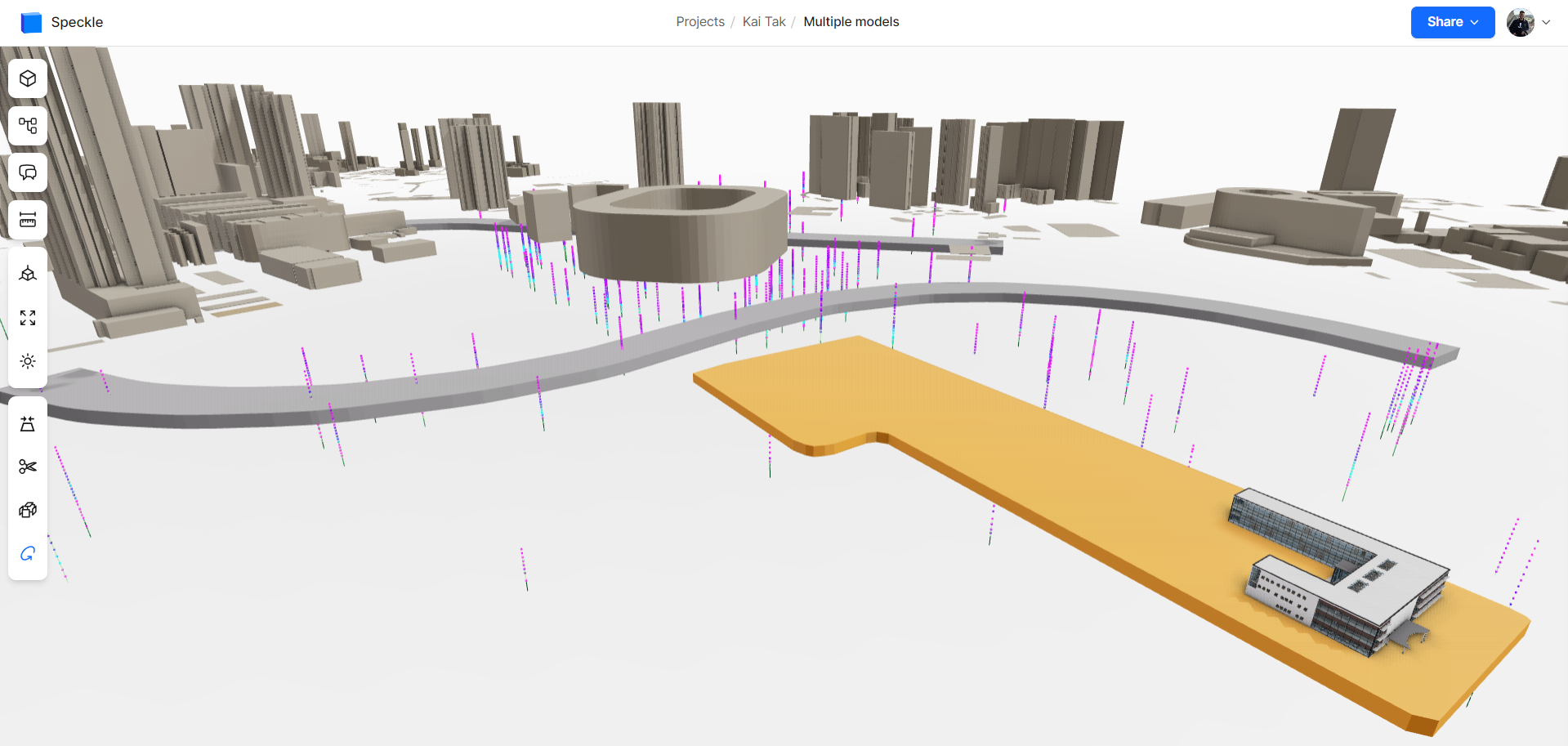

Moreover, your GI data becomes available in all the software that Speckle has connectors for.
🔓 Free and Open Source Software
bedrock-ge is Free and Open Source Software (FOSS), meaning it gives you full access to the code, and you can customize bedrock-ge to integrate with other tools and fit your workflows and project needs.
As the name implies, FOSS is free to use, so you're not tied to expensive software licenses or locked into a specific software vendor.
You can give feedback and contribute, such that together we can build the tools we've always wanted and needed.
Installation
We recommend to use uv to manage Python for you.
Using uv, you can add bedrock-ge to your Python project and install it in your project's virtual environment by running:
uv add bedrock-ge
It's also possible to install bedrock-ge from PyPI (Python Packaging Index) using pip:
pip install bedrock-ge
Feedback
Got some feedback, a great idea, running into problems when working with Bedrock or just want to ask some questions?
Please feel free to:
- Open an issue for feature requests or bug reports:
bedrock-geissues, - Start a discussion in this GitHub repo: Bedrock discussions,
- Or start a discussion on the Speckle community forum if that's more appropriate: Speckle community forum
All feedback and engagement with the Bedrock community is welcome.
Contributing
Contributing isn't scary. Contributing isn't just about writing code:
- Spread the word about Bedrock
- Use Bedrock and provide feedback
- Share how you use Bedrock
- Help each other out, e.g. by replying to questions in the discussions or
bedrock-geissues - Documentation and tutorials
- Most pages on the bedrock.engineer website can be edited, so if you see a spelling mistake or have a suggestion on how to explain something better, click this button to make a contribition.
- If you would like to contribute code, awesome! Please create an issue for what you'd like to contribute. If you don't know how to get started, please indicate this in your issue, and we'll help you out.
Maintainers
Joost
I studied geotechnical engineering and applied geophysics and then worked for Arup for 4 years as a geotechnical engineer and computational designer.
During my time at Arup I worked a lot on bringing computational design into the world of geotechnical engineering, and on bridging the gaps between geotechnical engineering and structural engineering.
Bedrock is the Free and Open Source Software (FOSS) that I wish existed when I worked as a geotechnical engineer at Arup.
Jules
I studied Applied Geoscience (Petroleum Engineering Reservoir Geology) but frustration with technical software led me to learn to code and as a result, I mostly worked in software development.
Over the past 5 years, I’ve worked on data-rich applications across various domains, specifically in frontend development. My primary interest is figuring out how to build tools for more thoughtful display and processing of technical information, for geoscience in particular.
Contributors
Please take a look at the contributors page.
Professional Support
While bedrock-ge is an Free Open Source Software (FOSS) project, you might be looking for professional support implementing it, contact info@bedrock.engineer for more information.


Download files
Download the file for your platform. If you're not sure which to choose, learn more about installing packages.
Source Distribution
Built Distribution
Filter files by name, interpreter, ABI, and platform.
If you're not sure about the file name format, learn more about wheel file names.
Copy a direct link to the current filters
File details
Details for the file bedrock_ge-0.2.4.tar.gz.
File metadata
- Download URL: bedrock_ge-0.2.4.tar.gz
- Upload date:
- Size: 13.5 MB
- Tags: Source
- Uploaded using Trusted Publishing? No
- Uploaded via: uv/0.6.17
File hashes
| Algorithm | Hash digest | |
|---|---|---|
| SHA256 |
0c78498687affee5539f638332a3d2b8ed29333ea2118f93d4f98636af93cf71
|
|
| MD5 |
9b63a424b2b812b0064b2560ca143fea
|
|
| BLAKE2b-256 |
2302847dc7fbd00b62b6b10f6d5ade0bc6e3b031895a6aa43a01d96f5a42a619
|
File details
Details for the file bedrock_ge-0.2.4-py3-none-any.whl.
File metadata
- Download URL: bedrock_ge-0.2.4-py3-none-any.whl
- Upload date:
- Size: 93.1 kB
- Tags: Python 3
- Uploaded using Trusted Publishing? No
- Uploaded via: uv/0.6.17
File hashes
| Algorithm | Hash digest | |
|---|---|---|
| SHA256 |
dd7666de9d6389b2acdd7e4b0c16bac9d426b57651c219faf7b232f64add5d80
|
|
| MD5 |
78815fa24b209bf2f755cb9b69ba0931
|
|
| BLAKE2b-256 |
498e14f94ee64fd553ad033873663ba94471cda90f73cbe9cde16158d033f521
|






