
Automated behavioral analysis software and pipeline for neuroscience.

Project description




Automated Behavioral Analysis Interface
Currently built to integrate seamlessly with DeepLabCut
Other tools coming soon!
Table of Contents
- About
- Getting Started
- Pretrained Models
- Workflow & Configuration
- Outputs & Metrics
- Contributing
- License
- Contact
About
Behavython is an automated, high-throughput behavioral analysis interface. It features a modular architecture that converts raw tracking data (CSV/H5) into structured, biologically relevant behavioral metrics.
It natively supports:
- Geometry-based paradigms: Open Field, Elevated Plus Maze (EPM)
- Interaction-based paradigms: Social Recognition, Social Discrimination, Object Discrimination
The software enforces strict scientific reproducibility through automated environment management, robust data validation, and granular metric exports.
Getting Started
Automated Installation (Windows)
For a streamlined setup, we provide a batch script that automates the entire process: creating the Conda environment, installing the required pip dependencies, and configuring the CUDA environment.
How to use the installer:
- Download the script: Download behavython_installer.bat
Right-click the link and select "Save Link As..." to download it as a.batfile
In the windows explorer dowload prompt make sure to select "Save as type: All Files" and not "Text Documents" to avoid saving it as a.txtfile - Run the Installer: Double-click the downloaded file and follow the on-screen instructions.
- Detailed Instructions: For a full walkthrough of the automated process, refer to our Installation Guide.
Step-by-Step Installation (Manual)
We strongly recommend using mamba (or Miniconda/Mamba) to manage your isolated Python environment to prevent dependency conflicts.
1. Create the environment: Create a clean environment explicitly using Python 3.10.
mamba create -n behavython python=3.10
2. Activate the environment: You must be inside the environment for the next steps.
mamba activate behavython
3. Install Behavython:
Use pip inside the activated environment. Crucial: You must include the extra index URL to fetch the correct GPU-compiled PyTorch wheels. Omitting this may result in an incompatible CPU-only installation.
pip install behavython --extra-index-url https://download.pytorch.org/whl/cu118
GPU Setup (Critical)
⚠️ Required for correct execution
Behavython relies heavily on GPU-accelerated frameworks. You must install the NVIDIA CUDA toolkit and cuDNN AFTER you have completed the pip installation above, and it must be done INSIDE the active behavython environment.
# Ensure you are still inside the 'behavython' environment
mamba install -c conda-forge cudatoolkit=11.2 cudnn=8.1.0
Failure to configure the GPU dependencies correctly will result in severe processing slowdowns and potential runtime memory errors during DeepLabCut operations.
Pretrained Models
Behavython comes with a pretrained model for roi and mouse tracking (c57 black on white arena top view) These can be downloaded from the GitHub Releases page.
The latest release (models-v1.0) includes:
c57_network_2025_minified.zip- Optimized for C57 rodent tracking.roi_network.zip- Dedicated network for Region of Interest detection in social recognition experiments.
Extract these ZIP archives into .behavython/models/ folder in your home directory located in:
- Windows:
C:\Users\<YourUsername>\.behavython\models\ - Linux/Mac:
~/.behavython/models/ - Note: Ensure the extracted model files are directly within the
modelsfolder, not nested inside additional subdirectories.
Workflow & Configuration
The Pipeline
Video → DeepLabCut → Filtered CSV → Behavython Core Pipeline → Metrics & Parquet
Arena Configuration (Geometry Tasks)
For Open Field and Elevated Plus Maze (EPM) experiments, Behavython requires a .json configuration file defining the spatial geometry. You can extract these coordinates using the ImageJ Point Tool.
- Open Field: Requires exactly 4 ordered corners (Top-Left, Top-Right, Bottom-Right, Bottom-Left).
- Elevated Plus Maze: Requires exactly 12 ordered points defining the outer boundaries, arms, and center zone.
Example: Open Field (arena.json)
Use the image as reference to order the points correctly.
Here, you can copy this example and save as a .json file to use
In order, the points should be created in imageJ in this sequence:
- top-left
- top-right
- bottom-right
- bottom-left
{
  "experiment_type": "open_field",
  "arena_corners": [
    [126.0, 72.0],
    [637.0, 74.0],
    [633.0, 581.0],
    [128.0, 581.0]
  ]
}
Example: Elevated Plus Maze (arena.json)
As with the open field, use the image as reference to order the points correctly.
Here, you can copy this example and save as a .json file to use
In order, the points should be created in imageJ in this sequence:
- Center Top Left
- Top Left
- Top Right
- Center Top Right
- Right Top
- Right Bottom
- Center Bottom Right
- Bottom Right
- Bottom Left
- Center Bottom Left
- Left Bottom
- Left Top
{
  "experiment_type": "elevated_plus_maze",
  "maze_points": [
    [128, 336],
    [384, 336],
    [384, 32],
    [514, 32],
    [514, 336],
    [900, 336],
    [900, 446],
    [514, 446],
    [514, 1042],
    [384, 1042],
    [384, 446],
    [128, 446]
  ]
}
Note: Incorrect coordinate ordering will corrupt spatial occupancy metrics.
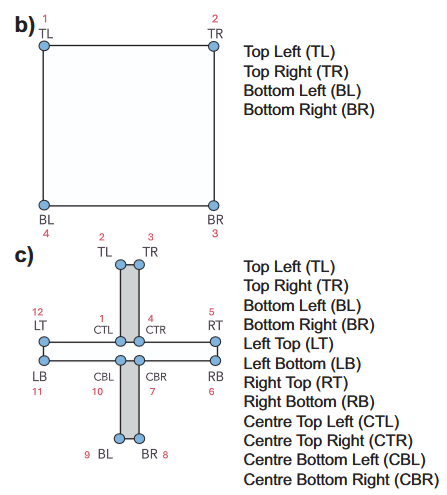
Coordinate ordering reference for Open Field and Elevated Plus Maze.
ROI Configuration (Interaction Tasks)
For interaction paradigms (like Social Recognition or Object Discrimination), Behavython requires Region of Interest (ROI) definitions exported as CSV files. You can generate these using the ImageJ Oval Tool.
ROI Requirements:
- ImageJ Measurements: Go to Analyze → Set Measurements. You must ensure both Centroid and Bounding Rectangle are checked. The resulting CSV needs the bounding box (BX, BY, Width, Height) and centroid (X, Y) coordinates.
- File Naming Convention: The exported CSV must contain the original video name, followed by an ROI identifier:
- Single-Object/Target:
video_name_roi.csv - Two-Choice Tasks:
video_name_roiL.csvandvideo_name_roiR.csv(Left and Right).
- Single-Object/Target:
- File Format: The file must be a standard
.csv(Comma Separated Values) file.
Example: Social Recognition/Discrimination (video_name_roi.csv)
 ,Area,X,Y,BX,BY,Width,Height
1,24065,376.500,387.500,289,300,175,175
Outputs & Metrics
The pipeline outputs data in multiple formats for both statistical aggregation and granular programmatic review.
General Storage
analysis_summary.xlsx/.csv: Scalar metrics aggregated per animal.analysis_timeseries.parquet: Highly compressed, frame-by-frame data utilizing Apache Arrow for efficient downstream data science workflows.analysis_log.json: Comprehensive error and warning logs per session.
Task-Specific Metrics
Geometry Experiments (Open Field, EPM):
- Zone occupancy times and percentages.
- Transition counts between zones.
- Discrete
spatial_statearrays per frame.
Interaction Experiments (Social/Object):
- Investigation and approach proportions.
- Mean inter-bout intervals (seconds).
- Discrete bout analysis (Collision bouts, approach-only bouts, abortive retreats).
analysis_collisions.parquet: Granular export containing distance to objects, interaction angles, and frame-by-frame flags.
Contributing
Contributions to the codebase and scientific pipelines are welcome.
- Open an issue to report bugs or suggest features.
- Submit a pull request for code changes. Ensure modifications align with the project's modular architecture and strict type-hinting standards.
License
This project is distributed under the GNU GPL v3.0 License. See the LICENSE file for more information.
Contact
- Matheus Costa — matheuscosta3004@gmail.com
- João Pedro — mcjpedro@gmail.com
Acknowledgments
- Flávio Mourão — https://github.com/fgmourao
- Núcleo de Neurociências (NNC) — http://www.nnc.ufmg.br
Developed at
Núcleo de Neurociências (NNC)
Universidade Federal de Minas Gerais (UFMG)
Brazil
Release history Release notifications | RSS feed


Download files
Download the file for your platform. If you're not sure which to choose, learn more about installing packages.
Source Distribution
Built Distribution
Filter files by name, interpreter, ABI, and platform.
If you're not sure about the file name format, learn more about wheel file names.
Copy a direct link to the current filters
File details
Details for the file behavython-0.9.0.tar.gz.
File metadata
- Download URL: behavython-0.9.0.tar.gz
- Upload date:
- Size: 769.6 kB
- Tags: Source
- Uploaded using Trusted Publishing? No
- Uploaded via: twine/6.2.0 CPython/3.10.20
File hashes
| Algorithm | Hash digest | |
|---|---|---|
| SHA256 |
20e80753645e6d5c0263c2e8b5b2246b5c86f4fa81637538f99e20118aa87f14
|
|
| MD5 |
e05f6d00736d39a7df75d69fce2bf6ad
|
|
| BLAKE2b-256 |
351457a487785c1ff72155a77bccbedaa63b9ca2c8467b674c2925dd88904821
|
File details
Details for the file behavython-0.9.0-py3-none-any.whl.
File metadata
- Download URL: behavython-0.9.0-py3-none-any.whl
- Upload date:
- Size: 774.7 kB
- Tags: Python 3
- Uploaded using Trusted Publishing? No
- Uploaded via: twine/6.2.0 CPython/3.10.20
File hashes
| Algorithm | Hash digest | |
|---|---|---|
| SHA256 |
6eada38884413e1f561c8c8791d38d795c41e682137cc1b39a47f759bd760f03
|
|
| MD5 |
87a5001254b7fd360aa1f1194a7d999e
|
|
| BLAKE2b-256 |
1be59ae918de8b12922ea848b07ea8d8b39daec276804a5442921e4bc708f42c
|






