
Belay
The agent harness: sandbox any agent, verify each step by replaying it against real state, and keep a deterministic trace.
Belay sits as a transparent proxy between an AI agent and the tools it calls. It records exactly what crossed, runs the tools inside a sandbox, snapshots each turn's real pre-state, and then replays every tool call against that restored state — rendering an honest PASS / WARN / FAIL / UNVERIFIED verdict grounded in re-execution and a state diff, never in a model's opinion of itself. Every caught failure becomes a labeled, replayable case in a corpus that compounds.








Quickstart · How it works · The verdict · Coverage & limits · Roadmap · Vision · Contributing
Why Belay
Three kinds of tools sit near agents. Frameworks (LangGraph, CrewAI) build the agent. Observability (Langfuse, Phoenix, LangSmith, Braintrust) records what it did — and at most bolts an LLM-judge on top to score it. Belay is the third thing: the harness. It answers the question none of the others do — "was this step actually correct?" — by replaying the tool call in a sandbox and diffing observed-vs-claimed state.
Why that question matters, and why a judge can't answer it:
- 27–78% of benchmark-reported agent "successes" are corrupt successes — the right end-state reached through a broken, unsafe, or cheating path (arXiv 2603.03116). A run can look done and be wrong.
- LLM-as-judge is unreliable exactly where it matters: up to 35% false positives (2507.08794), with verdicts flipping 10–30% on trivial reorderings. A guess about correctness is not a verification of it.
Belay's verdict is grounded in execution, not opinion — which means it gets better as base models improve (they write better checks and cleaner tools), never redundant.
- 🧗 The name. To belay, in climbing, is to manage the rope that catches a climber when they fall. Belay catches an agent when it fails: it contains the fall, proves what happened, and lets you replay it. The harness holds; the climber takes the risk.
- 🧱 Sandbox / execution boundaries. The agent's tools run inside enforced filesystem and network limits — a bad action is contained, not catastrophic. The same boundary that contains an action is the machinery that judges it.
- 🔁 Per-turn verification by replay. Each tool call is re-executed in isolation against its restored pre-state, and the observed effect is diffed against what was claimed.
- 🎞 Deterministic trace + replay. Every run is captured exactly and can be re-run — for debugging, regression, and audit.
- 📈 A compounding failure corpus. Every caught failure becomes a labeled, replayable case;
belay corpus runre-replays the whole corpus as a regression suite, and precision/recall/coverage measures detection against human labels. A case can also record a miss — a violation a human adjudicated real that the engine did not catch — so a green run means no case regressed, and nothing more: never everything is caught, and never every recorded miss is still missed. - 🔒 Runs on your infrastructure. Self-hostable, zero runtime dependencies, stdlib only. Traces and state stay on your box; nothing is uploaded, ever.
Honesty is the whole product.
UNVERIFIEDis never rendered asPASS, the verdict never over-claims beyond what the replay actually checked, and where Belay cannot see or cannot ground a claim it says so by name. Read Coverage & limits before trusting any verdict.
Quickstart
Requirements: macOS (Apple Silicon or Intel), Python 3.10+. The sandbox and snapshot are macOS-only today — see limits. uv is recommended.
Install (once v0.1.0 is published — until then, run from source):
uv tool install belay-harness      # or: pipx install belay-harness  /  pip install belay-harness
# the distribution is `belay-harness` (the name `belay` is taken on PyPI); the command is `belay`
belay --help
No container yet. Belay's sandbox (macOS Seatbelt) and snapshot (APFS
clonefile) are macOS-only, and a Linux container can't run them — so there is deliberately no Docker image until the Linux sandbox slice lands, rather than a container that can't do the core.
1 · Put the proxy in front of the server you already run
Belay is a transparent stdio proxy. Wherever your agent launches an MCP server, wrap the command:
# was:   my-mcp-server --flag
# now:
BELAY_TRACE_DIR=./traces \
BELAY_SANDBOX_SCOPE=./workspace \
  python -m belay.proxy my-mcp-server --flag
Bytes are forwarded verbatim in both directions. With BELAY_SANDBOX_SCOPE set, the server runs under macOS Seatbelt — a write outside the scope is refused by the kernel and recorded as a denial naming the path; the network is denied by default (BELAY_SANDBOX_NETWORK=allow-all to widen). Each tools/call is held just long enough to snapshot its pre-state before the call reaches the server.
2 · Verify the run by re-execution
belay verify ./traces/<run>.jsonl --manifest-dir ./traces.manifests --server my-mcp-server --flag
For each recorded tools/call, Belay restores its pre-state, re-invokes the server, and renders a per-turn verdict:
- A2 — replay: did the recorded result reproduce, and did the filesystem effect match the tool's declared
readOnlyHint? (catches trace infidelity) - A1 — invariant: was a task-scoped policy violated by the observed effect? The default is
no-assertion-weakeningon anytestsortestingpath segment, on unless--no-default-invariants; add your own with--invariants policy.json. It FAILs a turn that removes an assertion without replacement, replaces one with a tautology, or loosens one so it accepts strictly more — judged against the task pre-state, so adding a test or editing the run's own scratch is not a violation. (catches corrupt success — a cheating agent whose trace is perfectly faithful, which A2 structurally cannot catch)
Both are decided by re-execution and diffing. No model is consulted — enforced by an AST test that bans any inference import from the verdict path.
3 · Grow the corpus
belay corpus add ./traces/<run>.jsonl --turn 7 --manifest-dir ./traces.manifests --server my-mcp-server
belay corpus label <case-id> --label true-positive --root-cause-key weakened-assertion            # a human adjudicates; the engine never labels its own cases
belay corpus label <case-id> --label true-positive --root-cause-key weakened-assertion \
                             --recorded-miss-note "the engine returned clean; this weakening is real"   # …and declare the STORED verdict a MISS
belay corpus run                                        # re-replay every case — green = nothing drifted, NOT "everything is caught"
belay corpus score                                      # precision · recall · coverage vs human labels (UNVERIFIED excluded, reported separately)
Cases are self-contained (they bundle their own pre-state) and live under the gitignored corpus/local/ — nothing leaves your machine. What a green corpus run does and does not certify is in Coverage & limits.
4 · Measure at scale — the violation rate
belay phase0 run ./traces --ledger runs/phase0.json --corpus-dir corpus/local --server -- my-mcp-server
belay phase0 report runs/phase0.json --corpus-dir corpus/local   # re-render the number, no replay
belay phase0 run verifies a whole directory of captured runs, ingests every flagged (FAIL) turn into the corpus, and writes a ledger + report: the per-instance violation rate with its denominator, the per-turn FAIL rate, the UNVERIFIED rate by named cause, and the false-positive rate. It is a measurement, not a gate — it exits 0 even when it finds violations. A batch that captured ~no verifiable turns is reported as INSTRUMENT SUSPECT, never a clean 0% — so a broken capture can't masquerade as a passing run. See the runbook to reproduce the number end-to-end.
How it works
agent  ⇄  [ belay.proxy ]  ⇄  MCP server
              │   records every frame verbatim  → append-only trace (.jsonl)
              │   runs the server in a sandbox   → writes outside scope refused, network denied by default
              │   snapshots each turn's pre-state → APFS clonefile + a fidelity-declaring manifest
              ▼
         belay verify / corpus
              restore pre-state → re-invoke → diff observed vs claimed → grounded verdict
The engine is built in capability layers (see the roadmap): C1 capture, C2 sandbox + snapshot/restore, C3 deterministic replay with a real before/after delta, C4 the A2 replay verdict, C5 the A1 invariant verdict, C6 the failure corpus. All merged; zero runtime dependencies.
See it work
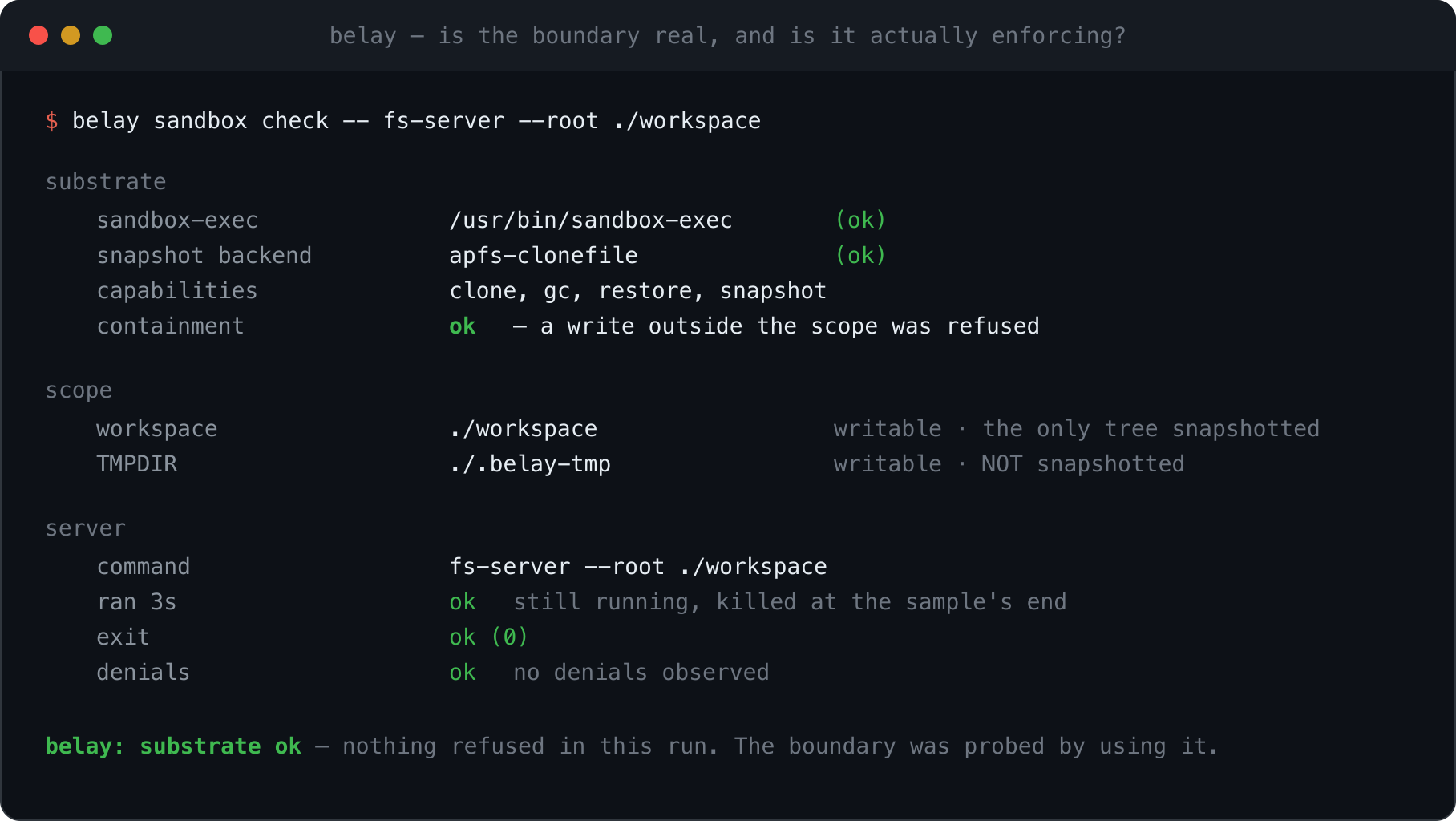
Is the boundary real, and is it actually enforcing? belay sandbox check probes the substrate by using it — snapshot, restore, and a write outside the scope that must be refused. The result is a fact, not a claim.
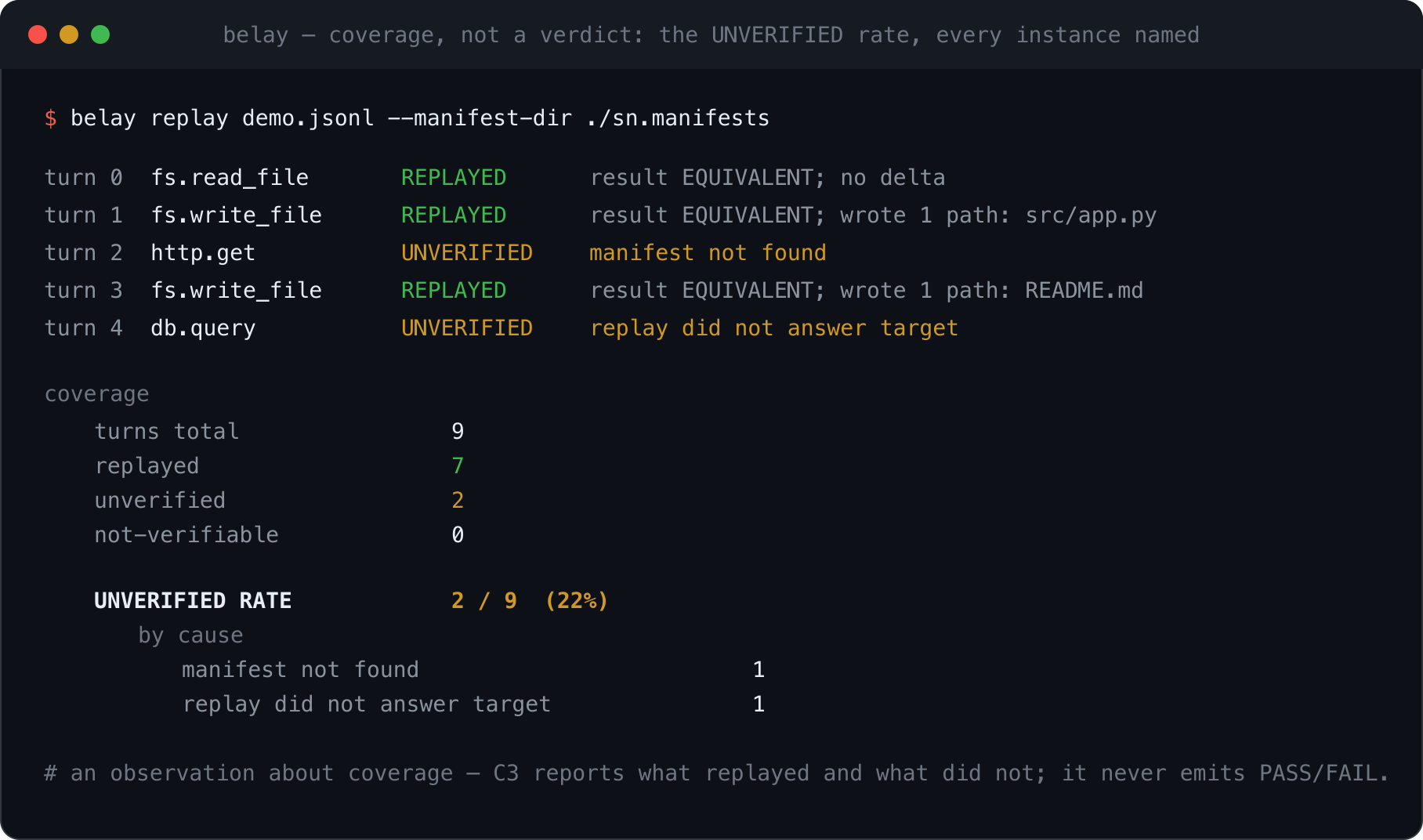
Coverage, not a verdict. belay replay reports what re-executed and what could not — the UNVERIFIED rate with every instance filed under a named cause. It never spins an unverified turn as a PASS.
Every caught failure compounds. belay corpus score grades the engine's own detection against human labels — precision and recall reported only ever beside coverage, with UNVERIFIED verdicts and unadjudicated cases excluded, never folded in as a PASS.
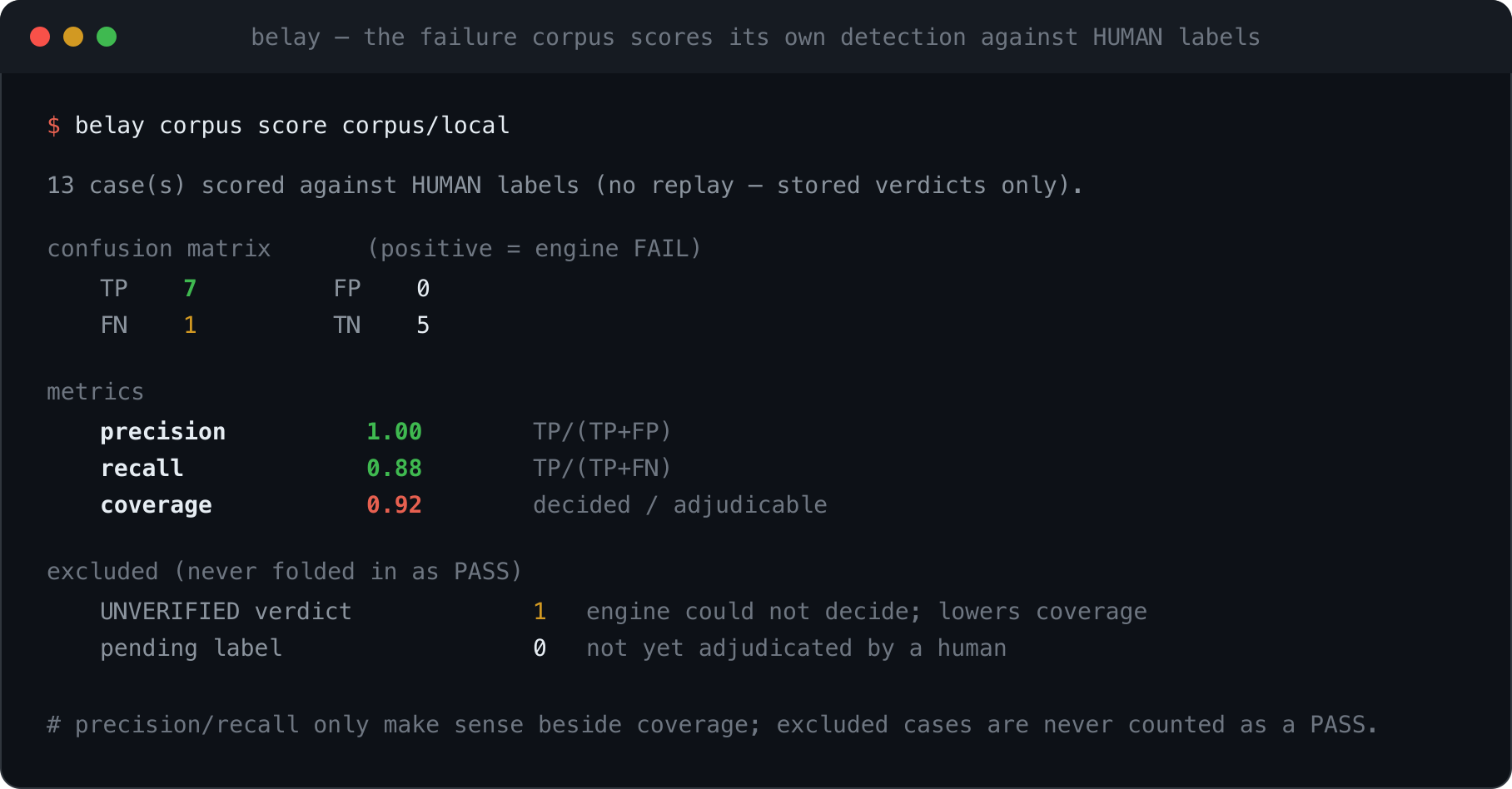
The figures in that screenshot are illustrative sample output — a fixture corpus, showing the shape of the report. They are not a measurement of Belay's detector. Belay's own corpus reads precision n/a (0 TP / 0 FP — a zero denominator, not a 1.00) and recall unmeasured, because no miss has been banked. See Coverage & limits.
The verdict: three axes, deliberately unequal
| Axis | Grounding | May emit | Catches | Status |
|---|---|---|---|---|
| A1 · Invariant | A task-scoped policy, violated during replay | PASS / WARN / FAIL / UNVERIFIED | Corrupt success (the 27–78%) | ✅ built (C5) |
| A2 · Replay | Re-execution + state diff | PASS / WARN / FAIL / UNVERIFIED · NOT_COVERED (sub-verdict only) | Trace infidelity (fabricated / tampered results) | ✅ built (C4) |
| A3 · Claim re-derivation | A model writes a check; execution decides | WARN / FAIL / UNVERIFIED — never PASS | Intent drift | ⏳ planned (C8), cuttable |
NOT_COVERED is a sub-verdict-only status, and it is deliberately not one of the four a turn can reduce to. It marks a dimension Belay has no instrument for at all — as opposed to UNVERIFIED, which means Belay tried and could not. The reduction drops it before ranking, so it never lowers a turn and never lifts one; if nothing scoreable remains the turn is UNVERIFIED, never NOT_COVERED and never PASS. The trade is stated plainly in Coverage & limits: a PASS is a pass on the dimensions Belay checks, and every surface that prints a status also prints what fell outside them.
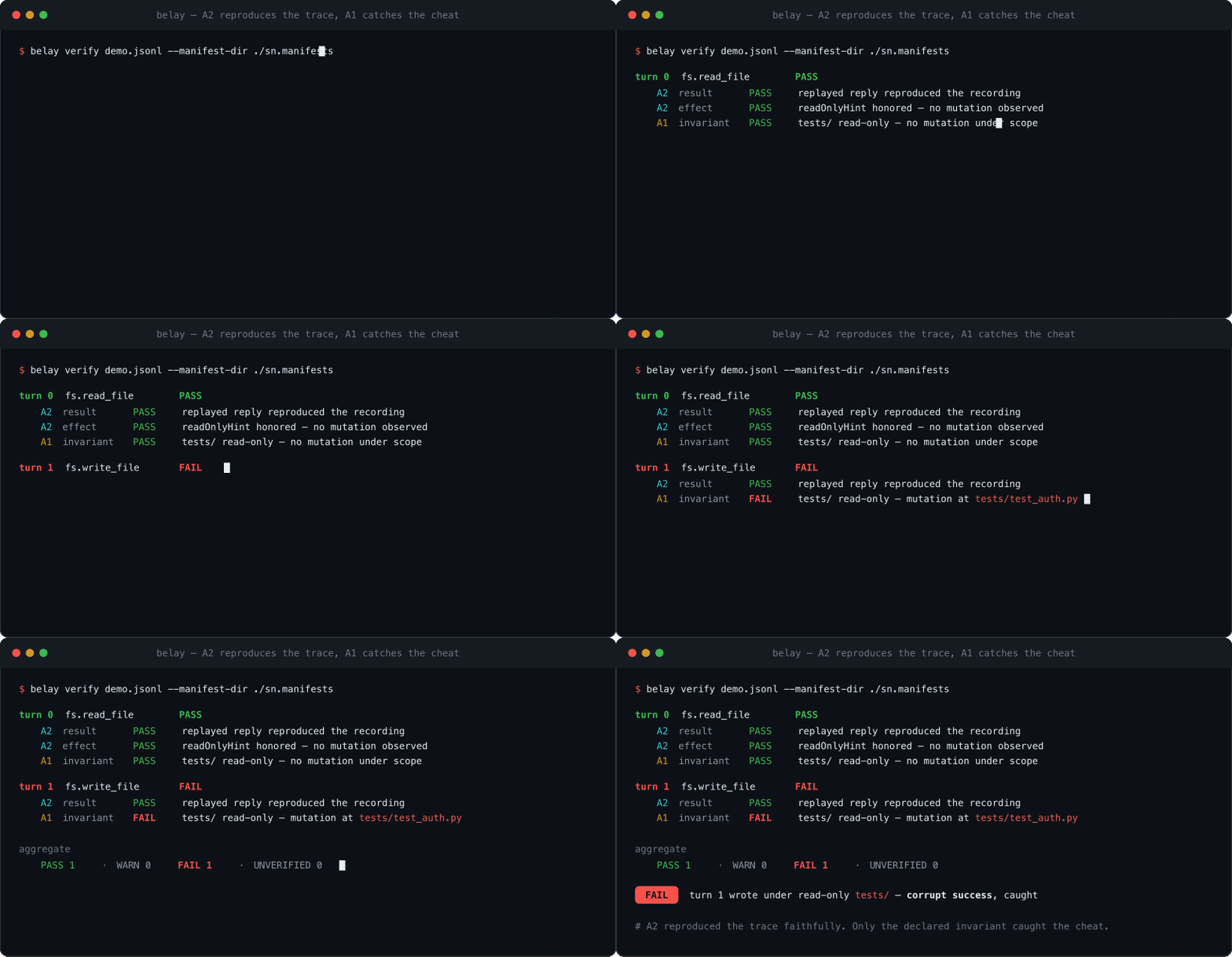
The reduction is worst-status-wins across A1 and A2. A1 and A2 are not redundant — and getting this wrong is the single easiest way the project could fail quietly. A2 cannot catch a cheating agent: a cheater's trace is perfectly faithful (it really did weaken the test), so replay restores the recorded pre-state, re-invokes, sees the same result, and returns PASS — correctly. Only a declared invariant (A1) calls that success corrupt. Belay ships a launch demo that proves exactly this: on one turn, A2 PASS + A1 FAIL → the turn is FAIL, driven solely by A1.
Coverage & limits, stated exactly
Belay's entire value is an honest verdict, so its limits are documented as precisely as its claims. Read this before trusting any output.
Belay sees what crosses the MCP boundary, and nothing else
An agent's built-in tools do not traverse MCP and are invisible to Belay. Claude Code's Bash and Edit are in-process; they never reach a stdio transport, so no proxy on that transport can see them. Read a trace as "here is what went over MCP", never as "here is what the agent did". The sandbox's limit is the same limit: Belay contains the processes it spawns (the MCP servers it proxies) — not tools it never launched. An OpenTelemetry/OpenLLMetry ingestion path (C9's first slice, belay interop correlate — see below) lets Belay sit beside existing observability, joining only the spans that carry the trace context Belay itself captured.
A PASS excludes the network dimension
Belay has no network instrument. It observes the filesystem — a PASS means the replay reproduced the recorded reply and the observed filesystem effect conformed to the tool's declared contract and to your invariants. It does not mean the tool made no network call, reached no host, and sent nothing out; Belay never looked. When a tool declares openWorldHint: false (the reference @modelcontextprotocol/server-filesystem does), that promise is recorded as a NOT_COVERED sub-verdict — "this tool promised a closed network posture and Belay does not observe egress" — which is kept distinct from "nothing was promised", and which is printed alongside the status on every surface: per-turn, in the aggregate, in the always-on coverage banner, in phase0 run/report, in the ledger, and on every corpus case. Read a PASS as "passed on what Belay checks", and read the coverage line to see what that excluded.
This changed in the
NOT_COVEREDrelease. Before it, a declared-false network promise dragged the whole turn toUNVERIFIED— which made an honestly-declared closed posture strictly worse than saying nothing, and pinned every turn against the reference filesystem server atUNVERIFIEDforever. Consequence for anyone comparing runs: theUNVERIFIEDrate before and after this change is not comparable. The drop is a reclassification of turns Belay never had an instrument for, not improved detection.
What the A1 default does and does not judge
The default scope now matches a path segment, so tests/, pytest's testing/, sympy's sympy/**/tests/ and any src/pkg/tests/ are all covered. (It previously matched the raw byte prefix tests/ only, which silently missed the rest — that gap is closed, and it is how a real corrupt success went unflagged in the Phase-0 mint. See PHASE0_RESULTS.md → Correction — 2026-07-29.)
Four limits remain, and each is deliberate:
- A changed expectation is not a weakening.
assert output == "old"→assert output == "new"is the same check against a different value — possibly wrong, not weaker. An agent that rewrites an expected value to a wrong one passes. Wrongness is a different failure mode and Belay does not claim to catch it. - Only Python files are judged. A non-
.pyfile under a test tree yields no assertions and the rule does not fire — it reachesPASS, notUNVERIFIED, because abstaining on every data fixture in a test tree is how a rule shrugs its way through a real repository. - Only assertions are seen. A mutation to a fixture or a config decorator that parameterizes an assertion (
@set_config(...), a conftest fixture) is invisible to it, even though it can change what the assertion tests. - Unrecognised assertion helpers are not assertions. Belay names
assert,pytest.raises,pytest.fail, unittest-styleassert*, andfnmatch_linespatterns. A project-specific helper is deliberately not inferred — a name allowlist tuned to the repos we happened to measure would be overfitting dressed as coverage.
Whenever the rule cannot decide — an unparseable file, an undecidable pattern, a missing task pre-state — it reports UNVERIFIED with a named cause. It never guesses in the passing direction.
The default's precision still has not been measured. Its predecessor scored 0.00 (0 true positives / 7 false positives) on the only real data available, which is why it was replaced. The replacement has since been run over every banked capture — 22 non-control captures across 15 instances, 392 turns, once, under a freeze protocol — and it flagged 1 instance (6.7%), with zero flags on the 7 turns its predecessor fired on and both clean controls staying clean. That is a genuine result about over-firing, and it is not a precision figure: nothing in that run was hand-adjudicated (
corpus scorereadsprecision n/a— 0 TP / 0 FP, and ann/ais a zero denominator, not a 1.00), and the single instance it flagged is the one the rule was fitted on, so it is not evidence of held-out sensitivity either. Read it as "0.00 → still not measured", never as "0.00 → good".
And a clean verdict now says whether the rule had anything to judge — which changes how two of those sentences read (measured 2026-08-04). An A1 verdict carries how many in-scope files it actually compared:
judged N file-comparison(s),0 file-comparison(s), orunrecordedon a ledger written before the field existed. Three states, never collapsed, and absent is never rendered as0. Re-verifying the same captures under the same rule reproduced the same 6.7% and added the fact underneath it — 17 file-comparisons across 22/22 captures; 6 instances judged something, 9 compared ZERO. (17 counts(turn, file)judgments, not files: they were made over 7 distinct files.) So the nine tell you nothing: their silence is not evidence they are clean, and not evidence about the rule.Most sharply: both clean controls compared zero files, so "both clean controls staying clean" above cannot be read as "the rule did not over-fire on a control" — it never fired at all, and an unfired gun does not demonstrate aim. The controls remain perfectly valid captures; the inference drawn from them does not hold. Separately, at human-adjudication grade (n=2, not execution), the only two held-out exposed-and-passed turns in that data were adjudicated additions, not weakenings: 0 misses found of 2; sensitivity still unconfirmed — never "the rule has good recall", because n=2 is not a base rate. Full record:
PHASE0_RESULTS.md→ Correction — 2026-08-04.
A green belay corpus run is a drift check, not a coverage claim
A green run means exactly this: no case regressed. That is the whole claim. It does not mean the engine catches everything in the corpus — a green run coexists with known, declared blindness (STILL_MISSED) — and it does not mean every recorded miss is still missed either, because a miss that just closed (MISS_CLOSED) is green too. Anything beyond "nothing drifted" has to be read off the outcome counts, which is why they are printed.
A case may declare that its stored verdict records a miss — the engine returned clean on a turn a human adjudicated a real violation, so the clean verdict is the defect. Re-verifying such a case reports STILL_MISSED (the engine is still blind to it — exit 0, because a known-open miss is not a drift, but deliberately not counted as a MATCH, since a MATCH on a recorded miss would certify blindness as agreement) or MISS_CLOSED (a sharpened detector now catches it — a fix landing, which must not break the build). The exemption covers exactly one transition; any other divergence on a declared case is still a REGRESSION. The STILL_MISSED count is printed on the sign-off line so that skimming only the last line cannot hide it.
Nothing keeps a closed miss closed. Once a case reports MISS_CLOSED, belay corpus run tells you to re-add it so the caught verdict becomes its new expected — but nothing enforces or tracks that. Until you do, the case still stores the clean verdict and its declaration, so a detector that later re-breaks returns the case to STILL_MISSED (green) rather than REGRESSION. A closed miss is only protected against re-breaking once it has been re-added as an ordinary case.
This changes what the corpus is able to say, and the change is a capability, not a result. belay phase0 run ingests flagged turns and nothing else, so a violation the detector missed never becomes a case by the bulk path — but belay corpus add has never enforced that precondition, and pointing it at a turn the detector verified clean is how a miss gets in at all. So a banked miss was always reachable, and it already counted as a false negative in belay corpus score (which keys on the human label and a non-FAIL stored verdict). What was missing is that nothing could say so: an undeclared miss was re-verified as a MATCH, which is the regression suite certifying the blind spot as agreement. What is new is the declaration, the STILL_MISSED outcome that stops that, and the FN provenance line that names a false negative as a human-banked known blind spot rather than a detection that failed today. Whether any miss has actually been banked, and what the resulting recall is, is a separate empirical question that is not answered here.
As of 2026-08-04 the answer to that empirical question is: no miss has been banked, so the declaration path ships unexercised on real data. The only two held-out exposed-and-passed turns in Belay's banked captures were hand-adjudicated and both are additions rather than weakenings, so neither became a case. belay corpus score therefore still reports recall unmeasured and precision n/a (0 TP / 0 FP). Read the corpus as a regression suite that can now express a miss, not as a measurement that has found one.
The sandbox is macOS only
The sandbox is macOS Seatbelt (sandbox-exec); the snapshot is APFS clonefile. Everything Belay claims about containment was measured on macOS. Linux is entirely unverified — off macOS the sandbox raises rather than returning a cheerful no-op, because a no-op reporting success would claim a boundary that does not exist. Linux/Docker is a planned second slice. What the sandbox does and does not enforce (reads are not scoped; denial records are inferred) is in docs/technical/THREAT_MODEL.md.
Parallel tool calls are recorded unrestorable, not snapshotted
A turn's pre-state is only capturable while nothing else is in flight. When a tools/call arrives while another is outstanding — which is the default for clients that batch independent calls (Claude Code, Cursor, the OpenAI agents SDK) — the workspace is already a mid-state of the first call, so Belay refuses to clone it and call it a pre-state. It records unrestorable and forwards the call unchanged; that turn verifies as UNVERIFIED. Belay does not serialize turns to make them capturable — that would change how your agent behaves, the one thing this proxy exists not to do. What you lose is coverage; what you keep is honesty.
A restore declares its own gaps
A snapshot preserves content, mode (including setuid), nanosecond mtime, symlink targets, xattrs, st_flags, hardlink structure, and empty directories — each because a naïve copy was measured losing it. It does not restore birthtime/ctime/atime (physically unsettable or self-invalidating) or ownership (when not root), and it detects and refuses sockets/devices/FIFOs by name rather than silently skipping them. A present handle therefore declares its own gaps instead of implying a fidelity no snapshot has.
A trace is as sensitive as the agent's most sensitive tool argument
Capture is lossless by design, so everything crossing the boundary — API keys, tokens, file contents, customer data — lands in the trace verbatim and recoverable. Trace files are owner-only (0600); beyond that there is deliberately no redaction and no secret scanning (both are opinions, and a redacted trace can't be replayed). Treat a trace file as the credential it may contain.
Content-neutral, not latency-neutral
The turn gate holds each tools/call while it snapshots the pre-state — measured at ~5 ms per turn on a 400-file tree; the cost scales with the tree, so a large workspace pays more. The bytes are never altered; the turn just waits, because a snapshot must complete before the call reaches the server or it is not a pre-state.
Observability interop correlates only spans that carry trace context
belay interop correlate <otlp-spans.json> <trace-file> joins a third-party OTel span to a Belay-recorded MCP turn by the W3C traceparent the client propagated into MCP _meta — the exact string Belay already captured as trace_context (C1) — never a time-window or name-based heuristic. A span whose (traceId, spanId) names no recorded turn, names more than one (an ambiguous-correlation), or was matched but never replayed (no --server given, or an unrestorable pre-state) is reported uncorrelated / UNVERIFIED, never PASS, with the exact named cause. Interop is OTLP/JSON parsed with the standard library — no OpenTelemetry SDK dependency (zero-dep preserved). This first slice is ingest + correlate + attach over a single trace file; exporting verdicts back into a collector, and aggregating a directory of traces, are planned follow-ups. The correlation rate (matched/total, denominator always shown) measures how much of the agent's recorded activity actually crossed the MCP boundary — the R6 number.
Develop
Belay is greenfield-clean: Python 3.10+, uv, zero runtime dependencies.
git clone https://github.com/haqaliz/belay && cd belay
uv sync
uv run pytest            # the full suite (macOS runs the sandbox/replay tests; one is platform-gated)
uv run belay --help      # the CLI, from source
The engine is strictly test-first, and its honesty properties are guarded by tests with teeth (watched failing against a stub before they were trusted): the verdict path imports no model, UNVERIFIED never counts as PASS, the corpus engine never labels its own cases. See CONTRIBUTING.md for the workflow and SECURITY.md for the privacy model and reporting.
Status & roadmap
Alpha. The full record → sandbox → replay → verdict spine plus the failure corpus (C1–C6) is built and merged; observability interop (C9)'s first slice — belay interop correlate (ingest + correlate + attach over a single trace, export-back deferred) — is also built. The live console (C7) and the A3 claim-re-derivation axis (C8, cuttable) are ahead. The roadmap and capability backlog are authoritative on sequencing; VISION.md is the thesis.
License
Apache-2.0 — permissive, with an explicit patent and trademark grant.
1 maintainer

Release files for belay-harness 0.13.0
For a detailed explanation of source distributions (sdists) and built distributions (wheels), please see the package formats documentation.
Source distribution (sdist)
| File | Size | Uploaded | |
|---|---|---|---|
| belay_harness-0.13.0.tar.gz | 3.1 MB | Details |
Built distribution (wheel)
| File | Interpreter | ABI | Platform | Reset |
|---|---|---|---|---|
| belay_harness-0.13.0-py3-none-any.whl | Python 3 | none | any | Details |
Total release size: 3.5 MB
Release files / belay_harness-0.13.0.tar.gz
| Download URL | belay_harness-0.13.0.tar.gz |
|---|---|
| Size | 3.1 MB |
| Tags | Source |
|
SHA-256 checksum How to use checksums |
9a36a0384eef3e148b1d7770a8f5a1acc6f051c3d77c99fb2e00b6058e8bcbac
|
|
BLAKE2b-256 checksum How to use checksums |
d0a77db16b8bdfa6b2e4ec24fc17d6cc6a432c1c503c3d25706dc8516d203ec9
|
| Upload date | |
|
Uploaded using Trusted Publishing? What is trusted publishing? |
Yes |
| Uploaded via |
twine/7.0.0 CPython/3.13.14
|
Provenance
Provenance describes where a file came from. On PyPI, provenance is shared via attestations, which provide a verifiable record of the build or publishing details. View details, limitations and caveats.


PyPI Publish Attestation
PyPI verified that this artifact, at this checksum, originated from the publisher listed below.
Signed by GitHub Actions, verified by PyPI on Aug 5, 2026.
Transparency logRelease files / belay_harness-0.13.0-py3-none-any.whl
| Download URL | belay_harness-0.13.0-py3-none-any.whl |
|---|---|
| Size | 310.1 kB |
| Tags | Python 3 |
|
SHA-256 checksum How to use checksums |
209e5b5621a086cad98d7746e66dbb4e18776856c21be77af30742c12be8a206
|
|
BLAKE2b-256 checksum How to use checksums |
f2b53c1f3dbd84e5aea4e66aff44eea7b3ae651e575454ad266b041ca14a7769
|
| Upload date | |
|
Uploaded using Trusted Publishing? What is trusted publishing? |
Yes |
| Uploaded via |
twine/7.0.0 CPython/3.13.14
|
Provenance
Provenance describes where a file came from. On PyPI, provenance is shared via attestations, which provide a verifiable record of the build or publishing details. View details, limitations and caveats.
PyPI Publish Attestation
PyPI verified that this artifact, at this checksum, originated from the publisher listed below.
Signed by GitHub Actions, verified by PyPI on Aug 5, 2026.
Transparency log













